wayground logo

Free Printable Worksheets

Font size

S
M
L
XL
Worksheets

Biology Second Semester review quiz

Total questions: 116

Worksheet time: 1hrs 17mins

Name
Class
Date
1.

The allele (Y) represents yellow and the allele (y) represents green. Which allele is dominant?

a)

Yellow

b)

Green

c)

Both alleles are equally dominant

2.

Which of the following can be described as homozygous dominant?

a)

Yy

b)

yy

c)

YY

d)

yY

3.

What are the genotypes of the P generation?

a)

Yy and Yy

b)

YY and yy

c)

Yellow and green

d)

Yellow and yellow

4.

What are the phenotypes of the P generation?

a)

Yy and Yy

b)

YY and yy

c)

Yellow and green

d)

Yellow and yellow

5.

White flowers is an example of a

a)

Phenotype

b)

Genotype

6.

An organism’s physical appearance is its __________________________.

a)

Gene

b)

Genotype

c)

Allele

d)

Phenotype

7.

If the trait is hair color, which of the following is an allele?

a)

Black hair

b)

Brown eyes

c)

Eye color

d)

Short hair

8.

An organisms genetic makeup or “letters” is its _______________________.

a)

Phenotype

b)

Genotype

c)

Allele

d)

Trait

9.

A heterozygous plant can make which of the following sex cells (gametes):

a)

H only

b)

h only

c)

H and h

10.

A _______________ is the “allele code” written as capital and lowercase letters, while a ________________ is the physical trait that is expressed.

a)

Genotype, phenotype

b)

Phenotype, genotype

c)

Genotype, allele

d)

Allele, gene

11.

A person with attached ear lobes inherited this recessive trait from…

a)

Both mother and father

b)

Mother only

c)

Father only

d)

Mutations

12.

A dog with the alleles Bb has a ______________genotype.

a)

Homozygous recessive

b)

Homozygous dominant

c)

Heterozygous

d)

Brown

13.

When the genotype consists of a dominant and a recessive allele, the phenotype will be like _________________ allele.

a)

the dominant

b)

the recessive

c)

both dominant and recessive

d)

neither

14.

What does the notation Tt mean to geneticists?

a)

One dominant and one recessive allele

b)

Two recessive alleles

c)

Two dominant alleles

15.

Passing on traits from parents to offspring

a)

Chromosome

b)

Genotype

c)

Heredity

d)

Allele

16.

A genotype where one dominant and one recessive allele was passed on from both parents for one trait.

Bb Aa Tt Ll

a)

Allele

b)

Homozygous Dominant

c)

Homozygous Recessive

d)

Heterozygous

17.
What is the percentage of homozygous recessive offspring?
a)
0%
b)
25%
c)
50%
d)
75%
18.
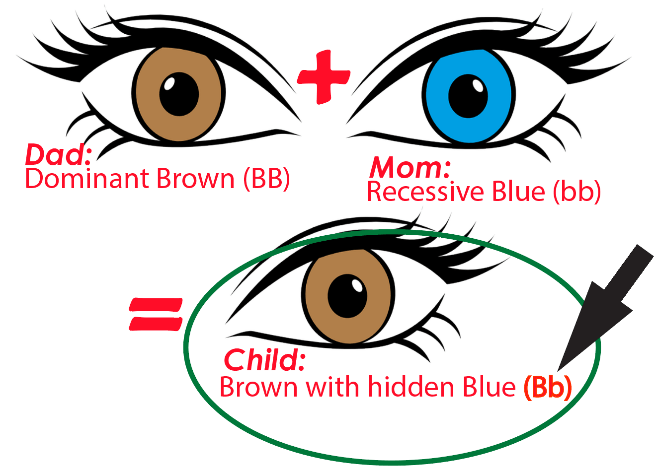
Two brown eyed parents (Bb) have a baby. What is the chance the baby is blue eyed?
a)
0 %
b)
25%
c)
50%
d)
75%
19.
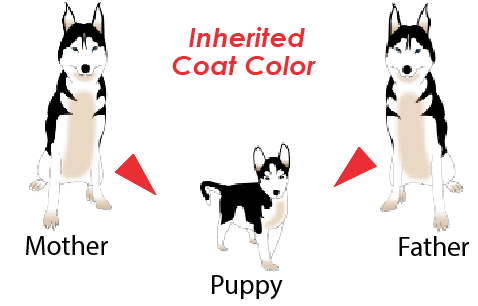
this image is an example of
a)
codominance
b)
dominance
c)
incomplete dominance
20.
A breed of chicken shows codominance for feather color. One allele codes for black feathers, another codes for white feathers. The feathers of heterozygous chickens of this breed will be:
a)
all black
b)
all white
c)
all gray
d)
speckled black and white
21.

In some carnations, flower color exhibits codominance. Identify the correct genotypes for red, white, and speckled carnations.

a)

Red = RR, white = rr, speckled = SS

b)

Red = RR, white = WW, speckled = SS

c)

Red = RR, white = RW, Speckled = WW

d)

Red = RR, white = WW, speckled = RW

22.
If this image were real, it would represent what type of inheritance?
a)
incomplete dominance
b)
codominance
c)
polygenic inheritance
d)
compete dominance
23.
A red flowered plant (RR) breeds with a White flowered plant (WW). The gene for petal color in these plants expresses incomplete dominance.  What percentage of the offspring will have pink (RW) flowers?
a)
0%
b)
25%
c)
50%
d)
100%
24.

A roan cow shows codominance in fur color (brown and white). What is the phenotype ratio expected in offspring a female roan and a male roan mate together?

a)

All four would be brown and White

b)

Half would be orange, half would be white

c)

2 Brown: 2 Brown and White: 0 White

d)

1 Brown: 2 Brown and White: 1 White

25.
The Law of Independent Assortment states: 
a)
most genes are inherited together
b)
only dominant genes are inherited
c)
recessive genes can never be expressed
d)
genes that control different characteristics are inherited separately and are not related
26.
The Law of Segregation states: 
a)
alleles are inherited together
b)
alleles separate during gamete formation
c)
only dominant genes are inherited
27.
Which of the following sequences of processes correctly reflects the central dogma?
a)
protein synthesis, transcription, translation
b)
protein synthesis, translation, transcription
c)
transcription, translation, protein synthesis
d)
translation, transcription, protein synthesis
28.
If the structure of DNA were likened to a ladder, what would make up the “supporting structure” (not the “rungs”) of the ladder?
a)
amino acids and sugars
b)
nucleotide bases, including thymine
c)
nucleotide bases, including uracil
d)
sugar-phosphate molecules
29.
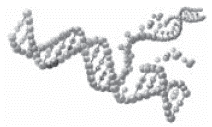
What process is shown in the illustration below?
a)
commensalism
b)
deletion
c)
passive transport
d)
replication
30.
What is the complimentary mRNA sequence to the DNA sequence A-T-T-G-C-A.
a)
T-A-A-C-G-T
b)
U-A-A-C-G-T
c)
U-A-A-C-G-U
d)
T-A-A-G-C-U
31.
Which defines a codon in DNA or mRNA?
a)
pair of nucleic acid and sugar
b)
pair of phosphate and sugar
c)
three-base code
d)
two-base code
32.
Are all mutations bad?
a)
Yes
b)
No
33.
Which organelle is DNA usually found in?
a)
cell membrane
b)
vacuole
c)
chloroplast
d)
nucleus
34.
What are the building blocks of proteins called?
a)
DNA
b)
RNA
c)
Ribosomes
d)
Amino Acids
35.
DNA has a ______ strand; RNA has a ______ strand.
a)
double/double
b)
double/triple
c)
double/single
d)
single/single
36.
In RNA, the nitrogen base____ replaces ____ that was present in DNA. 
a)
A, U (adenine, uracil)
b)
C, G (cytosine, guanine)
c)
U, T (uracil, thymine)
d)
U, A (uracil, adenine)
37.
The "central dogma" states that genetic information flows from 
a)
Protein-->mRNA-->DNA
b)
Protein-->DNA-->mRNA
c)
mRNA-->DNA-->Protein
d)
DNA-->mRNA-->Protein
38.
Transcription takes place in the 
a)
cytoplasm
b)
ribosome
c)
mitochondrion
d)
nucleus
39.
Translation occurs in the
a)
nucleus
b)
mitochondria
c)
cytoplasm
d)
golgi apparatus
40.

Which Nucleotide matches to Cytosine?

a)

Guanine

b)

Adenine

c)

Uracil

d)

Thymine

41.

This organelle is crucial for the translation process:

a)

Mitochondria

b)

Ribosome

c)

Gogli Apparatus

d)

Vacuole

42.

The DNA sequence UAGCGAUUACGU is part of a gene. How many amino acids are coded for by this sequence?

a)

20

b)

4

c)

8

d)

12

43.

What is the role of tRNA?

a)

To treat the DNA strand

b)

To transfer codons

c)

To transfer amino acids

d)

To tackle mutations

44.

Codons are located on the...

a)

DNA

b)

mRNA

c)

rRNA

d)

tRNA

45.

Anticodons are complementary to...

a)

codons

b)

amino acids

c)

nucleotides

d)

nitrogenous bases

46.

Anticodons are located on the...

a)

DNA

b)

mRNA

c)

rRNA

d)

tRNA

47.

Can more than one codon code for the same type of amino acid?

a)

yes

b)

no

48.

When reading the codon chart, which molecule do you reference?

a)

DNA

b)

mRNA

c)

tRNA

d)

rRNA

49.
Where the better adapted organisms survive to pass traits along to offspring.
a)
Evolution
b)
Natural Selection
c)
Extinction
d)
Artifical Selection
50.
Why are advantageous traits more likely to be passed onto offspring?
a)
Because they are more likely to survive and reproduce.
b)
Because they come from dominant alleles.
c)
Because they come from recessive alleles.
d)
Because the trait is an acquired phenotype.
51.
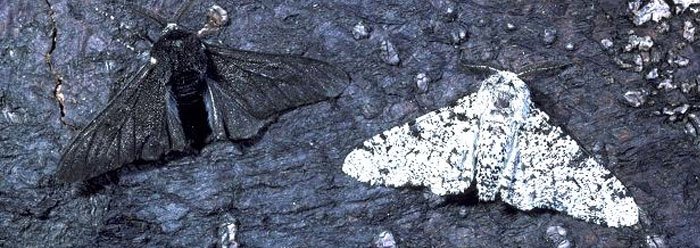
The trees these moths used to live on were white, but have been covered in soot from coal factories. Which moth will be more successful in this environment?
a)
Dark moth
b)
Light moth
c)
Both will be equally successful
d)
Neither will be successful
52.
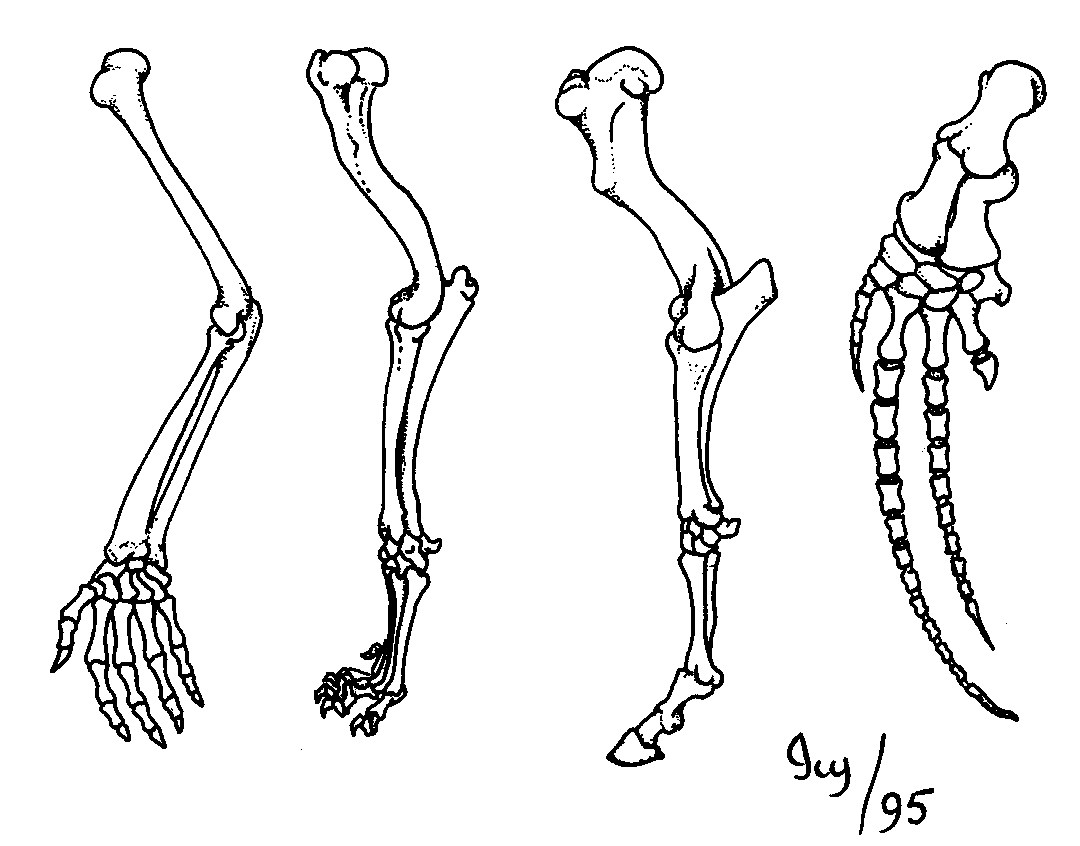
Structures with the same parts have different functions; suggests that organisms share a common ancestry
a)
vestigial structures
b)
homologous structures
c)
adaptive radiation
d)
fossil
53.
Study of embryos of various organisms to show a common ancestor because of similarities in development
a)
natural selection
b)
embryology
c)
speciation
d)
evolution
54.
The diagram shows fossils in different rock layers. Which of these statements about the age of these fossils is most likely correct?
a)
Fossil A and C are the same age
b)
Fossil B is older than fossil C
c)
Fossils A is older than fossil B
d)
Fossil D is older than fossil C
55.

Whales are aquatic mammals that contain a pelvis (hip) bone. Even though it does not aid in its movement, the function must have been used by a common ancestor of the whale. Thus, the pelvis is referred to as a(n)

a)

vestigial structure

b)

analogous structure

c)

homologous structure

56.
The ability of an organism to survive and reproduce in its specific environment 
a)
diversity.
b)
evolution
c)
adaptation
d)
 fitness
57.
Where humans have bred organisms together based on traits we like.
a)
Evolution
b)
Natural Selection
c)
Extinction 
d)
Artificial Selection
58.
The difference in the physical traits of an individual from those of other individuals in a group is called a(n)
a)
change
b)
adaption
c)
species
d)
variation
59.
An error in DNA copying that results in a new trait
a)
Homeostasis
b)
Mutation
c)
Natural Selection
d)
Selective Breeding
60.

What is the term for a feature that allows an organism to survive better in its environemtn?

a)

variation

b)

adaptation

c)

homologous structure

d)

vestigial structure

61.
What increases genetic variation when animals move from one population to another
a)
genetic drift
b)
sexual selection
c)
bottleneck effect
d)
gene flow
62.
Choose which scientist corresponds best with the statement: 
acquired characteristics are inherited
a)
Darwin 
b)
Lamarck
63.
Comparing human hemoglobin of chimpanzees, horses, kangaroos, and chickens, reveal that humans have the fewest amino acid differences with 
a)
Kangaroos
b)
Horses
c)
chickens
d)
chimpanzees
64.
All the individuals of a species that live in a particular area are called a
a)
variation
b)
population
c)
fossil
d)
group
65.
Who hypothesized that human populations are kept in check by war, famine, and disease?
a)
Darwin
b)
Hutton
c)
Malthus
d)
Lamarck
66.
Which of the following is a term for a group of similar organisms that can reproduce fertile offspring?
a)
individual
b)
population
c)
species
d)
fossil
67.
______ _________ explains how two or more organisms could evolve similar traits even though they are not related to each other.
a)
convergent evolution
b)
reproductive isolation
c)
derived characters
d)
hybrid vigor
68.
A __________ is a branching diagram that shows evolutionary relationships.
a)
cladogram
b)
table
c)
derived character
d)
relationship tree
69.
The system of binomial nomenclature was developed by ___________
a)
Linneaus
b)
Mayr
c)
Darwin
d)
Mr. King
70.
The scientific name for humans is _______ ____
a)
Homo sapiens
b)
Homo neandertal
c)
homo Sapiens
d)
homo sapiens
71.
__________ characters are similar characteristics that have evolved separately in two unrelated organisms.
a)
analogous
b)
homologous
c)
cladistic
d)
phylogenic
72.
What characteristic did Darwin observe about the finches on the Galapagos Islands?
a)
Their feathers 
b)
Genotypes 
c)
Their beaks
d)
Their body sizes
73.
Who said that geological forces acting today are the same ones that have been acting in the past?
a)
Lamarck
b)
Darwin
c)
Hutton
d)
Lyell 
74.
What is the study of the distribution of organisms around the world?
a)
geology
b)
biogeography
c)
paleontology
d)
geography
75.
This Age Structure Diagram indicates _______
a)
Rapid Growth
b)
Slowing Growth
c)
Zero Growth
d)
Negative Growth
76.
All these organisms share the same
a)
Biome
b)
Population
c)
Community
d)
Habitat
77.
At what stage does this population reach it's carrying capacity on the Demographic Transition Model
a)
1
b)
2
c)
3
d)
4
78.
Fungi are a  ________
a)
Autotrophs
b)
Heterotroopers
c)
Decomposers
d)
Primary Consumers
79.
The image shown is an example of _______ 
a)
Parasitism  
b)
Commensalism 
c)
Mutualism 
d)
Communism 
80.
An individual belonging to a specific species
a)
Biotic
b)
Community
c)
Organism
d)
Reptile
81.
Organisms that obtains its energy from abiotic sources, such as sunlight or inorganic chemicals
a)
Autotroph
b)
Heterotroph
c)
Omnivore
d)
Carnivore
82.

Barnacles are animals that cannot move. In order to get food, they attach to whales and catch any floating plankton in the water. The whale is neither helped nor harmed in the interaction. What type of symbiosis is this?

a)

Mutualism

b)

Commensalism

c)

Parasitism

d)

Neutralism

83.

In the wild, some alligators gets their teeth cleaned by birds. The birds gets their food from the alligators' teeth.

What type of symbiosis is this?

a)

Mutualism

b)

Commensalism

c)

Parasitism

d)

Neutralism

84.

In this photo, what is an abiotic factor?

a)

Deer

b)

Grass

c)

rain

85.

What is this picture describing?

a)

It is describing natural selection.

b)

It is describing direct competition between flamingos and ducks.

c)

It is describing abiotic factors of the tundra.

d)

It is describing the niche of each bird.

86.

A bee receives nectar from a flower and carries the pollen to other flowers:

a)

predation

b)

parasitism

c)

mutualism

d)

commensalism

87.

Mistletoe grows and spreads on trees, taking their nutrients:

a)

predation

b)

parasitism

c)

mutualism

d)

commensalism

88.

What would be a good example of a primary consumer?

a)

carnivore

b)

detrivore

c)

decomposer

d)

herbivore

89.

Which organisms would be at the top or last trophic level?

a)

plant

b)

herbivore

c)

omnivore

d)

carnivore

90.

The monkey would be a

a)

decomposer

b)

producer

c)

primary consumer

d)

secondary consumer

91.

Introduced species disrupt ecosystems because they are a/an

a)

Keystone Species

b)

Endemic Species

c)

Invasive Species

d)

Native Species

92.

Barnacles do not affect whales as they grow, but receive the benefit of a food source. This is

a)

parasitism

b)

mutualism

c)

commensalism

d)

neutralism

93.

These organisms are often not shown in a food chain, but are important for recycling nutrients

a)

producers

b)

decomposers

c)

primary consumers

d)

carnivores

94.

What percentage of energy is passed on to the next trophic level?

a)

5%

b)

10%

c)

50%

d)

90%

95.
Which of the following is an organism that eats only meat?
a)
herbivore
b)
carnivore
c)
omnivore
96.
What would most likely happen if the rabbit population was removed from the food chain grass —› rabbit —› fox?
a)
their would be more grass
b)
there would be less rabbits
c)
there would be more fox
97.
Which is an example of a parasitic relationship?
a)
a bee pollinates a flower
b)
a tapeworm takes nutrients from a dog
c)
an orchid lives in a tree but does not harm the tree
98.
What may happen if the snowshoe hare was removed from the food web pictured?
a)
The insects in the habitat would increase.
b)
The shrew population would decrease due to being only hawk food source.
c)
The willow tree population would decrease.
d)
Foxes would dies due to no food source. 
99.
Members of a species in a defined area
a)
Ecosystem
b)
community
c)
biodiversity
d)
population
100.
Consumer that eats plants
a)
heterotroph
b)
herbivore
c)
producer
d)
community
101.
Series of steps in which organisms transfer energy by eating and being eaten
a)
foodweb
b)
consumer
c)
food chain
d)
omnivore
102.
Organisms that relies on other organisms for food; consumer
a)
herbivore
b)
decomposer
c)
heterotroph
d)
species
103.
All the organisms in a particular location, including their nonliving environment
a)
ecosystem
b)
carnivore
c)
niche
d)
population
104.
What does fungi do to dead plants and animals?
a)
Leave them there
b)
Decompose them
c)
Wait for other animals to eat them
d)
Move away
105.
What may happen if the snowshoe hare was removed from the food web pictured?
a)
The insects in the habitat would increase.
b)
The shrew population would decrease due to being only hawk food source.
c)
The willow tree population would decrease.
d)
Foxes would dies due to no food source. 
106.
In the energy pyramid here, how much of the energy in the producers gets passed to the herbivores?
a)
10%
b)
20%
c)
80%
d)
90%
107.
Which of the following leads to a decrease in biodiversity?
a)
protection of ecosystems
b)
pollution control
c)
selective cutting
d)
introduction of exotic or invasive species
108.
A carbon "sink" is best described as:
a)
a reservoir that readily releases carbon to another reservoir
b)
a carbon reservoir that stores more carbon that it is releasing
c)
something that causes carbon to leak out to the atmosphere
d)
a carbon reservoir that is releasing more carbon than it is taking in
109.
Nitrogen fixation processes nitrogen from which of the following sources?
a)
lightning
b)
fertilizers
c)
dead plants
d)
atmosphere
110.
What is it called when water is changed from a liquid to a gas?
a)
EVAPORATION
b)
PRECIPITATION
c)
TRANSPIRATION
111.
Nitrogen makes up _____ percent of the atmosphere.
a)
66%
b)
78%
c)
90%
112.
In the food web shown, the snail would be considered...
a)
primary consumer
b)
secondary consumer
c)
tertiary consumer
d)
producer
113.
Which biome, because of its climate and amount of rainfall, has the largest number of species of plants and animals?
a)
Tundra
b)
Rainforest
c)
Desert
d)
Pineforest
114.
In the food web shown, the snail would be considered...
a)
primary consumer
b)
secondary consumer
c)
tertiary consumer
d)
producer
115.

Which of the following statements account for the change in population seen between years 7 and 8?

a)

The birth rate of the pigeons increased.

b)

The emigration rate of the pigeons decreased.

c)

The death rate of the pigeons exceeded the birth rate.

d)

The neighborhood reached its carrying capacity for the pigeon population

116.

Scientists found, that over a period of 200 years, a mountain pond was transformed into a meadow. During that time, several communities of organisms were replaced by different communities. Which of these best explains why new communities were able to replace older communities?

a)

The original species became extinct.

b)

Species in the older community died from old age.

c)

The abiotic characteristics of the habitat changed.

d)

Diseases that killed the older organisms disappeared.