wayground logo

Free Printable Worksheets

Font size

S
M
L
XL
Worksheets

Chapter 10 & 11 Test Review

Total questions: 120

Worksheet time: 2hrs 54mins

Name
Class
Date
1.

Which statement below desribes the events during G2 of Interphase?

a)

The cell grows, develops, and makes new proteins

b)

The DNA replicates to form a new set of identical chromosomes

c)

The cell grows, makes new organelles, and prepares for mitosis

d)

the nucleolus disappears and the nuclear envelope disintegrates

2.

Which stage of the cell cycle is MOST critical for ensuring that daughter cells are identical?

a)

G1

b)

S

c)

Prophase

d)

G2

3.

In which stage of the cell cycle does the cell split into two?

a)

Mitosis

b)

G1

c)

Cytokinesis

d)

S

4.

_____ is the uncontrolled growth of cells, often resulting in a tumor or mass of abnormal cells

a)

Cancer

b)

Apoptosis

c)

Radiation

5.

Apoptosis is

a)

programmed cell death

b)

mysterious cell death

c)

programmed cellular mutation

d)

mysterious cellular mutation

6.

If you look at a cell under a microscope, which phase is it MOST likely to be in?

a)

Cytokinesis

b)

M phase

c)

Interphase

d)

G1 Phase

7.
Put the following actions in order: DNA replicates, cell grows, cell divides, cell prepares for mitosis. 
a)
DNA replicates, cell grows, cell prepares for mitosis, cell divides
b)
cell grows, cell prepares for mitosis, DNA replicates, cell divides
c)
cell grows, DNA replicates, cell prepares for mitosis, cell divides
d)
DNA replicates, cell prepares for mitosis, cell grows, cell divides
8.

Select all stages of interphase?

a)

G1

b)

S

c)

G2

d)

Mitosis

9.
a)
Prophase
b)
Interphase
c)
Anaphase
d)
Telophase
10.
a)
Anaphase
b)
Cytokinesis
c)
Telophase
d)
Metaphase
11.
a)
Cytokinesis
b)
Interphase
c)
Anaphase
d)
Metaphase
12.
a)
Anaphase
b)
Cytonkinesis
c)
Interphase
d)
Prophase
13.
a)
Cytokinesis
b)
Anaphase
c)
Telophase
d)
Prophase
14.
Chromosomes condense from long stands into rod like structures. 
a)
Prophase
b)
Interphase
15.
The phase in mitosis where chromosomes move away and are pulled apart by spindles to opposite sides of the cell.
a)
prophase
b)
anaphase
c)
metaphase
d)
telephase
16.
A chromatid is attached to a spindle fiber by the
a)
nucleolus
b)
deep furrow
c)
centromere
d)
centriole
17.
The process by which the nuclear material is divided equally between two new cells
a)
mitosis
b)
cancer
c)
spindle
d)
centromere
18.
In mitosis, the two resulting cells are
a)
different from the starting cell and identical to each other.
b)
different from the starting cell and different from each other.
c)
identical to the starting cell and different from each other.
d)
identical to the starting cell and identical to each other.
19.
What is the name of the structure labeled X?
a)
Centriole
b)
Centrosome
c)
Chromatid
d)
Chromosome 
20.

Cytokinesis is

a)

division of nucleus

b)

division of cell

c)

division of cytoplasm

21.

Sister chromatids contain

a)

two non-identical copy of DNA

b)

two identical copy of DNA

22.

Longer phase of cell cycle is

a)

Interphase

b)

M phase

c)

S phase

d)

G1

23.

The sequence of growth and division of a cell.

a)

Cell Cycle

b)

Cell Division

24.

_____ is when organelles double.

a)

S

b)

G1

c)

G2

25.

Proteins needed for Mitosis are produced.

a)

G1

b)

S

c)

G2

26.

One half of a replicated chromosome.

a)

Chromatid

b)

Chromatin

c)

Chromosome

27.

Centromeres of the chromatid pairs line up in the middle of the cell.

a)

Prophase

b)

Anaphase

c)

Metaphase

28.

A __________ fears in the plasma membrane which deepens and divides the cytoplasm into two daughter cells.

a)

Interphase

b)

Cleavage furrow

c)

Nucleus

29.

When the chromosomes reach opposite sides of the cell the spindle fibers break up. The nuclear membrane begins to reform.

a)

Metaphase

b)

Anaphase

c)

Telophase

30.
Which cells are more efficient at obtaining nutrients?
a)
Small Cells
b)
Medium Size Cells
c)
Large Cells
d)
X-Large Cells
31.
The absorption of nutrients is determined by...
a)
The cell's volume
b)
The cell's surface area
c)
The cell's ribosomes
d)
The cell's DNA
32.
The amount of nutrients needed is determined by...
a)
The cell's volume
b)
The cell's surface area
c)
The cell's Rough ER
d)
The cell's Smooth ER
33.
As a cell becomes larger, its
a)
surface area increases faster than its volume.
b)
volume increases faster than its surface area
34.
As a cell’s size increases, its ratio of surface area to volume decreases.
a)
True
b)
False
35.
The larger a cell is, the more difficult it is for the cell to move enough nutrients and wastes across its cell membrane to maintain its normal functions.
a)
True
b)
False
36.
How can surface area (SA) be increased? 
a)
Grow larger
b)
Divide into smaller pieces
37.
High Surface area to volume ratio allows cells to do what quickly?
a)
Move materials around inside the cell
b)
Move materials in and out of the cell 
c)
Communicate to other cells
d)
Divide
38.

Which of the following are reasons why cells need to divide?

a)

Growth

b)

Replace

c)

Repair

d)

Reproduction

39.

Bacteria reproduce asexually by a process called

a)

replication

b)

meiosis

c)

mitosis

d)

binary fission

40.
In binary fission how does the DNA of the daughter cells compare to the DNA of the parent cell? 
a)
It is only half of the amount of DNA found in the parent.
b)
It is identical.
c)
It is a mix of the parent's DNA.
d)
It has some similarities and some differences.
41.

Mitosis is also referred to as...

a)

cellular multiplication

b)

cellular subtraction

c)

cellular addition

d)

cellular division

42.

Mitosis starts with one cell and ends with...

a)

one cell

b)

two cells

c)

three cells

d)

four cells

43.
What is cell differentiation?
a)
Process by which cells produce more cells
b)
Process by which cells become specialized
c)
Process by which cells become unspecialized
d)
Process by which cells die
44.
What is one goal of cellular differentiation/specialization?
a)
To create specialized cells to help organism maintain homeostasis.
b)
To many cells.
c)
To make stem cells
d)
to make single celled organisms
45.
Stem cells are
a)
cells that grow uncontrollably
b)
undifferentiated and can be any type of cell
c)
never go through cell division
d)
only found in embryos
46.
What is the difference between embryonic stem cells and adult stem cells?
a)
Embryonic stem cells can differentiate into more cell types than adult stem cells
b)
Adult stem cells are pluripotent, just like embryonic stem cells
c)
Adult stem cells can differentiate into more cell types than embryonic stem cells
d)
Adult stem cells grow bigger than embryonic stem cells
47.
Stem cell research is controversial because in involves?
a)
social issues
b)
ethical issues
c)
educational issues
d)
economical issues
48.

DNA replication is important for mitosis because...

a)

it results in a variety of traits amongst the same type of cells

b)

it ensures more genetic material in the strongest cells

c)

it ensures both cells will have identical, correct genetic information

d)

it creates variety amongst cells

49.
Which process and type of resulting cells are represented?
a)
mitosis, gametes
b)
mitosis, body cells
c)
meiosis, gametes
d)
meiosis, body cells
50.
The chromosomes that pair up during meiosis, are called __________ chromosomes.  
a)
homozygous 
b)
asexual
c)
homologous
d)
genes
51.
A male shark has 40 chromosomes in each of its sex cells. How many would be present in its body cells?
a)
20
b)
40
c)
80
d)
160
52.
Which letter(s) in the diagram correspond to cells that are haploid? 
a)
A
b)
B
c)
C
d)
A and B
53.
Compared to the number of chromosomes contained in a body cell, how many chromosomes would normally be contained in a gamete?
a)
The same number
b)
One-fourth as many
c)
Twice as many
d)
Half as many
54.
What causes genetic variation in meiosis?
a)
chromosomes lining up
b)
crossing over of chromosomes
c)
separation of chromosomes
d)
chromosomes pulling apart
55.
Crossing over helps promote 
a)
male genotype
b)
genetic variation
c)
DNA replication
d)
mitosis
56.
Females have ____ and males have _____ chromosomes.
a)
XX, XY
b)
XY, XX
c)
XX, XX
d)
XY, XY
57.
A human being has a somatic cell that has 46 chromosomes.  What is the haploid number found in a gamete?
a)
23
b)
46
c)
69
d)
92
58.
Diploid Cells are represented by
a)
2n
b)
n
c)
4n
d)
1/2 n
59.
Identify the phase:
a)
Metaphase I
b)
Metaphase II
c)
Anaphase I
d)
Anaphase II
60.
Identify the phase.
a)
Metaphase I
b)
Metaphase II
c)
Anaphase I
d)
Anaphase II
61.
Identify the process.
a)
Mitosis
b)
Meiosis I
c)
Meiosis II
d)
Interphase
62.
After meiosis II the daughter cells will contain ____ chromosomes if the original cell contained 78.
a)
78
b)
39
c)
23
d)
46
63.
Which of the following cells is a gamete?
a)
egg
b)
bone
c)
heart
d)
muscle
64.
In mitosis cells are genetically _______, but in meiosis cells are genetically ______.
a)
diverse, identical
b)
identical, diverse/different
65.

Is the following cell diploid or haploid?

a)

Diploid

b)

Haploid

66.
When does replication of chromosomes occur in animal cell meiosis?
a)
Before Meiosis I and Meiosis II
b)
Before Meiosis II Only
c)
Before Meiosis I Only
d)
During Prophase I and Prophase II
67.
Identify the phase.
a)
Telophase I
b)
Telophase II
c)
Metaphase I
d)
Metaphase II
68.
In sexual reproduction, chromosome reduction is necessary to ___.
a)
ensure that all offspring have the correct diploid number of chromosomes
b)
ensure that all offspring have the correct haploid number of chromosomes
c)
ensure that all daughter cells are identical
69.

This type of asexual reproduction has the offspring growing off of the parent.

a)

Budding

b)

Regeneration

c)

Runner

d)

Binary Fission

70.

This type of asexual reproduction occurs when pieces of the parent divide to form new organisms.

a)

Regeneration

b)

Binary Fission

c)

Budding

d)

Runner

71.
What is the process shown in the diagram above? 
a)
mitosis
b)
cytokinesis
c)
prophase I
d)
Prophase II
72.

CANCER CELLS ARE DIFFERENT BECAUSE THE DON'T ENTER THE G-0 PHASE AND THEY ARE LIKELY TO DO WHICH OF THE FOLLOWING

a)

FAIL TO COMPLETE S PHASE

b)

MUTATE DURING G1 PHASE

c)

REPEAT THE CELL CYCLE CONTINUOUSLY

d)

DIE AFTER COMPLETING MITOSIS

73.
Aa, DD, bB, yy are all examples of
a)
genotypes
b)
phenotypes
74.
AA and Aa always show up as
a)
dominant
b)
recessive
75.
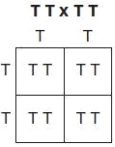
What ratio of the offspring from the cross shown will be homozygous recessive for the  trait of tallness? 
a)
0 in 4
b)
1 in 4
c)
2 in 4
d)
4 in 4
76.
Which of the characteristics is a lion least likely to pass on to its offspring?
a)
fur color
b)
length of tail
c)
scars on leg
d)
body size
77.
Which of the following is a phenotype?
a)
Aa
b)
red hair
c)
heterozygous
d)
DNA
78.
Which of the following is homozygous recessive?
a)
Tt
b)
tt
c)
TT
d)
T
79.

B = brown eyes

b = blue eyes

One brother has genotype BB and the other brother has genotype Bb.

Which statement is true about these two brothers?

a)

They have same phenotype and genotype

b)

They have different phenotypes and genotypes

c)

They have same phenotype, but different genotypes

d)

They have different phenotypes, but the same genotype
80.

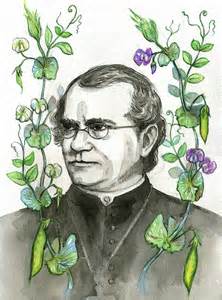
Who is considered the "father of genetics"?

a)

Reginald Punnett

b)

Gregor Mendel

c)

James Watson

d)

Charles Darwin

81.

How many alleles (letters) does a child get from EACH parent for each trait?

a)

1

b)

2

c)

3

d)

4

82.
In pea plants, the tall allele is dominant to the short allele. What key would demonstrate this?
a)
Tall = T
Short = S
b)
Tall = T
Short = t
c)
Tall = t
Short = T
d)
Tall = TT
Short = tt
83.
A heterozygous long-tusked elephant is crossed with a homozygous recessive short-tusked elephant. What is the probability of the offspring having short tusks?
a)
0%
b)
25%
c)
50%
d)
75%
84.
What is the probability of a purple-horned unicorn if a heterozygous pink-horned unicorn is crossed with a heterozygous pink-horned unicorn?
a)
0%
b)
25%
c)
50%
d)
75%
85.
Georgette wants to breed her pet phoenixes, but she isn't sure if the babies will burst into blue flames or red flames. Her documents show that her female phoenix is homozygous dominant for red flames, while her male phoenix is homozygous recessive for blue flames. What color flames will the babies have?
a)
Red
b)
Blue
c)
Purple
d)
50% Red, 50% Blue
86.
Leonardo bet his friend Olivet that two heterozygous green-eyed sea monsters could not have a recessive blue-eyed baby sea monster. Olivet said they can have a blue-eyed sea monster.
Who wins the bet?
a)
Leonardo
b)
Olivet
c)
Both
d)
Neither
87.

Two black-furred ewoks have 12 babies, 9 ewok babies have black fur, while 3 ewok babies have brown fur. What are the probable genotypes of the parents?

a)

BB and bb

b)

BB and Bb

c)

Bb and Bb

d)

Bb and bb

88.
Jabba the Hutt has finally decided to settle down and have a family. He has undergone genetic testing and learned that he is heterozygous for Hutt Fungal Syndrome, which is caused by recessive alleles. He is worried that his children might suffer from this syndrome. His Hutt mate has undergone genetic testing and discovered she is homozygous dominant for the syndrome. Should Jabba be worried?
a)
Yes
b)
No
89.
A Jawa notices that his beloved pet desert rat, who has brown fur, just had several rat babies, some of which had white fur and some which had brown fur. Brown fur is the dominant trait. This means his rat must have what genotype?
a)
Homozygous Dominant
b)
Heterozygous
c)
Homozygous Recessive
90.
Bob the abominable snowman lives in the snowy Andes mountains. He has white fur, which blends in nicely. He is therefore dismayed when his mate keeps having red-furred babies. What is Bob's likely genotype?
a)
Homozygous Dominant
b)
Heterozygous
c)
Homozygous Recessive
91.
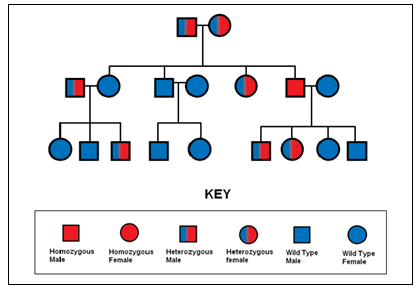
In a pedigree, what shape represents a male?
a)
circle
b)
square
c)
triangle
d)
diamond
92.
How many generations are shown in this pedigree?
a)
1
b)
2
c)
3
d)
4
93.
What does an open circle represent?
a)
Not Affected Male
b)
Not Affected Female
c)
Affected Male
d)
Affected Female
94.
Which individual in the first generation is a carrier?
a)
The male
b)
The female
c)
individual 1
d)
None of the above
95.
How many kids did the mother and father from the first generation have?
a)
2
b)
4
c)
5
d)
6
96.
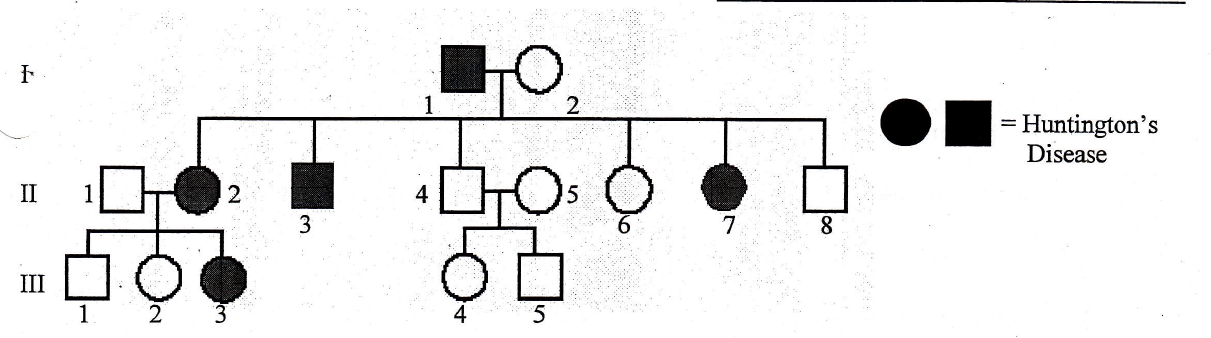
How many children did I-3 and I-4 have?
a)
2
b)
3
c)
4
d)
5
97.

If this pedigree shows an autosomal recessive disorder, what MUST the genotype of individual II-3 be?

a)

HH

b)

Hh

c)

hh

d)

None of the above

98.
How are individuals III-2 and II-4 related?
a)
Cousins
b)
Dad and Daughter
c)
Uncle and Niece
d)
Grandpa and Granddaughter
99.
There are no carriers for Huntington's Disease- you either have it or you don't. Is Huntington's disease caused by a dominant or recessive trait?
a)
Dominant
b)
Recessive
100.
What do we use pedigrees for?
a)
To look at families
b)
To make determinations about the offspring
c)
To track traits in families
d)
Nothing
101.
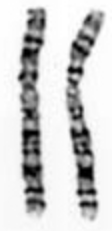
Determine the sex of the individual whose karyotype is displayed in the image.
a)
female
b)
male
102.
Which structure is labeled as A in the diagram?
a)
Centromere
b)
Chromosome
c)
Sister chromatids
103.
Which structure is labeled as B in the diagram?
a)
Centromere
b)
Chromosome
c)
Sister chromatids
104.
Which structure is labeled as C in the diagram?
a)
Centromere
b)
Chromosome
c)
Sister chromatids
105.
Nondisjunction can result in 
a)
trisomy conditions
b)
monosomy conditions
c)
additional sex chromosomes
d)
all of these
106.
A pair of identical chromosomes shown in a karyotype, one inherited from mom, and one inherited from dad are called
a)
sister chromotids
b)
centromeres
c)
homologous chromosomes
d)
autosomes
107.
An egg contains
a)
22 autosomes and an X chromosome
b)
22 autosomes and an Y chromosome
c)
44 autosomes and 2 X chromosomes
d)
44 autosomes and an X and a Y chromosome
108.
What is the haploid number for this Karyotype?
a)
26
b)
27
c)
52
d)
54
109.

When there is more than 2 alleles for a gene.

a)

polygenic inheritance

b)

multiple alleles

c)

codominance

d)

linked genes

e)

sex-linked traits

110.

When several genes control one phenotype

a)

polygenic inheritance

b)

multiple alleles

c)

codominance

d)

linked genes

111.

When there are 2 dominant alleles for the same gene

a)

polygenic inheritance

b)

multiple alleles

c)

codominance

d)

linked genes

e)

incomplete dominance

112.

When two genes are located close together on the same chromosome so the traits tend to be inherited together.

a)

polygenic inheritance

b)

multiple alleles

c)

codominance

d)

linked genes

e)

incomplete dominance

113.

When one allele isn't totally dominant over the recessive allele (heterozygous = an in-between phenotype)

a)

polygenic inheritance

b)

multiple alleles

c)

codominance

d)

linked genes

e)

incomplete dominance

114.

Traits controlled by genes located on the X or Y chromosome

a)

polygenic inheritance

b)

multiple alleles

c)

sex-linked traits

d)

linked genes

e)

incomplete dominance

115.

Examples include hemophilia, muscular dystrophy, and color blindness (affects mostly boys).

a)

polygenic inheritance

b)

multiple alleles

c)

sex-linked traits

d)

linked genes

e)

incomplete dominance

116.

Examples include skin color and height (the individual's phenotype exists somewhere along a spectrum)

a)

polygenic inheritance

b)

multiple alleles

c)

sex-linked traits

d)

linked genes

e)

incomplete dominance

117.

Heterozygous shows 2 traits at the same time.

a)

codominance

b)

multiple alleles

c)

sex-linked traits

d)

linked genes

e)

incomplete dominance

118.

Best human example is the ABO bloody type.

a)

polygenic inheritance

b)

multiple alleles

c)

sex-linked traits

d)

linked genes

e)

incomplete dominance

119.
A red flowered plant (RR) breeds with a White flowered plant (WW). The gene for petal color in these plants expresses incomplete dominance.  What percentage of the offspring will have pink (RW) flowers?
a)
0%
b)
25%
c)
50%
d)
100%
120.
What do you call the non-Mendelian inheritance pattern that states that neither trait is dominant and the traits appear to blend together?
a)
Codominance
b)
Incomplete dominance
c)
Polygenic traits