
 Worksheets
Semester 2 Exam Review
Total questions: 123
Worksheet time: 1hrs 2mins

Jerry walked from home to school, then from the school to the park. What is his total distance?
2 km
3 km
5 km
8 km

A jogger runs on the track shown in the figure above. What is the jogger's displacement after running a complete lap around the track?
100 m
130 m
160 m
0 m
Which scenario would lead to a displacement of zero? There may be more than one answer!
Allison walks from home 50 meters to the store to buy a 2 liter of Dr. Pepper.
Jeremiah walks from the bus stop 20 meters to the park and then back to the bus stop.
Ricky runs 14 meters East from the school, but realizes he forgot his Chromebook and goes back.
Alaysia skips 10 meters to the end of the sidewalk.

What is the total displacement, in meters, if the person traveled all the way around the rectangle?
3 m
5 m
13 m
0 m

From the figure, what is the displacement?
20 meters
25 meters
15 meters
25 meters NE

Joe rides from point A to B to C. What is the displacement?
7 m
12 m
5 m
2 m


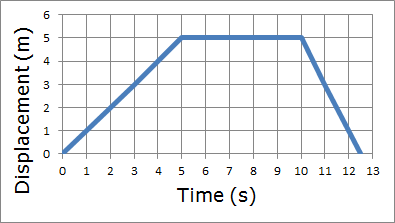

Which statement is true about velocity?
Must have measurement of speed.
Must have a measurement of speed and direction.
Must have only direction.
Has neither a measurement of speed or direction.
When a car goes around a corner at 20 mph, why do we say it accelerates?
The car is accelerating because of the velocity is constant
The car accelerates because it's going 20 mph
Cars always accelerate when they are in motion
The car is accelerating because it's changing direction
Which of the following is an acceptable velocity measurement?
25 m/s North
25 m/s
25 m
25 m North


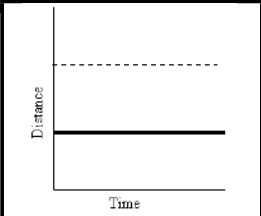
Match the description to the graph:
"The car is coming back."




A book rests on a table. The normal force points:
Perpendicular to the table and away from the table.
Perpendicular to the table and towards the table.
Parallel to the table and away from the table.
Parallel to the table and towards the table.

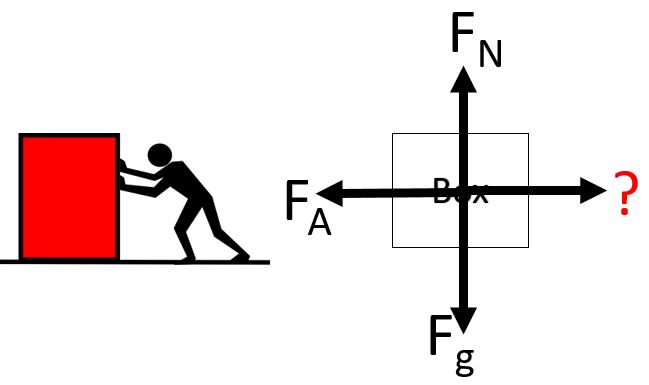
Name the missing force on the crate that is sliding at a constant velocity.
force friction
force traction
force gravity
force applied

The coffee cup in the picture is at rest on the table. What is true about the Normal force?
The normal force is exactly 15
The normal force is less than 15
The normal force is more than 15
The normal force is -10

A man pushes a box across the floor at a constant velocity. There is a force that is non-contact from the Earth; what is the name of that force?
force gravity
force normal
force friction
force applied
A man pushes a box across the floor at a constant velocity. What is the name of the force acting perpendicular to the floor?
force gravity
force normal
force friction
force applied

Two blocks of equal mass are dragged across different surfaces. Which will experience the greater Friction force?
Box A
Box B
Equal

Two Boxes are pulled along the same surfaces. Box C has more mass than box D. Which box feels the greater force of Gravity?
Box C
Box D
Equal

Is the object in equillibrium?
Yes
No
Not enough information

The net force acting on the object is acting
to the right
up
down
to the left
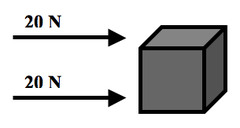

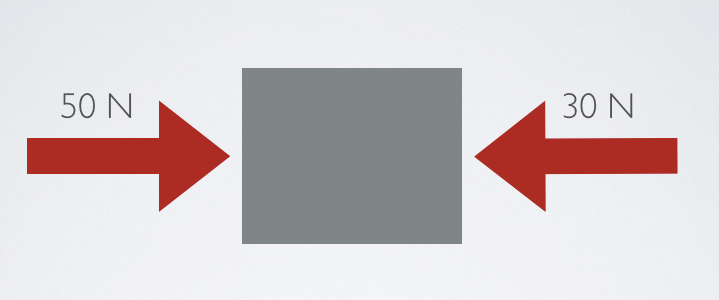

The force exerted by ropes and chains is called
tension
normal
elastic
mechanical

What is Newton's Third Law of Motion?
an object at rest stays at rest, and an object in motion will stay in motion until an outside force acts upon it
the acceleration of an object will be equal to the net force of an object divided by its mass
for every action, there will be an equal and opposite reaction
an object that is not moving will stay not moving moving until an unbalanced force acts on it
If a bird hit your windshield on your car, the force of the car on the bird equals
the force of the bird on your car.
the force of the car on the brid
an elastic collision on the windshield
a noncontact force acting on the windshield

The forces in a force pair are in the _______ direction
opposite
same
What is Newton's Third Law of Motion?
an object at rest stays at rest, and an object in motion will stay in motion until an outside force acts upon it
the acceleration of an object will be equal to the net force of an object divided by its mass
an object that is not moving will stay not moving moving until an unbalanced force acts on it
for every action, there will be an equal and opposite reaction

A player hits a ball with a bat. The action force is the impact of the bat against the ball. The reaction force is...
The grip of the player's hands on the ball
the air resistance of the ball
the force of the ball against the bat

What is inertia?
the force that opposes motion
the force of attraction between 2 objects
an object's tendency to stay in its state of motion
a change in an object's speed and/or direction

Why does an 18-wheeler truck have more inertia than a bicycle?
it has more mass
it has more volume
it is not as aerodynamic
It has more space
Which of the following has greatest inertia?
Basketball
Bowling ball
Tennis ball
Pingpong ball
work is done when
the object you apply a force on moves
any force is applied to an object, regardless if it moves or not
the force is zero
the force and direction of motion are perpendicular
Which form of energy is involved in a pencil falling from a desk?
kinetic
nonmechanical
gravitational potential
elastic potential
Energy stored due to the interactions between objects
potential
positional
total
kinetic
The ability to do work is called
energy
force
power
machine


In which scenario is work = 0 J ?
Pushing a stationary wall
Pulling a trolley car
Pushing a book across the table
Dropping a set of keys from a height, h.
Work is measured in units called
Joules
Power
Force
Newtons
What is an electrical circuit?
a whole bunch of wires
a broken path that electric charges can flow
a circuit board
a complete, unbroken path through which electric charges flow
When a switch is open...
the circuit is working and gives energy
the circuit is broken and charges cannot flow
the circuit is turning lights on
I don't know...ask Ms. Cednick

Will this circuit light the bulbs?
Yes, both will light up
Yes, but only the one on the right
Yes, but only one on the left
No, neither of the bulbs will light up


The symbol represents a ________________ and the long side represents the ________________ side.
cell, positive
cell, negative
battery, positive
battery, negative

This is an example of a _______ circuit
open
series
parallel
square

This is an example of a ______ circuit
Series
Parallel
Open
Dihexihedral

What type of circuits have more than one path for current?
open
closed
series
parallel

The following instructions explain how to make a circuit that will power a buzzer:
1.Connect a wire from the positive pole of the
battery to the switch.
2. Connect a wire from the switch to the buzzer.
3. ?
4. Close the switch.
What is the missing step in #3?
Connect a wire from the buzzer to the positive pole of the battery.
Connect a wire from the switch to the negative pole of the battery.
Connect a wire from the buzzer to the negative pole of the battery
Connect a wire from the positive pole to the negative pole of the battery.

What do all waves transfer?
Matter
Heat
Electricity
Energy

What are the two types of waves?
longitudinal and transverse
sound and light

What is the number of complete waves passing a fixed point in a given amount of time?
Amplitude
Intensity
Wavelength
Frequency

What does #1 represent?
Period
Frequency
Wavelength
Amplitude

What does #2 represent?
Period
Frequency
Wavelength
Amplitude

The highest point on a wave is:
the crest
the trough
the top
the coast

You can't hear sounds in outer space because there is no
medium
light
energy
heat
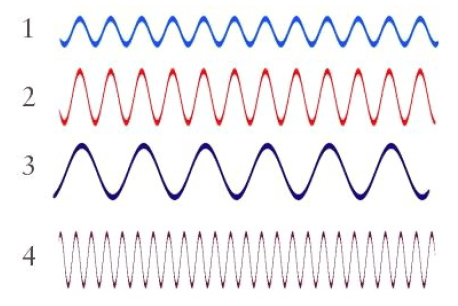
Which wave in the diagram has the greatest frequency?
1
2
3
4
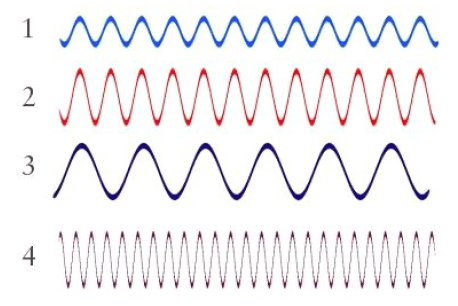
Which wave in the diagram has the greatest wavelength?
1
2
3
4


Cell phones (also have microwaves) and televisions use this type of EM wave. It has the longest wavelength with the lowest frequency.
Radio Wave
TV Wave
Gamma wave
Ultraviolet Wave

The type of wave with the shortest wavelength and highest frequency. This type of wave is extremely harmful.
radio
infrared
gamma
x ray

Which has the LONGEST wavelength and, therefore, the lowest frequency/energy
Gamma Rays
Radio Waves
Visible Light
Infrared rays


The Sun is our star made mostly of
helium
hydrogen and helium
hydrogen
helium, hydrogen, and gold
What protects Earth from solar winds?
The poles
The moon's gravity
The magnetic field
The tidal range
The Corona
Prominences
Sunspots
Solar Winds
What does the Big Bang Theory tell us
About the popular television show.
the entire universe was once condensed in the form of primeval atom, or a dense mass.
how the universe began.
As galaxies move away from our galaxy
a shift on the electromagnetic spectrum
(EMS) is noticed. This phenomena is
called _____________.
redshift
blueshift
unshift
blackshift
How does Cosmic Microwave Background Radiation support the Big Band Theory?
Microwaves are found everywhere in the universe.
Microwaves occurred at the time of the Big Bang
Microwaves are useful in our everyday lives
Only A & B
How does the abundance of hydrogen and helium support the Big Bang Theory.
Hydrogen and helium are elements on the Periodic Table
Hydrogen and helium are in the same ratio throughout the universe.
Hydrogen and helium have many current uses today

What is the correct order for the formation of our solar system?
1,2,3,4
2,3,4,1
2,4,3,1
1,3,4,2

How did Albert Einstein contribute to our understanding of the universe?
He discovered that galaxies were moving away from each other.
His Theory of Relativity helped us understand gravity, which holds our Universe together.
He did NOT contribute to our understanding of the Universe.
He discovered the Red Shift phenomena.

Hydrogen and helium were the first atoms to form because...
they are the lightest and simplest.
they are the heaviest.
they required more oxygen than others to form.
they did not require human intervention to exist.


Our sun is currently in what star stage?
Protostar
Nebula
Main Sequence
Red Giant
On the H-R diagram, it compares a star's brightness to its
Temperature
Composition
Age

In the universe, most stars are classified as which type?
Supergiants
Giants
White Dwarfs
Main Sequence

sort of cool, dim (not too much light), and red?


Stars are born in
the big bang
black holes
protoplanetary disks
nebulae

After a small star has used up all of it's hydrogen, it will become a......
white dwarf
red giant
interstellar cloud
supernova
When a supergiant runs out of fuel for fusion it will collapse in on itself and explode in a ....
big bang
black hole
nebula
supernova

