
 Worksheets
Meteorology Practice
Total questions: 127
Worksheet time: 2hrs 51mins
What powers a hurricane?
warm water evaporating
the heat from the core
cold ocean currents
tidal waves tidal waves
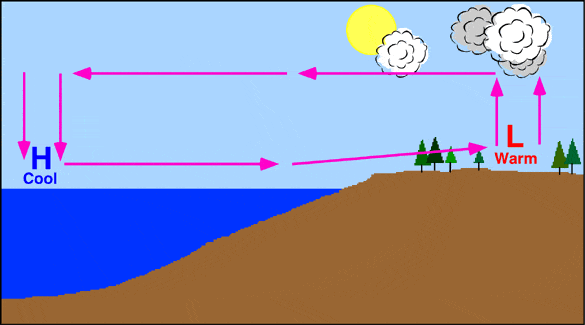
A sea breeze is caused by warm air _______ over the land during the day.
sinking
rising
condensing
blowing
The force of a Hurricane decreases as it moves over land because of ________.
a lack of warm, moist air
mountain ranges
cold ocean currents
a high pressure system
What is necessary for a Hurricane to form?
warm ocean water
cold ocean water
a strong warm front
a high pressure system
The main source of energy that drives all weather patterns is _______.
the sun
the core
the moon
the ocean

What type of front in shown on the weather map?
cold
warm
occluded
stationary
The lines on a weather map are called _______ and show area of equal ________.
isobars/pressure
isobars/temperature
contour lines/elevation
contour lines/pressure
The current temperature, humidity, and rainfall outside are examples of _______.
weather
climate
geology
weather and climate
What type of weather instrument measures atmospheric pressure?
hygrometer
barometer
anomometer
thermometer
When people think about what it's like in Central Texas, they always think to themselves that it's terribly hot and it's dry like a desert. On February 14, 2010 however, it snowed in Austin! Choose the statement that best explains what is happening in this scenario.
Climate is just another word for weather.
The climate in Texas is hot and dry, but the WEATHER on February 14th was cold and snowy.
The weather for Texas is always hot and dry, all the time, which matches the climate in Texas perfectly.
The weather in Texas is always hot and dry, but on February 14 the CLIMATE was cold and snowy.

Cold
Stationary
Occluded
Warm

These people are standing on the beach, looking out out over the ocean.
Consider how convection occurs during the daytime, when the sun shines down on the land and the water.
Is the wind blowing at their backs or blowing into their faces?
The wind is blowing onto their backs (land breeze)
There is no wind
The wind is blowing into their faces (sea breeze)

It's daytime on the beach.
What will happen to the air over the land and water?
Choose the one correct statement.
The water gets hot faster, so the air above it will rise.
The water gets hot faster ,so the air above it will sink.
The land gets hot faster, so the air above it will rise.
The land gets hot faster, so the air above it will sink.

Describe an air mass that forms over water in the gulf of mexico in terms of its temperature and moisture
wet and warm
wet and cold
dry and warm
dry and cold
Describe an air mass which forms over canada in terms of temperature and moisture
Wet and warm
wet and cold
dry and warm
dry and cold
Because the Earth is spinning. Globally winds cannot travel in a straight line. What is this effect called?
Nefario effect
gravitational effect
coriolis effect
weather effect
Generally all wind will travel from __ to __
High pressure to Low pressure
Low pressure to high pressure
Cold fronts to warm fronts
warm fronts to cold fronts
Which of the following statements is MOST accurate about the gases in our atmosphere?
Carbon Dioxide and Oxygen are the two most abundant gases in our atmosphere.
Carbon Dioxide and Methane are the two most abundant gases in our atmosphere.
Nitrogen and Carbon Dioxide are the two most abundant gases in our atmosphere.
Nitrogen and Oxygen are the two most abundant gases in our atmosphere.
Jamie says he thinks the Stratosphere is the most important. Which of the following would be the BEST argument for Jamie to make?
The Stratosphere is the most important layer because it protects our earth from being hit by meteors.
The Stratosphere is the most important layer because it contains all the air that we breathe along with our weather. Without the stratosphere we would not have our water cycle or any air to breathe.
The Stratosphere is the most important layer because it contains the ozone which protect us from harmful ultraviolet (UV) rays which can cause skin cancer.
The Stratosphere is the most important layer because it contains the ozone which is responsible for the greenhouse effect which keeps our Earth at a livable temperature.
A space shuttle is making its way back to Earth from a long journey in space. Which of the following would be the correct order of the layers of the atmosphere the space shuttle would go through from outer space until it finally reaches Earth?
Troposphere, Stratosphere, Mesosphere, Thermosphere
Troposphere, Mesosphere, Thermosphere,Stratosphere,
Thermosphere, Mesosphere, Stratosphere, Troposphere
Thermosphere, Troposphere, Stratosphere, Mesosphere
What are the two most abundant greenhouse gases and what do they do?
The two most abundant greenhouse gases are carbon dioxide and methane. These two gases trap heat in the atmosphere and make our planet a livable temperature.
The two most abundant greenhouse gases are nitrogen and oxygen. These two gases trap heat in the atmosphere and make our planet a livable temperature.
The two most abundant greenhouse gases are oxygen and nitrogen. These two gases provide us with the air that we breathe.
The two most abundant greenhouse gases are carbon dioxide and methane. These two gases provide us with the air that we breathe.
What is the difference between a local and global wind?
Local winds affect only areas near the equator while global winds affect the poles.
Local winds affect a larger area while global winds affect a smaller area.
Local winds affect a smaller area while global winds affect a larger area.
Local winds affect the poles while global winds affect only areas near the equator.

Which of the following is the correct label and
description for the top and bottom diagrams?
The top one is land breeze which is caused by the land cooling down faster than the water. The bottom one is a sea breeze which is caused by the land heating up faster than the water.
The top one is sea breeze which is caused by the land heating up faster than the water. The bottom one is a land breeze which is caused by the land cooling down faster than the water.
The top one is land breeze which is caused by the land heating up faster than the water. The bottom one is a sea breeze which is caused by the land cooling down faster than the water.
The top one is sea breeze which is caused by the land cooling down faster than the water. The bottom one is a land breeze which is caused by the land heating up faster than the water.
What type of air mass is represented by cP and what are the characteristics of this air mass?
cP is a Continental Tropical air mass and it will be cool and dry.
cP is a Continental Polar air mass and it will be cool and dry.
cP Is a Continental Tropical air mass and it will warm and dry.
cP is a Continental Polar air mass and it will be warm and dry.
When do hurricanes lose energy?
When they move over mountains or valleys
When they move over the equator
When they move over warmer water or land
When they move over cooler water or land

What type of air front is shown in the picture?
Warm
Cold
Stationary
Occluded

What is the name of this front?
Cold
Warm
Occluded
Stationary
What is the main source of energy that drives weather patterns on the Earth, including ocean currents and wind (convection in the atmosphere)?
The core
Volcanoes
The Sun
Plate Tectonics
What causes the wind to blow?
Uneven heating of the atmosphere results in areas of High & Low pressure, causing wind to blow from HIGH to LOW pressure
Humidity
Uneven heating of the atmosphere results in areas of High & Low pressure, causing wind to blow from LOW to HIGH pressure
Ocean currents
Cold
Stationary
Occluded
Warm
a boundary between two air masses of different density, moisture, or temperature
Station model
Front
Low pressure
Radio Model
High thin, white, feathery clouds made of ice crystals
Cirrus
cumulus
Isobar
Barometer
masses of puffy, white clouds, often with flat bases. They sometimes tower to great heights and can be associated with fair weather or thunderstorms
Stratus
Cumulus
Cirrus
Cloud
At what point do scientists classify an area's weather as its climate?
1 year
5 years
15 years
30 years
The hot and humid weather in Texas during the summer is most likely due to what type of air mass?
continental polar
continental tropical
maritime polar
maritime tropical
Frigid air that travels southward from Canada would be what type of air mass?
continental polar
continental tropical
maritime polar
arctic
The Coriolis effect is due to the __________ of Earth.
revolution
rotation
shape
density
Why do we have seasons on earth?
The tilt of the Earth means that the angles of the sun’s rays change.
The Earth gets closer to the sun during summer.
The sun gets hotter during summer.
There are more clouds during winter
As you go higher in the troposphere (the layer of the atmosphere that is closest to Earth) the temperature
Increases
Decreases
Stays the same
first decreases then increases
Which of the following is not a type of severe weather?
Blizzard
Tsunami
Severe Thunderstorm
Drought
Climate is different than weather because
Weather is short term, climate is over long periods of time
Weather deals with precipitations, climate with temperature
Climate deals with precipitations, weather with temperature
Weather and climate are the same
A continental air mass is always fairly
dry
damp
cold
hot
What is a cold front?
A place where a warm air mass is pushing a cold air mass out of the way
A place where a cold air mass is pushing a warm air mass out of the way
A place where 2 air masses meet but no movement is taking place
A place where a cold air mass is being squeezed by 2 warm air masses
What causes land breezes and sea breezes to flow at the shore?
Uneven heating and cooling of the land and water.
Prevailing winds driven by the angle of the sun's rays
The pull of the moon's gravity and the tides
The Coriolis effect

Based on these graphs, in which place would you rather live if you need a very wet climate?
Boston
San Francisco
What is a warm front
slow
mass of warm air taking over where cold air has been
fast
mass of cold air taking over where warm air has been
A thermometer measures
distance
temperature
height
weight
This instrument measures the amount of rain
wind vane
barometer
rain gauge
anemometer
An anemometer measures
wind speed
air pressure
amount of rain
temperature
This instrument measures air pressure
thermometer
rain gauge
anemometer
barometer
A wind vane measures
wind height
wind direction
wind color
wind speed

Name the front
cold front
warm front
flags
stationary front

Name the front
cold front
hot seat
stationary front
warm front

Name the front
warm front
stationary front
cold front
ice cream cones

What does the "H" on the weather map mean
hot pressure
happy pressure
high pressure
handy pressure


Precipitation in the form of circular or irregular-shaped lumps of ice.
Snow
Hail
Acid Rain
Liquid or solid water molecules that fall from earth's atmosphere and reach the ground
Precipitation
Condennsation
Evaporation
A costal breeze blowing from sea to land caused by the temperature difference when the land surface is warmer than the sea surface and usually occurs during the day.
Sea Breeze
Land Breeze
Wind Breeze
The boundary between troposphere and stratosphere is
Stratopause
Atmospause
Tropospause
Semi-stratosphere
A storm with lightning and thunder, composed of cumulonimbus clouds and usually associated with gusty winds, heavy rain and sometimes, hail and tornadoes.
Hail storm
Thunderstorm
Sandstorm
Which layer of the atmosphere contains ozone?
Thermosphere
Troposphere
Stratosphere
Mesosphere
Which layer of the atmosphere contains water vapor, clouds and is where weather happens?
Troposphere
Thermosphere
Mesosphere
Stratosphere
What happens to temperature as altitude increases?
It gets colder as you go up in the atmosphere
It gets warmer as you go up in the atmosphere
It depends on which layer of the atmosphere you're talking about - some get colder and some get warmer
The Earth's atmosphere is.....
78% carbon dioxide and 21% methane
78% hydrogen and 21% water vapor
78% oxygen and 21% nitrogen
78% nitrogen and 21% oxygen
A sea breeze......
Happens at night and blows from the sea to the land
Happens during the day and blows from the sea to the land
Happens at night and blows from the land to the sea
Happens during the day and blows from the land to the sea

The picture is showing examples of what?
Global winds
Local winds
Sea breezes
Land Breezes

What does mT mean?
cold and dry
cold and wet
warm and wet
warm and dry
What does cT mean?
cold and dry
cold and wet
warm and wet
warm and dry
What does cP mean?
cold and dry
cold and wet
warm and wet
warm and dry
What does mP mean?
cold and dry
cold and wet
warm and wet
warm and dry

What does this symbol represent?
warm front
cold front
occluded front
stationary front

What does this symbol represent?
warm front
cold front
occluded front
stationary front

What does this symbol represent?
warm front
cold front
occluded front
stationary front

What does this symbol represent?
warm front
cold front
occluded front
stationary front

Which of these are not causes global warming?
excess carbon dioxide
methane
CFCs
oxygen

Which gas is beneficial to us not being fried by UV rays?
Nitrogen
Ozone
CO2
CFCs

How do coastal towns compare to more inland towns? (2)
Warmer Winter
Colder Winter
Hotter Summer
Cooler Summer



