
 Worksheets
Review for Interim #2 (2025)
Total questions: 125
Worksheet time: 4hrs 10mins
Which type of bond is formed when electrons are transferred from one atom to another?
Covalent bond
Ionic bond
Metallic bond
Hydrogen bond
What is the chemical formula for sodium chloride?
NaCl
NaCl 2
Na 2 Cl
Na 2 Cl 2
What is the IUPAC name for H 2 O?
Hydrogen oxide
Dihydrogen monoxide
Water
Hydrogen dioxide
Which law states that mass is conserved during a chemical reaction?
Law of Definite Proportions
Law of Conservation of Mass
Law of Multiple Proportions
Law of Constant Composition
In the reaction 2H2+O2→2H2O , how many hydrogen atoms are present on each side of the equation?
2
4
1
8
Which of the following compounds is most likely to be ionic?
CO 2
NaF
H 2 O
CH 4
Given magnesium (Mg) and chlorine (Cl), predict the formula for the stable binary ionic compound they form.
MgCl
MgCl 2
Mg 2 Cl
Mg 2 Cl 2
Translate the chemical name "calcium oxide" into its chemical formula using IUPAC nomenclature.
CaO
CaO 2
Ca 2 O
Ca 2 O 2
A student mixes 10 g of reactant A with 15 g of reactant B. After the reaction, 25 g of product C is formed. What does this demonstrate?
Mass is not conserved
Mass is conserved
Mass increases
Mass decreases
Which chemical equation correctly shows conservation of atoms for the reaction between hydrogen and oxygen to form water?
H2+O2→H2O
2H2+O2→2H2O
H2+2O2→2H2O
2H2+2O2→2H2O
Does NaCl or H 2 O have a higher melting point and why?
NaCl, because it is ionic
H 2 O, because it is covalent
NaCl, because it is covalent
H 2 O, because it is ionic
What is the chemical formula for the ionic compound formed between aluminum (Al) and oxygen (O)?
AlO
Al 2 O 3
AlO 2
Al 3 O 2
Given the chemical formula K 2 S, use IUPAC nomenclature to determine the name of the compound.
Potassium sulfide
Potassium sulfate
Potassium sulfur
Dipotassium monosulfide
Plan an investigation to show that mass is conserved when copper reacts with sulfur to form copper(II) sulfide.
Weigh reactants and products before and after the reaction
Only measure the reactants
Only measure the products
Do not measure anything
Use a model of the chemical equation 2Na+Cl2→2NaCl to illustrate how the total number of atoms is conserved.
2 Na atoms and 2 Cl atoms on both sides
1 Na atom and 2 Cl atoms on both sides
2 Na atoms and 1 Cl atom on both sides
1 Na atom and 1 Cl atom on both sides
Which of the following is a property of covalent compounds?
High melting point
Conducts electricity in solution
Low melting point
Forms crystals
What is the formula for the ionic compound formed between potassium (K) and bromine (Br)?
KBr
K 2 Br
KBr 2
K 2 Br 2
What is the IUPAC name for Na 2 O?
Sodium oxide
Disodium oxide
Sodium dioxide
Sodium monoxide
During a chemical reaction, if the total mass of reactants is 50 g and the total mass of products is 50 g, what does this indicate?
Mass is lost
Mass is gained
Mass is conserved
Mass is destroyed
In the equation C+O2→CO2 , how many oxygen atoms are present on each side?
1
2
3
4
Which compound is most likely to be covalent?
NaCl
MgO
CO 2
KBr
Predict the formula for the stable binary ionic compound formed between calcium (Ca) and fluorine (F).
CaF
CaF 2
Ca 2 F
Ca 2 F 2
Translate the chemical name "magnesium chloride" into its chemical formula using IUPAC nomenclature.
MgCl
MgCl 2
Mg 2 Cl
Mg 2 Cl 2
A student combines 20 g of reactant X with 30 g of reactant Y. After the reaction, 50 g of product Z is obtained. What principle does this support?
Law of Conservation of Mass
Law of Definite Proportions
Law of Multiple Proportions
Law of Constant Composition
Which chemical equation shows conservation of atoms for the reaction between nitrogen and hydrogen to form ammonia?
N2+H2→NH3
N2+3H2→2NH3
2N2+3H2→2NH3
N2+2H2→2NH3
Compare the electrical conductivity of NaCl and CH 4 in water. Which compound conducts electricity and why?
NaCl, because it forms ions in water
CH 4 , because it forms ions in water
NaCl, because it is covalent
CH 4 , because it is ionic
Develop a model to predict the formula for the ionic compound formed between barium (Ba) and chlorine (Cl).
BaCl
BaCl 2
Ba 2 Cl
Ba 2 Cl 2
Plan an investigation to demonstrate mass conservation when zinc reacts with hydrochloric acid to produce hydrogen gas and zinc chloride.
Measure the mass of all reactants and products before and after the reaction
Only measure the mass of zinc
Only measure the mass of hydrogen gas
Do not measure anything
Use a model of the chemical equation 2K+2H2O→2KOH+H2 to illustrate how the total number of atoms is conserved.
2 K, 4 H, and 2 O atoms on both sides
2 K, 2 H, and 2 O atoms on both sides
4 K, 4 H, and 2 O atoms on both sides
2 K, 2 H, and 4 O atoms on both sides
Which of the following best explains why ionic compounds generally have higher melting points than covalent compounds?
Weak forces between molecules
Strong electrostatic forces between ions
Presence of hydrogen bonds
Low atomic mass
In the reaction 2Mg+O2→2MgO , how many magnesium atoms are present on each side of the equation?
4
3
2
1
What is the IUPAC name for the compound with the formula KBr?
Potassium bromide
Potassium bromine
Potassium bromate
Potassium dibromide
Valence electrons are transferred
Ionic bonds
Covalent bonds
Valence electrons are shared
Ionic bonds
Covalent bonds
Conducts electricity well when melted or dissolved
Ionic compounds
Covalent compounds
Poor electrical conductivity
Ionic compounds
Covalent compounds
Always a solid at room temperature
Ionic compounds
Covalent compounds
Can be a solid, liquid, or gas at room temperature
Ionic compounds
Covalent compounds
Generally high melting & boiling points
Ionic compounds
Covalent compounds
Generally low melting and boiling points
Ionic compounds
Covalent compounds
Generally, atoms form bonds so that _______________.
Each atom loses its electrons
Each atom has a stable electron configuration
Each atom has an unstable electron configuration
Each atom gains electrons

What kind of bond does this show?
Ionic
Covalent

What kind of bonds are shown here?
Covalent
Ionic
What happens when you put an ionic compound in water?
The ions separate
The ions pack more closely together
Nothing happens

What type of bonding does this picture show?
Ionic
Covalent

What type of bonding does this picture show?
Ionic
Covalent
Cations are (a) charged metal ion because the metals (b) electrons
Anions are (a) charged metal ion because the metals (b) electrons
Which of the following could form a covalent bond?
Two or More Nonmetals
Metal and Nonmetal
Two or More Metals
Metal and Polyatomic Ion
All Provided Options
How many valence electrons do most atoms need to be stable?
8
6
4
2
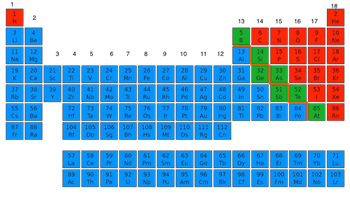
Where are the metals located on the periodic table?
The chemical bond between a non-metal and another non-metal will be a ________ bond.
metal
ionic
covalent
polar
The chemical bond between a metal and a non-metal will be a _____ bond.
metal
ionic
covalent
polar
Sodium and Bromine will make a _____ bond.
ionic
covalent
metallic
Carbon and Oxygen will make a ___________ bond.
ionic
covalent
metallic
MgO
ionic
covalent
metallic
If two fluorine atoms bond they will make a _____ bond.
ionic
covalent
metallic
Hydrogen and Chlorine will from a _________ bond
ionic
covalent
metallic
Why don't noble gases form bonds?
They all have a full octet
Noble gases do form bonds
They only bond when with eachother
none of these answers are correct
A sodium ion has a charge of
-1
-2
+1
+2
An example of a covalent compound is
sodium floride
calcium chloride
carbon dioxide
all of the above
What is the chemical formula for the compound containing one nitrogen atom and two oxygen atoms?
O2N
N2O
NO
NO2
True or False: An oxygen atom has eight valence electrons
True
False
Valence electrons are found
outermost energy level
innermost energy level
some where in the electron cloud
How many valence electrons does Boron have?
1
2
3
4
Group numbers on the periodic table help us determine
number of valence electrons
state of the element (solid, liquid, gas)
What does the number 3 represent in 4NH3?
Subscript
Superscript
Coefficient
What does the number 4 represent in 4NH3?
Subscript
Superscript
Coefficient

How many Nitrogen (N) atoms are in 4NH3?
4
1
3
12

How many Hydrogen (H) atoms are in 4NH3?
4
1
3
12

In the equation shown, what are the reactant(s)?
N2 + H2
NH3
In the equation shown, what are the product(s)?
N2 + H2
NH3

Is this equation balanced?
Yes
No

Is this equation balanced?
Yes
No

Is this equation balanced?
Yes
No

To balance an equation you should:
ONLY change subscripts.
ONLY change coefficients.
Change BOTH subscripts and coefficients.

88 g of strontium reacts with 160 g of bromine to produce _______ g of strontium bromide.
72
240
248
80
24 g of magnesium reacts with 38 g of fluorine to produce ______ g of magnesium fluoride.
10
24
14
62
14 g of lithium reacts with _____ g of sulfur to produce 46 g of lithium sulfide.
32
60
25
10
40 grams of calcium reacts with 71 grams of chlorine to produce _______ g of calcium chloride.
31
101
100
111
In the chemical formula C12H22O11 , how many elements are there?
1
2
3
4
In the chemical formula C12H22O11 , how many C atoms are there?
12
22
11
45
In the chemical formula C12H22O11 , how many O atoms are there?
12
22
11
45
In the chemical formula C12H22O11 , how many H atoms are there?
12
22
11
45
What is the TOTAL number of atoms in the chemical formula C12H22O11 ?
12
22
11
45
How does a balanced chemical equation satisfy the Law of Conservation of Mass?
During a chemical reaction, matter is destroyed.
During a chemical reaction, the total number of atoms increases.
During a chemical reaction, one or more new substances are formed.
During a chemical reaction, the total amount of matter stays the same.
What happens to the total mass of the substances after a chemical reaction?
It decreases.
It increases.
It remains the same.
It increases then decreases.
Jin bought a heat pack that weighs 15 g. He shook it so it would release heat to warm his hands. The release of heat indicates a chemical reaction took place in a closed system. What would be the mass of the heat pack after the chemical reaction?
5 g
10 g
12 g
15 g

According to the law of conservation of mass, how much zinc was present in the zinc carbonate?
256 g
88 g
104 g
40 g
So, the Law of Conservation of Mass would tell us that the mass of all the REACTANTS must __________ the mass of all PRODUCTS in a chemical reaction.
equal
be greater than
be less than
Which of the following equations does not demonstrate the law of conservation of mass?
2Na + Cl2 ➡️ 2NaCl
NaOH + HCl ➡️ NaCl + H20
P4 + 5O2 ➡️ 2P4O10

The reactants in the image above are:
CH4 and 2 O2
2 H2O and CO2
All of these are reactants
All of these are products

Aria and David are studying chemistry and they come across the elements magnesium (Mg) and bromine (Br) in the Periodic Table. Avery joins them and asks, 'What would be a characteristic of the compound MgBr2 that we could observe if we had it in our lab?'.
It has a high melting point.
It is formed by covalent bonds.
It is a gas at room temperature.
It does not conduct electricity when dissolved in water.
An unbalanced chemical equation is shown below.
CH4 + O2 → CO2 + H2O
Which is the correctly balanced equation for the expression?
CH4 + 2O2 → CO2 + H2O
CH4 + 3O2 → CO2 + H2O
2CH4 + O2 → CO2 + H2O
CH4 + 2O2 → CO2 + 2H2O
Potassium chloride can be produced from potassium metal and chlorine gas. Which of the following is the correct, balanced equation for the production of potassium chloride?
4K(s) + Cl2(g) → 2K2Cl(s)
K(s) + Cl2(g) → KCl(s)
2K(s) + Cl2(g) → 2KCl(s)
K(s) + Cl2(g) → KCl2(s)
An unbalanced chemical equation is shown below.
NO + O2 → NO2
Which is the correctly balanced equation for the expression?
NO + O2 → 3NO2
NO + 2O2 → 2NO2
2NO + O2 → 2NO2
2NO + O2 → NO2
During combustion, methane yields carbon dioxide and water. The unbalanced equation for this reaction is:
CH4 + O2 CO2 + H2O
What coefficients are needed in order to balance this equation?
1, 1, 1, 2
1, 2, 1, 2
5, 4, 3, 6
1, 1, 2, 1
An unbalanced chemical equation is shown below.
Al + O2 → Al2O3
Which is the correctly balanced equation for the expression?
4Al + O2 → 2Al2O3
4Al + 3O2 → 2Al2O3
3Al + 2O2 → Al2O3
2Al + 3O2 → Al2O3
An unbalanced chemical equation is shown below.
CH4 + O2 CO2 + H2O
Which of the following particle diagrams correctly represents the balanced form of the equation?


3 Pb + 2 H3PO4 ----> 3 H2 + 1 Pb3(PO4)2
Synthesis (or combination)
Decomposition
Single replacement
Double replacement
What reaction has the following general formula:
A + CD --> C + AD
Combination
Decomposition
Single Replacement
Double Replacement
Combustion
What reaction has the following general formula:
AB + CD --> CB + AD
Combination
Decomposition
Single Replacement
Double Replacement
Combustion
What reaction has the following general formula:
CxHy + O2 −>CO2 + H2O
Combination
Decomposition
Single Replacement
Double Replacement
Combustion
What is the general reaction scheme for a decomposition reaction?
A + B --> AB
AB --> A + B
A + CD --> C + AD
AB + CD --> CB + AD
CxHy+O2 −> CO2+H2O
Which of the following atomic models of chemical reactions correctly demonstrates the Law of Conservation of Matter?
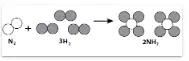
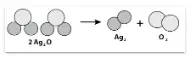
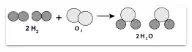
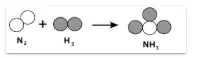
Students want to gather evidence for the claim that the number of atoms present before a chemical reaction is equal to the number of atoms present after the chemical reaction. They decide to react vinegar and baking soda in a sealed plastic bag. Which of the following would provide the evidence the students need?
The mass of the plastic bag, baking soda, and vinegar before the reaction was equal to the mass after the reaction
Bubbles were produced during the reaction, which meant that a gas was being produced
The plastic bag did not change in any way, indicating that it was not involved in the reaction
The mass of the baking soda was exactly equal ot the mass of the vinegar used to create the chemical reaction

True or False: The mass of the reactants is equal to the mass of the products?
True
False

Which of the models of a chemical reaction best represents the Law of Conservation of Mass?
A
B
C
D

Which of the models of a chemical reaction best represents the Law of Conservation of Mass?
A
B
C
D

