wayground logo

Free Printable Worksheets

Font size

S
M
L
XL
Worksheets

Geology Final

Total questions: 125

Worksheet time: 1hrs 22mins

Name
Class
Date
1.
Using this scale, which mineral can scratch fluorite?
a)
Talc 
b)
Gypsum 
c)
Apatite 
d)
Calcite 
2.
Rock that forms when magma or lava cools and hardens to become solid, either beneath or on Earth’s surface
a)
Sedimentary Rock
b)
Metamorphic Rock
c)
Igneous Rock
d)
Rock Cycle
3.
Rock that forms when minerals form from solutions or sediment from older rocks get pressed and cemented together.
a)
Sedimentary Rock
b)
Metamorphic Rock
c)
Igneous Rock
4.
Rock that forms when pressure, temperature, or chemical processes change existing rock.
a)
Igneous Rock
b)
Sedimentary Rock
c)
Metamorphic Rock
d)
Rock Cycle
5.
This image represents....
a)
Rift Zone
b)
Rock Cycle
c)
Uplift
d)
Erosion
6.
When wind, water, ice and gravity move soil from one place to another.
a)
glaciers
b)
composition
c)
rock slide
d)
erosion
7.
Scientists think that convection currents that move the plates flow in Earth's
a)
Continental crust
b)
oceanic crust
c)
Asthenosphere
d)
Lithosphere
8.
Where does molten material from the mantle rise up during the process of sea-floor spreading?
a)
Along the mid-ocean ridge
b)
At the north and south poles 
c)
Along the edges of all the continents near the shoreline and beaches
d)
at the equator
9.
The Earth is made up of two types of crust.  Which is more dense?
a)
Oceanic crust -basalt
b)
Oceanic crust- granite
c)
Continental crust- granite
d)
continental crust- basalt
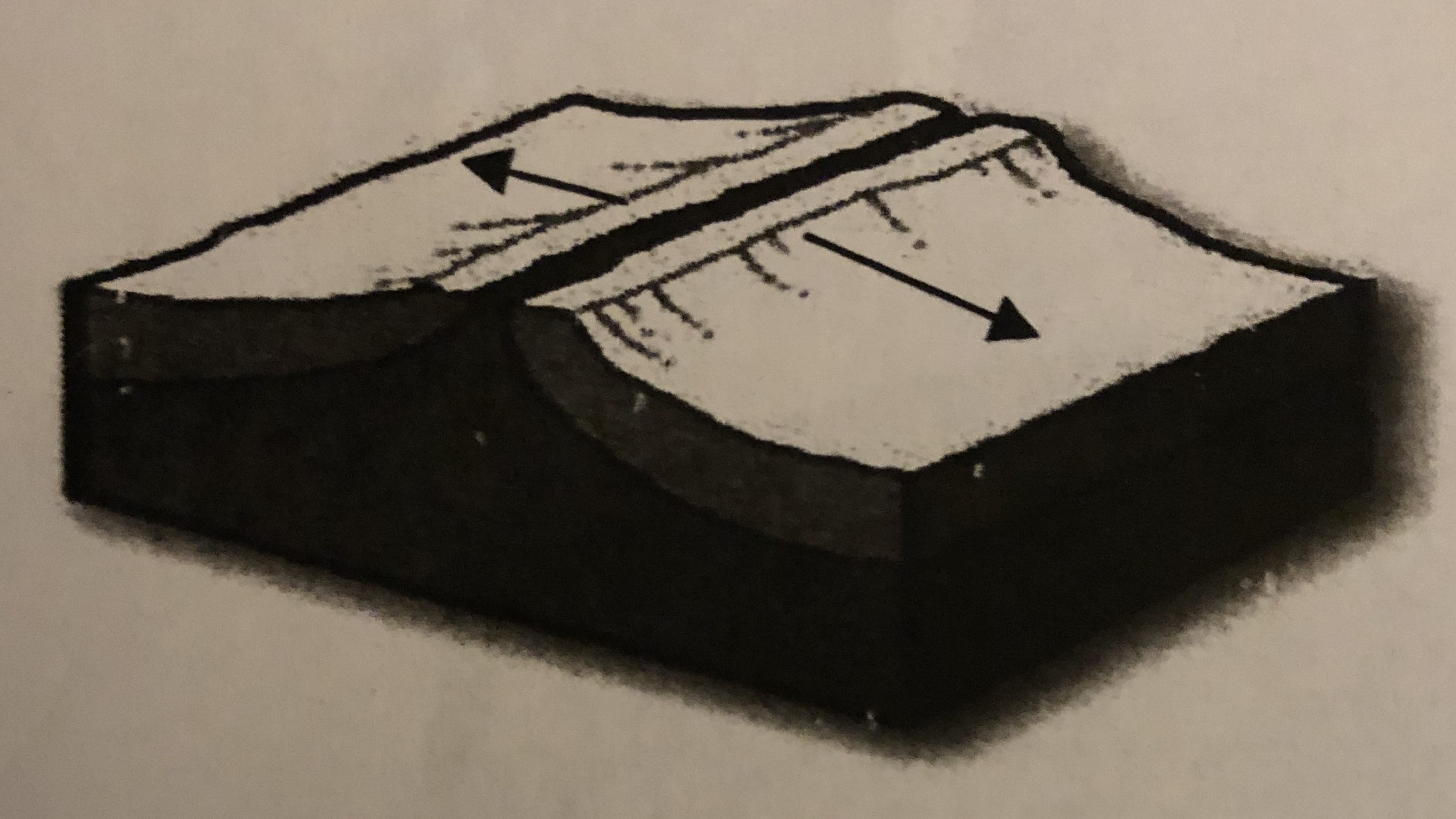
10.
What kind of plate boundary is shown here?
a)
divergent
b)
convergent
c)
transform
d)
strike slip
11.
Which of the following correctly lists the layers in order from oldest to youngest?
a)
A, B, C, D, E
b)
E, B, C, D, A
c)
E, D, C, B, A
d)
C, B, A, D, E
12.

Which earth layer is made up of the upper mantle and the crust?

a)

core

b)

lower mantle

c)

asthenosphere

d)

lithosphere

13.
The Law of __________ tells us younger rocks are on top.
a)
Uniform-itarianism
b)
Congruity
c)
Positronics
d)
Superposition
14.
A fossil found over a large area deposited within a short time period is _____________.
a)
a specimen interval
b)
an index fossil
c)
a time differential
d)
an indicator marker
15.
What is geology?
a)
study of animals
b)
study of society
c)
a branch of earth science that focuses on the study of the rock
d)
a type of corn
16.

The study of the solid earth and the processes that change the physical landscape of the planet is____

a)

Physical Geology

b)

Structural Geology

c)

Historical Geology

d)

Geomorphology

17.

Which statement best describes the principle of uniformitarianism? (Mark the one best answer.)

a)

Deposition occurs faster today than it did in ancient environments.

b)

Rocks form by the same processes today as in the past

c)

Weathering and erosion can be fast or slow, depending on the type of rock.

d)

Earth’s geological features were formed by a few catastrophic events.

18.
This is part of the....
a)
Geosphere
b)
Biosphere
c)
Hydrosphere
d)
Cryosphere
19.
All living things on earth are part of the....
a)
Biosphere
b)
Geosphere
c)
Hydrosphere
d)
Cryosphere
20.
This is part of the....
a)
Geosphere
b)
Atmosphere
c)
Hydrosphere
d)
Cryosphere
21.
This is part of the....
a)
Geosphere
b)
Atmosphere
c)
Cryosphere
d)
Hydrosphere
22.
A rock formed from fragments of other rocks is a(n)
a)
Metamorphic Rock
b)
Sedimentary Rock
c)
Extrusive Rock
d)
Igneous Rock
23.
If heat and pressure inside the Earth cause a rock to melt, the material that formed would be
a)
Metamorphic
b)
Magma
c)
Sedimentary
d)
Igneous
24.
As lava cools and crystallizes, what type of rock will form?
a)
Sedimentary
b)
Metamorphic
c)
Extrusive Igneous
d)
Intrusive Igneous
25.
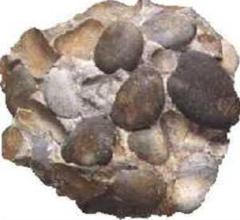
This rock was formed by smaller pieces of rock that settled at the bottom of a lake millions of years ago. What type of rock is this?
a)
Sedimentary
b)
Igneous
c)
Metamorphic
26.

According to the diagram, what process is shown by letter B?

a)

compaction & cementation

b)

weather & erosion

c)

heat & pressure

d)

melting

27.

Which state of matter is the earth's inner core?

a)

plasma

b)

liquid

c)

solid

d)

gas

28.

Which earth layer is made up of the upper mantle and the crust?

a)

core

b)

lower mantle

c)

asthenosphere

d)

lithosphere

29.

Which of the following is not a theory of how the earth came to be?

a)

Creation

b)

Nebular Hypothesis

c)

Big Bang Theory

d)

Dust Combination Theory

30.
Which type of plate is older?
a)
continental
b)
oceanic
31.
What type of plate is thicker?
a)
continental 
b)
oceanic
32.
The Earth is composed of a complex set of cycles, parts and processes that all work together as a
a)
Planet
b)
Unit
c)
System
33.
Scientist think the Earth is ___ years old.
a)
4,500
b)
45,000
c)
4.5 million
d)
4.5 billion
34.
What is the correct order (starting from the surface) of Earth’s layers?
a)
mantle, outer core, inner core, crust
b)
crust, mantle, outer core, inner core
c)
outer core, inner core, crust, mantle
d)
crust, outer core, inner core, mantle
35.
When carbon dioxide dissolves from the air into the ocean -the interaction is between
a)
the atmosphere and atmosphere
b)
the atmosphere and hydrosphere
c)
the atmosphere and geosphere
d)
the atmosphere and biosphere
36.
The color of a mineral in powder form is called the mineral's 
a)
hardness
b)
specific gravity
c)
luster
d)
streak
37.
How light reflects off of a mineral is called the mineral's 
a)
luster
b)
streak
c)
cleavage
d)
fracture
38.
Diamond has a hardness of ___ on Mohs Hardness Scale.
a)
1
b)
5
c)
8
d)
10
39.
By definition, a mineral has which of the following characteristic(s)?
a)
definite chemical composition
b)
crystal structure
c)
naturally occuring
d)
all of the above
40.
How do you test the hardness of a mineral? 
a)
Throw it against a wall
b)
Step on it
c)
Scratch Test
d)
Kick it until it breaks
41.
A mineral breaks into pieces like are shown in the picture. How would you describe its breakage?
a)
Fracture
b)
Cleavage
c)
Glassy
d)
Waxy
42.
The mineral in the picture has a ____________ luster.
a)
Nonmetallic
b)
Metallic
c)
Pearly
d)
Earthy
43.
Refer to the Mohs Hardness Scale. A mineral with a hardness of 7 can scratch -
a)
orthoclase feldspar, but cannot scratch talc
b)
calcite, but cannot scratch apatite.
c)
topaz, but cannot scratch fluorite
d)
gypsum, but cannot scratch corundum
44.

A mineral can be scratched by gypsum and quartz.

What is the hardness range?


a)

1-2

b)

2-7

c)

2-10

d)

7-10

45.

A mineral could be scratched by topaz but NOT by fluorite.

What is the hardness range?

a)

1-4

b)

4-8

c)

4-10

d)

8-10

46.
Mineral containing silicon, oxygen, and usually one or more other elements
a)
carbonate
b)
halide
c)
silicate
d)
sulfate
47.

Silicate mineral MUST contain Silicon (Si) and ______________.

a)

Oxygen

b)

Aluminium

c)

Carbon

48.

Which is NOT the characteristic of Ferromagnesian (Mafic) Silicate mineral.

a)

Light in color

b)

Combination of Silicate and Mg OR Fe

c)

Dark color of mineral

49.

The figure shows the ______________________ silicate mineral crystal structure

a)

Independent tetrahedron

b)

Single chain

c)

Double chain

d)

Sheet

50.

Tend to form tetrahedrons

a)

Silicates

b)

Carbonates

c)

Oxides

51.

Is ice a silicate or non-silicate?

a)

silicate

b)

non-silicate

c)

neither, it's not a mineral

52.

Which of the following describes covalent bonds?

a)

Bonds form because of opposite charges

b)

electrons are shared to fill outer electron shells

c)

Electrons are transferred between atoms

d)

Covalent bonds are magical

53.

What charge is the proton?

a)

positive

b)

no charge (neutral)

c)

negative

d)

Senaida-charged

54.

If a mineral contains iron (Fe) or magnesium (Mg), what would it be classified as?

a)

light silicate

b)

dark silicate

c)

nonsilicate

55.

If a mineral contains aluminium (Al), potassium (K), calcium (Ca), or sodium (Na), what would it be classified as?

a)

light silicate

b)

dark silicate

c)

nonsilicate

56.

What kind of mineral is heavier and found in oceanic crust?

a)

light silicates

b)

dark silicates

c)

nonsilicates

57.

What are the three most common elements in the Earth's crust?

a)

oxygen

b)

silicon

c)

gold

d)

aluminium

58.
What is the most common Extrusive igneous rock?
a)
Granite
b)
Basalt
c)
Pumice
d)
Scorie
59.
If an Igneous rock is dark-colored, what is the amount of silica?
a)
high
b)
low
c)
doesn't matter
60.
Is Granite high or low in Silica?
a)
high
b)
low
61.
What is the most common Intrusive Igneous rock?
a)
Basalt
b)
Gabbro
c)
Diorite
d)
Granite
62.
Where can we find Basalt?
a)
mountains
b)
valleys
c)
deserts
d)
ocean floor
63.
High or Low Silica?
a)
high
b)
low
64.
A type of rock that forms from the cooling of molten rock at or below the surface of the Earth
a)
Igneous Rock
b)
Metamorphic Rock
c)
Sedimentary Rock
d)
Chemical Rock
65.
This rock cools so quickly that crystals have no time to form.
a)
Basalt
b)
Obsidian
c)
Gabbro
d)
Pumice
66.

Describe the texture of the following igneous rock.

a)

glassy

b)

rough

c)

vesicular

d)

coarse

67.

Describe the texture of the following igneous rock.

a)

smooth

b)

coarse

c)

vesicular

d)

glassy

68.

Describe the mineral composition of the following igneous rock.

a)

felsic

b)

mafic

69.

Describe the mineral composition of the following igneous rock.

a)

felsic

b)

mafic

70.
Which is true of this image?
a)
All minerals form from magma at the same time.
b)
As minerals form, the composition of magma changes.
c)
As more magma is crystallized the number of atoms in magma remains constant.
d)
Igneous rocks form from precipitation in water.
71.
According to the Bowen's reaction series, which mineral forms at the hottest temperature?
a)
Olivine
b)
Pyroxene
c)
K-spar
d)
Quartz
72.
What category of igneous rock has two different sizes of crystals?
a)
glassy
b)
aphanitic/extrusive
c)
phaneritic/intrusive
d)
porphyritic
73.
What is the name of a mafic, extrusive (aphanitic) igneous rock?
a)
Granite
b)
Rhyolite
c)
Gabbro
d)
Basalt
74.
What is the name of a mafic, intrusive (phaneritic) igneous rock?
a)
Granite
b)
Rhyolite
c)
Gabbro
d)
Basalt
75.
Sheet-like intrusions that lie parallel to previous rock units are:
a)
dike
b)
sill
c)
pluton
d)
batholith
76.
Sheet like intrusions that cut across previous rock units are:
a)
dike
b)
sill
c)
pluton
d)
batholith
77.
The largest intrusive body is a
a)
dike
b)
sill
c)
pluton
d)
batholith
78.
A type of volcano that is a steep conical hill
a)
cinder cone
b)
shield
c)
composite
d)
magma
79.
Which of the following are landscape features associated with volcanoes? 
a)
batholiths, stocks, sills, dikes, and laccoliths
b)
vents, craters, and calderas
c)
hot spots and flood basalts
d)
uplift, erosion, weathering, and deposition
80.

________ is a volcano where the magma chamber collapsed

a)

vent

b)

fissure

c)

hot spot

d)

caldera

81.
What is letter A in the picture?
a)
Vent
b)
Crater
c)
Conduit
d)
Tephra
82.
What is letter F in the picture?
a)
Pyroclastic Flow
b)
Crater
c)
Vent
d)
Tephra
83.
__________ volcanoes are formed from fast flowing, lava which flows easily over the surface, forming larger volcanoes with gentle sides.
a)
Cone
b)
Composite
c)
Angel
d)
Shield
84.
Ring of Fire Volcanoes have...
a)
Blocky lava
b)
Sea water trapped inside
c)
Huge, violent eruptions
d)
All of the above
85.
What factor(s) determine(s) whether an eruption will be explosive?
a)
The amount of gases in the magma
b)
The amount of silica in the magma
c)
The amount of gas and silica in the magma
d)
None of these affect the explosiveness of the volcano
86.
The metamorphic rock __________ usually forms when limestone is subjected to heat and pressure deep beneath the surface.
a)
marble
b)
slate
c)
sandstone
87.
Any rock formed when another rock is changed by heat or __________ is a metamorphic rock.
a)
pressure
b)
arrangement
88.
Metamorphic rock can form out of other metamorphic rock.
a)
true
b)
false
89.
What is the name of this Metamorphic Rock?
a)
Schist
b)
Slate
c)
Gneiss
d)
Marble
90.
__________ metamorphism occurs when magma heats the surrounding rock and changes it.
a)
Regional
b)
Forced
c)
Igneotrophic
d)
Contact
91.
__________ metamorphism occurs when rock formations in the crust collide and build pressure
a)
Regional
b)
Forced
c)
Igneotrophic
d)
Contact
92.
What are the two main types of metamorphic rocks and how are they different?
a)
intrusive and extrusive; intrusive rocks are formed inside the earth and extrusive rocks are formed on the surface
b)
foliated and nonfoliated; foliated rocks do not have visible bands/layers and nonfoliated rocks do have visible bands/layers
c)
intrusive and extrusive; intrusive rocks are formed on the earth's surface and extrusive rocks are formed in the Earth
d)
foliated and nonfoliated; foliated rocks have visible bands/layers and nonfoliated rocks do not have visible bands/layers
93.
This pink and black striped rock can be classified as
a)
foliated metamorphic
b)
unfoliated metamorphic
c)
clastic sedimentaary
d)
organic sedimentary
94.
What can work through fractures in rocks, causing changes to the minerals in the rock?
a)
Plate Boundaries
b)
Sediments
c)
Hot Fluids
d)
Air
95.

Subduction zones occur:

a)

at tectonic plate boundaries, creating an area of low temperature and high pressure.

b)

at tectonic plate boundaries, creating an area of high temperature and high pressure.

c)

in the middle of continents, creating an area of low temperature and high pressure.

96.

True or False: Mineral-rich water can change the composition (types of minerals) in a rock.

a)

True

b)

False

97.
The process in which dissolved minerals crystallize and glue sediment together.
a)
cementation
b)
deposition
c)
organic rock
98.
What size sediment makes sandstone?
a)
Pebble
b)
Silt
c)
Sand
99.
Name one size of sediment that can make breccia or conglomerate.
a)
Clay
b)
Pebble
c)
Sand
100.
How is sediment formed?
a)
Weathering and Erosion
b)
Melting
c)
Pressure
101.
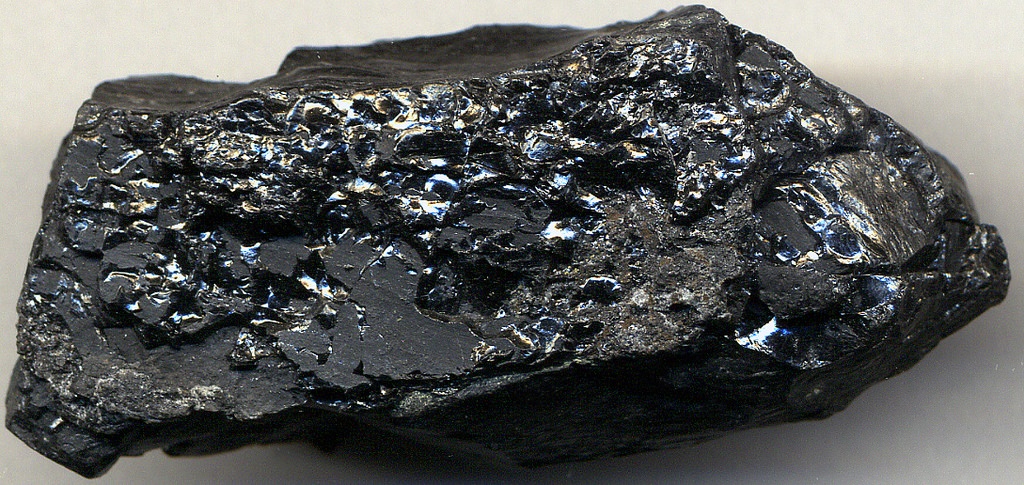
This rock is made of the remains of dead sea creatures (which have turned into oil). What type of sedimentary rock is it?
a)
Clastic
b)
Chemical
c)
Organic
102.

Which of the following is a land-derived sedimentary rock?

a)

rock gypsum

b)

limestone

c)

gabbro

d)

conglomerate

103.

Which of the following is an organically formed sedimentary rock?

a)

obsidian

b)

coal

c)

siltstone

d)

shale

104.
Layers of soil are also known as:
a)
Soil Profiles
b)
Soil Horizons
c)
Soil sheets
d)
Soil cores
105.
Which of the following orders sediment particle size from smallest to largest?
a)
silt, sand, clay
b)
sand, silt, clay
c)
clay, sand, silt
d)
clay, silt, sand
106.
Which of the horizons in the soil profile shown represent the organic material?
a)
Horizon O (Humus)
b)
Horizon A
c)
Horizon B
d)
Horizon C
107.

Which layer is the parent material?

a)

Horizon O

b)

Horizon A

c)

Horizon B

d)

Horizon C

e)

Horizon R

108.

What are the types of sedimentary rock?

a)

Igneous; Metamorphic; Sedimentary

b)

Clastic(detrital); Igneous; Sedimentary

c)

Chemical; Clastic(detrital); Inorganic

d)

Organic; Clastic(detrital); Chemical

109.

What kind of detrital rock forms in lakes?

a)

conglomerate

b)

sandstone

c)

shale

110.
A break in Earth's crust along which rocks move is called a ________.
a)
plate
b)
rift
c)
fault
d)
breach
111.
The movement of fluid, caused by differences in temperature, that transfers heat from one part of the fluid to another is _____________.
a)
Convection current
b)
Seismic waves
c)
Sea-floor spreading
d)
Conduction current
112.
What is the process by which oceanic crust sinks beneath a deep-ocean trench and back into the mantle at a convergent plate boundary?
a)
Subduction
b)
Induction
c)
Abduction 
d)
Reduction
113.
_____________ is a plate boundary where two plates move away from each other.
a)
Convergent boundary
b)
Transform boundary
c)
Divergent boundary
d)
Insurgent boundary
114.
_____________ is when two plates move toward each other.
a)
Convergent boundary
b)
Allegiant boundary
c)
Transform boundary
d)
Sliding boundary
115.
A _____________ is when two plates move past each other in opposite directions.
a)
emergent boundary
b)
divergent boundary
c)
transform boundary
d)
convergent boundary
116.

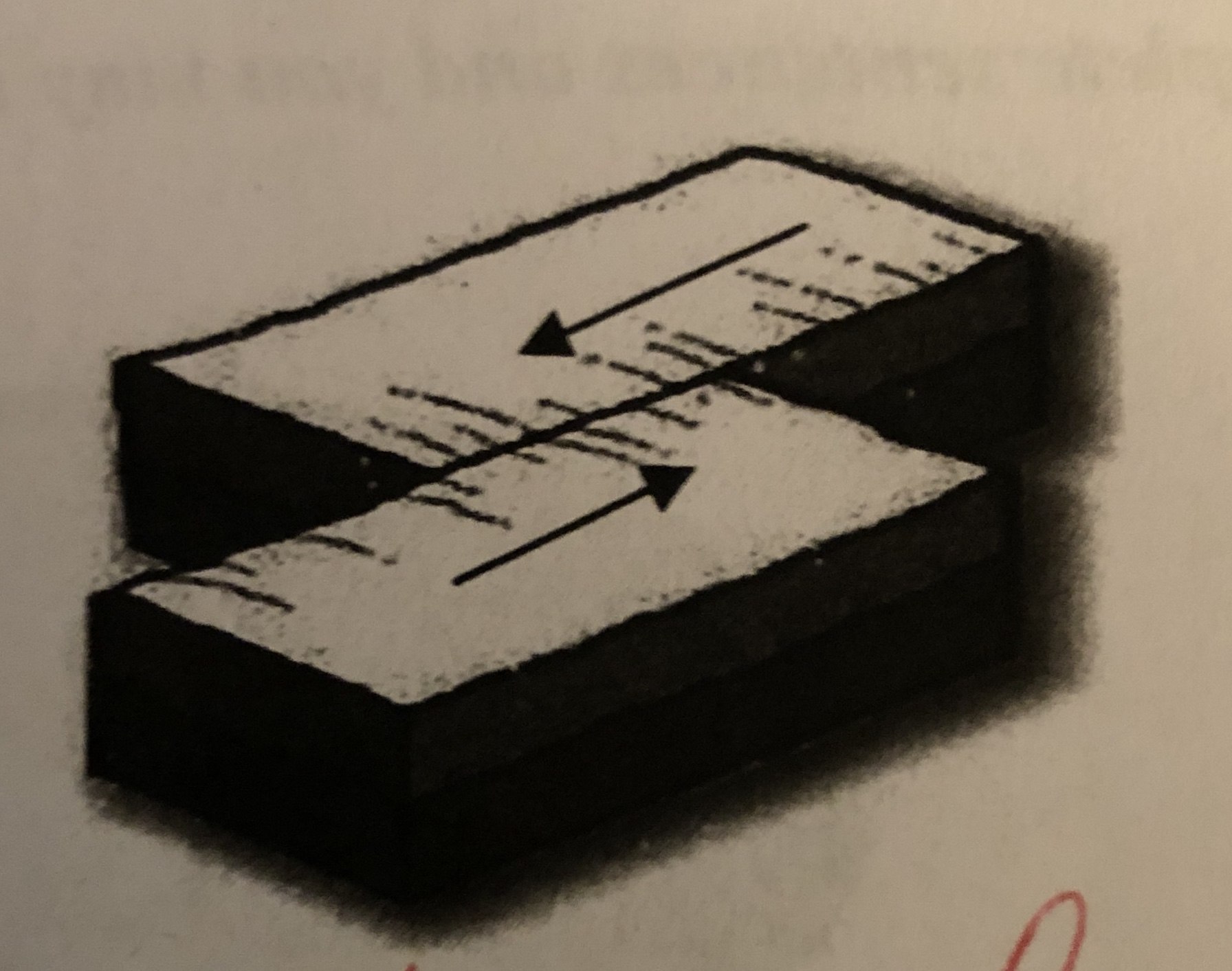
What type of boundary is this?

a)

convergent

b)

divergent

c)

transform

117.

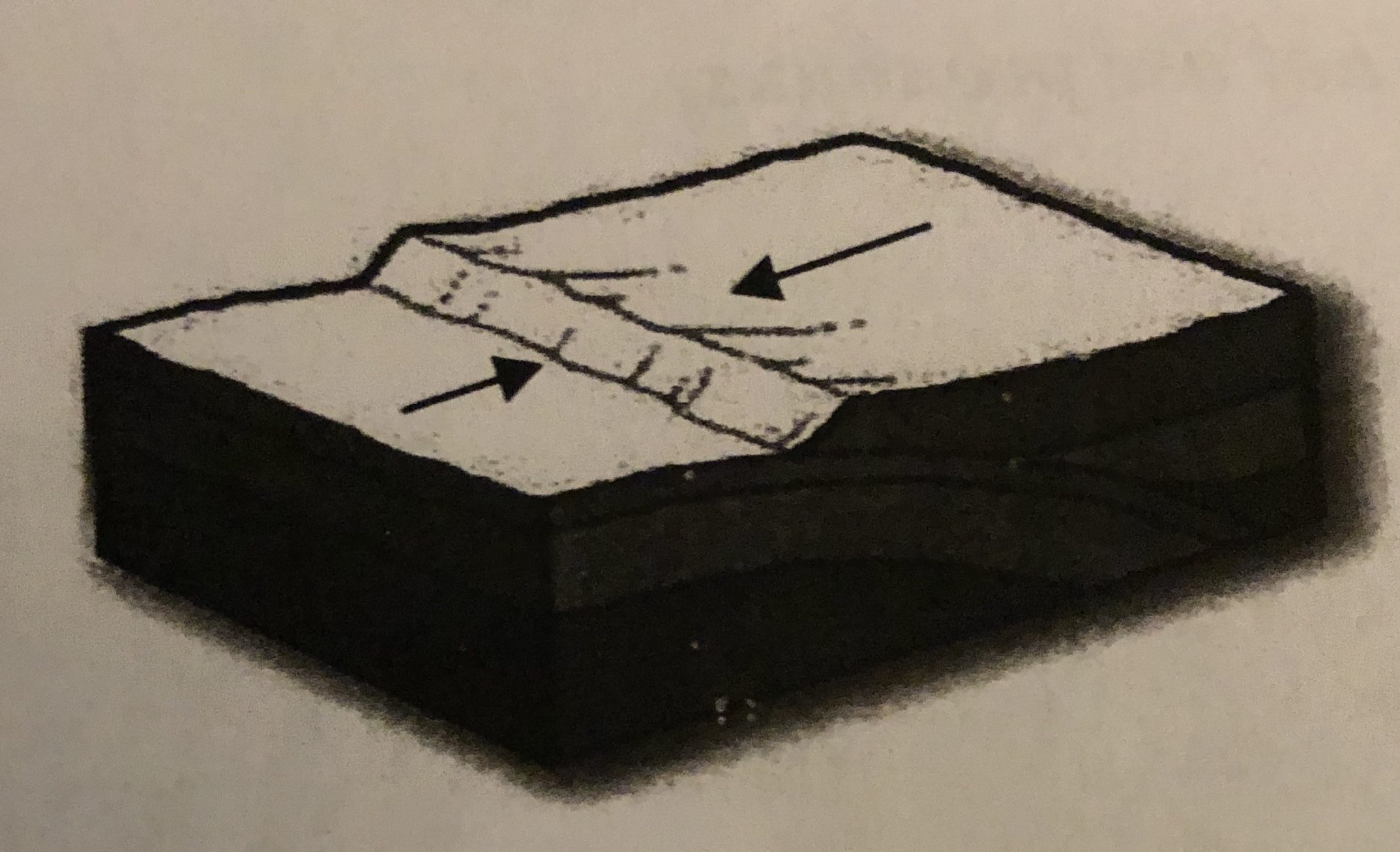
What type of boundary is this?

a)

convergent

b)

transform

c)

divergent

118.

What type of boundary is this?

a)

convergent

b)

divergent

c)

transform

119.

Any trace of an ancient organism that has been preserved in rock is called a

a)

landform

b)

continent

c)

fossil

d)

landmass

120.

Which layer is OLDER? Layer M or Intrusion P?

a)

Layer M

b)

Intrusion P

121.

Which layer is OLDER? Layer E or Intrusion A?

a)

Layer E

b)

Intrusion A

122.

What geologic principle(or law) is best displayed here?

a)

Superposition

b)

inclusion

c)

Cross-cutting relationships

d)

Unconformities

123.

Choose the correct spelling of the word below.

a)

buge

b)

bude

c)

budge

124.
Most volcanoes and earthquakes occur...
a)
along the coast
b)
along tectonic plate boundaries
c)
in the Arctic
d)
in the ocean
125.
What is the primary purpose of index fossils?
a)
They help scientists determine the absolute age of sedimentary rocks
b)
The help scientists determine the relative age of rocks
c)
They help scientists indentify mass extinctions in Earth’s history
d)
They provide scientists with evidence for the theory of evolution by natural selection