wayground logo

Free Printable Worksheets

Font size

S
M
L
XL
Worksheets

Macromolecule Review

Total questions: 125

Worksheet time: 2hrs 2mins

Name
Class
Date
1.

When reading the ingredients on a nutrition facts label carbohydrates are written as a type of

a)

food additive

b)

enzyme

c)

sugar

d)

protein

2.

Starch is...

a)

a protein

b)

a carbohydrate

c)

a lipid

3.

Fat, oil, butter and cream cheese are apart of which macromolecule group?

a)

amino acids

b)

carbohydrates

c)

lipids

d)

protein

4.

What is the monomer for carbohydrates? Remember: its the fancy word for sugar

a)

nucelotide

b)

monosaccaride

c)

nucleic acid

d)

polymer

5.

Which macromolecule has the function of quick energy?

a)

Lipids

b)

Carbohydrates

c)

Protein

d)

Nucleic Acids

6.

Which macromolecule has the function of long term energy or energy storage

a)

Nucleic Acids

b)

Carbohydrates

c)

Lipids

d)

Protein

7.

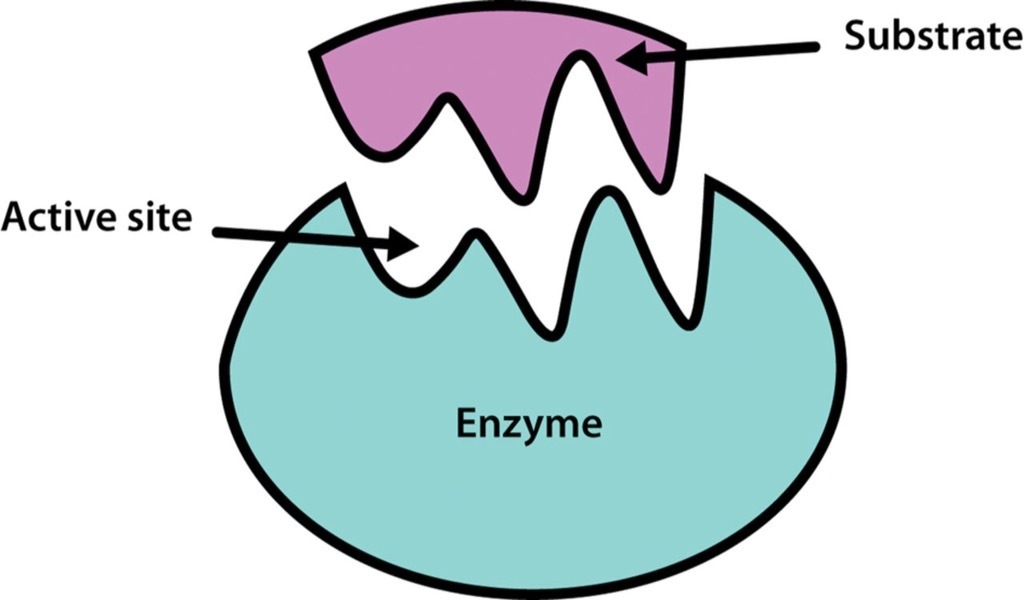
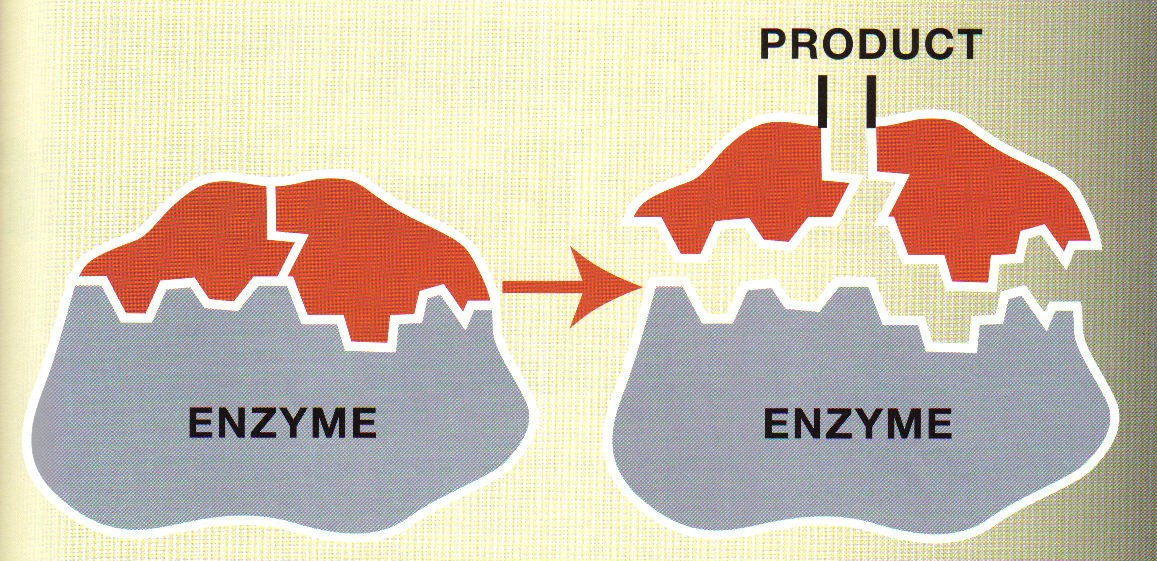
When looking at the enzyme substrate model, the substrate turns into what at the end of the chemical reaction?

a)

Nothing

b)

It does not change

c)

Products

d)

Pieces

8.

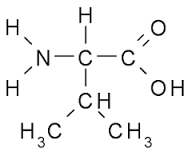
What is the monomer for protein?

a)

Polymer

b)

Nucleic Acids

c)

Amino Acids

d)

Fatty Acids

9.
Which major macromolecule is being represented in this image? 
a)
carbohydrate
b)
lipid
c)
protein
d)
nucleic acid
10.
What are the single sugars that are the building blocks of carbohydrates?
a)
monosaccharides
b)
disaccharides
c)
polysaccharides
d)
amino acid
11.
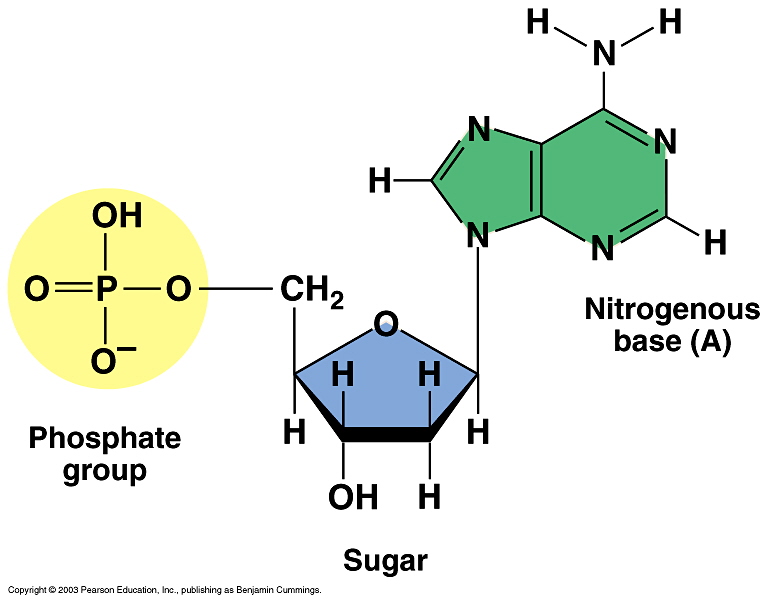
Which of the four major biological macromolecules can be easily identified by the nitrogen base and phosphate found in its structure?
a)
carbohydrate
b)
lipid
c)
protein
d)
nucleic acid
12.
The element _______is found in all of the organic compounds.
a)
Iron
b)
Nitrogen
c)
Carbon
d)
Oxygen
13.
Nucleotides are monomers of
a)
Carbohydrates
b)
Lipids
c)
Proteins
d)
Nucleic Acids
14.
Waxes, oils and fats are examples of
a)
Carbohydrates
b)
Lipids
c)
Proteins
d)
Nucleic Acids
15.
Glycerol and fatty acids are the monomers of
a)
Carbohydrates
b)
Lipids
c)
Proteins
d)
Nucleic Acids
16.
What is the function of nucleic acids?
a)
store genetic information
b)
store energy (long-term)
c)
store energy (short-term)
d)
build skin, hair, nails, muscles
17.
Carbohydrates are made of... 
a)
C H O
b)
C H O N
c)
C H O N P
d)
C H O N S
18.
Lipids are made of... 
a)
C H O
b)
C H O N
c)
C H O N P
d)
C H O N S
19.
Proteins are made of... 
a)
C H O
b)
C H O N
c)
C H O N P
d)
C H O N S
20.
Which macromolecule stores energy, insulates us, and makes up the cell membrane?
a)
lipids
b)
proteins
c)
carbohydrates
d)
nucleic acids
21.
What are the four macromolecules?
a)
proteins, nucleic acids, carbohydrates, and lipids
b)
monosaccharides, lipids, polysaccaharides, and proteins
c)
RNA, DNA, proteins, and carbohydrates
d)
proteins, DNA, RNA, and steroids
22.
RNA and DNA are which type of macromolecules?
a)
carbohydrate
b)
lipid
c)
nucleic acid
d)
protein
23.
Which biomolecule is made of nucleotides and contain you DNA?
a)
Carbohydrate
b)
Lipids
c)
Protein
d)
Nucleic Acid
24.
Which biomolecule has sugars and starches?
a)
Lipids
b)
Proteins
c)
Carbohydrates
d)
Nucleic Acid
25.
Which biomolecule functions include enzymes­ which speeds the rate of chemical reactions, structural components in cells, mechanical functions in muscles and cytoskeleton, cell signaling, and immune response; provides structure and helps with chemical reactions 
a)
Protein
b)
Lipids
c)
Carbohydrate
d)
Nucleic Acid
26.
Which biomolecule is important source of energy for humans; glucose for human cells, tissues, and organs; provides fiber, sugar, and starches; provides structural support, cell wall, and cell membrane maker?
a)
Nucleic Acid
b)
Lipid
c)
Carbohydrate
d)
Protein
27.
Which biomolecule includes fats, such as triglycerides, oils, waxes, and steroids (cholesterol); insoluble in water; provides energy storage, insulation, part of cell membrane, and hormones 
a)
Nucleic Acid
b)
Lipids
c)
Carbohydrate
d)
Protein
28.
Identify the biomolecule
a)
Lipid
b)
Protein
c)
Carbohydrate
d)
Nucleic Acid
29.
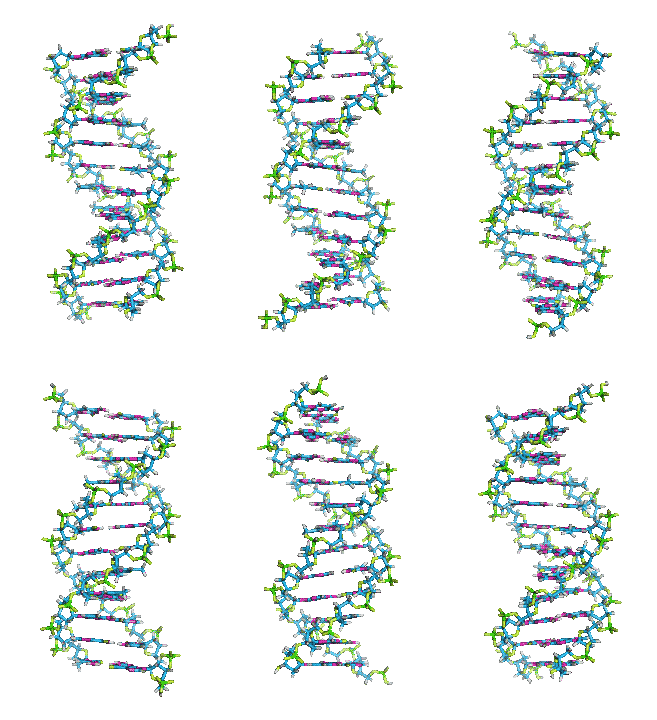
Which biomolecule is this a picture of?
a)
Protein
b)
Nucleic Acid
c)
Lipid
d)
Carbohydrate
30.
Which biomolecule is this a picture of?
a)
Protein
b)
Nucleic Acid
c)
Lipid
d)
Carbohydrate
31.
Which biomolecule is made of nucleotides and include your DNA? (Hint: they carry genetic information)
a)
Carbohydrate
b)
Lipids
c)
Protein
d)
Nucleic Acid
32.
ALL polymers (large molecules) are made up of...
a)
monosaccharides
b)
monomers
c)
proteins
d)
None of these
33.
Monomers combine to form ________ through the process of ________.
a)
polymers; hydrolysis
b)
polymers; dehydration synthesis
c)
monomers; hydrolysis
d)
monomers; dehydration synthesis
34.

Polymer's split apart to form ________, by __________.

a)

monomers, hydrolysis

b)

monomers, dehydration synthesis

c)

amino acids, hydrolysis

d)

amino acids, dehydration synthesis

35.
Which 2 molecules contains the elements C-H-O and function pertains to energy?
a)
Lipids and Protein
b)
Carbohydrates and Nucleic Acids
c)
Protein and Carbohydrates
d)
Carbohydrates and Lipids
36.
Carbon, Hydrogen, Oxygen and Nitrogen are the elements that make up______?
a)
Carbohydrate
b)
Lipid
c)
Protein
d)
Nucleic acid
37.
Which of the following answers links a biomolecule with one of its proper functions?
a)
Lipids - Store genetic information
b)
Carbohydrates - short term energy storage
c)
Nucleic Acids - Catalyze reactions
d)
Proteins - long term energy storage
38.
Peptide bonds in proteins can be broken down by the enzyme peptidase. Adrian orders a hamburger and French fries for lunch. He adds cheese and mayonnaise to his hamburger and then sits down to eat lunch with his friends. Which structure would most likely result from the action of peptidase in Adrian’s stomach?
a)
Lipids
b)
Glucose
c)
Nucleic Acid
d)
Amino Acid
39.
The molecule in the diagram plays what role in the body?
a)
Releasing Energy
b)
Forming part of the sugar-phosphate backbone of DNA
c)
Storing Fat
d)
Controlling blood glucose levels
40.
Which biomolecule is also known as enzymes?
a)
Carbohydrate
b)
Lipid
c)
Nucleic Acid
d)
Protein
41.

Which biomolecule helps form muscles?

a)

Nucleic Acid

b)

Carbohydrate

c)

Protein

d)

Lipids

42.
If you want a reaction to speed up you need an _________.
a)
nucleic acid
b)
enzyme
c)
nerve cell
d)
carbohydrate
43.
What biomolecule do enzymes belong to? 
a)
Carbohydrate
b)
Lipid
c)
Nucleic Acid
d)
Protein
44.
Carbon, Hydrogen, Oxygen and Nitrogen are elements in what biomolecule?
a)
Carbohydrate
b)
Lipid
c)
Protein
d)
Nucleic acid
45.

Which biomolecule makes up cell membranes?

a)

Protein

b)

Carbohydrate

c)

Lipid

d)

Nucleic acid

46.

The area that the substrate fits into on the enzyme is called the:

a)

Active Site

b)

Allosteric Site

c)

Construction Site

d)

Geometric Site

47.
Examine the reaction below.  In this reaction, catalase functions as an
a)
enzyme in the digestion of hydrogen peroxide
b)
enzyme in the synthesis of hydrogen peroxide
c)
indicator in the detection of hydrogen peroxide
d)
hormone in the digestion of hydrogen peroxide
48.
The monomer of this macromolecule are monosaccharides.
a)
Carbohydrates
b)
Lipids
c)
Nucleic Acids
d)
Proteins
49.
The monomer of this macromolecule are nucleotides.
a)
Carbohydrates
b)
Lipids
c)
Nucleic Acids
d)
Proteins
50.
The monomers of this macromolecule are glycerol and fatty acid chains.
a)
Carbohydrates
b)
Lipids
c)
Nucleic Acids
d)
Proteins
51.
This macromolecule is made up of Carbon, Hydrogen, and Oxygen - in NO fixed ratio.
a)
Carbohydrates
b)
Lipids
c)
Nucleic Acids
d)
Proteins
52.
This macromolecule is made up of Carbon, Hydrogen, and Oxygen - in the fixed ratio of 1C:2H:1O.
a)
Carbohydrates
b)
Lipids
c)
Nucleic Acids
d)
Proteins
53.
This macromolecule is made up of Carbon, Hydrogen, Oxygen, Nitrogen and Phosphorus.
a)
Carbohydrates
b)
Lipids
c)
Nucleic Acids
d)
Proteins
54.
Fats, oils and waxes are examples of this type of macromolecule
a)
Carbohydrates
b)
Lipids
c)
Nucleic Acids
d)
Proteins
55.
DNA & RNA are examples of this type of macromolecule
a)
Carbohydrates
b)
Lipids
c)
Nucleic Acids
d)
Proteins
56.
This macromolecule can store energy, make up membranes, and serve as a chemical messenger.
a)
Carbohydrates
b)
Lipids
c)
Nucleic Acids
d)
Proteins
57.
This macromolecule includes compounds like cellulose, glucose, fructose, sucrose, and maltose.
a)
Carbohydrates
b)
Lipids
c)
Nucleic Acids
d)
Proteins
58.
This macromolecule includes compounds like hemoglobin, keratin, lactase, collagen, and myosin.
a)
Carbohydrates
b)
Lipids
c)
Nucleic Acids
d)
Proteins
59.
All of the following are parts of a nucleotide monomer EXCEPT
a)
5 carbon sugar
b)
phosphate group
c)
glycerol
d)
nitrogen base
60.
Which of the following is a correct pair of nitrogen bases in DNA?
a)
Adenine - Thymine
b)
Guanine - Uracil
c)
Cytosine - Thymine
d)
Adenine - Guanine
61.
Which compound below would be a carbohydrate?
a)
C12H12O24
b)
C6H12O6
c)
C4H8O2
d)
C3H12O3
62.
What would be the result of dehydration synthesis on a group of amino acids?
a)
Formation of a carbohydrate.
b)
Formation of a protein.
c)
Breakdown of a protein.
d)
Breakdown of a lipid.
63.
What would be the result of dehydration synthesis on a group of nucleotides?
a)
Formation of a nucleic acid.
b)
Formation of a carbohydrate.
c)
Breakdown of a lipid.
d)
Breakdown of a protein.
64.
How many different amino acids exist?
a)
4
b)
7
c)
14
d)
20
65.
Carbon is very diverse because it can form up to ______ __________ bonds.
a)
3, hydrogen
b)
4, polar
c)
4, covalent
d)
2, ionic
66.
The process of _________________________ for _________________ is shown in this diagram.
a)
hydrolysis, carbohydrates
b)
dehydration synthesis, carbohydrates
c)
hydrolysis, proteins
d)
dehydration synthesis, proteins
67.
The process of _________________________ for _________________ is shown in this diagram.
a)
hydrolysis, carbohydrates
b)
dehydration synthesis, carbohydrates
c)
hydrolysis, proteins
d)
dehydration synthesis, proteins
68.
In general, monomers linked together make up ______________.
a)
carbon
b)
polymers
c)
organics
d)
inorganics
69.
Dehydration synthesis ___________ water, resulting in the ___________ a bond.
a)
adds, formation of
b)
removes, formation of
c)
adds, breaking of
d)
removes, breaking of
70.
Hydrolysis ___________ water, resulting in the ___________ a bond.
a)
adds, formation of
b)
removes, formation of
c)
adds, breaking of
d)
removes, breaking of
71.
To which group of macromolecules do antibodies (chemicals that aid in immune responses) belong?
a)
Carbohydrates
b)
Lipids
c)
Nucleic Acids
d)
Proteins
72.
To which group of macromolecules do most hormones (chemical messengers) belong?
a)
Carbohydrates
b)
Lipids
c)
Nucleic Acids
d)
Proteins
73.
What is the shape of a DNA molecule?
a)
chain
b)
circle
c)
double helix
d)
triple helix
74.
What is the optimal pH of arginase?
a)
2
b)
7
c)
5
d)
9.5
75.
What is the optimal pH of salivary amylase?
a)
2
b)
7
c)
5
d)
9.5
76.
What is the optimal pH of pepsin?
a)
2
b)
7
c)
5
d)
9.5
77.
At what pH is pepsin denatured?
a)
2
b)
1
c)
5
d)
3
78.
The substance that an enzyme acts on is called the
a)
Active site
b)
Enzyme
c)
Substrate
d)
Denaturer
79.
Structure A in this diagram is the
a)
product(s)
b)
substrate
c)
enzyme
d)
active site
80.
Structure B in this diagram is the
a)
product(s)
b)
substrate
c)
enzyme
d)
active site
81.
Structure C in this diagram is the
a)
product(s)
b)
substrate
c)
enzyme
d)
active site
82.
Structure D in this diagram is the
a)
product(s)
b)
substrate
c)
enzyme
d)
active site
83.
Produces water as a byproduct.
a)
Dehydration synthesis
b)
Hydrolysis
c)
Neutralization
d)
Homeostasis
84.
Water is used to break bonds between monomers in a polymer.
a)
Dehydration synthesis
b)
Hydrolysis
c)
Neutralization
d)
Homeostasis
85.
All of the following are (made of) inorganic compounds EXCEPT
a)
carbon dioxide
b)
granite
c)
pine tree
d)
water
86.
All of the following are (made of) organic compounds EXCEPT
a)
coal
b)
rose
c)
carbon dioxide
d)
earthworm
87.
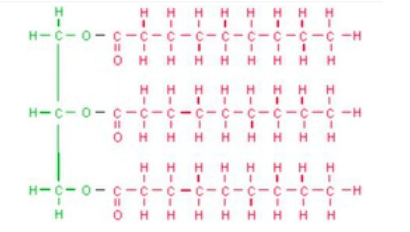
What type of fat is this?
a)
saturated fatty acid
b)
unsaturated fatty acid
c)
steroid
d)
wax
88.

Which type of fat is this?

a)

saturated

b)

unsaturated

c)

trans

89.

An unsaturated lipid contains, ________

a)

more oxygen than hydrogen

b)

double bonds

c)

ionic bonds

d)

only one fatty acid

90.

A stick of butter is what type of fat?

a)

Saturated Fat

b)

Polyunsaturated Fat

c)

Monounsaturated Fat

d)

Trans Fat

91.

Which of the following foods contains unsaturated fats?

a)

lettuce

b)

olive oil

c)

cheese

d)

eggs

92.
Unsaturated fats are __________ at room temperature.
a)

liquid

b)

solid

c)
toxic
d)
saturated
93.
Saturated fats are __________ at room temperature.
a)
liquid
b)
gases
c)
plasma
d)
solid
94.

What is a peptide bond?

a)

Bond that holds two amino acids together.

b)

A bond that holds hydrogen and oxygen molecules together.

c)

A bond that holds the phosphate group of one nucleotide and a sugar of a neighboring nucleotide.

d)

A bond that is formed by the sharing of electrons.

95.

When a protein unfolds, it is

a)

Denatured

b)

Building

c)

Adding amino acids

d)

Making food

96.

Each amino acid is different from the other due to....

a)

The R group

b)

The amino group

c)

The carboxyl group

d)

The central carbon

97.
The primary sequence of a protein refers to the:
a)
Order of amino acids
b)
α-Helix or β-Pleated Sheet
c)
Interaction of subunits
d)
Hydrogen Bonding
98.

Which protein structure is only found in proteins with more than one polypeptide chain?

a)

Primary

b)

Secondary

c)

Tertiary

d)

Quaternary

99.

Most enzyme names end in which 3 letters?

a)

-ase

b)

-ate

c)

-ose

d)

-ion

100.

_______ dictates the function of a protein.

a)

Shape

b)

Temperature

c)

pH

d)

Time

101.

The dehydration synthesis bond between

amino acids.

a)

Ionic Bonds

b)

Peptide Bonds

c)

Hydrogen Bonds

d)

Nucleic Bonds

102.

A macromolecule is a ....

a)

Very small molecule

b)

Very large molecule

c)

An average-sized molecule

d)

All of the above

103.

What happens to an enzyme when it denatures?

a)

The activation energy of the reaction is doubled.

b)

The activation energy of the reaction is lowered.

c)

It's optimal conditions for temperature of the enzyme are doubled.

d)

The shape of the enzyme molecule is changed.
104.
What is the purpose  of an enzyme?
a)
give permission for the reaction
b)
raise activation energy
c)
speed up reactions
d)
control how many reactions occur
105.
Where do substrates bind on an enzyme?
a)
voltage-gated channels
b)
surface receptor
c)
calcium channels
d)
active site
106.
What happens when enzymes are heated to a high temperature?
a)
The enzymes die.
b)
The shapes of the enzyme are altered or denatured
c)
The enzymes' amino acid sequence changes.
d)
The enzymes remain the same
107.
What happens to an enzyme when it is denatured?
a)
Activation energy is lowered.
b)
It becomes stronger.
c)
It loses its shape.
d)
Activation energy is raised.
108.
Which factors can change the shape of an enzyme and thus denatures a enzyme?
a)
Excessive heat and changes in pH
b)
Nothing can
c)
Exposure to light and sound
d)
Exposure to bacteria and Amoebas
109.
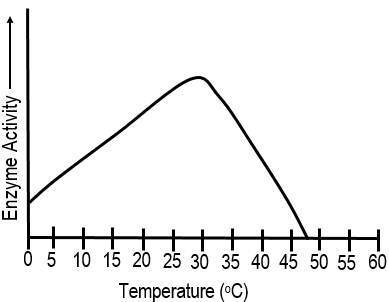
Based on the graph, what temperature does this enzyme work best? 
a)
15 C
b)
40 C
c)
30 C
d)
47 C
110.

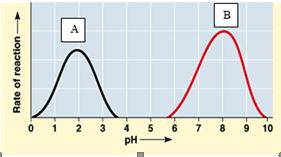
What is the optimal pH of enzyme B?

a)

8

b)

2

c)

5.7-10

d)

10

111.
What is structure A?
a)
Substrate
b)
Active site
c)
Enzyme
d)
Products
112.
What is structure D?
a)
Substrate
b)
Active site
c)
Enzyme
d)
Products
113.
What is structure C?
a)
Substrate
b)
Active site
c)
Enzyme
d)
Products
114.
What is the name for the mechanism of enzyme activity?
a)
Lock and key
b)
jigsaw puzzle
c)
hammer and nail
d)
two hands pattern
115.
Which of these is most likely an enzyme?  
a)
Sucrose
b)
Galactose
c)
Fructose
d)
Amylase
116.

Which substrate would this enzyme catalyze?

a)
b)
c)
d)
117.

What temperature do human enzymes work best?

a)

39 degrees Celsius

b)

12 degrees Celsius

c)

20 degrees Celsius

d)

37 degrees Celsius

118.

what is the enzyme that breaks down milk sugar?

a)

lactase

b)

diastase

c)

protease

d)

lipase

119.

Which polysaccharide is used by plants to make their cell wall?

a)

starch

b)

glycogen

c)

cellulose

d)

chitin

120.

What is the polysaccharide used by animals to store glucose?

a)

glycogen

b)

fructose

c)

starch

d)

cellulose

121.

Which polysaccharide is used by plants to store glucose?

a)

glycogen

b)

cellulose

c)

starch

d)

chitin

122.

Which polysaccharide makes up the exoskeleton of insects?

a)

cellulose

b)

starch

c)

chitin

d)

glycogen

123.
How many bonds can carbon make?
a)
1
b)
2
c)
3
d)
4
124.
What is one difference between RNA and DNA?
a)
RNA has thymine
b)
DNA has uracil
c)
RNA is single stranded
d)
DNA nitrogen bases
125.
Steroids and cholesterol are types of _______.
a)
Proteins
b)
Carbohydrates
c)
Lipids
d)
Nucleic Acids