
 Worksheets
Earth Science Semester 1 Review
Total questions: 120
Worksheet time: 1hrs 22mins

What do the inner planets have in common?
They are all the same size
They are made of gas.
They rotate at the same speed.
They are all rocky.

The asteroid belt is between what two planets?
Earth and Mars
Mars and Jupiter
Venus and Mars
Jupiter and Saturn

A rocky/metal object in space that orbits the Sun between Mars & Jupiter is called a(n) _______________.
asteroid
comet
meteor
planet

A bright object with a tail, moving slowly across the sky is most likely a _________.
asteroid
comet
meteor
UFO

spring
summer
fall
winter

gravity
wind
spring
neap


nuclear fission
nuclear fusion
nuclear reaction
nuclear core

carbon and oxygen
carbon and hydrogen
helium and nitrogen
hydrogen and helium


gas
dust
stars
gravitational attraction

M38
Milky Way Galaxy
Andromeda Galaxy
Pinwheel Galaxy

The initial explosion that resulted in the formation and expansion of the universe is called __________________.
the Big Bang
the start of the universe
the beginning
the formation of space

Earth rotates around on an imaginary straight line called___________.
a season
an axis
an equator
an orbit

Due to rotation, only one side of the Earth faces the Sun at a time. This causes...
seasons
climate changes
day and night
months of the year

The Sun is...
a planet
only one planet away from Earth
Earth's moon
a star in the center of our solar system

have more mass
have less mass
be rocky
orbit the sun

gravitational pull
temperature
orbit
equinox

temperature
size
location
luminosity

Their mass and the distance between them
The distance between them
The sum of their masses
The mass of the large object

sphere
ellipse
circular
crescent

Brightness
Size
Temperature
Color


The life cycle of a star is determined by:
mass
temperature
color
shape

Stars are born in nebulae. Which best describes a nebula?
a collection of gas and dust
a belt of asteroids
a collection of older stars
an empty space

What two measurements are used to classify stars in an HR diagram?
location & distance
size & location
brightness & distance
temperature & brightness

Galaxies are classified according to:
shape
size
color
temperature

What type of galaxy is shown in this image?
Spiral
Irregular
Elliptical
Dwarf

What evidence best proves the expansion and separation of galaxies that has occurred since the theorized Big Bang?
Gravity
Red Shifting
the EM Spectrum
Light Years

How does our star, the Sun, compare to other stars in the Universe?
Cooler than most
Dimmer than most
Brighter than most
Average in every way

Why do planets orbit the Sun?
The Sun is the only celestial object that has a gravitational pull.
The Sun’s chemical composition makes it attract planets.
Only celestial bodies that emit light, like the Sun, can be at the center of an orbit.
The Sun is the most massive object in our solar system, so it exerts the greatest gravitational pull.

White Dwarfs
Supergiants
Main Sequence
Giants

Where do comets originate?
Kuiper Belt
Asteroid Belt
The Sun

What is the definition of a dwarf planet?
A dwarf planet is a solar system body that has a spherical shape and an orbit around the Sun that is not cleared of other objects.
A dwarf planet is a small planet that is smaller than Mars.
A dwarf planet is a planet that is further than 2 AU from its orbiting star.

What must happen in order for a satellite to orbit Earth?
The satellite's forward motion must be less than the gravitational pull on it from Earth
The forward motion of the satellite must be balanced by the pull of gravity from Earth
It's not possible for a satellite to orbit Earth
Earth's gravity must be stronger

What is plagiarism?
coming up with your own ideas or way of writing the concept down
putting data in graphical form
using writing or part of the writing of another person as your own
giving credit to others for their work

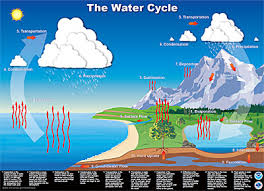
25%
72%
97%
100%
Where is most of the freshwater located on Earth?
in the oceans
in polar ice and glaciers
in rivers, streams, and lakes
under the ground


How are air masses form into clouds? Clouds are form when
cold moist air rises and then cools
warm moist rises, expands and then cools
cold air reaches the lifted condensation level
The temperature at which the air become completely saturated with water vapor is called
humidity
dew point
air density
air pressure
Humidity is the
air density from cold air masses
amount of air pressure in the air.
amount of water vapor present in the air.
concentration of water vapor that form clouds in the air.

Warm air tends to ______
Rise
Sink

One way to get water vapor to condense from the air include
Cooling the air down
Warming the air up

Where is the humidity likely to be higher?
At low elevations
At higher elevations

How does the temperature change as you go up in elevation?
The temperature gets colder as you go up
The temperature gets warmer as you go up
The temperature stays the same as you go up

If warm air and cold air both have same amount of water vapor, which has a lower relative humidity?
Cold air
Warm air

When someone refers to 'dry air', what they really mean is _______ .
high humidity air
hot air
cold air
low humidity air


Why is cold air is drier than warm air?
because there is less room for water molecules.
because the water molecules are more likely to condense to a liquid.
because it cannot hold any water.
because it is too dense.
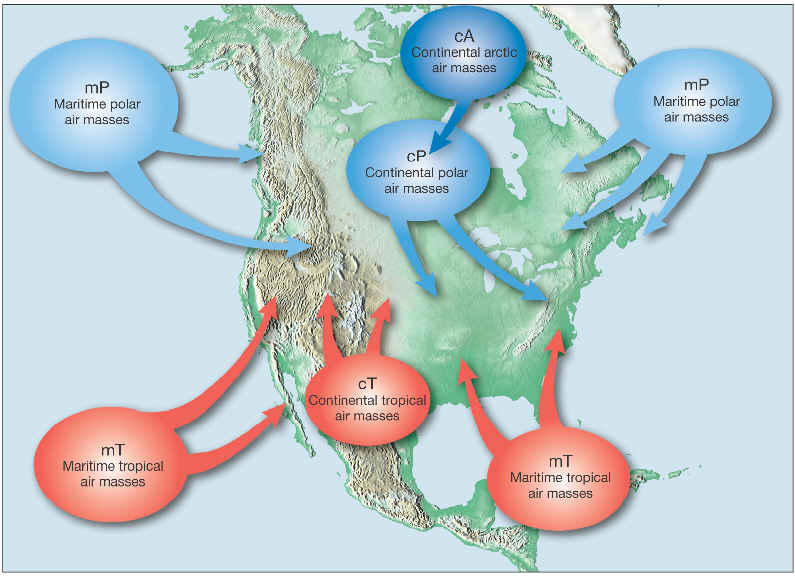
An air mass is a large mass of air that is defined by its temperature and ____________________.
Elevation (altitude)
Water vapor content (humidity)
Strength
Weather

Which type of air mass is dry and warm?
Continental polar
Continental tropical
Maritime polar
Maritime tropical

What is the correct symbol for maritime polar?
MP
Mp
mP
mp

Applying what you know about air masses, which air mass would you expect to find here in Chad, Africa? (circled on the picture **hint: find the equator line**)
Continental polar
Continental tropical
Maritime polar
Maritime tropical

What does salinity measure?
ocean temperature
amount of salt in water
ratio of mass to volume
Select the most dense option below.
warm, 15% salty water
cold, 15% salt water
warm 5% salty water
cold, 5% salty water
Temperature and salinity together are called the _______ circulation.
hot-salt
Coriolis Effect
wind currents
thermohaline


The energy and motion from waves is caused by
currents
tides
wind
gravity
Which type of water will sink?
Warm, less salty
Warm, more salty
Cold, less salty
Cold, more salty


What are the three factors that contribute to water scarcity?
Climate change, overuse of groundwater, and water pollution.
Climate change, ocean droughts, and water pollution.
Hurricanes, overuse of groundwater, and water pollution.
El niño, hurricanes, and ocean evaporation.
How do oceans influence the temperature of the tropics and poles?
They keep it warm by brining more rain.
They help to distribute heat to the poles.
The oceans do not play a role in temperature.
They cool the poles by creating wind.
What is plagiarism?
coming up with your own ideas or way of writing the concept down
putting data in graphical form
using writing or part of the writing of another person as your own
giving credit to others for their work

Explains HOW or WHY
Theory
Law

Which is a scientific question?
Are cats better than dogs?
Do orange cats have more personality?
Do orange cats eat more food than other cats?

Which of the following is a question that can evaluate the reliability of conclusions and claims made by other scientists?
How much money did they spend on their experiment?
Do I agree with their claim?
What evidence supports the claim?
Do I like their results?
What is a control?
What a scientist changes in an experiment to test their hypothesis
What scientist measure to see if it responded to a change
What happens when you do an experiment
What you keep the same throughout all experimental groups
What is an dependent variable?
What a scientist changes in an experiment to test their hypothesis
What scientist measure to see if it responded to a change
What happens when you do an experiment
What you keep the same throughout all experimental groups
What is an independent variable?
What a scientist changes in an experiment to test their hypothesis
What scientist measure to see if it responded to a change
What happens when you do an experiment
What you keep the same throughout all experimental groups

data
theory
hypothesis
fact
Which of these contains steps in the right order for the scientific method?
Ask a question, research, state your hypothesis, experiment, analyze, draw a conclusion
State your hypothesis, analyze, ask a question, research, experiment, , draw a conclusion
State your hypothesis, ask a question, research, draw a conclusion, experiment, analyze
When should you write a hypothesis?
After writing procedures
After making observations and doing research on a question/problem
After buying materials for an experiment
At the very beginning of the experiment

When can a theory be revised?
if new knowledge expands and corrects our understanding
if the general public does not understand the theory
Science can change and is a continually ongoing process.
True
False

