
 Worksheets
Anatomy Fall Midterm Review - All Units
Total questions: 120
Worksheet time: 1hrs 1mins
In identifying that cells make up tissues which make up organs which make up organ systems in the human organism, which one of the essential concepts of A&P are you illustrating?
Hierarchy of structural organization
Complementary structure and function
Homeostasis
In recognizing that the heart valves cause the one-way blood flow that effectively delivers oxygen, which one of the essential concepts of A&P do you understand?
Hierarchy of structural organization
Complementary structure and function
Homeostasis
What are examples that represent an anatomical study?
Calculating lung capacity
Observing the ligaments that support the knee
Measuring blood sugar levels after eating
Tracking heart rate while excerising
What are examples that would not represent an anatomical study?
Comparing the size of different mammals femurs
Measuring blood pressure before and after a meal
Dissecting a section of the brain
Identifying the muscles of the abdomen
Which of the systems is responsible for rapid, short term communication?
Endocrine system
Skeletal system
Digestive system
Nervous system
A group of tissues working together to cause a common function is known as a:
Organism
Organ system
Organ
Cell
What are examples of negative feedback?
Sweating to lower body temperature
Insulin lowering blood sugar
Contractions during childbirth
Blood clotting
What are examples of positive feedback?
Shivering to raise body temperature
Blood clotting
Calcitonin lowering blood calcium levels
Contractions during childbirth
The plane that divides anterior from posterior is the __________ plane.
oblique
sagittal
transverse
frontal
The diaphragm separates the ___________ and ___________ cavities.
thoracic ; abdominal
pelvic ; abdominal
cranial ; spinal
pelvic ; thoracic
The membrane which forms the lining directly on the surface of the heart is the
parietal peritoneum
visceral pericardium
visceral pleura
parietal pericardium

Letter A -
umbilical
sural
cranial
pectoral

Letter B -
coxal
popliteal
femoral
sacral

Letter C
Pectoral
Cervical
Sacral
Umbilical

Letter D
Sacral
Lumbar
Thoracic
Plantar

Letter E
Cranial
Femoral
Cervical
Sural

Letter F
Popliteal
Pectoral
Umbilical
Scapular

Letter G
Femoral
Metacarpal
Digital
Patellar

Letter H
Tarsal
Popliteal
Perineal
Vertebral

Letter I
Antecubital
Cervical
Cranial
Thoracic
Which layer of skin contains features that give us our no slip grip and forms fingerprints?
Reticular layer
Hypodermis
Papillary layer
Stratum corneum
What are characteristics of the epidermis?
Avascular
Water proof
Dead keratinized cells
All of the above
Goosebumps or the “hair standing on end” occur because of the contraction of?
Sudoriferous glands
Frontalis
Nerve receptors
Arrector pili muscles
_______ along with sweating, is involved in cooling down the body.
Shivering
Vasoconstriction
Vasodilation
Insulin

Letter A
dermis
epidermis
hair follicle
nerve receptor

Letter B
blood vessels
dermis
Arrector pili muscles
hypodermis

Letter C
Epidermis
Dermis
Hypodermis
Sebaceous gland
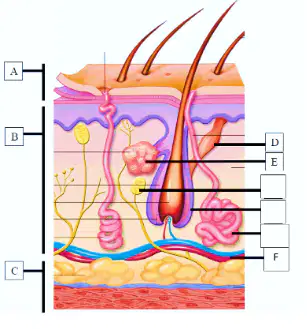
Letter D -
Arrector pili muscle
Pacinian corpuscle
Nerve ending
Hair follicle

Letter E
Cutaneous blood vessels
Sebaceous gland
Arrector pili muscle
Dermis

Letter F
Arrector pili muscle
Dermis
Cutaneous blood vessels
Epidermis
Which one of following is NOT a correctly matched function of bones?
Storage: of fat and minerals
Protection: produces hormones that initiate fight or flight in response to threats
Hematopoiesis: blood cell formation
Support: Internal framework
Hematopoiesis is carried out in the __________
yellow bone marrow
liver
epiphyseal plate
red bone marrow
The _____________ is to bone as a coat is to you
endosteum
periosteum
perimysium
epimysium
Your joints can move with smooth friction reduced motion due to __________ on the ends of the bones.
hyaline cartilage
reticular cartilage
articular cartilage
irregular connective tissue
Longitudinal growth ceases when the ________________ plates ossify
epiphyseal
endochondral
cranial
periosteum
Which type of fracture is typically only seen in children?
Comminuted fractures
Greenstick fractures
Depression fractures
Impact fractures
In a compound fracture, what are additional complications?
hypothermia
infection
brain damage
pannus
If you are a post-menopausal aged woman, which bone disorder you are most likely develop?
gouty arthritis
Osteoporosis
Ricketts
Fibromyalgia
A person who has a blood cell cancer, such as leukemia, has uncontrolled cell growth in the region of the bone called -
heart
melanocytes
abdomen
red bone marrow

Letter A
Epiphysis
Spongy bone
Diaphysis
Epiphyseal plate

Letter B
Epiphysis
Diaphysis
Spongy bone
Epiphyseal line

Letter C
Epiphysis
Diaphysis
Spongy bone
Epiphyseal line

Letter D
Epiphysis
Diaphysis
Spongy bone
Epiphyseal line
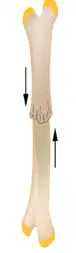
Which fracture is most likely to occur from a fall with an outstretched arm?


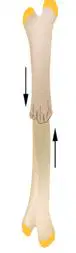
1Which fracture is most likely to cause an infection?


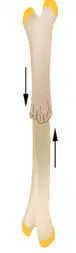
Which fracture is most likely to occur in a child?


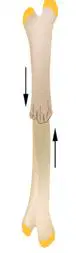

Which fracture is most likely to occur in an older adult?


Which of these are a hinge joint?
Neck
Elbow and knee
Hip and shoulder
Which of these are a ball and socket joint?
Neck
Elbow and knee
Hip and shoulder
Which of these are a pivot joint?
Neck
Elbow and knee
Hip and shoulder
fibrocartilage discs that subdivide a joint cavity to improve stability
articular cartilage
menisci
synovial fluid
synovial membrane
Lubricating liquid that also nourishes articular cartilage
articular cartilage
menisci
synovial fluid
synovial membrane
produces synovial fluid, inner portion of articular capsule
articular cartilage
menisci
synovial fluid
synovial membrane
protects & cushions ends of bone
articular cartilage
menisci
synovial fluid
synovial membrane
What is the contractile unit of a muscle?
Sarcomere
Myofiber
Sarcoplasmic reticulum
Motor neuron
In muscles, ______ are the thin myofilaments and _________ are the thick myofilaments
troponin ; actin
myosin ; actin
tropomyosin ; myosin
actin ; myosin
What are the 3 major functions of muscles?
movement
heat generation
posture maintenance
all of the above
The attachment site attached to immovable bone is the muscle’s
insertion
origin
head
tendon
The attachment site attached to the movable bone is the muscle’s
insertion
origin
destination
fixator
The bulk of a muscle’s body lies ________ to the joint it crosses.
proximal
distal
anterior
lateral
During contractions the _______ moves towards the __________.
origin ; insertion
fixator ; synergist
insertion ; origin
agonist ; synergist
Ability to receive and respond to stimulus
extensibility
elasticity
contractility
excitability
Ability to shorten forcibly
extensibility
elasticity
contractility
excitability
Ability to be stretched or extended
extensibility
elasticity
contractility
excitability
Ability to resume resting length (recoil)
extensibility
elasticity
contractility
excitability
A muscle that stabilizes a motion, aids the antagonist
antagonist
agonist
synergist
fixator
Muscle responsible for producing a movement
antagonists
agonist
synergist
fixator
A muscle that helps the prime mover
antagonist
agonist
synergist
fixator
Reverses or opposes a motion
antagonist
agonist
synergist
fixator

Letter A
Biceps brachii
Temporalis
Frontalis
Quadriceps

Letter B
Orbicularis oris
Grastrocnemius
Rectus abdominus
Masseter

Letter C
Sternocleidomastoid
Tibialis anterior
Pectoralis major
Deltoid

Letter D
Latissimus dorsi
Gluteus maximus
Hamstring
Deltoid

Letter E
Triceps brachii
Biceps brachii
Extensor radialis
Brachialis

Letter AB
External oblique
Adductor
Rectus abdominus
Gracialis

Letter AD
Flexor digitorum
Tibialis anterior
Quadriceps
Sternocleidomastoid

Letter BC
Zygomaticus
Masseter
Gluteus medius
Trapezius

Letter AE
Frontalis
Deltoid
Quadriceps
Sternocleidomastoid

Letter AC
Rectus abdominus
External oblique
Sartorius
Latissimus dorsi

Letter BD
Quadriceps
Biceps brachii
Femoralis
Soleus

Letter A
Deltoid
Trapezius
Triceps brachii
Hamstring

Letter B
Biceps brachii
Peroneus longus
Brachiradialis
Triceps brachii

Letter C
Trapezius
Latissimus dorsi
Gluteus medius
Gastrocnemius

Letter D
Calcaneus
Gluteus medius
Hamstring
Gluteus maximus

Letter E
Deltoid
Sartorius
Gluteus maximus
Gluteus minumus

Letter AB
Quadriceps
Gastrocnemius
Tibialis posterior
Hamstring

Letter AC
Extensor digitorum
Sartorius
Gastrocnemius
Gracialis

Letter AD
Soleus
Sartorius
Gluteus maximus
Pectoralis minor
Name the 3 primary functions of the nervous system.
Sensory input, integration, motor output
Reproduction, sensory input, integrateion
Sensory input, protection, integration
Movement, integration, motor output
Neurons can _____________ while neuroglial cell can __________.
Conduct ; transmit
replicate ; conduct
insulate ; protect
conduct ; replicate
Which type of neuron transmits a nerve impulse toward the CNS?
Sensory/afferent neurons
Interneurons / association neurons
Motor / efferent neurons
Write the steps of impulse conduction through a neuron in order beginning with the dendrite.
Dendrite -> cell body -> axon -> synapse
Dendrite -> axon -> cell body -> synapse
Dendrite -> synapse -> cell body -> axon
Dendrite -> axon -> cell body -> synapse
Name the small space between a neuron and its target cell that prevents continuous stimulation of a neuron.
Synapse
Synaptic cleft
Dendrite
Myelin sheath
The association neurons are found completely within the ______ and are responsible for ____________.
CNS ; sensory input
PNS ; integration/reflexes
CNS ; integration/reflexes
PNS ; motor output
What is sensory input?
The gathering of information from the internal and external environment
All of the above
Processing and interpreting of sensory information and determining whether a response is needed
Activating a muscle or gland in response to sensory information
What is motor output?
Processing and interpreting sensory information
Activating muscles or glands in response to sensory information
Gathering information from the internal and external environment
The speed at which a muscle can contract
What is integration?
Activating muscles or glands in response to sensory information
Processing and interpreting of sensory information
Gathering information from the internal and external environment
Generating voltage through the movement of charged ions
What is a dendrite?
Structure that receives impulses and transmits them to the cell body
Structure that transmits impulses from the cell body to the target cell
Structure that processes and interprets impulses.
Space in between a neuron and its target cell
What is the cell body of a neuron?
The structure that conducts electrical impulses
The metabolic control center of the cell
The structure that detects sensory information
The structure that stores neurotransmitters
What is an axon?
A protective coating that speeds up nerve impulses
A structure that conducts impulses from the cell body to the target cell
The structure that detects sensory stimuli
The structure that processes sensory information
What is an axon terminal?
Structure that detects stimuli
Structure that conducts impulses away from the cell body
Structure that stores neurotransmitters
Structure that transmits signals towards the cell body
What is the neurilemma?
Space in between a neuron and its target cell
Site that detects stimuli
Site where the electrical impulses are actually generated
Site of neurotransmitter storage
What is a synapse?
An electrical impulse generate by neurons.
The space separating a neuron and its target cell
Entire junction of a neuron, its target cell, and the space separating them.
A protective coating that speeds up signal transduction
What is a synaptic cleft?
The structure that stores neurotransmitters
The space separating a neuron from its target cell
The structure that conducts impulses towards the cell body
The target cell of a neuron
What is a glioma?
A type of white blood cell that protects nerve cells
A tumor formed from the glial cells in the nervous system
A neuron that is replicating out of control
The structure that generates electricity in the brain
What is a neurotransmitter?
Structures that perform integration in the CNS
Chemical messengers released by neurons to communicate with their target cell
Electrical impulses generated by sensory neurons
Structures that transmit electrical impulses away from the cell body
What is a myelin sheath?
A protective coating that speeds up nerve signal transduction
Where electrical signals are actually generated on a neuron
A structure that helps nerves replicate when they are worn out
A structure that detects sensory stimuli
What is saltatory conduction?
The processing and interpreting of sensory information in the brain
Electrical impulses skipping over myelin sheaths as they travel down an axon
The type of signal transduction that unmyelinated nerves must do
The passing of neurotransmitters from a neuron to its target cell
What does it mean when a nerve is polarized?
When a neuron is resetting after generating an action potential.
When a neuron is at rest and maintaining a negative charge
When a neuron has been stimulated and is increasing its charge
When a neuron is firing off an impulse and rapidly increases its charge
What is an action potential?
When electrical impulses skip over myelin sheaths
Waves of voltage changes that travel down a neuron and release neurotransmitters
A neurons ability to respond to stimuli
When a neuron is at rest waiting for stimuli
What is irritability?
The ability of a neuron to convert electrical impulses into chemical messages
The ability of a neuron to respond to stimuli and convert them into electrical impulses
The ability to transmit an impulse to a target cell
How I feel after doing this many quizizz questions
What is conductivity?
The ability of a neuron to produce neurotransmitters
The ability of a neuron to regenerate after an injury
The ability of a neuron to transmit electrical impulses and send signals to target cells
The ability of a neuron to respond to stimuli and convert them to electrical signals
What is a node of Ranvier?
The structures that detect sensory stimuli
The gaps between myelin sheaths on an axon
Where myelin is produced on a neuron
The site on neurotransmitter storage

A -
Dendrite
Axon
Cell body
Nucleus

B -
Cell body
Dendrite
Node of Ranvier
Axon

C -
Axon hillock
Axon terminal
Dendrite
Myelin sheath

D (entire structure)
Myelin sheath
Node of Ranvier
Axon
Cell body

E
Dendrite
Axon
Synapse
Axon terminal

F (gap)
Neuron
Myelin sheath
Axon
Node of Ranvier

G
Myelin sheaths
Axon
Axon terminal
Cell body

