
 Worksheets
Unit 5 APES Quiz Questions
Total questions: 123
Worksheet time: 1hrs 2mins
What does the 'Tragedy of the Commons' refer to?
The common tragic themes found in classic literature.
A historical event where common land was taken over by feudal lords who mismanaged the land into unsustainable use.
The economic theory that individuals acting independently and rationally according to each's self-interest will deplete a common resource.
A play by William Shakespeare that revolves around commoners facing a tragic end due to air and land pollution and is a warning to modern day citizens.
Who popularized the concept of the 'Tragedy of the Commons'?
Adam Smith
Elinor Ostrom
Thomas Malthus
Garrett Hardin
The 'Tragedy of the Commons' can best be mitigated by:
Privatization of resources
All of the above
Strict governmental regulations
Community-based resource management
Which resource is often cited as an example of the 'Tragedy of the Commons'?
Solar energy
National parks
The Internet
Fisheries
What assumption about human behavior does the 'Tragedy of the Commons' fundamentally rely on?
People are naturally cooperative and will work together to manage resources.
People tend to ignore their long-term self-interest for immediate gains.
People will always act rationally and in the interest of the common good.
People behave altruistically when dealing with shared resources.
What is an example of a “commons”?
Toilet paper
Gasoline
National forest
Private lake
What is one real-world strategy that has been successful in preventing the 'Tragedy of the Commons'?
Relying on natural disasters to regulate usage of resources.
Ignoring the problem until the resource is depleted.
Implementing a system of laws and quotas.
Banning all access to common resources.
Elinor Ostrom was awarded a Nobel Prize in Economic Sciences for her work on:
Predicting economic crises.
Developing new forms of market trading.
Demonstrating how local property can be successfully managed by local commons without any regulation by central authorities or privatization.
Explaining the processes that drive the 'Tragedy of the Commons'.
Which of the following is an example of a 'commons' as described in the concept of the 'Tragedy of the Commons'?
An individual's backyard garden
A farm owned by a corporation
Air
A privately-owned lake
The 'Tragedy of the Commons' often becomes apparent through the depletion or degradation of which type of resource?
Non-renewable resources only
Privately managed resources
Limited resources
Unlimited resources like solar energy
What is a common solution for preventing the 'Tragedy of the Commons' in public fisheries?
Encouraging the catch of juvenile fish to promote growth of adults
Implementing quotas and size limits on catches
Allowing unrestricted access to the fisher
Increasing the number of fish taken to boost economic gain.
Which of the following is NOT a solution to the 'Tragedy of the Commons'?
Imposing fines for overuse of a shared resource
Establishing a system of fees and licenses for resource usage
Creating rules of use in common spaces such as no campfires in a park.
Encouraging unlimited access to the resources for economic gain.
What is the best solution that can be implemented in national parks to mitigate the effects of the 'Tragedy of the Commons' while ensuring equity and access to the park?
Allowing private companies to manage all aspects of the park
Closing the parks to the public permanently
Implementing entry fees and regulating the number of visitors.
Unlimited access for all visitors always in order for more people to gain appreciation of natural spaces.
Why might only allowing the catch of male fish in a public lake help prevent the 'Tragedy of the Commons'?
It ensures that all fish in the lake are male which helps increase the number of baby fish.
Male fish are less valuable, thus discouraging fishing.
It guarantees that fishing will become a less popular activity.
Less males are needed to breed and maintain maximum sustainable yield.
Drinking water managed as a commons would be best preserved by:
Privatizing the distribution of water to the highest bidder.
Imposing no restrictions on water usage.
Allocating water rights that allow for fair and sustainable usage.
Providing unlimited free access to water for agricultural use.
What is clearcutting?
The method of cutting trees along the edge of a forest to prevent forest fires.
The practice of cutting down trees in a zig-zag pattern to promote regrowth.
The selective cutting of trees that are only mature or diseased.
The process of removing all trees in a forested area in a single operation.
Which of the following is an economic benefit of clearcutting?
It promotes long-term sustainability of forest ecosystems.
It allows for quick and efficient harvesting of timber.
It increases the cost of timber over selective cutting.
It leads to increased biodiversity in the forest for hunters.
What environmental issue is most directly associated with clearcutting?
Increased soil erosion and sedimentation in waterways
Enhanced greenhouse gas absorption
Increased water retention in the soil
Improved soil fertility due to the decomposition of organic matter
Clearcutting can lead to several environmental disadvantages. Which of the following is NOT one of them?
Increased soil erosion
Increased soil and stream temperatures
Reduced flooding
Disruption of local water cycles
How does clearcutting contribute to climate change?
By increasing the ozone hole, reflecting UV away from the earth
By discouraging the growth of new trees that absorb carbon dioxide more efficiently
By reducing the number of trees that can store carbon dioxide
By releasing oxygen into the atmosphere when trees are cut and burned
In the context of heat absorption, how does clear-cutting impact the earth's surface?
It results in increased heat absorption by the earth's surface due to less shade.
It has no significant impact on the earth's temperature.
It leads to a decrease in the earth's temperature due to less heat absorption by trees.
It increases the absorption of gamma rays back into the atmosphere.
What is a consequence of erosion due to clear-cutting for the water bodies?
Water bodies receive fewer nutrients and sediments enhancing the productivity.
More sediments and nutrients from the soil end up in the water.
Water bodies become less prone to flooding and less prone to eutrophication.
Water becomes clearer and less nutrient-rich.
The impact of clear-cutting on biodiversity can be complex. Which statement is true?
Clear-cutting encourages the growth of shade-requiring species and decrease of sun-loving species.
Biodiversity is not affected by clear-cutting, because species are usually able to adapt to increased sun exposure.
Clear-cutting increases overall biodiversity by creating new habitats and not impacting the old habitats.
Biodiversity shifts, often resulting in an overall decrease due to edge-effects.
Habitat fragmentation due to clear-cutting has several effects. Which of the following is NOT one of them?
Increased edge-effects and a decrease in biodiversity
Decreased territory for shade-requiring species
Disruption of the habitats of certain animals and plants
Enhanced living conditions for all forest species
How does clearcutting cause a change in the water cycle?
Clear-cutting leads to an increase in water retention in the soil.
The water cycle remains unchanged after clear-cutting due to adaptations in the soil biome.
Clear-cutting causes a decrease in water evaporation from streams and rivers.
Clear cutting leads to a decrease in transpiration.
How does clearcutting affect the local climate of a forested area?
It has no significant impact on local temperatures.
It increases rainfall due to enhanced condensation.
It can lead to a local increase in temperature due to reduced shade.
It decreases the local temperature due to increased shade.
Clearcutting can lead to changes in the water cycle. Which of the following is a potential consequence?
Increased evapotranspiration due to higher tree density
Reduced water runoff and increased water storage
Enhanced water purification due to increased sedimentation
Disruption of natural water cycles leading to drier conditions

According to the diagram, what happens to the absorption of sunlight after trees are cut down?
Sunlight is reflected more, leading to a cooling effect.
Sunlight absorption increases, leading to a warmer ground surface.
There is no change in the absorption of sunlight.
Sunlight absorption decreases significantly due to the absence of trees.
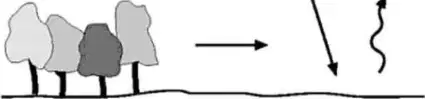
What does the diagram imply about evapotranspiration after clear-cutting?
Evapotranspiration rates increase due to more exposure to sunlight.
Evapotranspiration rates decrease, leading to less moisture in the atmosphere.
The diagram does not provide information about evapotranspiration.
Evapotranspiration stops completely without trees.
What was a primary objective of the Green Revolution?
To decrease the world's reliance on synthetic chemicals
To increase food production through new agricultural practices
To promote organic farming methods and no-till agriculture.
To reduce the environmental impact of farming that promoted sustainability.
Which of the following is NOT a method associated with the Green Revolution?
Use of genetically modified organisms (GMOs)
Decreased use of machinery in farming
Introduction of irrigation systems
Application of synthetic fertilizers
What is an advantage of using synthetic pesticides in agriculture?
They improve the health of farmworkers.
They are beneficial for all species in the ecosystem.
They are more expensive but more effective than natural methods.
They can be more targeted in eliminating pests.
One of the disadvantages of synthetic pesticides is:
They are less effective than traditional methods.
They are beneficial to pollinators.
They can contaminate water with toxins.
They specifically avoid killing non-targeted species.
What are synthetic fertilizers known for?
Delivering a balanced array of macro and micronutrients to crops
Reducing the potential for runoff into water bodies
Increasing the micronutrient content in the soil
Providing targeted macronutrients to crops
Which is a disadvantage of using synthetic fertilizers?
They always improve the soil structure.
They can lead to eutrophication in water bodies due to runoff.
They only provide micronutrients to the crops.
They are more expensive than organic fertilizers.
The Green Revolution involved which of the following agricultural advancements?
The introduction of irrigation, tractors, and machinery.
A return to traditional farming techniques using horses and oxen and plows.
The development of organic farming practices and regenerative soil building.
The global reduction of farmland areas in favor of preserved wetlands.
Which innovation is considered a hallmark of the Green Revolution?
Decreased reliance on irrigation
High-yielding varieties (HYVs) of grains
Biodynamic farming methods
Hand-held farming tools
What was one of the main effects of the Green Revolution on global food production?
It led to a dramatic increase in global food production.
It had no significant impact on global food production.
It shifted global food production from primarily grains to primarily meat.
It caused a significant decrease in global food production.
How did irrigation change during the Green Revolution?
Only traditional irrigation methods such as drip irrigation were used to maintain soil integrity .
Irrigation allowed for more recharge of ancient aquifers.
New irrigation technologies and practices were developed to increase efficiency.
There was a widespread abandonment of irrigation practices in favor of dry-land farming.
In the context of the Green Revolution, what is the significance of synthetic fertilizers?
They were only used in industrialized countries.
They were used to increase crop yields.
They were banned due to their harmful environmental effects.
They were replaced entirely by organic compost.
The use of machinery in agriculture during the Green Revolution:
Decreased significantly to maintain traditional farming methods.
Contributed to soil compaction.
Lowered the productivity of farms.
Was only accessible in developed countries.
What is one criticism of the Green Revolution regarding the environment?
It led to a decrease in the use of chemicals in agriculture in favor of natural compost and manure.
It increased biodiversity in farmed areas resulting in the collapse of bee colonies.
It often resulted in negative environmental impacts, such as soil degradation.
It reduced water usage in agricultural practices due to the reliance on irrigation.
Which agricultural practice involves turning over the soil before planting?
Tilling
Polyculture farming
Crop rotation
Hydroponics
What is the environmental impact of slash-and-burn farming?
It increases the organic matter in the soil.
It leads to a reduction in greenhouse gas emissions.
It can result in deforestation and loss of biodiversity.
It conserves water resources.
Which of the following is the most likely result of the excessive use of fertilizers?
Runoff into streams which directly poisons aquatic life.
Causing the decline beneficial pollinators.
Enhancing the growth of beneficial microorganisms in the soil.
Causing eutrophication in water bodies.
How does industrial agriculture decrease organic matter in the soil?
By implementing no-till farming practices.
By removing crop residue that would otherwise decompose in the soil.
By increasing the amount of compost added to the soil.
By promoting the growth of cover crops which decomposes into the soil.
Why does tilling the soil contribute to eutrophication?
It increases the amount of nitrogen and phosphorus in the soil since tilled soil needs more fertilizer.
It loosens soil which leads to erosion that carries nutrients into water bodies.
It compacts the soil which leads to erosion that carries nutrients into water bodies.
It increases the soil's capacity to absorb nutrients which allows for eutrophication in small puddles.
Slash-and-burn farming impacts the environment by:
Leading to deforestation and a significant release of greenhouse gases.
Increasing biodiversity by creating new habitat for grassland organisms.
Reducing overall carbon emissions due to the burning of biomass which then gets sequestered in the newly tilled soil.
Enhancing soil fertility without long-term consequences.
How does slash-and-burn agriculture affect the carbon cycle?
It increases oxygen levels, which offsets any carbon dioxide emissions.
It has no effect on the carbon cycle as new vegetation absorbs CO2 quickly.
It releases stored carbon dioxide when vegetation is burned.
It captures carbon dioxide, reducing the greenhouse effect.
What is NOT negative effect of synthetic fertilizer use?
It can contaminate groundwater with nitrates and phosphates.
It is usually more expensive than buying organic fertilizers.
It causes eutrophication in bodies of water.
It can cause air pollution when sprayed on fields.
Which type of fertilizer is derived from natural sources such as animal manure and compost?
Chemical fertilizer
Synthetic fertilizer
Organic fertilizer
Inorganic fertilizer
What is a primary benefit of using inorganic/synthetic fertilizers in agriculture?
They increase the organic matter content in the soil.
They release nutrients slowly over time.
They improve the soil structure over the long term.
They provide nutrients to plants quickly.
Synthetic fertilizers are known for:
Containing living microorganisms that benefit soil health.
Being made from artificial chemical compounds.
Reducing the risk of waterway eutrophication.
Being completely free of potential pollutants.
One of the main reasons farmers use synthetic/inorganic fertilizers is because they:
Can be more precisely tailored to provide specific nutrients needed by crops.
Do not require any soil testing before application.
Are made from renewable resources and are thus more sustainable.
Are more sustainable and eco-friendlier.
Organic fertilizers differ from synthetic fertilizers because they:
Provide immediate nutrients to plants without any delay.
Have a higher concentration of nutrients per unit weight.
Are not based on plant or animal waste and are purely chemical.
Typically release nutrients more slowly and improve soil structure.
What is the largest human use of freshwater globally?
Recreational activities
Industrial processes
Irrigation
Drinking
Which of the following is not a type of irrigation?
Cloud seeding
Spray
Furrow
Drip
What happens in waterlogging?
The water table rises, affecting root oxygen absorption.
Plants receive excessive nutrients from too much water.
Soil loses all its water content and turns into clay soil.
Soil is eroded by excessive water.
Furrow irrigation is characterized by:
Flooding entire fields
High efficiency in water usage
Using spray nozzles to distribute water.
Using ditches between crops
What is a drawback of flood irrigation?
It is the most expensive method.
It can lead to waterlogging and soil erosion.
It uses complex technology, sensors, and expensive materials.
It is suitable only for small fields and orchards.
Spray irrigation is:
Most often powered by wind energy.
The least efficient method.
Expensive and requires fossil fuels to pump water.
Not likely to cause salinization.
Drip irrigation is known for:
Being highly efficient.
Its simplicity and low cost.
Causing high levels of soil salinization.
Causing severe soil erosion.
Salinization in soil is mainly caused by:
The overuse of chemical fertilizers, which can introduce excessive amounts of salts and minerals into the soil, disrupting its natural balance.
Rainwater which carries salts from evaporation, condensation, and precipitation.
Heavy rainfall, which can lead to the leaching of essential nutrients and minerals.
Evaporation of irrigated water leaving salts behind.
To prevent salinization, one should:
Use flood irrigation frequently.
Plant water-intensive crops.
Apply water at night to reduce evaporation.
Increase the use of chemical fertilizers.
Which type of irrigation is best for sandy soil?
Flood
Drip
Furrow
Spray
What is soil salinization?
The accumulation of salts in soil over time
The addition of organic matter to the soil which increases sodium chloride
The process by which soil becomes acidic due to excess salts
The erosion of topsoil layers
Which of the following can be a cause of soil salinization?
Planting cover crops
Planting deep-rooted trees
Excessive rainfall
Improper irrigation practices
What is desertification?
The process of a desert becoming a forest
The degradation of arable land
The creation of artificial deserts for tourism
The accumulation of sand in an area
Which factor is NOT typically associated with desertification?
Overgrazing by livestock
Soil erosion
Heavy snowfall
Soil salinization
What can be a consequence of soil salinization for agriculture?
Reduction in plant germination and growth.
Increase in beneficial soil bacteria.
Increase in water retention.
Enhanced growth of all crops.
Which of the following is a potential solution to combat desertification?
No-till and drip irrigation.
Over-extraction of groundwater.
Intensive tilling of soil
Continuous monoculture farming.
What role does climate change play in desertification?
It reverses the process of desertification.
It has no effect on desertification.
It decreases the chances of desertification.
It can exacerbate the conditions leading to desertification.
Which of the following is a way to prevent soil salinization?
Spray irrigation
Flood irrigation
Drip irrigation
Furrow irrigation
Which of the following is a way to mitigate soil salinization?
Plant crops that are sensitive to salts.
Drip irrigation
Buy a new field without salt contamination.
Flush soil with a large amount of fresh water
What are ways to deal with soil that is salinized?
Plant crops that have tolerance for salt.
Plant crops that are out of the range of tolerance for salt.
Plant legumes that absorb salts from the soil.
Plant crops that are sensitive to salts
Which of the following is a consequence of using common pesticides over time?
Pests may develop resistance, leading to the "pesticide treadmill."
Pests are likely to become more susceptible to the same pesticides.
Crop yields will consistently increase without any negative side effects.
There is a significant increase in the genetic diversity of pest organisms.
How does pest control primarily benefit agriculture?
By increasing the dependency on manual labor.
By promoting the growth of all insect species.
By ensuring that no artificial selection occurs among pests.
By reducing crop damage and increasing yields.
What is the "pesticide treadmill"?
A situation where continuous use of pesticides is needed to maintain control of pest populations.
A practice of using lower amounts of pesticides each year.
A method of rotating different pesticides to maintain their effectiveness.
A system where pesticides are used to increase the speed of crop growth.
Which of the following is an advantage of genetically modified (GM) foods?
They contribute to a greater use of chemical pesticides.
They prevent any cross-contamination between GM and non-GM fields.
They can grow more food per hectare and often have enhanced nutritional profiles.
They increase the genetic diversity of crops and the biodiversity of beneficial insects.
What is one of the disadvantages associated with GM foods?
They can promote monoculture and reduce the genetic diversity of crops.
They do not ensure that crops are completely free from any diseases.
They lead to a decrease in food production per hectare.
They are disease-prone and reduce the vitamins available in food.
Genetically modified (GM) crops are engineered to have certain desirable traits. Which of the following is a recognized advantage of GM crops?
They can produce higher yields per hectare.
They enhance the genetic diversity of plant pests.
They use more organic pesticides than traditional crops.
They increase the microbial content of the soil.
Genetically modified crops can be engineered to contain more vitamins. This is an advantage because:
It can potentially lead to a decrease in nutritional deficiencies in populations.
It eliminates the need for any other types of food in a diet.
It increases the crops' resistance to all types of mechanical damage.
It ensures that the crops will not require water to grow.
One of the disadvantages of GM crops is that they:
Always require more water than non-GM crops.
Contribute to increased genetic diversity in farming systems.
Can accidently pollinate and contaminate traditional varieties of crops.
Are unable to grow in areas where traditional crops are planted.
Why is the loss of genetic diversity in crops a concern with GM crops?
It promotes the development of new crop varieties.
It ensures that crops are more adaptable to changing environmental conditions.
It can lead to crops being more vulnerable to diseases and pests.
It increases the variety of crops available for cultivation.
How might pollen from GM crops affect non-GM or organic fields?
By potentially contaminating them, leading to unwanted hybrid crops.
By enhancing the resistance of non-GM crops to pests and diseases.
By decreasing the soil fertility in adjacent fields which leads to fertilizer runoff.
By increasing the biodiversity in those fields.
Biological control can have unintended consequence when ________.
genetically engineered organisms are used.
the biological control agent is altered by breeding with crop plants.
the biological control agent becomes invasive and affects nontarget species.
agricultural crops crossbreed with local vegetation.
What is the biggest threat to bees that pollinate our food crops??
Synthetic fertilizers
Eutrophication in surface water
Methane emissions from CAFOs
Colony Collapse Disorder
Which of the following pest control methods is the least toxic to humans and species?
Broad-spectrum pesticides
Insecticidal soap and toxic plant derivatives
Chlorinated Hydrocarbons
Herbicides such as Round-up
Concentrated Animal Feeding Operations (CAFOs) are characterized by:
Spacious environments where animals are free to graze and reproduce.
Small-scale operations that primarily focus on animal welfare and ethical slaughter.
Large, crowded facilities designed to rapidly fatten livestock for slaughter.
Systems that use no grain feed and only natural grasses.
What is a primary reason for using CAFOs in meat production?
They produce meat with a higher nutritional value and less ecological impact.
They reduce the potential for surface water, groundwater, and soil pollution.
They require more land than free-range grazing.
They are more cost-effective and increase production efficiency.
Free-range grazing is a method of meat production where animals:
Are kept in confined spaces with limited movement.
Are fed a diet high in grains and antibiotics to promote rapid growth.
Are allowed to roam and feed on grass throughout their lifecycle.
Contribute significantly to ground and surface water contamination.
The overuse of antibiotics in CAFOs can lead to:
Improved animal welfare and health and cage-free livestock.
The development of antibiotic-resistant bacteria.
Decreased costs in meat production.
Enhanced bacterial resistance in humans that consume the meat.
Which countries are known for high consumption of beef and other meats?
Developed countries with high incomes.
Island nations with limited agricultural land, but a high amount of CAFOs.
Countries where vegetarianism is the cultural norm.
Predominantly underdeveloped countries with agrarian societies.
How does meat production compare to plant-based agriculture in terms of land use efficiency?
It takes approximately 20 times more land to produce calories from meat than from plants.
Meat production is about 20 times more land-efficient than agriculture.
They are equally efficient in terms of land and water use.
Meat production requires less land but more water.
What is an impact of overgrazing by livestock?
More efficient water usage and conservation.
Loss of vegetation and soil erosion.
Enhanced carbon sequestration in the soil.
Increased soil fertility and biodiversity.
Desertification caused by overgrazing leads to:
The loss of productivity of soil.
The decrease of eutrophication in surface water.
An increase in the land's ability to hold water.
The loss of new water sources.
Which of the following results from reduced meat consumption?
Higher CO₂, methane, and N₂O emissions.
Increased use of antibiotics and growth hormones.
More land being required for agriculture and water diversion projects.
Decreased greenhouse gas emissions and water conservation.
Meat from free-range animals tends to be:
Higher in antibiotics and growth hormones.
Less expensive for consumers.
Lower in antibiotics and other chemicals.
Lower in nutritional value.
Which of the following is true of free-range grazing?
It leads to a higher concentration of organic waste.
It requires larger areas of land, making the meat more expensive.
The meat produced is often less expensive for consumers.
It decreases the land available for agriculture.
Which of the following is true of animal waste from CAFOs?
It reduces the overall carbon footprint of the operation.
It can act as a natural fertilizer with no negative effects.
It is always safely processed and used as biofuel.
It can contaminate ground and surface water.
Which of the following is true of animal waste from free-range grazing animals?
It acts as a natural fertilizer for the land.
It is often collected and sold as a separate commercial product.
It has no significant impact on the environment.
It contributes to air pollution at a higher level than CAFOs.
In what way can less meat consumption impact soil quality?
By increasing the need for tilling and soil aeration.
By reducing soil erosion and conserving soil quality.
By necessitating the use of more synthetic fertilizers.
By promoting the use of more pesticides and herbicides.
What is a manure lagoon?
An artificial wetland designed to filter waste from free-range livestock.
A natural pond where animals can drink water.
A treatment facility for animal waste to be converted into organic fertilizer.
A constructed pit or pond where animal waste from CAFOs is stored.
Which of the following is true of manure lagoons?
It can reduce the methane emissions from animal waste.
If it fails, it can lead to contamination of surface and groundwater.
It can attract wildlife and increase biodiversity.
It typically filters out pathogens, making nearby water safer.
How does raising livestock impact climate change?
Animals consume greenhouse gases, reducing their concentration in the atmosphere.
By reducing the need for fossil fuels in transportation.
Livestock, especially cattle, produce methane, a potent greenhouse gas.
By sequestering carbon dioxide and increasing oxygen levels.
What is expected to happen with global meat consumption as more countries develop?
Meat consumption will decrease as countries adopt more sustainable practices.
Meat consumption will increase as countries become wealthier.
Meat consumption is predicted to remain the same regardless of development.
There will be a shift from meat consumption to plant-based diets globally.
Why might free-range grazing animals produce less methane than those in CAFOs?
Because they consume natural grasses, which lead to lower methane production.
Free-range animals are genetically modified to produce less methane.
Because they are less active and therefore have slower digestive processes.
Because they are given a diet high in methane-reducing additives.
How does the production of feed for livestock in CAFOs impact the environment?
It reduces the use of fertilizers and pesticides in agriculture which increases greenhouse gases.
The production process burns fossil fuels, contributing to climate change.
It has no significant environmental impact.
It leads to increased absorption of greenhouse gases.
What effect does the transportation of animals and meat have in the context of climate change?
It encourages the growth of more forests to offset the carbon footprint.
Transporting animals and meat burns fossil fuels, contributing to global warming.
It has a cooling effect on the planet due to increased airflow.
It significantly reduces greenhouse gas emissions due to efficient logistics.
Overfishing has led to which of the following environmental issues?
Increased populations of marine mammals.
Enhanced water quality in oceans.
Lessened biodiversity in aquatic systems.
An increase in the number of fish species.
What is a direct impact of overfishing on food webs?
It decreases the population of organisms lower on the food chain only.
It can lead to an overpopulation of fish higher up in the food chain only.
It can disrupt the balance, affecting both higher and lower levels of the food chain.
It stabilizes the population of fish at all levels of the food chain.
Economically, overfishing can initially lead to:
A decrease in money and jobs related to fishing.
Immediate collapse of local fishing economies.
An increase in money and jobs related to fishing.
No significant change in the fishing industry.
What is bycatch in the context of fishing?
Unintended catch that is often discarded.
Fish that are caught and released for conservation purposes.
The intended catch that is sought after by fishermen.
The most profitable catch in commercial fishing.
Which fishing method is particularly harmful due to its high bycatch rates?
Sustainable aquaculture practices.
Spearfishing by individual divers.
Line fishing in shallow waters.
Bottom-trawling for benthic species.
Bottom trawling can be detrimental because:
It selectively targets the most abundant fish species.
It avoids disturbing the seabed and marine habitats.
It increases the survival rate of bycatch when thrown back into the ocean.
It scrapes the seabed, destroying habitats and resulting in high bycatch.
The tragedy of the commons in relation to overfishing explains:
The international cooperation in maintaining fish populations.
How communal fishing grounds are sustainably managed by all.
The ability of the ocean to replenish fish stocks quickly regardless of fishing rates.
The overexploitation of ocean resources due to lack of regulation.
CITES is an agreement that:
Helps prevent overfishing by regulating the trade of endangered species.
Focuses only on the conservation of terrestrial wildlife.
Encourages unlimited trade of all marine species.
Prohibits any kind of fishing activity internationally which protects invasive species.
How can individual consumers help reduce the impacts of overfishing?
By avoiding all seafood, including sustainably sourced options.
By consuming only bycatch species.
By increasing their consumption of high-demand fish species.
By choosing seafood that is certified as sustainable.
Government regulations to reduce overfishing include:
Promoting the use of bottom trawling and drift nets.
Setting quotas and size limits on catches.
Removing all restrictions on fishing methods.
Encouraging more energy efficient industrial fishing techniques.
What happens when fish stocks in a region crash due to overfishing?
Fisher people in the region see an increase in their income.
Fishing becomes an easier and more reliable occupation.
There is a temporary increase in the availability of fish.
Fisher people may lose jobs and income.
How does overfishing affect marine mammals?
It ensures a stable food supply for marine mammals.
It decreases the population size due to a reduction in food availability.
It allows marine mammals to diversify their diet.
It has no impact as marine mammals are not part of the food web.
What is an ecological consequence of consumers preferring fish that are higher on the food chain such as tuna or swordfish?
It ensures a balanced and sustainable ecosystem.
It decreases the demand for fishing which provides more jobs for fisheries.
It leads to an increase in the population of top predators which consume more producers.
It can cause an imbalance by increasing the population of lower food chain species.
Which method can consumers use to select sustainable seafood?
Random selection of any available seafood.
Selecting only the most popular and demanded fish species.
The Monterey Bay Aquarium's Seafood Watch or similar programs.
Choosing the least expensive seafood options.

