
 Worksheets
Unit 3 - Precognition
Total questions: 121
Worksheet time: 2hrs 0mins
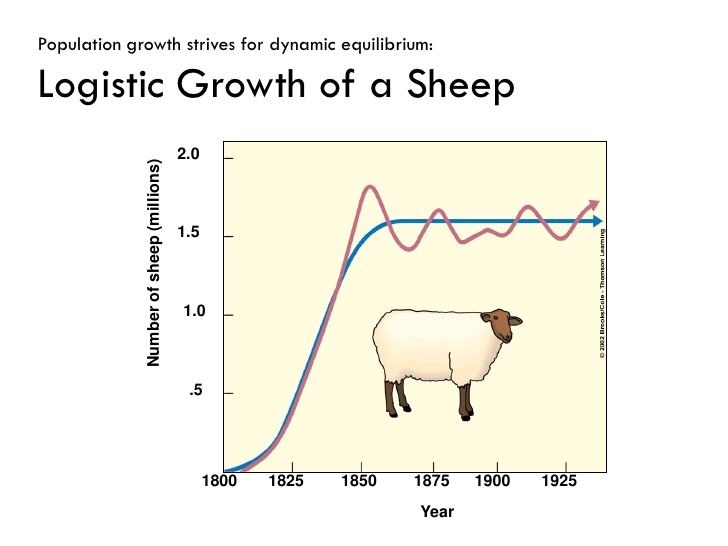


Which of the following are density dependent factors?
competition for resources
predation
disease
natural disasters
A population’s emigration in one month totaled 2 individuals. During the same period, immigration was 12 individuals. Natality (births) was 8, and mortality was 15 due to a parasite infection. What was the net effect on the population size?
+5
+3
0
-4
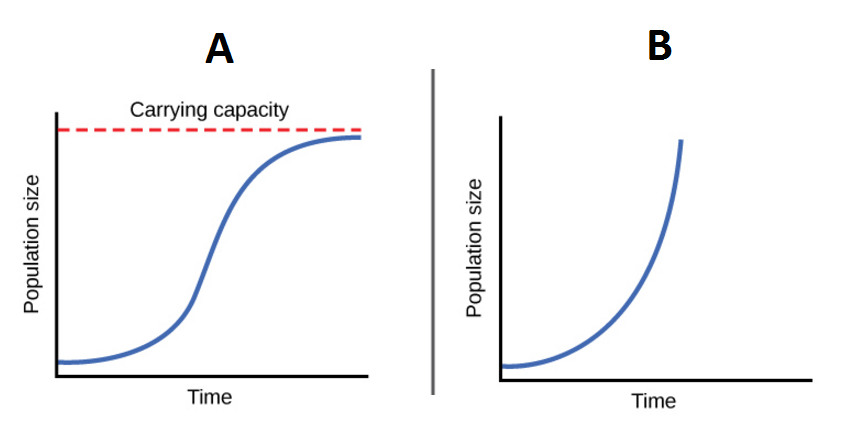
What type of growth model is shown in image A?
Exponential
Logistic

The Florida Panther is a large cat that is native to the southern parts of Florida. Recently, the panther's main food source, rabbits, have been infected with a deadly disease that only affects rabbits. How would this most likely affect the population of panthers in the coming years?
The panther population will decrease since they won't have access to as much food
The panther population will not be affected because they will adapt to eating other food
The panther population will increase because they will produce more offspring to make up the difference
The panther population will decrease because they will contract the disease.

Describes how the organisms are spread out from one another.
Denisty
Volume
Distribution
Population pattern

What type of distribution pattern is evenly spaced apart from one another?
Uniform
Clumped
Random
Uneven

This is the most commonly seen distribution pattern. Example: wolves. This is usually because there are resources found in particular areas and the organisms need more space to survive.
Random
Uniform
Clumped
Ueven
What are the three types of distribution patterns?
uniform, clumped, random
uniform, uneven, random
uneven, clumped, random
uniform, clumped, uneven
When a population continues to grow at a fast rate.
Exponential Growth
Logistic Growth
Carrying Capacity
Infinity Growth
This type of growth happens when an organism reaches its carrying capacity.
Exponential growth
Logistic growth
infinity growth
none of the above
This is when an individual or population to reproduce under optimal (the best) environmental conditions. This rarely happens because of limiting factors.
Biotic Potential
Carrying capacity
Environmental Resistance
Logistic Growth
Biodiversity, aka biological diversity, usually refers to
the same species in a general location
the number of different species in a given area
the number of animal species in a given area
the number of plant species in a given area

Why is "A" less biodiverse than "B"?
Image "A" is more biodiverse.
Image "A" has many corn plants and this makes it have high "rich" biodiversity.
Image "A" has a lot more plants than image "B"
Even though "A" has a lot of corn plants they are all the same species and makes this a low "poor" biodiverse area.
Species that are clearly critical to the functioning of an ecosystem are known as
biodiversity
keystone species
main species
native species
b. If there aren't all the different species, there will be resources that aren't being used

Identify the species richness of this community.
4
6
25
24

What is the abundance for species A?
25
15
18
10

What species have the lowest abundance?
B
C
D
E
F

Which community has the highest abundance of species A?
Community A
Community B

Which community has higher species richness?
Community A
Community B
Both community A & B

Which site has the greatest biodiversity?
Site A
Site B
What are the 2 types of stratification?
Vertical & Horizontal
Quadrat & Vertical
Quadrat & Transect
Horizontal & Diagonal
Which are abiotic factors?
Temperature
Grasses
Trees
pH
What is the name of the survey used to assess changing biotic data across ecosystem profiles?
Line transect
Quadrat survey
Belt transect
Linear sampling
Which piece of equipment can be used for estimating the number of plants in an area?
Light meter
Pitfall trap
Quadrat
Moisture meter
How can a representative sample of the plant species growing in a field be obtained?
By randomly placing a quadrat at many different locations around the field
By randomly placing many quadrats in one corner of the field
By placing one quadrat at a random location in the field

Limpets were found in 25 out of 50 quadrats. What percentage of quadrats contained limpets?
100%
25%
50%
75%
What type of population would you ESTIMATE using a quadrat?


What is the best way to place a quadrat?
Place it where you like
Divide the sample area into a grid and use a random number generator to choose a square.
Throw the quadrat so it's random
Divide the sample area into a grid and choose a square.

What is the trophic level of the diatom (phytoplankton)?
producer
primary consumer
secondary consumer
tertiary consumer

What is the trophic level of the krill (zooplankton)?
producer
primary consumer
secondary consumer
tertiary consumer

What is the trophic level of the arctic cod?
producer
primary consumer
secondary consumer
tertiary consumer

According to the cladogram, which organism is most distantly related to the human?
crayfish
grasshopper
perch
frog

Based on the data given in the table, which two are most closely related?
Human & Gorilla
Gorilla & Orangutan
Human & Chimpanzee
Chimpanzee & Orangutan

Based on the figure, which organism is most closely related to the polar bear?
black bear
european brown bear
western north american brown bear
asian brown bear
2-word naming system by Carolus Linnaeus
(a)
The 8 levels of classification, from most broad to most specific.
Domain, Genus, Family, Order, Class, Phylum, Kingdom, Species
Domain, Species, Kingdom, Genus, Phylum, Family, Class, Order
Domain, Kingdom, Phylum, Class, Order, Family, Genus, Species
Order, Kingdom, Species, Domain, Phylum, Family, Class, Genus
Ctenodiscus crispatus (Mud Starfish)
The foredune and hinddune were randomly sampled using quadrats. They were found to have D values of 0.47 and 0.68 respectively. What conclusion about these two sites is most correct?
The hinddune is more biodiverse than the foredune
The foredune is more biodiverser than the hinddune
The hinddune had a greater species richness
The hinddune had greater evenness
Which of the following is NOT a heterotroph?
Producers
Consumers
Herbivores
Carnivores
Which type of consumer eats dead/decaying organisms?
Herbivores
Carnivores
Omnivores
Detritivores
Why does energy decrease as you move up a food chain?
Organisms get larger, so energy decreases
Energy is lost as heat as you move up a food chain
There are more organisms as you move up a food chain
There are more resources as you move up a food chain
How much energy moves on to the next trophic level?
100%
90%
10%
1%
If producers get 100% of the energy, secondary consumers get _______ of the energy
100%
10%
1%
0.1%

Which group of organisms have the largest biomass in this meadow environment?
deer
wolves
mice
grasses
Cows eat grass and then various animals consume cows. The amount of energy available to the consumers is lower than the amount of energy available to the cow because cows
reproduce rapidly, passing on energy to their offspring
convert solar energy to food
store all their energy in milk
use energy for their own functions throughout life

The bar graph shows the biomass of 4 different populations in a community. Which population is probably made of producers?
A
B
C
D
What is the fundamental difference between matter and energy?
Matter is cycled through ecosystems; energy is not.
Energy is cycled through ecosystems; matter is not.
Energy can be converted into matter; matter cannot be converted into energy.
Matter can be converted into energy; energy cannot be converted into matter.
Decomposers are important to ecosystems because they _________________.
change chemical substance from producers
are at the highest level of the energy pyramid
make nutrients available for producers to reuse
convert light energy into sugars through photosynthesis
In an energy pyramid, the lowest level has _________________.
less energy than the top level
more energy than the top level
less energy than the second level
the same amount of energy as the second level
A complex interaction from the feeding relationships among various organisms in an ecosystem that form a network is called _________________.
food web
food chain
community
trophic level
In an energy pyramid, the lowest level represents _________________.
producer
decomposer
primary consumer
secondary consumer
All the energy in a food chain originated from _________________.
plant
the sun
predators
decomposers
The only organisms that can convert nitrogen in the atmosphere into a form useful to living things are nitrogen-fixing
plants
bacteria
insects
animals


Primary succession occurs in an area that has:
soil
no soil
some soil
none of these
___ are the first organisms to colonize an area and begin the process of ecological succession.
foundational organisms
introductory organisms
primary organisms
pioneer species
What is an example of an area that is likely to undergo primary succession?
Glaciers melt and leave exposed rock
Plants die from drought and decompose
Land is bulldozed and soil remains
Which of the following is the correct order of ecological succession?
grass - shrubs - lichens - trees
lichens - shrubs - grasses - trees
lichens - grasses - shrubs - trees
grasses - lichens - shrubs - trees
What is the main difference between primary and secondary ecological succession?
Primary begins WITHOUT soil; Secondary begins WITH soil
Primary is the first state and secondary is the second stage
Primary builds plant community; secondary builds animal community
Primary begins WITH soil; Secondary begins WITHOUT soil
All of the following contribute directly to soil formation EXCEPT
lichens
decomposition of organisms
volcanic eruptions
erosion of rock by weather
What is an example of a disturbance that could bring about secondary succession?
Humans cut down many trees in a small region
A volcanic eruption covers a village in lava.
What is the term that describes a steady and stable community?
peak community
turf community
climax community
disturbed community
Which is faster: Primary or Secondary Succession?
Primary Succession
Secondary Succession
Both Take The Same Amount of Time
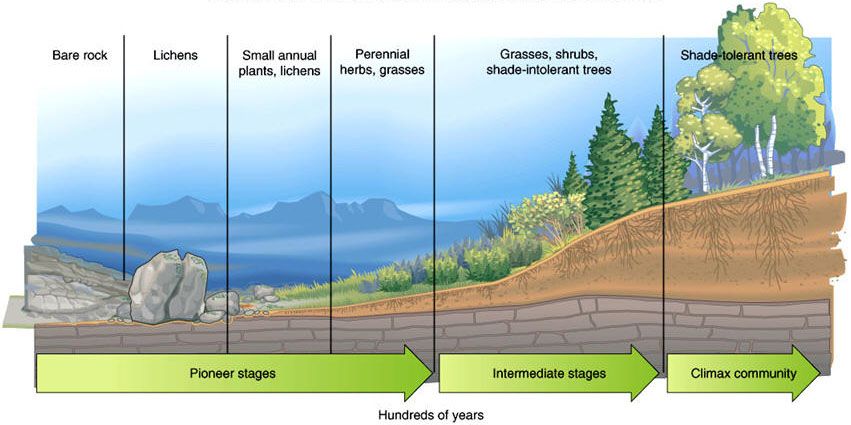
Which of the following isn't a property of effective pioneer species
Nitrogen-fixing
Photosynthetic
Low reproductive rate
Tolerant to harsh conditions
Match the term to the definition:
competitive exclusion principle
it states that no two species can occupy the same niche in the same habitat at the same time
an interaction in which one organism captures and feeds on another organism
interaction in which one animal feeds on producers, such as plants
a species that influences the survival of many other species in an ecosystem
Match the term to the definition:
symbiosis
a relationship in which two different organisms live closely together
a relationship in which one organism lives on or in a host and harms it
a relationship between two organisms in which one organism benefits and the other is unaffected
a species that influences the survival of many other species in an ecosystem
Match the term to the definition:
parasitism
a relationship in which two different organisms live closely together
a relationship in which one organism lives on or in a host and harms it
a relationship between two organisms in which one organism benefits and the other is unaffected
a species that influences the survival of many other species in an ecosystem
Match the term to the definition:
commensalism
a relationship in which two different organisms live closely together
a relationship in which one organism lives on or in a host and harms it
a relationship between two organisms in which one organism benefits and the other is unaffected
a species that influences the survival of many other species in an ecosystem
Match the definition to the term:
any necessity of life, such as water, nutrients, light, food, or space
tolerance
habitat
niche
resource
The range of all conditions in which a species lives and how it gets what it needs to survive and reproduce.


a relationship between two species in which both species compete for limited resources such that both species are negatively affected by the relationship
Symbiosis
interspecific competition
species richness
species-area effect
the differentiation of niches that enables similar species to coexist in a community
character displacement
climax community
resource partitioning
pioneer species


What is a keystone species?
A species that helps to hold an ecosystem together
A species that lives in or around rocks
Keys and stones have nothing to do with ecology
A keystone isn't a living thing, it's just a stone

Where the organism lives in an ecosystem is considered it's...
Habitat
Niche
Home
Biosphere

Which of the following would be the most likely effect, if there were a sudden increase in the cricket population?
There would be a decrease in the small bird population.
There would be a decrease in the grass/flowers population.
There would be a decrease in the mice population.
There would be an increase in the grass/flowers population.
Removing a species from a food web typically results in...
Increased population of their prey
Increased population of their predators
Plant overgrowth
The whole system to collapse

A keystone species fills a unique ecological niche and therefore carries unique functions in an ecosystem
True
False

What is the branch of science that deals with the study of living things and their relationship with the environment?
Anthropology
Ecology
Ecosystems
What is a community?
A habitat with abiotic factors
A very small habitat
All the abiotic factors in a specific area
All the different populations that live together in an area
Which of the following are all abiotic?
Temperature, Light, Rain, Gravity, Heat
Water, Fish, Insects, Lily Plants
Dogs, Meat, Cats, Catnip
Lion, Pride Rock, Warthog, Meerkat
What is binomial nomenclature (naming)?
A two headed turtle
A two name naming system
A two grouped system to classify
A microscope with two lenses.

Who organized living things based on shared characteristics and created a system for assigning scientific names, known as Binomial nomenclature?

