
 Worksheets
Unit 4 Test Atmosphere & Weather
Total questions: 117
Worksheet time: 2hrs 46mins


What does a hygrometer measure?
Crop irrigation levels
Humidity
Water in the ocean
Aridity
Which convection cell is closest to the equator?
Ferrell
Polar
Termperate
Maritime

What type of weather do high pressure systems usually bring?
cloudy weather
snowy weather


Which layer of the atmosphere do we live in? (click to enlarge picture)
Thermosphere
Mesosphere
Stratosphere
Troposphere

Which layer of the atmosphere contains clouds and weather? (click to enlarge picture)
Therosphere
Mesosphere
Stratosphere
Troposphere

Which gas is most abundant in the atmosphere? (click to enlarge picture)
oxygen
nitrogen
water vapor
argon
Which layer has the lowest air pressure?
Thermosphere
Mesosphere
Stratosphere
Troposphere
What happens to the temperature at the "pause" between layers?
it increases
it decreases
it stays the same

How does temperature in the Troposphere change as the altitude increases? (click to enlarge picture)
temperature increases
temperature decreases
temperature stays the same

Which gases do volcanoes put into the atmosphere?
oxygen and methane
nitrogen and chlorine
water vapor and carbon dioxide
carbon dioxide and chlorine

If we were to suddenly have twice as many trees on the planet as we do now, what do you hypothesize might happen?
oxygen levels would decrease due to more photosynthesis
oxygen levels would stay the same
carbon dioxide would decrease due to more photosynthesis
carbon dioxide would increase due to trees using up all the water
What is the process of heat being radiated back into the atmosphere called?
radiation
depletion of ozone
greenhouse effect
condensation
Which process will increase the levels of CO2 in the atmosphere?
cellular respiration by plants and animals
Factory emissions
Photosynthesis
Sunlight
If cars and factories continue to increase in their use of fossil fuels such as petroleum products (gasoline) or coal, what conclusion could be made based on scientific data such as the previous graph?
Temperatures will continue to increase due to a rise in CO2.
Temperatures will decrease due to a rise in CO2.
Temperatures will remain stable.
Temperatures will disappear.
What is the name of the convection cell that occurs near the equator?
Hadley cell
Trade winds
Ferrel cell
Polar cell
What is the name of the gas that surrounds our planet and protects us from harmful UV radiation?
Ozone
Nitrogen
Carbon dioxide
Oxygen
The gas molecules that cause the Earth's greenhouse effect are all of the following except
carbon dioxide
water vapor
methane
nitrous oxide
oxygen
the contamination of the atmosphere by the introduction of pollutants from human and natural sources
air pollution
smog
acid deposition
climate change
______________ ______________ is produced when fuels containing sulfur are burned in the presence of oxygen.
Carbon dioxide
Sulfur dioxide
Carbon monoxide
Greenhouse gas
The Clean Air Act- regulates vehicle emissions.
true
false
A type of pollution found both indoors and outdoors, which includes pollen, dander, soot, carbon, and dust.
Water droplets
Allergens
Particulate matter
Combustibles
This atmospheric compound is critical to the planet in its protection against UV radiation, but when found close to the ground is part of photochemical smog that can cause serious health problems.
particulate matter
carbon monoxide
stratospheric ozone
tropospheric ozone


Lines on a weather map that connect areas of equal pressure.
warm front
cold front
isobar
millibar
barometer
Low pressure areas usually indicates what type of weather?
fair
cloudy
True or False: Air has weight.
True
False

Air pressure is greater in which beaker?
Beaker B
Beaker C
Outermost layer
High concentration of UV‐absorbing ozone
Layer that contains the ionosphere layers
Molecules here can escape into outer space
Where magnetic storms called auroras occur
Meteors burn up
Hottest Layer 100s of *

Which layer protects Earth from getting hit by most meteoroids?
Troposphere
Stratoshphere
Mesosphere
Thermosphere

As altitude above Earth increases air pressure...
decreases.
increases.
stays the same.

The main layers of the atmosphere are classified by changes in ..
precipitation
temperature

Which layer of the atmosphere helps protect Earth from too much ultraviolet radiation because this layer contains ozone?
troposphere
mesosphere
thermosphere
stratosphere

Transfer of energy by electromagnetic waves.
Conduction
Convection
Radiation

The process of sunlight entering the atmosphere, converting to infrared radiation and is trapped by gasses in the air.
Radiation
Conduction
Greenhouse Effect

Transfer of thermal energy by contact of particles of matter.
Conduction
Radiation
Convection

The transfer of thermal energy by movement of particles within matter.
Conduction
Convection
Radiation

Winds occur because hot air rises and cool air sinks in a process called:
conduction
convection
radiation
magnetism

Winds that blow from 300 latitude to the equator are called:
westerlies
polar easterlies
trade winds
horse latitudes

What is the process of global winds curving due to the Earth's rotation called?
Coriolis effect
Doldrums
Trade winds
Convection

Winds that blow from 300 latitude to 600 latitude are called:
polar easterlies
prevailing westerlies
trade winds
doldrums

Winds that blow from the North and South pole toward 600 latitude are called:
trade winds
prevailing westerlies
polar easterlies
doldrums
Warm air rises causing __________ pressure and cool air sinks causing __________ pressure.
high, low
low, high
high, high
low, low
Winds always blow from areas of _________ pressure to areas of _________ pressure.
high, high
low, low
low, high
high, low


Match the following winds to their latitude ranges:
trade winds
30° to 0°
westerlies
30° to 60°
polar easterlies
90° to 60°

Where do convection cycles happen?
core
mantle
crust
Convection cycles move in the mantle. How does this affect the crust?
crust has no motion
crust moves in random direction
crust moves in same direction convection cycle moves
What is magma made of?
solid rock
melted rock
small pieces of sediment

Density has to do with what two things?
Material and Volume
Mass and Volume
Mass and Density
Material and Density

Which state of matter is least dense?
Solid
Liquid
Gas

What layer of earth changes because of the convection cycle?
Crust
Core
Mantle
If magma increases in temperature (get hot) what will happen?
It moves down (sinks)
It moves up (rises)
If magma decreases in temperature (cooler) what will happen to the magma?
It will move down (sink)
It will rise up (float)
A sea breeze occurs during the
night
day
high tide
low tide
During the night the _____ is warmer than the sand because heat is being released.
stratosphere
mesosphere
trees
ocean
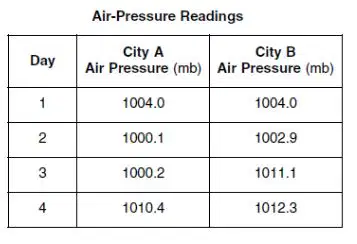
The table below shows air-pressure readings taken at two cities, in the same region of the United States, at noon on four different days. The wind speed in the region between cities A and B was probably the greatest at noon on day...
1
2
3
4
Closer isobars indicate a ________________________
strong pressure gradient and strong winds
weak pressure gradient and weak winds
strong pressure gradient and weak winds
weak pressure gradient and strong winds

Widely spaced isobars indicate:
strong pressure gradient and strong winds
weak pressure gradient and weak winds
strong pressure gradient and weak winds
weak pressure gradient and strong winds

Determine the winds associated with the image below:
Sea breeze
Land breeze
Country breeze
Valley breeze
Mountain breeze
Global winds are caused by differences in pressure caused by:
warm air rising at the equator and cold air sinking at the poles
warm air sinking at the equator and cold air rising at the pole.
Warm air rising at the equator and cold air rising at the poles
warm air sinking at the equator and cold air sinking at the poles
Jordan researched the hourly temperatures of an ocean and a land mass near each other. Each morning Jordan discovered the land and ocean had a similar temperature. For the rest of the day the sun continues to warm the ocean and the land. During the day, which direction will the wind MOST LIKELY blow?
Toward the land
Toward the ocean
Remain still
not enough data to tell

Which of the following is NOT a contributing factor to the uneven warming of Earth’s surface?
Different surfaces warm at different rates
Different surfaces retain energy differently
The sun is farther from the Earth during the winter
The sun’s rays hit the surface at various angles
Which of the following statements best explains why it is warmer at the equator than the North Pole?
The equator has more daylight hours per year than the North Pole.
The equator has a larger area than the North Pole.
The equator is closer to the Sun than the North pole.
The equator receives more direct sunlight than the North Pole.

During the daytime, the land warms up faster than water causing the air above the land to be less dense and rise into the atmosphere. This causes _____________________.
sea breezes
land breezes
global winds
jet streams
Which statement about Earth's heating patterns is true?
The rate of cooling depends on the season.
Large bodies of water cool more quickly than land.
Land cools more quickly than large bodies of water.
Land and large bodies of water cool at the same rate.
What is the result of an increase in greenhouse gases, such as carbon dioxide, in our atmosphere?
The atmosphere is getting larger
The atmosphere is getting cooler
The atmosphere is getting warmer
The atmosphere is getting smaller
What are the two main greenhouse gases in our atmosphere?
Carbon dioxide and Methane
Carbon Dioxide and Nitrogen
Carbon dioxide and Oxygen
Oxygen and Methane
Which of the following particles are found in the atmosphere?
Dust
Volcanic Ash
Smoke
All of the above
___________ results from chemical reactions involving sunlight, air, exhaust, and ozone
Fog
Smog
Nitrogen
Oxygen
Most (78%) of the air we breathe is made up of _________.
oxygen
carbon dioxide
nitrogen
water vapor
Since being passed in 1963, the ________ has resulted in a significant reduction in air pollutants.
Clean Water Act
Safe Drinking Water Act
The Frack Act
The Clean Air Act
What does the Clean Air Act regulate and protect the public from?
Wild Life
Bad Air Pollutants
Aquatic Lifeforms
Litter on the streets
a secondary pollutant
forms in the stratosphere
is transformed by sunlight, water, or other elements in the atmosphere
cannot be directly tracked to its source
forms primarily from incomplete combustion
Acid deposition forms as a result of
nitrogen oxides and photochemical smog
carbon monoxide and VOC's
sulfur dioxide and VOC's
nitrogen oxides and sulfur dioxides
The effects of acid deposition include
increased cancer rates in aquatic organisms
increased pH of lake water
decreased mobilization of metals
decreased aquatic biodiversity
Which outdoor air pollutant is also a significant indoor air pollutant?
sulfur dioxide
carbon monoxide
ozone
lead

