wayground logo

Free Printable Worksheets

Font size

S
M
L
XL
Worksheets

Ap Bio CA 2 review

Total questions: 120

Worksheet time: 2hrs 52mins

Name
Class
Date
1.
In which way are photosynthesis and cellular respiration different?
a)
Cellular respiration stores ATP, while photosynthesis releases ATP.
b)
Cellular respiration produces oxygen, while photosynthesis uses oxygen.
c)
Photosynthesis releases energy, while cellular respiration stores energy.
d)
Photosynthesis uses carbon dioxide, while cellular respiration produces carbon dioxide.
2.
What is the correct equation for cellular respiration?
a)
6O2 + C6H12O6 -> 6CO2 + 6H2O + Energy
b)
6O2 + C6H12O6 + Energy -> 6CO2 + 6H2O
c)
6CO2 + 6H2O -> 6O2 + C6H12O6 + Energy
d)
6CO2 + 6H2O + Energy -> 6O2 + C6H12O6
3.
What does metabolism mean?
a)
Converting energy into food
b)
Making light reactions happen
c)
Converting food into energy
4.
In cellular respiration, the electron transport chain takes place in
a)
the membrane of the mitochondrion
b)
the folds of the mitochondrion
c)
the cytoplasm
d)
the cell nucleus
5.

The Electron Transport Chain is a series of chemical reactions in which energy is transferred to form a large amount of what molecule?

a)

glucose

b)

oxygen

c)

pyruvic acid

d)

ATP

6.
In which way are photosynthesis and cellular respiration different?
a)
Cellular respiration stores ATP, while photosynthesis releases ATP.
b)
Cellular respiration produces oxygen, while photosynthesis uses oxygen.
c)
Photosynthesis releases energy, while cellular respiration stores energy.
d)
Photosynthesis uses carbon dioxide, while cellular respiration produces carbon dioxide.
7.
What is the correct equation for cellular respiration?
a)
6O2 + C6H12O6 -> 6CO2 + 6H2O + Energy
b)
6O2 + C6H12O6 + Energy -> 6CO2 + 6H2O
c)
6CO2 + 6H2O -> 6O2 + C6H12O6 + Energy
d)
6CO2 + 6H2O + Energy -> 6O2 + C6H12O6
8.
What does metabolism mean?
a)
Converting energy into food
b)
Making light reactions happen
c)
Converting food into energy
9.
In cellular respiration, the electron transport chain takes place in
a)
the membrane of the mitochondrion
b)
the folds of the mitochondrion
c)
the cytoplasm
d)
the cell nucleus
10.
After intense activity, your muscles feel sore because of 
a)
the accumulation of NAD+
b)
the accumulation of lactic acid 
c)
the accumulation of ATP
d)
the accumulation of carbon dioxide
11.
Fermentation enables glycolysis to continue under 
a)
anaerobic conditions
b)
aerobic conditions
c)
photosynthetic conditions
d)
hydrophobic conditions
12.

Which organism go through cellular respiration?

a)

animals

b)

plants

c)

both animals and plants

d)

none

13.

Cellular Respiration occurs in what cell organelle?

a)

chloroplast

b)

cytoplasm

c)

mitochondria

d)

animal

14.

Which molecule is the reactant of Glycolysis?

a)

water

b)

glucose

c)

carbon dioxide

d)

ATP

15.

What's the chemical formula for glucose?

a)

6C6HO6

b)

C12H6O12

c)

C6H12O6

d)

CHO

16.

The Electron Transport Chain is a series of chemical reactions in which energy is transferred to form a large amount of what molecule?

a)

glucose

b)

oxygen

c)

pyruvic acid

d)

ATP

17.

Which of the following structures is where cellular respiration (Kreb's Cycle and Electron Transport Chain) occurs in the cell?

a)

nucleus

b)

cytoplasm

c)

mitochondria

d)

vacuoles

18.

What type of respiration requires oxygen?

a)

Aerobic

b)

Anaerobic

19.

Select ALL the products of Cellular Respiration? *clue: 3*

a)

oxygen

b)

glucose

c)

carbon dioxide

d)

water

e)

ATP (energy)

20.
Which type of respiration is most efficient?
a)
Aerobic
b)
Anaerobic
21.
Which organ excretes carbon dioxide?
a)
Lungs
b)
Liver
c)
Heart
d)
Kidney
22.
What happens to your breathing rate when you exercise?
a)
It increases
b)
It decreases
c)
It stays the same
23.

True or False: Only animals can undergo Cellular Respiration.

a)

True

b)

False

24.

What type of respiration does not require oxygen?

a)

Aerobic

b)

Anaerobic

25.

Select ALL the products of Cellular Respiration? *clue: 3*

a)

oxygen

b)

glucose

c)

carbon dioxide

d)

water

e)

ATP (energy)

26.

Which is a product of glycolysis?

a)

2 molecules of pyruvic acid

b)

1 molecule of glucose

c)

NAD+

d)

oxygen

27.

Where does the pyruvic acid produced by glycolysis go next?

a)

the Calvin Cycle

b)

the electron transport chain

c)

the Krebs Cycle

d)

back through the glycolysis process

28.

Glycolysis requires oxygen

a)

True

b)

False

29.

Which of these is broken down into pyruvic acid?

a)

glucose

b)

oxygen

c)

water

30.

After the NAD+ receives electrons, what does it change to?

a)

ATP

b)

NADH

c)

ADP

31.

During glycolysis, glucose is broken down into how many molecules of pyruvic acid?

a)

2

b)

3

c)

4

d)

1

32.

Glycolysis DOES NOT need ATP to occur.

a)

True

b)

False

33.
Where does glycolysis take place in cells?
a)
Cytoplasm
b)
Mitochondrion
c)
Endoplasmic Reticulum
d)
Ribosomes
34.
In the final step of glycolysis ATP is made through the process of:
a)
Substrate Level Phosphorylation
b)
Oxidative Phosphorylation
c)
Photo-Phosphorylation
d)
RedOx Reactions
35.
Which of the following is not a product of glycolysis?
a)
FADH2
b)
NADH
c)
ATP
d)
Pyruvate
36.
Respiration uses ___ and ___, and produces ___ & ____.
a)
CO2 & ATP, O2 & glucose
b)
O2 & glucose, CO2 & ATP
c)
CO2 & glucose, O2 & ATP
d)
O2 & ATP, CO2 & glucose
37.
This organelle could likely be found in 
a)
plant cells only.
b)
animal cells only.
c)
prokaryotes only.
d)
plant and animal cells.
38.
Name the space designated by B
a)
stroma
b)
matrix
c)
intermembrane space
d)
cytoplasm
39.
What process is found in both aerobic and anaerobic metabolism?
a)
the Kreb's cycle
b)
oxidative phosphorylation
c)
the citric acid cycle
d)
glycolysis
40.
oxidation is______ and reduction is________
a)
loss of electrons, gain of electrons
b)
gain of electrons, loss of electrons
c)
gain of oxygen, loss of oxygen
d)
gain of protons, loss of protons
41.

The net total amount of ATP produced by 1 molecule of glucose in aerobic conditions is

a)

30

b)

32

c)

36

d)

38

42.

Electron transport helps establish a _____ that powers ATP production.

a)

proton gradient

b)

vacuole

c)

peroxisome

d)

power vault

43.

When Photosystem II absorbs light, it becomes ____.

a)

dull

b)

light

c)

excited

d)

Photosystem IV

44.

This excites the chlorophylls, making its electrons move faster.

a)

Light Photons

b)

Protons-E

c)

Proton Gradient

d)

Neurogen Light

45.

While at Photosystems II and I, the electrons ______ from sunlight.

a)

explodes

b)

shade

c)

release energy

d)

gather energy

46.

What does FADH2 and NADH bring to the electron transport chain?

a)

Oxygen

b)

Water

c)

Electron

d)

ATP

47.

ATP synthesis by ATP synthase is driven by

a)

H+ movement

b)

electron movement

c)

NADH movement

d)

FADH2 movement

48.

Please indicate the correct equation(s) for Cellular Respiration. (2 answers)

a)

Glucose + Oxygen --> Carbon Dioxide + Water + Energy

b)

C6H12O6 + O2 --> CO2 + H2O + ATP

c)

Carbon Dioxide + Water + Energy --> Glucose + Oxygen

d)

C6H12O6 + 6 O2 --> 6 CO2 + 6 H2O + ATP

49.
What enzyme in the ETC is responsible for generating the ATP molecules?
a)
ATPase
b)
ATP synthase
c)
Hexokinase
d)
none of the above
50.

When protons are pumped outside the matrix, across the inner membrane...

a)

water is made

b)

a concentration gradient of H+ ions (protons) is created

c)

NADH gets reduced

d)

CO2 is produced

51.

ATP synthesis by ATP synthase is driven by

a)

H+ movement

b)

electron movement

c)

NADH movement

d)

FADH2 movement

52.
What are the two products of the light reactions that are needed for the calvin cycle?
a)
NAD and NADPH
b)
NADP + and Glucose
c)
NADPH and ATP
d)
Oxygen and NADPH
53.

Select all that are raw materials for Photosynthesis.

a)

Water

b)

Carbon Dioxide

c)

Oxygen

d)

Sunlight (Light Energy)

e)

Glucose (Sugar/food)

54.
The formula for glucose is...
a)
C12 H22 O11
b)
NaCl
c)
NaOH
d)
C6 H12 O6
55.

What role does NADPH play in cellular respiration

a)

It is long term energy storage

b)

it is a high-energy hydrogen carrier

c)

it breaks down glucose

d)

it is an enzyme

56.

what are the inputs of the calvin cycle?

a)

NADPH

b)

ATP

c)

CO2

d)

H2O

e)

chlorophyll

57.
What is the function of NADPH and ATP?
a)
They absorb light
b)
They power the light-dependent reactions
c)
They are light-reflecting pigments
d)
They are short term energy carriers
58.
What are the two products of the light reactions that are needed for the calvin cycle?
a)
NAD and NADPH
b)
NADP + and Glucose
c)
NADPH and ATP
d)
Oxygen and NADPH
59.
What is the main purpose of the light dependent reactions?
a)
To provide the energy for the calvin cycle
b)
To capture energy and make sugar
c)
To reflect green light
d)
To make sugars
60.

Main products of the Calvin Cycle

a)

Oxygen, NADP+, ADP

b)

Glucose, CO2, ADP

c)

ADP, NADP+, Glucose

d)

ATP, NADPH, Oxygen

61.

The Calvin Cycle occurs in the

a)

Thylakoid

b)

Grana

c)

Inner membrane of chloroplast

d)

Stroma

62.
In order to efficiently create 1 glucose molecule, the Calvin Cycle must occur how many times?
a)
3
b)
6
c)
1
d)
12
63.
The 5-Carbon molecules that the Calvin Cycle starts and ends with, is called _____________.
a)
PGA
b)
G3P
c)
RuBP
d)
RuDp
64.

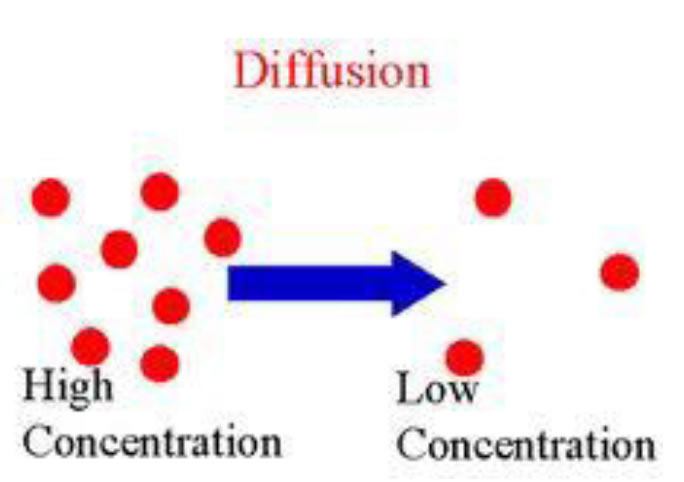
Diffusion is a form of __________ transport.

a)

Passive

b)

Active

c)

Easy

d)

Free

65.

_____________ is the free movement of particles across the membrane with the concentration gradient

a)

diffusion

b)

facilitated diffusion

c)

active transport

d)

fusion

66.

Some cells move large particles out of the cell through the process of:

a)

Protein Synthesis

b)

Endocytosis

c)

Exocytosis

d)

Cytoplasmic Streaming

67.
In this image, the cell is using which type of molecular transport?
a)
Osmosis
b)
Diffusion 
c)
Endocytosis
d)
Exocytosis 
68.

The sodium potassium pump is an example of

a)

Passive Transport

b)

Active Transport

c)

Facilitated Diffusion

d)

Endocytosis

69.

Human red blood cells contain 0.9% sodium chloride as a component of their cytoplasm. What would happen if an IV solution containing 3.5% sodium chloride is introduced into a person? 

a)

The red blood cell would get bigger and burst.

b)

The red blood cell would stay the same size.

c)

The red blood cell would shrink.

d)

The red blood cell would first loose water and then absorb water.

70.
All cells have a:
a)
Nucleus
b)
Plasma membrane
c)
Cell wall
d)
Buddy
71.
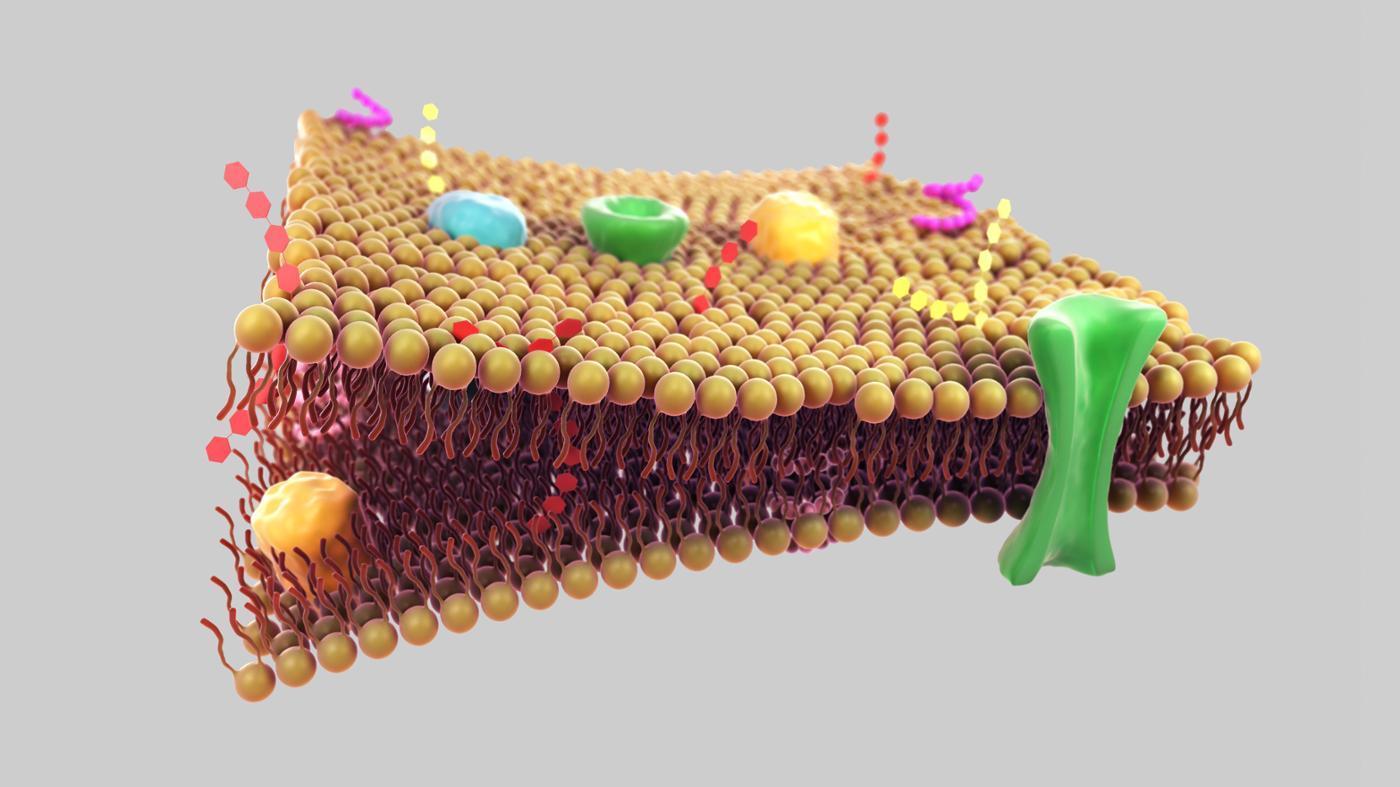
The function of the plasma membrane is....
a)
to regulate what enters and leaves the cell.
b)
fight bacteria and viruses that enter the cell.
c)
provide rigid support and protection to the cell.
d)
make sure each cell can move
72.
What do the brown structures represent?
a)
Phospholipids
b)
Glycoproteins
c)
Channel Proteins 
d)
Cyctoskeleton Filaments
73.
Hydrophilic means...
a)
water-loving
b)
water-fearing
c)
nonpolar
d)
lipid soluble
74.
Most of the cell membrane is made of...
a)
Lipids
b)
Carbohydrates
c)
Proteins
d)
Nucleic acids
75.
What does "bilayer" mean?
a)
one layer
b)
two layers
c)
laminated
d)
bilateral
76.
What is another term for "selectively permeable"?
a)
porous
b)
completely permeable
c)
permanent
d)
semipermeable
77.
Movement of particles from high to low concentration. 
a)
Passive Transport
b)
Active Transport
78.
A cell in an isotonic solution will
a)
swell
b)
shrink
c)
stay the same size
d)
impossible to tell
79.

Which part of the phospholipid is hydrophobic?

a)

The head

b)

The tails

c)

Only one tail

d)

The heart

80.
Describes the arrangement of the cell membrane as bendable and made of many parts. 
a)
The Fluid Mosaic Model 
b)
The Major Mobility Model 
c)
The Crazy Cell Model
d)
The Maze Model
81.

Hypotonic solutions

a)

make cells shrink

b)

make cells swell

82.
Carbohydrates are the first source of _______ for the body?
a)
repair
b)
hygiene
c)
fuel
83.
What molecule is this
a)
sucrose
b)
protein
c)
glucose
d)
cellulose
84.
What type of carbohydrate is this?
a)
polysaccharide
b)
disaccharide
c)
monosaccharide
d)
it isn't a carbohydrate
85.
What type of carbohydrate is this?
a)
polysaccharide
b)
disaccharide
c)
monosaccharide
d)
it isn't a carbohydrate
86.

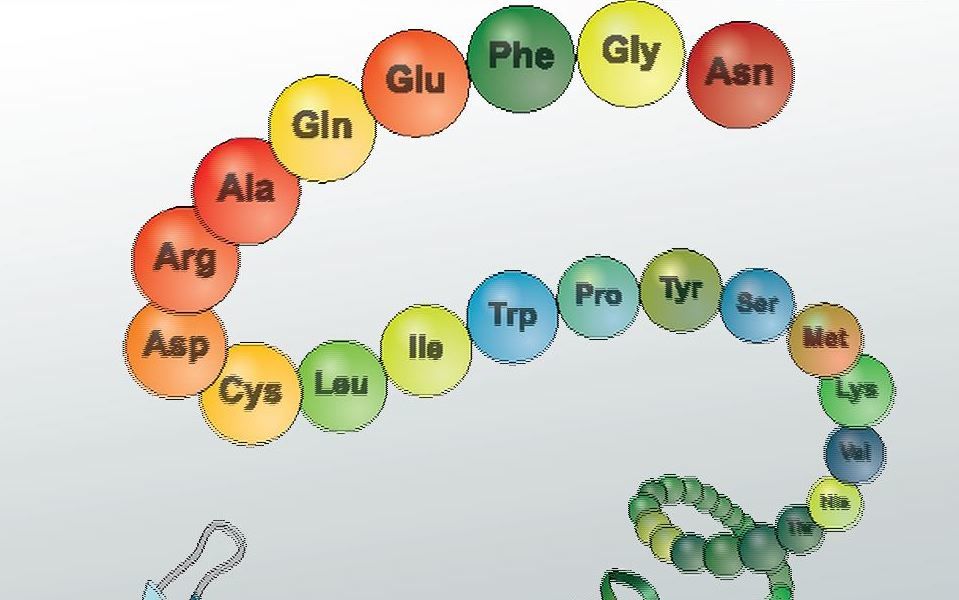
Amino Acids are monomers

a)

True

b)

False

87.
The bond that joins amino acids are called:
a)
Peptide Bonds
b)
Ester Bonds
c)
Glycosidic Linkages
d)
Phosphodiester Bonds
88.
Structures like an α-Helix are formed because of:
a)
Hydrophobic Interactions
b)
DiSulphide Bridges
c)
Salt Bridges
d)
Hydrogen Bonding
89.
The sequence of amino acids is determined by:
a)
Genes
b)
Hydrogen Bonds
c)
Like Dissolves Like
d)
pH
90.
What are the building blocks of proteins?
a)
amino acid
b)
fatty acid
c)
nucleotide
d)
lipid
91.
The level of protein structure that results from hydrogen bonding causing the protein to fold into α-helix and β-pleated sheets is known as
a)
primary structure
b)
secondary structure
c)
tertiary structure
d)
quaternary structure
92.
The name of the initial chain of monomers in a protein is called.....
a)
polypeptide
b)
polysaccharide
c)
polyester
d)
polynucleotide
93.
What is a peptide bond?
a)
Bond that holds two amino acids together.
b)
A bond that holds hydrogen and oxygen molecules together.
c)
A bond that holds the phosphate group of one nucleotide and a sugar of a neighboring nucleotide.
d)
A bond that is formed by the sharing of electrons.
94.

Saturated fats are __________ at room temperature.

a)

liquid

b)

solid

95.
The phospholipid bilayer comprises what part of the cell?
a)
cytoplasm
b)
cell membrane
c)
cytoskeleton
d)
nuclear membrane
96.

This macromolecule is used for long term energy storage.

a)

protein

b)

simple carbohydrate

c)

complex carbohydrate

d)

lipid

97.

The diagram shows the structure of palmitic acid. What type of fatty acid is palmitic acid?

a)

it is monosaturated

b)

it is polyunsaturated

c)

it is saturated

d)

it is a trans-fatty acid

98.

What is a role of cholesterol in animal cells?

a)

it increases body fat

b)

it controls membrane fluidity

c)

it lines the inner wall of capillaries

d)

it is a constituent of bile

99.
An example of an unsaturated fat would be ________
a)
butter
b)
bacon fat
c)
vegetable oil
d)
scrapple
100.

Which of these is a condition that must be met for Hardy-Weinberg equilibrium?

a)

extremely small population size

b)

no natural selection

c)

gene flow

d)

nonrandom mating

101.

If the frequency of dominant phenotype is 0.36, what is the frequency of the dominant allele?

a)

0.2

b)

0.48

c)

0.6

d)

0.8

102.

What does p stand for?

a)

dominant allele

b)

recessive allele

c)

homozygous dominant

d)

homozygous recessive

e)

heterozygous

103.

Which of the following is the equation that you would use for Hardy-Weinberg?

a)

p + 2q = 1

b)

2p + 2q = 1

c)

2p + q = 1

d)

p + q = 1

104.

Which of the following is the equation that you use for Hardy-Weinberg equilibrium?

a)

p2 + 2pq + q2 = 1

b)

p2 + q2 = 1

c)

p3 + q3 = 1

d)

p3 + 3pq + q3 = 1

105.

In generation 1, the recessive allele has a frequency of 0.6 and in generation 40, the recessive phenotype has a frequency of 0.36. Is the population is Hardy-Weinberg?

a)

No, the frequency changed from one generation to another.

b)

Yes, the frequency changed from one generation to another

c)

No, the frequency remained the same from one generation to another

d)

Yes, the frequency remained the same from one generation to another

106.

If there are 400 red flowers, 200 pink flowers, and 100 white flowers. Solve for the frequency of the recessive allele.

a)

0.28

b)

0.14

c)

0.38

d)

0.42

107.

The two ways in which evolutionary relationships are done include

a)

morphological

b)

genetic

c)

structure

d)

analogous structures

108.

If you were building a phylogenetic tree of cats, which of the following would be the best outgroup?

a)

wolf

b)

domestic cat

c)

frog

d)

leopard

109.

The yellow, blue, and read bubbles represent different phylogenies. How would you describe the yellow bubble?

a)

monophyletic

b)

paraphyletic

c)

polyphyletic

d)

anaphyletic

110.

Both butterflies and bats have the ability to fly due to wing development. How would you describe the evolutionary relationship of the animal's wings?

a)

polytomy

b)

homoplasies

c)

analogous

d)

vestigial

111.

On a phylogenetic tree, what do the branch lengths represent?

a)

The age of the organisms

b)

amount of genetic change since divergence

c)

amount of genetic change since convergence

d)

The age of divergence

112.

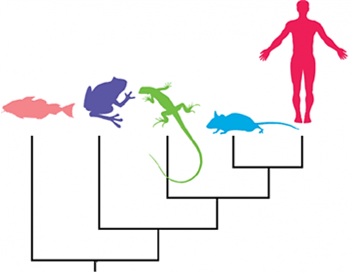
According to this phylogenetic tree, which creature is the least related out of all pictured?

a)

Fish

b)

Frog

c)

Salamander

d)

Human

113.

What number is the common ancestor of C and D

a)

1

b)

2

c)

3

d)

4

114.

From the picture above, What do the species all have in common?

a)

Back bone

b)

Same father

c)

Common ancestor

d)

Feathers

115.

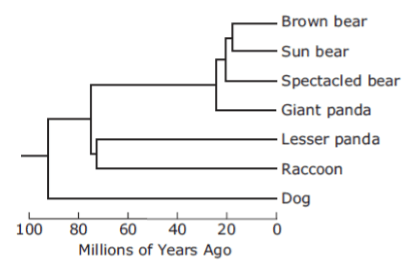
Who is the closest relative to the brown bear?

a)

Giant panda

b)

Dog

c)

Lesser panda

d)

Sun bear

116.

At what level does evolution occur?

a)

Cells

b)

Ecosystem

c)

Individuals

d)

Populations

117.

Which of the following criteria about Hardy-Weinberg Equilibrium does not

belong to the group?

a)

Random mating

b)

No mutation occurred

c)

A very large population size

d)

Gene pool is affected by natural selection

118.

Which of the following occurs when allele and genotype frequencies do not

change from generation to generation?

a)

Gene flow

b)

Genetic drift

c)

Natural selection

d)

Handy-Weinberg Equilibrium

119.

How do evolution directly affected by the gene flow?

a)

It doesn’t contribute to evolution

b)

It introduces new alleles into a population.

c)

It reduces the number of members in a population.

d)

It changes the environment in which a population resides.

120.

In order for the genetic drift to occur, what is the necessary parameter?

a)

The population must be large.

b)

The population must be small.

c)

The population must be under environmental stress.

d)

The population must be sterile.