
 Worksheets
Astronomy & Meteorology Final Review
Total questions: 119
Worksheet time: 2hrs 15mins
Which of the following ideas make up the Big Bang Theory?
The Universe is currently expanding.
The Universe was once hot and dense.
The Universe has a finite size.
The Universe is unbounded.
According to the big bang theory, the universe began as an explosion and is still expanding. This theory is supported by observations that the stellar spectra of distant galaxies show a
concentration in the yellow portion of the spectrum
concentration in the green portion of the spectrum
shift toward the blue end of the spectrum
shift toward the red end of the spectrum
In which list are celestial features correctly shown in order of increasing size?
galaxy, solar system, universe, planet
solar system, galaxy, planet, universe
planet, solar system, galaxy, universe
universe, galaxy, solar system, planet
Cosmic Background Radiation is...
Alpha Particles from the nearest black hole
The light from our sun
The leftover energy from the formation of our sun
The leftover energy from the Big Bang
Which of these waves has the longest wavelength?
X-ray
Gamma
Radio
Visible light
How old do we estimate the universe to be?
13.8 billion years old
25 million years old
13.8 million years old
8 billion years old

Extremely distant galaxies are moving away from us at ___
half the speed of light
almost the speed of light
the speed of light
speeds faster than light
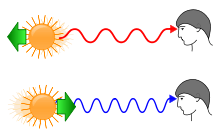

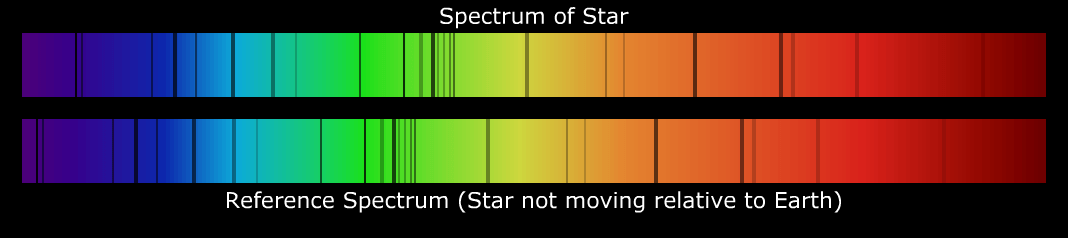
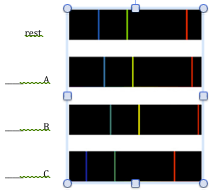
Is Galaxy A moving
Away
Towards
Stationary
Which of the following is the largest?
Planet
Galaxy
Satellite
Comet
Star
Which of the following is the largest?
Parsec
Lightyear
Astronomical Unit
1 billion Kilometers
Which is the correct order for a star's life cycle?
Main sequence -> red dwarf -> white dwarf
Protostar -> main sequence -> neutron star -> Red giant
Main sequence -> red giant -> supernova -> neutron star
Red giant -> supernova -> white dwarf -> black dwarf

What is a comet?
Large rocky ball of ice that orbits the sun
Cluster of billions of stars
Lumps of rock or iron that orbit the sun
Minor planets
select all that apply. The first elements created after the big bang were...
Neon
Hydrogen
Helium
Carbon
Red shift was first observed by which scientist?
Albert Einstein
Edwin Hubble
Watson and Crick
Neil Degrasse Tyson
The universe was in a hot dense state....
immediately after the big freeze
when it came out of the cosmological oven
immediately after the big bang
whenever it wanted to be.
In the seconds following the big bang the universe
cooled
ate a pizza
became less dense
had reduced pressure
The further a galaxy is from the observer the faster it is moving away. This is an explanation of what law?
Newtons Law
Universal Law
Hubble's Law
Kobe's Law
A common measure of distance in space is....
kilometers
feet
a space meter
a light year
All galaxies are expanding at a constant rate.
false
true
the study of the origins of the observable universe is referred to as.....
cosmetology
cosmology
astronomy
astrology
How is the "Big Bang" described?
an explosion
an expansion
a contraction


What stage in a stars life cycle is this describing?

an enormous explosion that occurs when a massive star dies
black hole
nuclear fusion
supernova
solar wind
a hot, dense, slowly cooling sphere of carbon that remains when a red giant star dies
red giant
supergiant
black hole
white dwarf
an immense cloud of dust & gas where stars are born
black hole
nebula
prominence
supernova

About 90 percent of the stars in the universe, including the sun, are main sequence stars. What do all main sequence stars have in common?
All main sequence stars are yellow like our sun.
All main sequence stars are as bright as our sun.
They are all undergoing fusion of helium into carbon within their cores
They are undergoing fusion of hydrogen into helium within their cores
A large group of stars, gas, and dust is called....
a universe
a cluster
a galaxy
a solar system
How are galaxies alike?
The are all the same shape
They have the same amount of stars
They all have stars, gas, and dust
They are all the same temperature

The sun produces energy by
attracting it with the force of gravity.
nuclear fission.
burning fuels such as oil.
nuclear fusion.

Which of the following is the correct order of the objects from largest to smallest?
sun, solar system, Milky Way, universe
universe, Milky Way, solar system, sun
Milky Way, sun, solar system, universe
solar system, universe, sun, Milky Way

Any object with mass has gravity.
True
Sometimes
False
Never

As distance between two objects increase the pull of gravity
Increases
Decreases
Stays the same

Two factors effecting the magnitude of the force of gravity between 2 objects are...
mass and distance
mass and matter
distance and weight
weight and mass
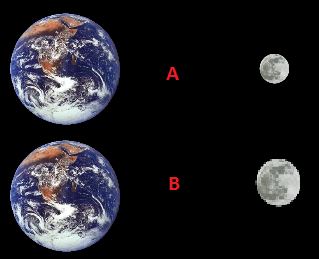
Which system has the greater gravitational attraction between the two objects (if any)?
System A
System B
Same gravitational attraction fro System A and System B

What is the period of rotation?
How long it takes a planet to orbit the sun
How fast a planet orbits the sun
How fast a planet spins
How elliptical a planet's orbit is

What is the period of revolution?
How long it takes a planet to orbit the sun
How long it takes a planet to spin around
How fast a planet spins
How elliptical a planet's orbit is

Kepler's 2nd Law states that a planet's velocity (speed and direction) is ____ when farther from the sun.
fastest
slowest
unchanged
the same

If a planet is closer to the sun, its orbit will be _____ than one farther away.
longer
slower
bigger
shorter

A person would weigh less on the moon than on the Earth because...
the moon has less mass, and therefore less gravity
the moon has more mass, and therefore less gravity
the moon has less mass, and therefore more gravity
the moon has more mass, and therefor more gravity

A person would weigh more on Jupiter than on the Earth because---
Jupiter has less mass, and therefore less gravity
Jupiter has more mass, and therefore less gravity.
Jupiter has less mass, and therefore more gravity.
Jupiter has more mass, and therefore more gravity

OUR solar system formed from:
the solar meteoroids
the solar nebula


How do scientists believe gravity influenced the formation of the planets in our solar system?
A large cloud of gas and dust ignited into a planet.
Gravity pulled the planets out of the Sun.
A large explosion created the planets.
Large pieces of debris clumped together to form planets.
What are the steps of the Nebular Theory?
Step 1: A tiny point rapidly expanded
Step 2: Helium was compressed into stars
Step 3: The stars explode and turn into planets
Step 1: Gravity pulled together atoms in a nebula
Step 2: Nuclear fusion occurred and a star is born
Step 3: Smaller clumps around the star formed into planets
Step 1: The solar system formed because of the Big Bang
Step 2: Our solar system was the first one
Step 3: Dark energy is pushing other solar systems away
Step 1: Gaseous planets will orbit the Sun slower
Step 2: Rocky planets will orbit the Sun faster
Step 3: The Sun will vaporize all the inner planets
What causes the tides?
The Moon and the Sun's gravity
The Earth and the Sun's gravity
Jupiter and Saturn's gravity
The inner planets gravity
What does the Earth, Moon and Saturn have in common?
The Sun revolves around them.
Saturn orbits the Earth, and at the same time, the Moon revolves around the Earth.
They all revolve in elliptical orbital paths around the Sun due to gravity.
They all have life on them.
How does the Moon's gravity cause the rise and fall of Earth's ocean levels?
The Sun's gravitational force "pulls" on both the Earth and the Moon at different times.
Earth revolves on its axis, which causes ocean levels to rise facing the Moon.
Since the Moon has more mass than Earth, the Moon's gravity causes tides.
The Moon's gravitational force "pulls" on the oceans
The only planet that has the presence of "life"
Mars
Earth
Venus
Jupiter


We do NOT have a lunar eclipse each month because...
The tilt of the moon's orbit is at 5 degrees
The moon is too small
The moon's orbital distance changes
All choices
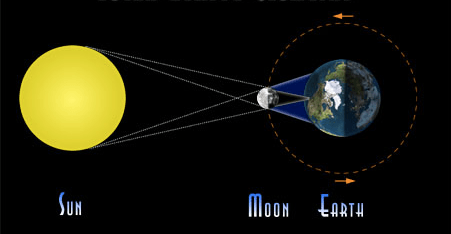

Which body has the greater effect on Earth's tides?
Sun
Saturn
Moon
Venus

What is a difference between spring and neap tides?
Spring tides occur when the earth and sun are IN LINE with the new or full moon.
Spring tides occur when moon in 3rd or 1st quarter phases
Spring tides are LOWER than neap tides
Spring tides occur in Spring and neap tides can occur in any season


Which season is taking place in the Northern Hemisphere in Position 1?

Which of the following best describes the tilt of the earth during the spring and fall equinoxes?

Which season is taking place in the Northern Hemisphere in Position 4?

Which season is taking place in the Northern Hemisphere in Position 2?
What type of weather might you notice near a LOW PRESSURE area?
Precipitation
Sunny skies
Dry air masses
True or False:
Precipitation depends on air temperature.
True
False
What is the correct definition of a COLD front?
When a warm air mass overrides a cold air mass
When a cold front catches up to a warm front
When a cold air mass moves under a warm air mass
Which of the following is NOT a main type of weather front?
Warm front
Cold front
Stationary front
Active front

Look at the point labeled A on the weather map. What kind of weather can you expect in this area?
Sunny and calm winds
Sunny and very windy
Rainy and windy
Cold, snow, and calm

Look at the point labeled B on the weather map. What kind of weather can you expect here?
Cold and windy
Rainy
Sunny and calm
Snow and wind
High Pressure Systems generally bring what kind of weather?
Sunny skies
Cloudy skies
Rain and precipitation
Windy weather

Look at the weather map. What type of air front is heading toward San Francisco?
Cold front
Warm front
Stationary front
Occluded front
What information, or data, on a weather map can be used to predict weather with 100% accuracy?
Isobar pressure lines
Direction of the warm and cold fronts
Location of the high and low pressure systems
Weather prediction is never 100% accurate
Which is most often a result of a warm air mass moving over a cooler air mass?
a decrease in wind speed
a decrease in cloud cover
an increase in precipitation
an increase in air pressure
The average yearly rainfall for Miami, Florida is about 58 inches. During the year, Miami goes through a dry period where it receives very little rainfall. Which factor is MOST likely responsible for the dry period?
cold air moving in from the north
distance from the Gulf Stream current
location of latitude north of the equator
warm air moving in from the Atlantic Ocean
High-pressure systems stop air from rising into the colder regions of the atmosphere where water can condense. What will MOST likely result if a high-pressure system remains in an area for a long period of time?
fog
rain
drought
tornado

Tornadoes can occur throughout the United States. One area where most of the tornadoes occur is known as Tornado Alley.
Which environmental factors MOST likely impact the formation of tornadoes in this area?
high-pressure systems colliding with other high-pressure systems
cold dry air and warm dry air moving toward each other
low evaporation rates and windy conditions
cool dry air colliding with warm moist air

