
 Worksheets
BIO SPRING FINAL REVIEW DAY 2 2022/23
Total questions: 117
Worksheet time: 3hrs 34mins
3' A A A T T T C 5'
The matching strand would read...


What is the correct order to make a protein?
Protein, DNA, RNA
RNA, DNA, Protein
DNA, RNA, Protein
Protein, RNA, DNA
When the mRNA sequence leave the nucleus, what organelle does it travel to?
mitochondria
smooth ER
ribosome
vacuole
What best explains the interaction between tRNA and mRNA during translation?
anticodons on the mRNA line up with complementary codons on the tRNA
anticodons on the tRNA line up with complementary codons on the mRNA
tRNA attach amino acids to the complementary mRNA sequence
mRNA attach amino acids to the complementary tRNA sequence
What does tRNA "transfer"?
amino acids
nucleic acids
nucleotides
AUG
What do amino acids come together to join?
a growing polypeptide chain (protein)
a growing lipid
a growing carbohydrate
a growing nucleic acid
codons are located on __________
mRNA
tRNA
rRNA
snRNA
anti-codons are located on __________
mRNA
tRNA
rRNA
snRNA
A mRNA sequence consist of 171 nucleotides. How many amino acids make up the protein this sequence will code for?
57
56
58
513
What sequence of mRNA always begins a new polypeptide chain?
UAG
AUG
GAU
UGA

The following codon is translated into which amino acid?
AUG
Methionine
Isoleucine
Histidine
Arginine
The following codon is translated into which amino acid?
AUU
Methionine
Isoleucine
Histidine
Arginine
The following codon is translated into which amino acid?
AGG
Methionine
Isoleucine
Histidine
Arginine
The following codon is translated into which amino acid?
UAA
STOP
Phenylalanine
Valine
Aspartic acid

What is the correct sequence of protein synthesis?
A. tRNA brings amino acids to the ribosome
B. DNA molecules serve as the templates for mRNA.
C. mRNA molecules move to ribosomes.
D. Polypeptides are formed on ribosomes.
A-B-C-D
B-C-A-D
C-B-A-D
D-B-A-C
Overall, protein synthesis consists of these steps
DNA synthesis, RNA synthesis and transcription
transcription and translation
DNA synthesis, transcription and translation


What mutation has occurred here?
T-G-A-C-C-A
T-G-A-G-C-A
Substitution
Deletion
Insertion
Frameshift

DNA molecule segment is : TTACGCAAG
The mutated DNA segment is TTACGCAAC. This is an example of ___ mutation.
Substitution
Insertion
Inversion
Translocation

ATT-TGA-GCC- Original
ATT-GAG-CC - Mutated
The example above is an example of a
Insertion- Frameshift
Deletion- Substitution
Deletion -Frameshift
All of the above

DNA molecule segment is : TTA-CGC-AAG
The mutated DNA segment is TTC-GCA-AG. This is an example of ___ mutation.
Substitution
Deletion
Insertion
Inversion

Original DNA: CAT GAT CCA
New DNA: CAT TGA TCC A
What mutation occurred?
deletion
substitution
tranverse
insertion
Mutation: ATC GCAT
What mutation occurred?

What type of gene mutation has occurred here? Normal-
AGA-TTC-ATA-GCG
Mutant-
AGA-TTC-AAT-AGC-G
deletion frameshift
insertion frameshift
substitution
nonsense

Why are insertion and deletion mutations so harmful?
They change all of the codons from the mutation on down the line, which changes the amino acid sequence
They insert things that an organism doesn't need.
They often delete things that organisms need.
Insertion and deletions are not any more harmful than substitution mutations.


Which of the following is true regarding substitution mutations ...
a missense mutation. This could affect the 3D structure of the protein.
a silent mutation. The mutation causes no effect as the first mRNA codon still codes for the same amino acid even though the base has been substituted.
a nonsense mutation. The mutation causes the second mRNA codon to become a stop codon, which means it stops synthesis of the amino acid chain prematurely. This will likely result in a non-functional protein.
frameshift mutation. This causes all of the amino acids shown to change. This will cause a non-functional protein.
have no effect on the amino acids produced during protein synthesis.
silent mutation
causes a stop codon instead of a normal amino acid codon. This causes translation to be terminated prematurely, causing a shorter protein.
nonsense mutation
causes a codon to code for a different amino acid than the original one.
missence mutation
causes the “reading frame” of the codons to shift forwards or backwards. This can change the entire sequence of amino acids.
frameshift mutation
causes a change to one base and potentially one amino acid of the polypeptide chain
point mutation
Label each of the following chromosomal mutations
Identify which of the following are true and which are false
Label the following steps of Mitosis
Identify the stages of Meiosis I
Identify the stages of Meiosis II
What is the purpose of Mitosis?
Growth of an organism and Repair of damaged tissue
To help the body get rid of extra cells
To increase the amount of classwork you have to do
To get rid of the nucleus
At the end of Mitosis, how many cells are there?
1
2
3
4
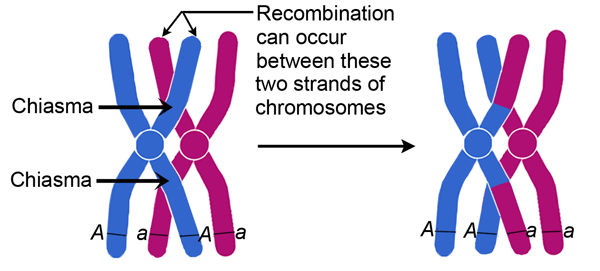
segregation of sister chromatids
condensation and segregation of alleles
mutationin which the DNA content of the gene is altered
crossing - over in which genes are exchanged
A pair of homologous chromosomes (a tetrad) is composed of (a) matching chromosomes, and (b) sister chromatids.
During meiosis, if an organism has 10 chromosomes, how many will the new daughter cells have?
10
8
5
2
During mitosis, if an organism has 10 chromosomes, how many will the new daughter cells have?
10
8
5
2
In mitosis the (a) daughter cells that are created are (b) . In meiosis the (c) daughter cells that are created are (d)
What is the primary cause of genetic variation during meiosis?
chromosomes lining up
"crossing over" of chromosomes
separation of chromosomes
chromosomes pulling apart
The failure of one or more pairs of homologous chromosomes or sister chromatids to separate "normally" during meiosis is called _____________________.
nondisjunction
anaphase I
nondiploidy
karyotype

Table 1 shows the stage and number of cells and chromosomes per cell at the end of the stage in a 2n=24 organism. Which of the following statements correctly describes the chromosomes in each daughter cell at the end of meiosis I ?
Each daughter cell contains 12 chromatids. Each chromatid is one of two from a single chromosome with the other one of the pair found in the other daughter cell.
Each daughter cell contains 12 chromosomes, each composed of two chromatids. Since the chromosomes were randomly divided, one daughter cell may contain both of a pair of homologous chromosomes, while the other cell contains both of another pair of homologous chromosomes.
Each daughter cell contains 12 chromosomes, each composed of two chromatids. Each chromosome is one of a pair of homologous chromosomes from the parent cell, with the other homologue found in the other daughter cell.
Each daughter cell contains 24 separate chromatids. Since every two chromatids were originally joined, forming one homologous chromosome, the number of chromatids is divided by two to determine the number of chromosomes.
Both mitosis and meiosis begin with a parent cell that is diploid. Which of the following best describes how mitosis and meiosis result in daughter cells with different numbers of chromosomes?
In mitosis, the chromosomes consist of a single chromatid, which is passed to two haploid daughter cells. In meiosis, the chromosomes consist of two chromatids during the first round of division and one chromatid during the second round of division, resulting in two haploid daughter cells.
In mitosis, synapsis of homologous chromosomes results in four haploid daughter cells after one division. In meiosis, synapsis of homologous chromosomes occurs during the second division and results in four diploid daughter cells.
Mitosis produces one identical daughter cell after one round of division. Meiosis has two rounds of division and doubles the number of chromosomes in the second round of division, producing four diploid cells.
Mitosis produces two identical diploid daughter cells after one round of division. Meiosis produces four haploid daughter cells after two rounds of division.
What is genetic recombination?
The combination of genes produced by crossing over and independent assortment.
When genes located close to each other on the same chromosome tend to travel together during meiosis.
A map that shows the sequence of genes on a chromosome.
The occurrence of one or more extra sets of chromosomes.
Why is genetic recombination a good thing?
Gives us new genes
is lethal in humans
increases genetic variation
separates during crossing over
What is polyploidy?
The combination of genes produced by crossing over and independent assortment.
When genes located close to each other on the same chromosome tend to travel together during meiosis.
A map that shows the sequence of genes on a chromosome.
The occurrence of one or more extra sets of chromosomes.
Phenotype refers to the (a) of an individual.
Which of the following genotypes is homozygous recessive? (a)
What does heterozygous mean?
An organism that has the same alleles for a trait (TT or tt)
An organism that has different alleles for a trait (Tt)
When neither allele is fully dominant; offspring is a mixture of both
the different forms of a trait (hair color--> brown, blonde, red
Law which states that different traits are inherited independently of each other (a)
Law states that 1 allele is more dominant than the other. Recessive allele is only expressed when dominant is not present (a)
If your genotype is Bb, then you can only pass a B or b to your child but you can't pass both. (a)

What allele combination should go in the missing box? (a)

What is the probability of heterozygous offspring? (a)

B = brown fur b = white furIn the punnett square, what is the probability for white fur? (a)

T - tall and t = shortIn the punnett square below, what belongs in the missing square (a)

This is an example of (a) ?
What type of inheritance do two alleles have if their traits blend together? (a)
When one allele is not dominant over the other, resulting in both traits expressed in a heterozygous individual (a)
Some flowers are controlled by codominance. Red flowers (RR), blue flowers (BB) and Speckled flowers (RB). What would the offspring look like if you crossed a red flower and a speckled flower (a)
In mice coat color is incompletely dominant. Black and white are homozygous. Brown mice are heterozygous. What would the heterozygous offspring look like genotypically (a)
In cattle red coats are represented as RR, and white coats are represented as WW. What would the genotypes be of offspring of a white coated cow and a brown coated cow. (a)

this image is an example of (a)

this image is an example of (a)

A calico cat shows both the traits for orange fur and black fur. What kind of allele expression is this? (a)
The different forms of a gene are called (a)

This type of inheritance pattern shows BOTH traits in possible offspring (a)

This is an example of (a) .

A woman with curly hair and a man with straight hair produced a child with wavy hair: (a)
X and Y are (a) chromosomes. Females are (b) and males are (c) .
In fruit flies, eye color is a sex-linked trait. Red (R) is dominant to white (r).
Which genotype shows a female fly with white eyes?
XRXr
X r X r
X r Y
X R Y
Which genotype shows a male with white eyes?
R = Red, r= white
X r X r
X R X r
X r Y
X R Y
Match the following. H= no hemophilia, h = hemophilia
Male without hemophilia
XHY
Female with hemophilia
XhXh
Female Carrier
XH Xh
Male with hemophilia
XhY
Female who is NOT a carrier
XHXH

Which of the following genotypes belongs in the red box in the Punnett square? (a)

The following punnett square depicts the x-linked cross of a female who carries hemophilia with a man showing no symptoms. Fill in the genootype represented by the blank box in the punnett square. (a)
Hemophilia is a recessive x-linked disorder. Which genotype represents a female who is a carrier for hemophilia? (a)

What is the likelihood of this cross have a child that is colorblind? (a)

What is the chance that a daughter will be colorblind? (a)

What chance will a boy will be colorblind? (a)
Who is more likely to have an X-linked trait? (a)
(a) are more likely to have an x-linked trait because males have only (b) X chromosome. Females can be (c) of an X-linked trait because they can be (d) for the trait since they have (e) X's.
What are the 4 possible phenotypes for human blood type?
Type A
Type B
Type BB
Type AB
Type O
If a person has type B blood, the phenotype is B. What can the genotype be? (a)
If a person has type A blood, the phenotype is A. What can the genotype be? (a)
If a person has type AB blood, the phenotype is AB. What can the genotype be? (a)
If a person has type O blood, the phenotype is O. What can the genotype be? (a)
if the father is type A and the mother is type B, in order for baby Sylvester to have the genotype ii, his parents must be? (a)
There are multiple alleles for the ABO blood group. Why are only two of these alleles present in any one individual?
Each parent contributes only one allele for the ABO blood group to the offspring.
There are not enough nucleotides in a red blood cell to produce a third allele.
Each allele in the ABO group must be dominant or recessive
Blood group alleles are not segregated during meiosis.
What is NOT a possible genotype for someone with type B blood? (a)
What is the genotype of a person with type A blood, who had a father with type O blood? (a)

The physical appearance of an organisms is its (a)

The different forms of a gene are called (a)

For the square that has OO in the bottom right. What would be the missing allele on the top? (A (a) )
If two parents have type AB blood, what is the probability that their child will have type O blood? (a)
If a father is AA and a mother is AB, what is the probability for a child with AB blood? (a)

