wayground logo

Free Printable Worksheets

Font size

S
M
L
XL
Worksheets

Honors Chemistry Semester 2 Review

Total questions: 116

Worksheet time: 2hrs 59mins

Name
Class
Date
1.
What is the first thing you must do to solve a stoichiometry problem?
a)
Write a Balanced Equation
b)
Panic
c)
Write an Unbalanced Equation
d)
Ask for help
2.
KNO3 --> KNO2 + O2
What coefficients are needed to balance the reaction?
a)
2, 2, 1
b)
2, 3, 2
c)
1, 2, 2
d)
1, 3, 1
3.
 The equation for Percent Yield:
a)
(predicted/experimental) X 100
b)
(experimental/predicted) X 100
c)
(experimental - predicted)/ Predicted X 100
4.
True or False. You must convert grams to moles to do stoichiometry.
a)
True
b)
False
5.
2H2   +   O2  →  2H2O
How many moles of water can be produced if 8 moles H2 are used?
a)
4 moles
b)
8 moles
c)
16 moles
d)
2 moles
6.
2H2  +   O2  →  2H2O
How many moles of oxygen are consumed if 8 moles H2 are used?
a)
2
b)
4
c)
6
d)
8
7.
What is a Limiting Reagent?
a)
speeds up a reaction
b)
what you run out of first
c)
what you have left over
d)
slows down a reaction
8.
What is a Excess Reagent?
a)
amount you end with
b)
what you run out of first
c)
what you have left over
d)
what you start with
9.
You need 2 pieces of bread, 1 tablespoon of peanut butter and 2 tablespoons of jelly to make a sandwich.  If you have 10 pieces of bread, 4 tablespoons of peanut butter and 20 tablespoons of jelly, what is the limiting reactant?
a)
bread
b)
jelly
c)
peanut butter
d)
sandwich
10.
For the Balanced Reaction: 3 Mg + 1 Fe2O3 → 3 MgO + 2 Fe; What is the Ratio of moles of Mg to moles Fe?
a)
3mol Mg / 2 mol Fe
b)
2 mol Mg/ 3 mol Fe
c)
1 mol Fe/ 2 mol Fe
d)
3 mol MgO / 2 mol Fe
11.
Use the equation 2 Al + 3 Cl2 ---> 2 AlCl3.  If 2 moles of aluminum and 2 moles of chlorine are reacted, identify the limiting reactant.
a)
AlCl3
b)
Cl2
c)
Al
d)
Gary Busey
12.
When does a chemical reaction stop?
a)
When the lab is finished
b)
When the excess reactant is used up
c)
When the limiting reactant is used up
d)
Chemical reactions never stop
13.
The Formula to make S'mores is:
2C + 1M + G→ C2MG2. If you have 5 Marshmallows (M), 9 Chocolate Pieces (C), and 9 Graham Cracker Halves (G), how many S'mores can you make?
a)
5
b)
4
c)
8
d)
42
14.
2Na + 2H2O → 2NaOH+ H2
How many grams of hydrogen are produced if 120 g of Na are available?
a)
5.2 g
b)
2.6 g
c)
690 g
d)
45 g
15.
If a chemist calculates the maximum amount of product that could be obtained in a chemical reaction, he or she is calculating the
a)
theoretical yield
b)
mole ratio
c)
actual yield
d)
percentage yield
16.

What is the new pressure of 210 mL of a gas that is compressed to 70 mL when the original pressure was 3.0 atm and the temperature is held constant?

a)

100 atm

b)

0.90 atm

c)

1.0 atm

d)

9.0 atm

17.

What is the volume of 1 mole of gas at Standard Temperature and Pressure (STP)?

a)

22.4 L

b)

2.4 L

c)

.24 L

d)

.024 L

18.

olid sodium carbonate, Na2CO3, reacts with sulfuric acid, H2SO4, to produce CO2 gas according to the following equation:


Na2CO3(s) + H2SO4(aq) → CO2(g) + H2O(l) + Na2SO4(aq)


During an experiment to produce carbon dioxide gas, a student recorded the following data:


Pressure CO2 = 708.1 mm Hg

Volume CO2 = 29.65 mL

Temperature CO2= 25.5 °C


How many moles of CO2 were produced?

a)

1.13 × 10⁻³ mol CO2

b)

8.57 × 10⁻¹ mol CO2

c)

8.46 × 10⁻¹ mol CO2

d)

8.88 × 10² mol CO2

19.

A sample of a gas in a rigid container at 30.0°C and 5.00 atm has its temperature increased to 40.0°C. What will be the new pressure?

a)

1.50 atm

b)

2.67 atm

c)

5.17 atm

d)

6.04 atm

20.

The volume of a gas is 100.0 mL at 20.0 K. What will be the new temperature if the gas is compressed to 20.0 mL under constant pressure?

a)

100 K

b)

10.0 K

c)

4.00 K

d)

5.00 K

21.

Which of the following is not one of the postulates of the kinetic molecular theory for ideal gases?

a)

The collisions between particles are elastic.

b)

The particles attract and then repel each other.

c)

The particle size is very small compared to the space between the particles.

d)

The particles are in constant random motion.

22.

According to the kinetic molecular theory of gases, the pressure of the gas is due entirely to the ―

a)

size of the gas particles compared to the size of its container

b)

mass of the gas particles compared to the size of its container

c)

force of the collisions of the gas particles with the walls of the container

d)

moles of gas particles within the walls of the container

23.

According to the kinetic molecular theory, which statement best describes the motion of gas particles?

a)

Gas particles are stationary.

b)

Gas particles are only in motion when a gas is heated.

c)

Gas particles are in continuous, random motion.

d)

Gas particles move together in the same direction.

24.

Given the following reaction for photosynthesis, 6 CO2 + 6 H2O → C6H12O6 + 6 O2, how many liters of O2 can be produced from 200 g of water at standard temperature and pressure?

a)

1.49 L

b)

249 L

c)

80.4 L

d)

124 L

25.

Given the combustion reaction C3H8 + 5 O2 ­­→ 3 CO2 + 4 H2O, how many liters of carbon dioxide can be produced from 5.00 liter of O2 at standard temperature and pressure?

a)

3.00 L

b)

.825 L

c)

1.21 L

d)

1.67 L

26.
Which property of water makes it well suited for the transport of gases and electrolytes through the human body?
a)
Its low molecular weight makes it an easy substance to pump.
b)
Its high polarity makes it an excellent solvent of many substances.
c)
Its high specific heat makes it resistant to temperature change.
d)
Its relative chemical stability makes itan excellent energy source.
27.
Use the solubility rules to determine which compound will precipitate out of solution when an aqueous solution of Na2SO4 is combined with an aqueous solution of Pb(NO3)2.
a)
PbSO4
b)
Pb(SO4)2
c)
Na2SO4
d)
NaNO3
28.

The dissolved substance is called the:

a)

solvent

b)

solute

c)

neither of the above

d)

all of the above

29.

Electrolytes are solutions that:

a)

conduct electricity

b)

do not conduct electricity

c)

are insulators

d)

none of the above

30.

True or False: Like dissolves like is a good rule of thumb to predict the solubility of substances.

a)

True

b)

False

31.

True or False: All solutions must involve a liquid.

a)

True

b)

False

32.

Pressure causes the solubility of a gas to:

a)

increase

b)

decrease

c)

none of the above

33.
In the above picture, a powder is about to be poured into the liquid. Which of the following should be done to make this powder dissolve faster?

a)
stir the powder in the liquid
b)
freeze the mixture
c)
add more powder to the liquid
d)
store the mixture in a dark place
34.
what a solute dissolves in
a)
solvent
b)
mixture
c)
solute
35.
When a certain amount of solvent cannot hold any more solute it is called a ________ solution.
a)
Diluted
b)
Saturated
36.
Solution where more solute can still be dissolved at the given temperature. 
a)
Saturated
b)
Unsaturated
c)
Supersaturated
d)
Homogeneous solution
37.
Which solute is the most soluble at 10 ⁰C?
a)
KI
b)
KClO3
c)
NH4Cl
d)
NH3
38.
How many grams of SOcan dissolve at 50 ⁰C?
a)
5 g
b)
10 g
c)
20 g
d)
39 g
39.
Which of these compounds decreases in solubility as the temperature increases.
a)
Ce2(SO4)3
b)
KClO3
c)
 K2Cr2O7
d)
KNO3
40.
This solution would be considered
a)
Unsaturated
b)
Supersaturated
c)
Saturated
d)
Undefined
41.
This graph represents a(n) ___ solution
a)
saturated
b)
supersaturated
c)
unsaturated
d)
undefined
42.

What will happen to the ability of a gas to dissolve in a liquid if the temperature increases?

a)

solubility of the gas increases

b)

solubility of the gas decreases

c)

solubility of the gas is not affected

43.

If I make a solution by adding water to 27.72 g of methanol (CH3OH) until the final volume of the solution is 275 mL, what is the molarity of methanol in this solution?

a)

5.66 M CH3OH

b)

3.13 M CH3OH

c)

0.77 M CH3OH

d)

2.19 M CH3OH

44.
How many L of a 14 M stock solution must beused to make 250 mL of a 1.75 M solution? M1V1=M2V2
a)
0.031 L
b)
31.3 L
c)
2000 L
d)
10.2 L
45.
You place electrodes in a solution and this happens! The solution must be:
a)
nonelectrolyte & covalent bond
b)
nonelectrolyte & ionic bond
c)
electrolyte & covalent bond
d)
electrolyte & ionic bond
46.
You place electrodes in a solution and this happens! This solution must be:
a)
electrolyte & ionic bond
b)
electrolyte & covalent bond
c)
nonelectrolyte & ionic bond
d)
nonelectrolyte & ionic bond
47.

Which of the following compounds is soluble?

a)

AgCl

b)

Pb(OH)2

c)

Na2CO3

d)

Co2O

e)

None of the above

48.

Which of the following compounds is insoluble?

a)

NaCl

b)

Ba(OH)2

c)

Na2SO4

d)

Fe2O3

e)

none of the above

49.
Which has a pH below 7?
a)
Acid
b)
Base
50.
Which has a pH above 7?
a)
Acid
b)
Base
51.
What is the pH of water?
a)
11
b)
4
c)
7
52.
Which is the stronger acid?
a)
pH 1
b)
pH 4
c)
pH 8
d)
pH 13
53.
Which range of numbers represent basic solution?
a)
0-6
b)
7
c)
8-14
d)
3-9
54.
A solution with a pH of 7 is________
a)
increasing
b)
neutral
c)
decreasing
d)
apple juice
55.
Acids react with
a)
water to produce bases and salts
b)
salts to produce bases and water
c)
neither bases, salts nor water
d)
bases to produce salts and water
56.

A substance is found to have the following characteristics:


Very bitter taste

Feels slippery to the touch

Produces OH- ions when dissolved in water


In what category would the substance be classified?

a)

acid

b)

base

c)

enzyme

d)

fatty acid

57.

HF is...

a)

an acid

b)

a base

c)

a salt

d)

an ionic compound

58.

Releases hydrogen in an aqueous solution.

a)

Arrhenius base

b)

Bronsted-Lowry base

c)

Arrhenius acid

d)

Bronsted-Lowry acid

59.

What is the pH of a solution where the [H+] is 1.0 x 10⁻¹¹?

a)

11

b)

13

c)

14

d)

1

60.

Milk is a very weak acid. What might its pH value be?

a)

6.5

b)

7.8

c)

4.2

d)

12.2

61.

Which of the following pH values represents a base?

a)

2.1

b)

4.6

c)

6.8

d)

8.1

62.

The strongest bases have pH values close to

a)

0

b)

14

c)

7

d)

5

63.

Releases hydroxide ions in an aqueous solution.

a)

Arrhenius base

b)

Bronsted-Lowry base

c)

Arrhenius acid

d)

Bronsted-Lowry acid

64.

Donates protons

a)

Arrhenius base

b)

Bronsted-Lowry base

c)

Arrhenius acid

d)

Bronsted-Lowry acid

65.

Accepts protons

a)

Arrhenius base

b)

Bronsted-Lowry base

c)

Arrhenius acid

d)

Bronsted-Lowry acid

66.

Which of the following are true about strong acids?

a)

They are strong electrolytes

b)

They dissociate completely in solution

c)

They lose their protons more easily

d)

All of the above

67.

What does pH measure?

a)

Electron concentration

b)

Neutron concentration

c)

Hydroxide ion concentration

d)

Hydrogen ion concentration

68.

The average kinetic energy of the particles in a sample of matter is measured as the —

a)

kinetic force

b)

thermal rate

c)

reaction rate

d)

temperature

69.

What type of energy is stored in chemical bonds?

a)

Chemical potential energy

b)

Thermal potential energy

c)

Chemical kinetic energy

d)

Thermal kinetic energy

70.

Calculate the heat transferred when 440 g of water cools from 87.2°C to 50.0°C. (C = 4.18 J/g°C)

a)

68000 J

b)

2.83 J

c)

-2.83 J

d)

-68000 J

71.

If 238 J of heat is absorbed by a sample of metal with a mass of 40.7 g, and it raises the temperature from 20.0°C to 32.4°C, what is the specific heat capacity of the metal?

a)

2.34 J/g°C

b)

0.472 J/g°C

c)

6.13 J/g°C

d)

0.163 J/g°C

72.
A sample of iron receives 50.J of heat energy that raises the temperature of the iron 25.0°C. If iron has a specific heat of .10 J/g°C, what is the mass of the iron sample?
a)
25g
b)
30g
c)
20g
d)
50g
73.

If a reaction is endothermic, which statement below best describes the energy of the products and reactants in the reaction?

a)

Energy is given off during the reaction, making the energy of the products greater than the energy of the reactants.

b)

Energy is given off during the reaction, making the energy of the reactants greater than the energy of the products.

c)

Energy is absorbed during the reaction, making the energy of the reactants greater than the energy of the products.

d)

Energy is absorbed during the reaction, making the energy of the products greater than the energy of the reactants.

74.
∆H is positive
a)
endothermic
b)
exothermic
75.
The products contain more energy than the reactants
a)
endothermic
b)
exothermic
76.
Exothermic reactions are reactions that
a)
release heat
b)
do not involve heat
c)
absorb heat
d)
take place instantaneously
77.

If the enthalpy change (ΔH) is negative the reaction is ____.

a)

Endothermic

b)

Exothermic

c)

Neutral

78.
H2 + ½ O2 --> H2O + 285kJ is an example of a(n)
a)
Electrical equation
b)
Heat equation
c)
Thermochemical equation
79.

The diagram shows  that the reaction is ___________ and the enthalpy change is __________.

a)

endothermic, negative

b)

exothermic, negative

c)

endothermic, positive

d)

exothermic, positive

80.
Calculate the enthalpy of the following reaction:
Ca(OH)2 -> CaO + H2O
ΔHf in kJ/mol:  
      Ca(OH)2  -983.2
        CaO         -634.9
        H2O         -285.5
a)
62.8 kJ
b)
-62.8 kJ
c)
-1840.6
d)
1840.6
81.

The diagram shows that the reaction is ___________ and the enthalpy change is __________.

a)

endothermic, negative

b)

exothermic, negative

c)

endothermic, positive

d)

exothermic, positive

82.

The reactants contain more energy than the products

a)

endothermic

b)

exothermic

83.

If a reaction is exothermic, which statement below best describes the energy of the products and reactants in the reaction?

a)

Energy is given off during the reaction, making the energy of the products greater than the energy of the reactants.

b)

Energy is given off during the reaction, making the energy of the reactants greater than the energy of the products.

c)

Energy is absorbed during the reaction, making the energy of the reactants greater than the energy of the products.

d)

Energy is absorbed during the reaction, making the energy of the products greater than the energy of the reactants.

84.

If a reaction is performed in a calorimeter, and the temperature inside the calorimeter decreases, which statement best describes the reaction?

a)

The reaction is endothermic because heat is being absorbed by the reaction.

b)

The reaction is exothermic because heat is being released by the reaction.

85.

If a reaction is performed in a calorimeter, and the temperature inside the calorimeter increases, which statement best describes the reaction?

a)

The reaction is endothermic because heat is being absorbed by the reaction.

b)

The reaction is exothermic because heat is being released by the reaction.

86.
Radioactive materials have unstable
a)
protons
b)
electrons
c)
nuclei
d)
orbitals
87.
Which of the following is NOT a type of nuclear radiation?
a)
alpha particles
b)
x-rays
c)
gamma particles
d)
beta particles
88.
Which of the following occurs in the nucleus during alpha decay?
a)
2 protons & 2 neutrons are lost
b)
2 neutrons & 2 electrons are gained
c)
2 protons & 2 neutrons are gained
d)
2 neutrons & 2 electrons are lost
89.
Which of the following is a characteristic of alpha decay?
a)
Helium is released
b)
It is negatively charged
c)
can penetrate any thickness of matter
d)
all of these
90.
During beta decay, a nucleus
a)
gains a proton and loses a neutron
b)
loses a proton and gains a neutron
c)
gives up two protons and two neutrons
d)
loses an electron
91.
When a nucleus undergoes gamma decay, the atomic number of the element
a)
decreases by one
b)
remains the same
c)
increases by one
d)
increases by two
92.
The type of nuclear radiation that can penetrate farthest through matter is
a)
gamma rays
b)
alpha particles
c)
beta particles
d)
x-rays
93.
What type of particle has no mass and no charge?
a)
alpha
b)
beta
c)
gamma
d)
none of these
94.
What type of particle can be stopped by a thin sheet of metal?
a)
alpha
b)
beta
c)
gamma
d)
none of these
95.
What type of decay can be stopped by a sheet of paper or clothing?
a)
alpha
b)
beta
c)
gamma
d)
none of these
96.

What are the values of x in the following alpha decay?

a)

236

b)

244

c)

60

d)

240

97.

What are the values of y in the following alpha decay?

a)

94

b)

92

c)

96

d)

236

98.

What are the values of x in the following beta decay?

a)

94

b)

236

c)

240

d)

96

99.

What are the values of y in the following beta decay?

a)

98

b)

96

c)

97

d)

240

100.

In balancing the nuclear reaction, What is the identity of the element labeled E?

a)

Pu

b)

U

c)

Th

d)

Np

101.

The missing product from this reaction is

a)

beta particle

b)

positron

c)

gamma particle

d)

alpha particle

102.

This reaction is an example of

a)

alpha decay

b)

beta decay

c)

positron decay

d)

electron capture

103.
Which of the following is an advantage of nuclear energy as a power source?
a)
Waste can be stored anywhere.
b)
Nuclear energy does not produce air pollution.
c)
Nuclear waste is not radioactive.
d)
Nuclear plants are low in cost.
104.
Which of the following is a disadvantage of nuclear energy as a power source?
a)
Nuclear waste must be safely stored
b)
Nuclear energy produces air pollution
c)
Nuclear energy produces less energy than the burning of coal
d)
The fuel source is very limited
105.
Fusion occurs when nuclei _______
a)
mutate
b)
combine
c)
split
d)
none of these
106.
Fission occurs when nuclei ________.
a)
mutate
b)
combine
c)
split
d)
none of these
107.
? refers to the minimum amount that can undergo a fission reaction & can sustain a chain rxn
a)
fission
b)
critical mass
c)
fusion
d)
alpha mass
108.
Which of the following is a fusion reaction?
a)
hydrogen-2 and hydrogen-3 combining to form a helium-4 atom and a neutron
b)
Carbon-14 emitting an alpha particle
c)
uranium-235 absorbing a neutron and breaking into barium-141, krypton-92, and three neutrons
d)
uranium-238 emitting a beta particle
109.
The nuclear process occurring at a nuclear power plant.
a)
Nuclear fusion
b)
Nuclear fission
c)
Combustion
d)
Multiplication
110.
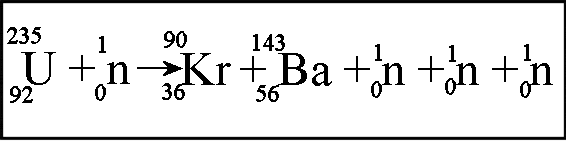
Classify this process.
a)
Nuclear fission
b)
Nuclear fusion
c)
Alpha decay
d)
Beta decay
111.
What process is modeled by the equation?
a)
alpha decay
b)
beta decay
c)
fission
d)
fusion
112.
What process is modeled with this equation?
a)
alpha decay
b)
beta decay
c)
fission
d)
fusion
113.
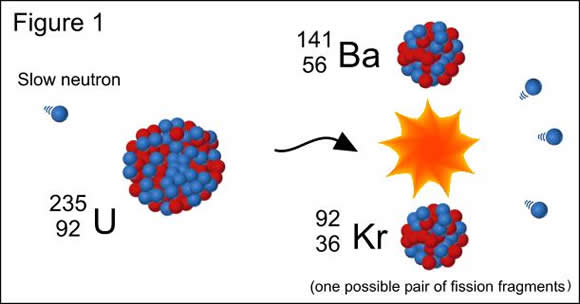
Which nuclear process is shown in the picture?
a)
fission
b)
fusion
c)
alpha decay
d)
beta decay
114.

The energy released by a nuclear reaction results primarily from the —

a)

conversion of energy into mass.

b)

conversion of mass into energy.

c)

breaking of bonds between atoms.

d)

formation of bonds between atoms.

115.

A nuclear fission reaction and a nuclear fusion reaction are similar because both reactions —

a)

release a large amount of energy.

b)

form light nuclides from heavy nuclides.

c)

form heavy nuclides from light nuclides.

d)

absorb a large amount of energy.

116.

For a given mass of reactants, the energy released is greatest for a reaction involving —

a)

fission.

b)

rapid oxidation.

c)

fusion.

d)

slow oxidation.