wayground logo

Free Printable Worksheets

Font size

S
M
L
XL
Worksheets

APES My Community Ecology Review

Total questions: 114

Worksheet time: 58mins

Name
Class
Date
1.

What factor describes when populations decrease because animals are moving out of a population?

a)

Emigration

b)

Limiting Factors

c)

Immigration

d)

Exponential Growth

2.
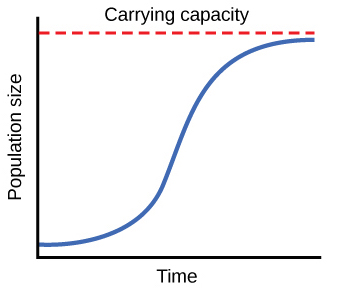
What does the graph represent?
a)
Emigration
b)
Exponential growth
c)
Immigration
d)
Logistic Growth
3.
Which limiting factor is independent of the number of individuals in a population?
a)
competition
b)
parasitism/disease
c)
stress
d)
natural disasters
4.

What point on the graph represents the carrying capacity?

a)

A

b)

B

c)

C

d)

D

5.

A population is...

a)

All members of one species in one area

b)

All members of all species that live in one area

c)

All of the living and nonliving things in an area

d)

None of these

6.
Which factor is a density-dependent limiting factor on the population of a species?
a)
seasonal variation
b)
natural disasters
c)
unusual weather
d)
predation
7.

What is happening at the 'A' on the graph?

a)

the population overshoots above the carrying capacity

b)

the population stops growing

c)

growth begins to slow down due to limited resources

d)

growth is speeding up due to an abundance of resources

8.
To measure population density, you must divide the number of individuals living in a defined space by the
a)
area of the space
b)
birth and death rates
c)
carrying capacity
d)
height of the space
9.
Lichens and mosses that first live in uninhabited areas are examples of
a)
secondary species
b)
non-native species
c)
pioneer species
d)
climax species
10.
Which threat to biodiversity is being displayed?
a)
overexploitation
b)
invasive species
c)
pollution
d)
habitat fragmentation
11.
Species that could become endangered in the near future are called
a)
unlucky
b)
extinct
c)
endangered
d)
threatened
12.
The sea otter is a(n) ___________ that influences the survival of many other species in its ecosystem.
a)
Cute furry creature
b)
endangered species
c)
keystone species
d)
important animal
13.
Which of these would NOT be true of a specialist species?
a)
They are more likely to go extinct during changes to an ecosystem. 
b)
They have a very narrow niche.
c)
They often lose in competition for resources to generalists. 
d)
They often feed on a very specific diet. 
14.
Introduced or invasive species are often difficult because:
a)
They contribute to habitat fragmentation
b)
They do not adapt well to new environments
c)
They increase biodiversity
d)
They often lack natural predators
15.
A species described as r-strategist would definitely NOT have which of the following characteristics?
a)
clumped population pattern
b)
much parenting
c)
many offspring
d)
random population pattern
16.
__________ growth shows growth of a population under environmental constraints (carrying capacity-K) that sets a maximum population size 
a)
logistic
b)
exponential
c)
niche
d)
uniform
17.
________ grow slowly over time, cares for its young over a long period of time and is usually near the carrying capacity of its ecosystem.
a)
K-strategists
b)
R-strategists
c)
Uniform strategists
d)
environmentalists
18.
J-Shaped curves
a)
show a decline after an increase
b)
display populations that have reached carrying capacity
c)
represent exponential growth
d)
does not depend on the numbe rof resources
19.

Two male Giraffes are fighting over the last green leaf of a tree that is dying.

a)

Intraspecific Competition

b)

Mutualsim

c)

Predation

d)

Commensalism

e)

Interspecific Competition

20.

Population increases at a constant rate over time.

a)

Exponential Growth

b)

Logistic Growth

c)

Stable Growth

d)

Strategic Growth

21.

What is the term that refers to all the populations in a given area?

a)

Population

b)

Community

c)

Ecosystem

d)

Biosphere

22.

Bird & Tree: A bird builds a nest in a hole in the trunk of the tree. It is protected from the rain and predators. The tree is not harmed or helped by the bird.

a)

Mutualism

b)

Commensalism

c)

Parasitism

23.

A human & a Tape Worm: The tape worm gets a place to live in the intestines of the human and food from the human. The human loses weight and nutrients from the tape worm.

a)

Mutualism

b)

Commensalism

c)

Parasitism

24.
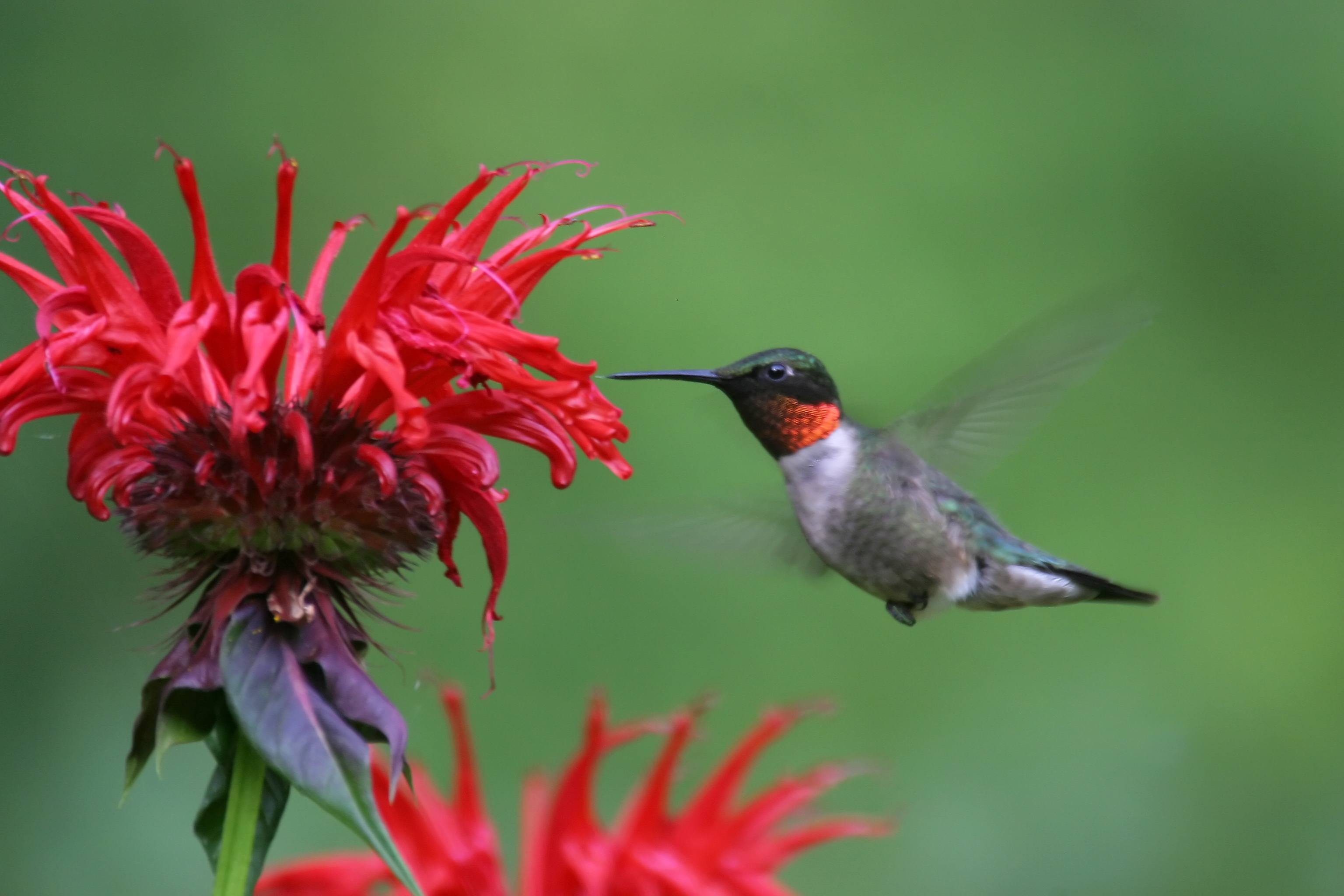
What type of symbiosis?  Hummingbirds feed on nectar from flowers.  The flowers are pollinated by hummingbirds as they move from flower to flower.
a)
commensalism
b)
mutualism
c)
parasitism
d)
predation
25.

Tree kangaroos live in the upper branches of trees in the rainforests of Queensland, as well as on the island of New Guinea. This is an example of the tree kangaroos ___.

a)

niche

b)

habitat

c)

community

d)

population

26.

Which statement best describes the relationship between species A and B?

a)

Species A is the prey of Species B

b)

Species A is a parasite of Species B

c)

Species A is a consumer and B is a producer

d)

Species A and B has a mutualistic relationship
27.
A key stone species is...
a)
the top carnivore.
b)
has the largest population.
c)
has the most specialized niche.
d)
determines numbers and types of other species.
28.
The secondary succession is 
a)
lichens and mosses arrive on bare rock and begin to trap soil
b)
a complex, stable ecosystem is formed
c)
plants grow in an area devastated by a flood
d)
plants grow in a newly formed pond
29.
Primary succession is... 
a)
When a hurricane causes a river to flood its banks
b)
When a farmer ploughs his fields to remove all existing plant life.
c)
When fire burns through a forest and ills all vegetation less than 1m tall.
d)
When increasing temperature causes a glacier to recede from an area of rocky ground
30.
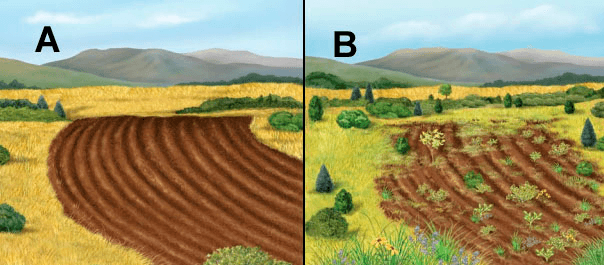
What type of succession is shown going from figure A to figure B?
a)
primary succession
b)
ecological succession
c)
secondary succession
d)
intermediate
31.
Starfish are considered ___ because if the species is negatively affected, it’s going to have a disproportionately greater effect on the whole ecosystem.
a)
a keystone species
b)
an invasive species
c)
an exotic species
d)
an introduced species
32.
When a pine tree grows real tall and blocks sunlight to another pine tree it is _______ competition.
a)
Interference
b)
Intraspecific
c)
Interspecific
d)
Exploitative
33.
Use the diagram to answer the question.
The trout is a source of food for the human and the eagle. When there are more than one organism vying for the same source we call this____?
a)
Population
b)
Resources
c)
Community
d)
Competition
34.

Which of the following traits are most likely to be present in an invasive species?

a)

Generalist

b)

Specialist

c)

r-selected species

d)

K-selected species

35.

Organisms that are successful in a new environment due to access to abundant resources and no predators

a)

threatened

b)

keystone

c)

endangered

d)

least concern

e)

invasive

36.

The BEST example of a population is

a)

groups of different species living in a specific place and potentially interacting with each other

b)

rabbits upon whom bobcats prey

c)

a community of different species interacting with each other and their nonliving environment

d)

a group of cats known as Felis concolor living and interbreeding in one area at the same time

37.

Solar energy flowing to the earth does all of the following EXCEPT

a)

a. evaporate water

b)

b. warm the atmosphere

c)

c. generate winds

d)

d. promote cellular respiration

38.

Which of the following is a correctly diagrammed food chain?

a)

a. Apple tree → worm → salmon → mayfly

b)

b. Algae → filter-feeding clam → octopus → shark

c)

c. Crocodile → antelope → lion → vulture

d)

d. Hawk → snake → mouse → grass

39.

Consider the food chain in the picture:

Using the 10% rule, how many calories of corn will be needed to support a snake that consumes 200 calories of lizard biomass per feeding?

a)

a. 20,000 calories

b)

b. 2000 calories

c)

c. 200,000 calories

d)

d. 20 calories

40.

A type of consumer, these organisms feed on the waste or dead bodies of other organisms.

a)

Omnivores

b)

Autotrophs

c)

Detritivores

d)

Heterotrophs

41.

These organisms can feed at more than one trophic level

a)

a. Omnivores

b)

b. Detritivores

c)

c. Autotrophs

d)

d. Heterotrophs

42.

The rate at which producers in an ecosystem convert solar energy into chemical energy is called

a)

a. range of tolerance

b)

b. gross primary productivity

c)

c. energy flow

d)

d. biological diversity

43.

Generalized pyramid energy flow has only a 10% efficiency because 90% of the energy is lost to the environment as heat. This phenomenon is explained by

a)

a. the second law of thermodynamics

b)

b. the law of limiting factors

c)

c. the law of conservation of matter

d)

d. the greenhouse effect

44.

What is the percent change in striped bass catch at Lake Sagamore from 1994 to 1999?

a)

500%

b)

50%

c)

100%

d)

200%

45.
Which of the following is an example of an ecosystem service?
a)
water filtration
b)
food 
c)
oxygen
d)
they all are!
46.
Of the following, which occupies the lowest trophic level?
a)
Spider
b)
Bat
c)
Rabbit
d)
Tiger
47.
Of the following, which occupies the lowest trophic level?
a)
Spider
b)
Bat
c)
Rabbit
d)
Tiger
48.
In this Food Web Pyramid Which type of consumer gets only 10% of the energy stored in plants?
a)
Herbivore
b)
Carnivore
c)
Omnivore
d)
Top carnivore
49.
In the energy pyramid shown, which organism has the least amount of biomass?
a)
Producers
b)
Herbivores
c)
Carnivores
d)
Top Predator
50.
As it moves through the various food web, energy
a)
is lost
b)
is gained
c)
stays the same
d)
none of these
51.
Which of the following best explains why there are usually no more than five trophic levels in a food chain?
a)
there are not enough organisms to fill more than five levels
b)
there is too much competition among the organisms at the lower levels to support more animals at higher levels
c)
the statement is not true; there can be unlimited amount of trophic levels
d)
energy is lost at each trophic level
52.
Which species is the producer?
a)
A
b)
B
c)
C
d)
D
53.
Which would have the greatest biomass?
a)
A
b)
B
c)
C
d)
D
54.
Which would have the smallest biomass?
a)
A
b)
B
c)
C
d)
D
55.
The difference between “gross production” and “net production” in an ecosystem is that:  
a)
 gross production is the amount of newly acquired energy stored after some of the energy has been used
b)
gross production is the amount of newly acquired energy stored before any has been used
c)
gross production is the amount of newly acquired energy divided by the sunlight energy available 
d)
net production is the amount of newly acquired energy stored before any has been used
56.
A forest has a GPP of 3.8 kg C/m2/year and the rate of cellular respiration is 2.4 kg C/m2/year. What is the NPP? 
a)
6.2 kg C/m2/year 
b)
1.4 kg C/m2/year
c)
9.12 kg C/m2/year 
d)
1.58 kg C/m2/year 
57.
16.Humans have a considerable effect on the hydrologic cycle. Which of the following has a direct effect?
 I. Deforestation
II.Urbanization
III.Mining of fossil fuels
a)
I only
b)
I & II
c)
II & III
d)
I, II, & III
58.
If the number of births is greater than the number of deaths in a population, what will happen to the growth of the population?
a)
It will increase.
b)
It will decrease.
c)
It will stay the same.
d)
It will fluctuate.
59.
Largest number of individuals of a population that the environment can support...  
a)
carrying capacity
b)
population crash
c)
lag phase
d)
mutualism
60.
When a population grows past the ecosystem's carrying capacity, what happens to the population?
a)
Continues to grow
b)
The population starts to die off to return to carrying capcity
c)
The population will go extinct due to lack of resources
d)
The population grows then finds a new carrying capacity
61.
Food, water, sunlight, shelter, and space are resources that are often __________.
a)
limiting factors
b)
wet
c)
messy
d)
found in rocks
62.

What is the correct equation for calculating population growth rate?

a)

Births + Deaths

b)

Births - Deaths

c)

Deaths / Births

d)

Deaths x Births

63.
________ grow slowly over time, cares for its young over a long period of time and is usually near the carrying capacity of its ecosystem.
a)
K-strategists
b)
R-strategists
c)
Uniform strategists
d)
environmentalists
64.
These types of organisms which multiply rapidly in numbers 
a)
R-strategists
b)
K-strategists
c)
predators
d)
mutualists
65.

A Density Independent Limiting Factor is a limiting factor of a population that can affect population growth no matter what the population density. What is a density independent limiting factor that can affect the human population growth of North Carolina?

a)

disease

b)

hurricanes

c)

food supply

d)

water supply

66.

Which of the following statements is true?

a)

Biodiversity decreases with increased sunlight

b)

Biodiversity decreases as you move away from the equator

c)

Biodiversity decreases as you decrease in altitude

d)

Biodiversity increases as you go further down in the oceans

67.

One characteristic feature of the tundra is that only the surface thaws in the summer and refreezes in the winter, leaving a permanently frozen subsoil. This characteristic is known as

a)

Hoarfrost

b)

Glaciation

c)

Permafrost

d)

Crystallization

68.

The kangaroo rat is able to get all of the water it needs through its food and therefore, never needs to drink liquid. This animal has adapted to survive in which biome?

a)

Forest

b)

Tundra

c)

Desert

d)

Grassland

69.
Which biome is characterized by low temperatures and low amounts of rainfall?
a)
Tundra
b)
Desert
c)
Temperate Deciduous Forest
d)
Tropical Rainforest
70.
The most important abiotic factors when studying biomes are...
a)
Food and Water
b)
Rain and Sunlight
c)
Temperature and Oxygen
d)
Precipitation and Temperature 
71.
The biome known for trees with broad leaves that fall off the trees in the winter.
a)
Taiga/Boreal/Coniferous Forests
b)
Temperate Seasonal (Decidious) Forests
c)
Deserts
d)
Tropical Rain Forests
72.

Which biome covers most of the land mass near Earth's equator?

a)

Desert

b)

Grassland

c)

Tropical rainforest

d)

Temperate forest

73.

The rain forest soil is

a)

poor and rocky

b)

frozen soil

c)

thick and nutrient rich

d)

thin and nutrient poor

74.
Which biome, because of its climate, has the largest number of species of plants and animals?
a)
Tundra
b)
Rainforest
c)
Desert
d)
Coniferous forest
75.

Plants with spines and waxy leaves are well suited for life in which environment?

a)

Desert

b)

Temperate forest

c)

Grassland

d)

Tropical Rainfroest

76.
This is the side of the mountain that is often drier and warmer.
a)
Leeward Side
b)
Wet Lapse Rate
c)
Windward Side
d)
Wild Side
77.
Which of the following contributes to the unequal warming of earth?
I. variation in the angle of sunlight that reaches Earth
II. variation in the amount of surface area over which the Sun's rays are distributed
III. variation in the amount of sunlight reflected from clouds
a)
I only
b)
I and II only
c)
II and III only
d)
III only
78.
The Coriolis effect is responsible for
a)
the convergence of two ascending Hadley cells
b)
the location of atmospheric currents caused by the unequal heating of Earth
c)
the cooling effect of air as it rises and expands
d)
the deflection of atmospheric currents
79.
Which is the correct order of the convection cells starting from the equator?
a)
polar, ferrell, hadley
b)
ferrell, hadley, polar
c)
polar, hadley, ferrell
d)
hadley, ferrell, polar
80.
Soil sample that is 60% clay, 30% silt, and 10% sand has which texture? 
a)
clay
b)
clay loam
c)
sandy loam
d)
silt 
81.
Which of the following is the correct order of soil particles in order of increasing particle size?
a)
clay-sand-silt
b)
sand-clay-silt
c)
silt-clay-sand
d)
clay-silt-sand
82.

The rate at which water flows through the soil is called soil percolation or ______.

a)

Groundwater

b)

Permeability

c)

Soil Pores

d)

Porosity

83.
Which soil component has the least capacity for holding water?
a)
silt
b)
clay
c)
sand
d)
humus
84.
You dig a small hole in the soil and the next day it rains. The hole fills with water, but does not empty even after several days of dry weather. What is the soil mostly made of?
a)
clay
b)
sand
c)
humus
d)
silt
85.
The Coriolis Effect is caused by
a)
Earth rotating around the sun
b)
Earth rotating on its axis
c)
The tides
d)
Gravity
86.
The sun's rays are least direct
a)
near the poles
b)
near the equator
c)
at high altitudes
d)
far from the ocean
87.

This phenomenon occurs when a coastal mountain range blocks the passage of precipitation to the leeward side of the mountains.

a)

thermal inversion.

b)

Coriolis effect.

c)

rain shadow effect.

d)

urban heat island effect.

e)

ENSO.

88.

This air circulation pattern occurs between 0 degrees latitude and 30 degrees latitude.

a)

Hadley cell

b)

Ferrell cell

c)

polar cell

d)

Coriolis effect

89.
Which of the following describes the importance of biodiversity to an ecosystem?
a)
a. People like to be able to see all the different plants and animals
b)
b. If there aren�t all the different species, there will be resources that aren�t being used
c)
c. Biodiversity is not as important as many people think
d)
d. Biodiversity can help minimize the effects of losing a species.
90.
The particular role (job) of an organism in its environment including types of food it eats, how it obtains its food and how it interacts with other organisms is called a what?
a)
niche
b)
habitat
c)
home
d)
ecosystem
91.
Two savanna communities both contain 15 plant species. In community A, each of the 15 species is represented by 20 individuals. In community B, 10 of the species are each represented by 12 individuals; the remaining 5 species are each represented by 3 individuals. Which statement best describes the two communities?
a)
Community A has the same biodiversity as community B
b)
Both communities have the same species evenness
c)
Community B has a higher species richness
d)
Community A has higher species evenness
92.
Which of the following biomes has the highest soil nutrient levels?
a)
Temperate seasonal forest
b)
tropical rainforest
c)
temperate rainforest
d)
boreal forest
93.
Which biome is MOST LIKE the "desert" in terms of precipitation?
a)
tropical rainforest
b)
temperate deciduous forest
c)
tundra
d)
coniferous forest
94.
 As you travel from the North Pole toward the equator, you would expect to see
a)
tropical rain forests, then deserts, then taiga.
b)
temperate deciduous forests, then taiga, then tropical rain forests.
c)
tundra, then grasslands, then tropical rain forests.
d)
taiga, then desert, then tundra.
95.

If a population has 1000 individuals, how many years will it take for that population to reach 8000 with an annual growth rate of 2%

a)

35

b)

70

c)

105

d)

140

96.

A wolf needs about 120 acres of land for it to have sufficient resources. How many acres of land are needed to support a wolf population of 17?

a)

2040 acres

b)

240 acres

c)

840 acres

d)

4030 acres

97.

Describe the first law of thermodynamics...

a)

Energy trends toward a less-organized state over time.

b)

Energy is not created, nor is it destroyed. It changes forms.

c)

Matter is neither created nor destroyed.

d)

Energy always moves in the same direction.

98.

This process converts carbon dioxide into glucose by using energy from sunlight...

a)

chemosynthesis

b)

photosynthesis

c)

cellular respiration

d)

aerobic respiration

99.

A wolf pack has 20 wolves one year and 23 the following year. What is the percent change in this wolf pack?

a)

15%

b)

20%

c)

25%

d)

23%

100.
Primary succession is... 
a)
When a hurricane causes a river to flood its banks
b)
When a farmer ploughs his fields to remove all existing plant life.
c)
When fire burns through a forest and ills all vegetation less than 1m tall.
d)
When increasing temperature causes a glacier to recede from an area of rocky ground
101.
People moving from the rural areas to cities is called...
a)
Ruralization
b)
Urbanization
c)
Colonization
d)
None of these
102.
What creates heat islands in cities? 
a)
too much concrete
b)
too many trees
c)
people breathing
d)
urban crisis
103.
what is the leading cause of deforestation?
a)
Diseases 
b)
Housing market
c)
Agriculture and Farming
d)
Paper mill
104.
What is deforestation?
a)
throwing someone out of a window
b)
selectively cutting trees for lumber, making sure the forest remains healthy
c)
allowing more animals to graze on the land than it can support
d)
cutting and removal of rainforest
105.
What are some consequences of deforestation?
a)
increased population in cities
b)
building of more infrastructure
c)
soil erosion, loss of biodiversity, loss of ability to remove CO2
d)
more mercury and cyanide released into rivers
106.

Urbanization has a negative impact on:

a)

Biodiversity, pollution, and ecosystems

b)

Biodiversity, ecosystems, and education

c)

Ecosystems, education, and economy

d)

Economy, pollution, and biodiversity

107.

Urban Sprawl affects which of the following?

a)

Pollution

b)

Public Health

c)

Economics

d)

All answers are correct

108.

An attempt to design cities so as to maximize their functionality and beauty is

a)

City Planning

b)

Urban Sprawl

c)

Urbanization

d)

Ecological Footprint

109.

Which of the following is NOT a problem with suburban sprawl?

a)

destruction of habitats

b)

loss of wetlands

c)

noise pollution

d)

air and water pollution

110.

Which of the following best describes an environmental advantage of urbanization?

a)

Individuals living in cities usually have a lower transportation carbon footprint than individuals living in rural areas

b)

Individuals living in cities usually have greater access to fresh, local agricultural products than individuals living in rural areas.

c)

Individuals living in cities have more varied employment opportunities than individuals living in rural areas.

d)

Individuals living in cities have greater access to health care than individuals living in rural areas.

111.

The type of species that are vulnerable to fragmentation are ___ because they require large plots of land.

a)

apex predators

b)

herbivores

c)

generalists

d)

primary consumers

112.

Based on the theory of island biogeography, which of the following is the most likely reason that an island in the ocean that is 5 kilometers from a continent would have a higher number of species than one that is 15 kilometers from a continent?

a)

There are more species that have the ability to travel 5 kilometers than can travel 15 kilometers.

b)

Islands that are closer to continents always have a wider range of habitats than more distant islands do.

c)

There are smaller populations of each species on islands that are at greater distances from continents.

d)

Islands that are closer to continents always have more ecological niches than more distant islands do.

113.

What prediction is correct about island biogeography?

a)

Smaller islands have more resources, and will have more biodiversity

b)

Larger islands have more space for resources, but will have less biodiversity due to competition

c)

Islands closer to mainland will be more diverse due to more successful dispersal.

d)

There is more diversity far away from the mainland because some species fly.

114.

The study of rates of colonization and extinction of species on islands or other isolated areas is known as

a)

The study of Islandology

b)

Genetic drift

c)

Demographic bottleneck

d)

Island biogeography