wayground logo

Free Printable Worksheets

Font size

S
M
L
XL
Worksheets

Evolution

Total questions: 118

Worksheet time: 2hrs 33mins

Name
Class
Date
1.
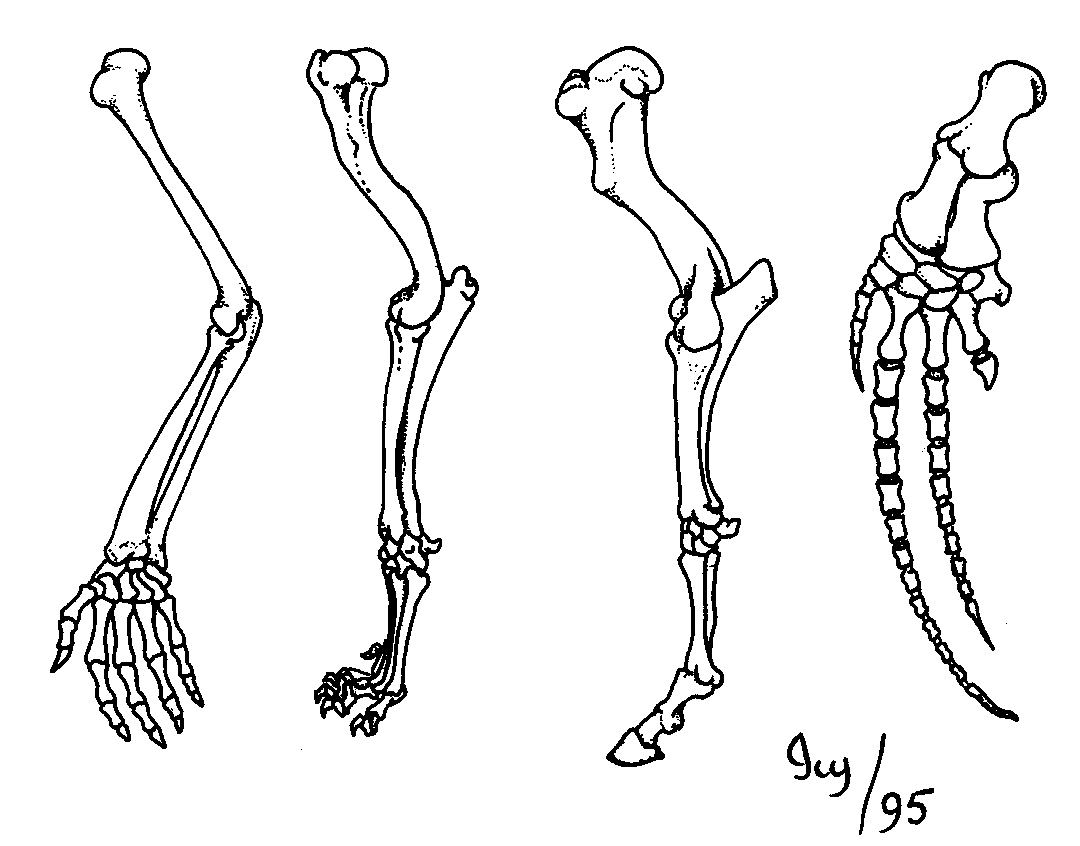
The scientific theory of evolution is supported by different types of evidence. The diagrams below show the skeletons of two different animal species. How does comparing the skeletons of these animals provide support for the scientific theory of evolution?
a)
 It provides information about the organisms' habitats.
b)
 It shows possible common ancestry between organisms.
c)
It provides information to determine the organisms' ages.
d)
It shows possible chromosomal similarities between organisms.
2.
According to fossil records, the horses that lived 50 million years ago were much smaller, weaker and slower than modern horses. Which process is most likely responsible for the changes that have led to the increased size, strength, and speed in horses?
a)
commensalism
b)
inbreeding
c)
migration
d)
evolution by natural selection
3.
The diagram illustrates an embryonic stage of two organisms.Which of the following can be determined by observing the embryos shown in the diagram? 
a)
The organisms share a common ancestry.
b)
The organisms belong to the same genus.
c)
The organisms are native to the same geographic areas.
d)
The organisms will grow into anatomically similar adults.
4.
Scientists have found evidence that about 2.4 million years ago a gene regulating jaw muscles mutated and may have led to the more graceful human jaw we see today. The diagram below shows the skulls of 3 hominid species.Which statement below most closely explains the link between jaw size and hominid evolution? 
a)
The jaws of hominids evolved to be smaller and less protruding over time. 
b)
The jaws of hominids evolved to be smaller and less protruding over time. 
c)
There appears to be no change in the jaws of hominids over time.
d)
The jaws of hominids changed over time due to a change in brain size. 
5.
Scientists are studying the evolutionary history of a group of plants in the United States, and they developed an evolutionary tree, as shown below.Which statement can be inferred from the evolutionary tree?
a)
Species 1 is most closely related to Species 8.
b)
Species 2 is most closely related to Species 3.
c)
Species 3 is most closely related to Species 7.
d)
Species 5 is most closely related to Species 6.
6.
Scientists are studying the evolutionary history of a group of plants in the United States, and they developed an evolutionary tree, as shown below.What information about the organisms best helps the scientists to determine the evolutionary relationships among them?
a)
DNA sequences
b)
 Anatomical features
c)
Habitat types
d)
Reproductive Strategies
7.
One of the accepted scientific theories describing the origin of life on Earth is known as chemical evolution. According to this theory, which of the following events would need to occur first for life to evolve?
a)
 onset of photosynthesis 
b)
 origin of genetic material 
c)
 Synthesis of organic molecules
d)
formation of the plasma membrane
8.
 The diagram represents the relationship between beak structure and food in several species of finches found on the Galapagos Islands. The different beak structures observed in the diagram are evidence of
a)
 different species of finches adapting to different environments over many generations
b)
 finches changing their beak characteristics so that they could feed efficiently
c)
finch species with different beak structures coming to the Galapagos Islands from the mainland
d)
 finches mating with birds of other species and acquiring some of their traits
9.
Natural selection is best described as
a)
a change in an organism in response to a need of that organism
b)
a process of nearly constant improvement that leads to an organism that is nearly perfect
c)
differences in survival rates as a result of different inherited characteristics
d)
inheritance of characteristics acquired during the life of an organism
10.
Which occurrence represents an example of evolution?
a)
 Exposure to radiation reduces the rate of mutation in leaf cells.
b)
A mutation in a liver cell causes a person to produce an enzyme that is less efficient.
c)
 Cells in a zygote eventually change into bone cells or skin cells
d)
Some antibiotics are almost useless, because pathogens have developed a resistance to these antibiotics.
11.
A biological ____________ is a group of interbreeding populations that is reproductively isolated from other groups.
a)
species
b)
family
c)
phylogeny
d)
hybrid
12.
______ _________ explains how two or more organisms could evolve similar traits even though they are not related to each other.
a)
convergent evolution
b)
reproductive isolation
c)
derived characters
d)
hybrid vigor
13.
A __________ is a branching diagram that shows evolutionary relationships.
a)
cladogram
b)
table
c)
derived character
d)
relationship tree
14.
The system of binomial nomenclature was developed by ___________
a)
Linneaus
b)
Mayr
c)
Darwin
d)
Mr. King
15.
The scientific name for humans is _______ ____
a)
Homo sapiens
b)
Homo neandertal
c)
homo Sapiens
d)
homo sapiens
16.
__________ characters are similar characteristics that have evolved separately in two unrelated organisms.
a)
analogous
b)
homologous
c)
cladistic
d)
phylogenic
17.
_________ characters may or may not be similar between two organisms but they developed from a common ancestor.
a)
homologous
b)
analogous
c)
cladistic
d)
phylogenic
18.
______________ is the process by which populations change in response to their environment.
a)
natural selection
b)
adaptation
c)
reproductive isolation
d)
divergence
19.
__________ enable an organism to survive in its environment.
a)
adaptations
b)
natural selections
c)
divergence
d)
extinctions
20.
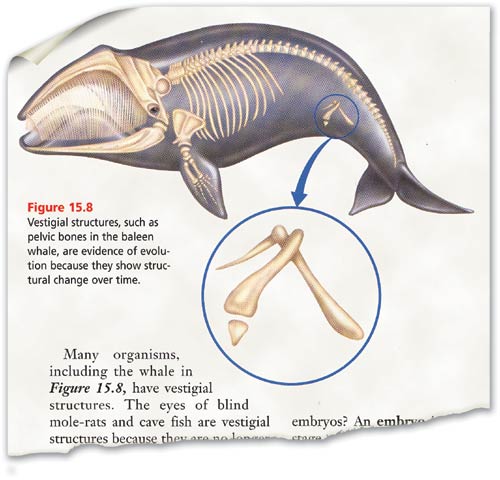
________ structures are reduced in size or function.
a)
vestigial
b)
homologous
c)
cladistic
d)
phylogenic
21.
________ are populations of the same species that differ genetically because of adaptation.
a)
subspecies
b)
homologues
c)
analogs
d)
genuses
22.
Scientists DO NOT classify organisms based upon
a)
geographic isolation
b)
structure
c)
breeding patterns
d)
DNA
23.

True or false, evolution happens when an individual organism starts changing itself to adapt to its environment. For example, an adult polar bear might start swimming more so it can handle the melting of the polar ice caps.

a)

false, if it had a cub that could swim better due to longer legs or more buoyant bone structure, this could become a more common trait.

b)

True, evolution happens due to changing individuals

c)

maybe, if it chose to.

d)

I wish I had a pet penguin

24.

Cheetah's all have 99% identical DNA. Which is/are true?

a)

They are more likely to evolve into a new species than other cats due to gene flow.

b)

They are likely to go extinct because they have so little variation.

c)

They likely underwent a bottleneck in their history.

d)

The founder's effect made it so they have several different subspecies.

e)

Cheetahs never prosper and winners never cheat.

25.

Some evidence that supports theropods as ancestors to birds is:

a)

some theropods had gizzards and hollow bones like birds

b)

their DNA is very similar

c)

they have all of the intermediate fossils between them

d)

theropods all had feathers

e)

scientists found collagen in fossils of theropods

26.

When organisms are better adapted to their environment they will survive and reproduce more successfully than organisms less adapted. This process is called what?

a)

Selective breeding

b)

Natural Selection

c)

Cloning

d)

Evolution of all species

27.

Gigantopithecus were very large primates that lived 500,000 years ago. Since none of these mammals are still today, they are said to be....

a)

Extinct

b)

Threatened

c)

Endangered

d)

Declining

28.

Scientists have collected millions of fossils of different organisms, and have developed a timeline of life on Earth. What do we call this?

a)

Mutation

b)

Natural Selection

c)

The theory of evolution

d)

Fossil Record

29.

Sometimes bones in the front limbs of animals are very similar in structure. What do we call similar bone structures that indicate a link to a common ancestor?

a)

Adaptations

b)

Gradualism

c)

Homologous Structures

d)

Extinction

30.

When looking at two birds of the same species, you notice that one has darker feathers than the other one. You also notice that one has a beak that is just a little longer. These slight differences within members of the same species are called.....

a)

Fossils

b)

Extinction

c)

Meiosis

d)

Variations

31.

What is the study of organisms at the early stages of development?

a)

DNA studies

b)

Comparative Embryology

c)

Extinction

d)

Fossil Record

32.
Which of the following is a term for a group of similar organisms that can reproduce fertile offspring?
a)
individual
b)
population
c)
species
d)
fossil
33.
If an organism has a vestigial structure, that structure likely once had a function in a(n)
a)
close relative
b)
early ancestor
c)
unrelated organism
d)
embryological stage
34.
Mutations are important because they bring about
a)
death of the organism in which they develop
b)
genetic variation needed for a population to evolve
c)
benefits for the individual, not for the population
d)
Hardey-Weinberg equilibrium within a population
35.
Extinction can occur because of which of the following?
a)
All can be causes of extinction.
b)
Increased competition with other species
c)
New predators within the environment
d)
Loss of habitat and/or catastrophes
36.
Magda is a tall, 11 year old drummer. She has a scar on her right cheek. She is good at swimming. Which of her traits did Magda most likely inherit?
a)
height
b)
the scar
c)
ability to swim
d)
ability to play drums
37.
According to the diagram, which organism is older?
a)
ammonite
b)
coral
c)
gastropod
d)
trilobite
38.
Structures with the same parts have different functions; suggests that organisms share a common ancestry
a)
vestigial structures
b)
homologous structures
c)
adaptive radiation
d)
fossil
39.
Which of the following is an example of a vestigial structure?
a)
the wings of a red-tailed hawk
b)
the hind limbs of a house cat
c)
the fins of sharks
d)
the tailbone of a human
40.
The diagram shows fossils in different rock layers. Which of these statements about the age of these fossils is most likely correct?
a)
Fossil A and C are the same age
b)
Fossil B is older than fossil C
c)
Fossils A is older than fossil B
d)
Fossil D is older than fossil C
41.
If species A and B have very similar genes and proteins, what is probably TRUE?
a)
species A and B share a relatively recent common ancestor
b)
species A evolved independently of species B for a long period
c)
species A is younger than species B
d)
species A is older than species B
42.
Farmers breed cows to produce high amounts of milk. This is an example of...
a)
Natural Selection 
b)
Variations in a species 
c)
Selective Breeding 
d)
inbreeding
43.
What is the process in which humans breed organisms for certain traits?
a)
natural selection
b)
inheritance
c)
artificial selection
d)
descent withOUT modification
44.
What increases genetic variation when animals move from one population to another
a)
genetic drift
b)
sexual selection
c)
bottleneck effect
d)
gene flow
45.
Individuals that are better able to cope with the challenges of their environment tend to  
a)
Decrease in population over time.
b)
Leave more offspring than those less suited to the environment.
c)
Leave fewer offspring than those less suited to the environment.
46.
The fossil record provides evidence that 
a)
Fossils cannot be dated.
b)
All species were formed during Earth’s formation and have changed little since then.
c)
The fossilized species have no connection to today’s species.
d)
Older species gave rise to more-recent species.
47.
Starting in 1954, commercial fishers in the northwest Pacific were paid by weight, rather than by the individual fish, for pink salmon. The fishers increased the use of a type of net that selectively catches larger fish.  Which of the following effects did this change in fishing technique most likely have on the salmon population over the next 20 years?
a)
The average body size of the salmon population decreased significantly.
b)
The average body size of the salmon population increased significantly.
c)
The average body size of the males in the salmon population increased, and the females stayed the same.
48.
European rabbits were introduced to Australia in 1859. The rabbits reproduced rapidly in their new habitat, displaced other animals, and overgrazed vegetation. In an attempt to reduce the rabbit population, a virus was introduced in 1951. This virus is usually deadly to European rabbits. When the virus was first introduced, the rabbits died in large numbers, but the death rate decreased over time. Which of the following best explains the decrease in the rabbit death rate? 
a)
Young rabbits learned to avoid being infected with the virus.
b)
The lifespan of the virus was too short to affect rabbits over a long period of time.
c)
Natural selection favored rabbits that were resistant to the virus. 
d)
No correct choices.
49.
Which of the following statements gives the most likely explanation for the presence of two very similar species of squirrels living on opposite sides of the Grand Canyon?
a)
One squirrel traveled across the canyon and started a new population on the other side.
b)
One squirrel traveled across the canyon and interbred with a different population on the other side.
c)
Members of one single squirrel species were geographically separated by the formation of the canyon.
d)
Members of two different squirrel species migrated from two different places to opposite sides of the canyon. 
50.
The Asian shore crab invaded parts of the eastern coast of the United States about 15 years ago. The Asian shore crab preys on blue mussels. In the time since the Asian shore crab arrived, the average shell thickness of the blue mussel population has increased. Which of the following is the most likely reason that this increase in shell thickness has occurred? 
a)
Blue mussels with thick shells attract more crabs that mussels without thick shells.
b)
Blue mussels with thick shells grow in larger colonies than mussels without thick shells.
c)
Blue mussels with thick shells catch more food per day than mussels without thick shells.
d)
Blue mussels with thick shells survive and reproduce more successfully than mussels without thick shells.
51.
Some willow trees alter the chemical composition of their leaves when attacked by caterpillars. Compared to normal leaves, the chemically altered leaves are less nutritious and more difficult for caterpillars to digest.
 Which of the following is a likely effect of this ability to alter leaf composition?
a)
Willow trees with this ability will attract more caterpillars than other willow trees.
b)
Willow trees with this ability have a survival advantage over other willow trees. 
c)
More butterflies will lay their eggs on willow trees with this ability than other willow trees. 
d)
None are correct
52.
Structures that share a common ancestry or are similar because they are modified versions of structures from a common ancestor that contain the same basic bone structure are
a)
Not related.
b)
Not homologous. 
c)
Homologous.
d)
Young in origin.
53.
The process in which organisms with traits well suited to an environment are more likely to survive and to produce offspring is
a)
Natural Selection
b)
Origin of Species
c)
Genetic Principles
d)
Trait Mechanism
54.
Comparing human hemoglobin of chimpanzees, horses, kangaroos, and chickens, reveal that humans have the fewest amino acid differences with 
a)
Kangaroos
b)
Horses
c)
chickens
d)
chimpanzees
55.
The hypothesis that evolution of a species occurs in periods of rapid change separated by periods of little or no change is called
a)
divergence
b)
gradualism
c)
punctuated equilibrium
d)
isolation
56.
The formation of new species is a process known as ____________________, which is typically the product of divergence. 
a)
gradualism
b)
speciation
c)
reproductive isolation
d)
subspecies
57.
The hypothesis that evolution of a species occurs gradually over time as a slow and constant process is known as
a)
speciation
b)
punctuated equilibrium
c)
gradualism
d)
microevolution
58.
Which of the following phrase best describes how Thomas Malthus influenced Charles Darwin’s idea of natural selection?
a)
The number of resources available can limit the survival of a species. 
b)
The survival of a species depends on the traits they acquire in their lifetime.
c)
The survival of a species is determined by how many offspring they leave behind.
d)
The Earth is constantly changing; seashell fossils were found at the top of the Andes Mountains. 
59.
Which of the following statements best reflects the evolutionary importance of the figures pictured?
a)
New genetic instructions have been disregarded in the evolution of vertebrates.
b)
Early in development, vertebrate embryos show no evidence of common ancestry.
c)
All adult vertebrates retain pharyngeal pouches (gills).
d)
The evolutionary history of organisms is seen in the way embryos develop.
60.
All the individuals of a species that live in a particular area are called a
a)
variation
b)
population
c)
fossil
d)
group
61.

What type of structures are shown?

a)

Homologous

b)

Analogous

c)

Vestigial

d)

Heterologous

62.

The "Best" form of evidence for evolutionary relationships is-

a)

Molecular- DNA

b)

Fossils

c)

Homologous Structures

d)

Analogous Structures

63.

According to fossil records, the horses that lived 50 million years ago were much smaller, weaker and slower than modern horses. Which process is most likely responsible for the changes that have led to the increased size, strength, and speed in horses?

a)

evolution by natural selection

b)

migration

c)

inbreeding

d)

commensalism

64.

Which of the following is not considered a VESTIGIAL structures in humans.

a)

coccyx

b)

appendix

c)

wisdom teeth

d)

kidneys

65.

All dogs have the common ancestor the wolf. This is an example of -

a)

divergent evolution

b)

convergent evolution

66.
which of the folllowing is an exammple of a vestigial structure?
a)
the wings of a red-tailed hawk
b)
the hind limbs of a house cat
c)
the fins of sharks
d)
the wings of an ostrich
67.
Two organisms that are closely related would have
a)
very similar DNA sequence
b)
exactly the same DNA sequences
c)
no proteins in common
d)
completely different DNA sequence
68.
Darwin’s finches is an example of this type of evolution.
a)
Divergent
b)
Coevolution
c)
Convergent
d)
Artificial
69.
Which layer is the oldest?
a)
1
b)
2
c)
3
d)
4
70.
Darwin referred to this as survival of the fittest. Over time, it results in changes in the inherited characteristics of a population. 
a)
Natural Selection
b)
Genetic Variation
c)
Survival of the Fittest
d)
Extinction
71.

Mimicry is

a)

Long Time evolutionary events

b)

Short time evolutionary events

c)

Mistakes in the genetic code

d)

When an organism looks very similar win physical resemblance to other objects

72.
If teeth shape in herbivores is flat  and good for grinding, and carnivores have sharp teeth for ripping and puncturing flesh. What can best be concluded?
a)
herbivores evolved from carnivores
b)
carnivores evolved from herbivores
c)
nutrients in food determine teeth shape
d)
different teeth evolved from natural selection
73.
Which of the following did NOT happen in the endosymbiotic theory?
a)
chloroplast moved into prokaryotes
b)
mitochondria moved into prokaryotes
c)
prokaryotes eventually turned into eukaryotes
d)
eukaryotes turned into prokayotes 
74.
If you were to obtain DNA from the following species they would
a)
have identical DNA
b)
have identical amino acid sequences
c)
have nucleotide sequences that showed similarities
d)
have the same number of chromosomes
75.
Combined genetic information of all the members of a particular population
a)
variation
b)
speciation
c)
gene pool
d)
fitness
76.
Some organisms have genes that improve their ability to survive and reproduce. If the gene also help their offspring survive and reproduce, then which of the following will most likely increase?
a)
The number of genes in a species
b)
The frequency of genes in a population
c)
The frequency of genes in one individual 
77.
The opossum and kangaroo both incubate their young in a pouch. This provides evidence that they---
a)
are descended from a common ancestor
b)
Have very similar skeletal structures
c)
belong to the same species
d)
must range great distances to eat
78.
What do these three organisms have in common?
a)
They have stomachs of the same size
b)
They have DNA made up of the same components
c)
They have eyes that see the same ways
d)
They have brains that are the same size
79.
The white feathers of a snowy owl allow it to blend in with its environment during the winter months (snow). This is an example of ________________
a)
Species
b)
Environmental Change
c)
Adaptation
d)
Variation
80.
The concept of gene flow is demonstrated when a cow is driven off from its herd, joins another herd, and reproduces. When the cow contributes to the gene pool of the new herd, which of these will most likely increase?
a)
Environmental fitness
b)
Reproductive mutations
c)
Natural selection
d)
Genetic variation
81.
Genetic drift is a process that causes---
a)
The genetic makeup of an entire population to disappear
b)
The genetic makeup of an entire population to be altered
c)
Organisms to better adapt to their environment
d)
Organisms to have the same DNA as their parents
82.
The DNA of an advanced species of grasshoppers contains---
a)
New types of bases, all formed from mutations in a primitive species of algae
b)
Different bases than the DNA of a primitive species of algae
c)
The same bases as the DNA of a primitive species of algae
83.
Which of the following statements best explains why some mosquitoes survived after the first spraying?
a)
Some mosquitoes had a genetic mutation that made them resistant to the insecticide
b)
A.  All mosquitoes had a genetic mutation that made them resistant to the insecticide
c)
A.  None of the mosquitoes had a genetic mutation that made them resistant to the pesticide
84.
A trait that an organism expresses during its lifetime will only cause its species to become better adapted if the trait—
a)
A.  Results from isolation of the organism from the rest of the population 
b)
A.  Is caused by the genetic code that is present in the gametes of the organism
c)
A.  Causes a change in the environment surrounding the organism
d)
A.  Decreases the number of genes in the body cells of the organism
85.
A graph regarding the effect of agricultural bioengineering on insect pests is shown below How has natural selection affected species of insect pests?
a)
A.  Natural selection has not affected the number of species that are resistant to pesticides
b)
A.  Natural selection has rapidly increased the number of species that are resistant to pesticides
c)
A.  Natural selection has only affected the number of species that are resistant to pesticides
86.
The table shows the survival rate of two types of beetles in the same environment over a period of three years.  

Which statement about the beetles in this environment is best supported by the data?
a)
Brown beetles have a shorter life cycle than green beetles have
b)
Green beetles are more fit for their environment than brown beetles
c)
 brown beetles are undergo more unfavorable mutations than green beetles
87.
The green frog (Lithobates clamitans clamitans) is found in many parts of the United States. The table contains some information about this frog.
Why does the ability to lay 1,000 to 5,000 eggs increase the fitness of the species L. clamitans clamitans?
a)
A.  It increases the probability that some offspring will survive long enough to reproduce.
b)
It increases the chance of the recombination of alleles, leading to genetic drift in the population.
c)
A.  It increases opportunities for offspring to compete for limited resources.
88.
A prey population consists of individuals with a variety of running speeds.
The adaptation that allows some of these animals to run fast would be an example of natural selection if it helps them —
a)
survive and undergo mutations in their DNA
b)
produce offspring that run at average speeds
c)
reproduce and increase the frequency of their genes in the population
d)
lower the mortality rates of the population
89.
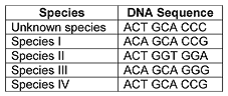
According to this data, the unknown bacterial species is most closely related to: 
a)
Species I
b)
Species II
c)
Species III
d)
Species IV
90.
Certain insects resemble (look like) the bark of the trees on which they live. Which statement provides the best explanation  for this resemblance? (Peppered Moths)
a)
The trees caused mutations in the insects
b)
Natural selection played a role in this protective coloration
c)
The insect camouflage so they developed this coloration
91.
The similarities of organisms in which two areas numbered in the picture provide the best evidence for common ancestry?
a)
1 and 2
b)
3 and 4
c)
5 and 6
d)
7 and 8
92.
Which statement best describes a relationship between these organisms?
a)
Organism A was probably more primitive than Organisms B and C
b)
Organism A was probably more complex than organism B and C
c)
All of these organisms probably lived at the same time
93.
Scientist sometimes compare the limbs of these organisms to look for evidence of common ancestry.
These limbs provide evidence of common ancestry because they— 
a)
have the same basic structure
b)
are the same size
c)
are parts of mammals
d)
perform the same function
94.
Genetic variation can aid in the survival of species when the environment changes.
Which of the following is the best example of an organism with a genetic variation that could improve survival chances over time?
a)
an ant that is resistant to pesticide
b)
a cactus that has no spikes
c)
a mouse that has learned to avoid mouse traps
95.
Common baboons live on the savanna in breeding groups called troops. While females tend to stay with the troop, younger or less dominant males may leave to join a neighboring troop.
Which of these is a likely outcome of movement by young males? 
a)
Gene flow occurs between the populations
b)
relative genotypic frequencies reach a constant state
c)
Allele frequencies suddenly change
96.
What is this an example of?
a)
diversity of species
b)
variation
c)
vestigial structures
d)
DNA studies
97.

Why are hybrid animals, e.g ligers or mules, not considered a new species?

a)

They are sterile

b)

They can interbreed

98.

What is a species?

a)

A group of organisms that can interbreed to produce fertile offspring.

b)

A group of organisms that can interbreed to produce infertile offspring.

c)

A group of different organisms that can interbreed to produce fertile offspring.

99.

What is the cause of allopatric speciation?

a)

Geographical Isolation

b)

Reproductive Isolation

100.
A population of chimpanzees was separated when the forest that they lived in had a section cut down and a town was built. After a long period of time, the chimpanzees came back into contact but were incapable of breeding. Which of the following best describes the process that occurred?
a)
adaptation
b)
speciation
c)
convergent selection
d)
stabilizing selection
101.

Which of the following is the best definition of geographic isolation?

a)

the separation of members of a species through geographical forces

b)

the separation of members of different species through geographical forces

c)

the separation of populations of different species through time

d)

the separation of members of a species through anatomical forces

102.

Human and cat DNA similitude is around 90%. This is an example of which of the following...

a)

Geologic Fossil Record

b)

DNA Structural Similarities

c)

Homologous Structure

d)

Embryological Development

103.
Which of the following is a type of evidence for evolution?
a)
natural selection
b)
genetic flow
c)
biochemistry
d)
sexual reproduction
104.
Studying the difference between fossils and modern organisms helps scientists better understand the --
a)
Role of mutations in life functions
b)
Primary function of key macromolecules
c)
Adaptation of organisms through acquired traits
d)
Evolution of organisms overtime
105.
What is a gene pool?
a)
Genes or DNA that have been changed.
b)
All the genes or DNA in a population.
c)
All the organisms in a population
d)
All the DNA or genes in a human
106.
When scientists compare the amino acid sequences for the red blood cell protein hemoglobin between various species, what can they determine about the evolutionary relationship between the species?
a)
It can be determined how efficient hemoglobin is for different species
b)
It can provide evidence about the relatedness of the different species: if they are more similar they have a more recent common ancestor.
c)
It cannot determine relatedness between different species, only individuals of the same species
d)
It can show which species evolved first
107.
When scientists compare the amino acid sequences for the red blood cell protein hemoglobin between various species, what can they determine about the evolutionary relationship between the species?
a)
It can be determined how efficient hemoglobin is for different species
b)
It can provide evidence about the relatedness of the different species: if they are more similar they have a more recent common ancestor.
c)
It cannot determine relatedness between different species, only individuals of the same species
d)
It can show which species evolved first
108.
The Table below shows the # of differences in amino acids in a protein called “Cytochrome C” when comparing humans to other organisms. The protein is used by many plants and animals to convert energy in cells.
List the 4 closest human relatives based on this biochemical comparison.
a)
chimpanzee, horse, rattlesnake, snapping turtle
b)
chimpanzee, gorilla, rhesus monkey, horse
c)
fruit fly, bread mold, tuna fish, snapping turtle
d)
gorilla, rhesus monkey, rattlesnake, gorilla
109.

Which Hardy-Weinberg factor represents the frequency of heterozygous individuals in a population?

a)

p2

b)

2pq

c)

q2

d)

p2 + 2pq

110.
A few deer wander out of their native woods into a completely new park where no deer had ever been before. They go on to create an entirely new population.
a)
Genetic Drift
b)
Natural Selection
c)
Non-random mating
d)
Mutation
111.
A few deer wander out of their native woods into a completely new park where no deer had ever been before. They go on to create an entirely new population.
a)
Genetic Drift
b)
Natural Selection
c)
Non-random mating
d)
Mutation
112.
What does the Hardy-Weinberg equilibrium measure?
a)
changes in allele frequencies
b)
numbers of mutations
c)
goodness of fit
d)
genetic diversity
113.
In the Hardy-Weinberg Equation, q2 is the frequency of what?
a)
The recessive allele 
b)
the dominant allele
c)
the recessive genotype
d)
the dominant genotype
114.
A population of 150 individuals has an allele frequency of 0.3 for the dominant allele (B) and a frequency of 0.7 for the recessive allele (b). Use the Hardy-Weinberg equation to determine the frequency of the genotype (bb).
a)
0.09
b)
0.42
c)
0.49
d)
0.21
115.

The allele frequency of p=.20 What is the percentage of recessive genotype?

a)

.80

b)

.04

c)

.32

d)

.64

116.

If a population experiences no migration, is very large, has no mutations, has random mating, and there is no selection, which of the following would you predict?

a)

The population will evolve, but much more slowly than normal

b)

The makeup of the population's gene pool will remain virtually the same as long as these conditions hold.

c)

The composition of the population's gene pool will change slowly in a predictable manner.

d)

Dominant alleles in the population's gene pool will slowly increase in frequency while recessive alleles will decrease.

e)

The population probably has an equal frequency of A and a alleles.

117.
Which of the following statements is supported by the graph below?
a)
The population is in Hardy-Weinberg equilibrium, as the sum of the frequency of the dominant allele and the recessive allele is always equal to 1
b)
The percentage of individuals homozygous recessive for this particular trait is increasing over time
c)
Selection has caused frequencies to change over time because individuals with a dominant allele survive at higher rates than individuals with recessive alleles
d)
Individuals who are homozygous recessive for this particular trait have migrated into the population, causing the frequency to approach 1
118.
When a population is in Hardy-Weinberg equilibrium,  what is NOT happening to the species?
a)
Survival
b)
Reproduction
c)
Death
d)
Evolution