
 Worksheets
Lesson 2 Natural Hazards
Total questions: 121
Worksheet time: 1hrs 5mins
Typhoon is locally known as ________________________
baha
ulan
bagyo
buhawi
The _________________ is the area of lowest atmospheric pressure in the structure of the tropical cyclone.
eyewall
eye
rain bands
clouds
This is the localized unusual increase of sea water level which can be brought by a tropical cyclone.
storm surge
high tide
flooding
tsunami
When a tropical cyclone has caused 300 casualties or more than 1 billion worth of damage, it is removed from the list of typhoons because ________________.
it might cause confusion
it might bring back memories to survivors
PAG-ASA just feels that it is time to change it
first two choices are correct
Wind speed is 121 kph to 170 kph within the next 18 hours
PSWS 1
PSWS 2
PSWS 3
PSWS 4
An instrument used to detect and record earthquakes.
seismic
router
seismograph
ground shaking
It produce tremors that occur before or after an explosion. It is relatively not common unlike tectonic earthquake.
Volcanic eruption
plate
after shock
ground shaking
Occurs when trembling of earthquake cause of a soil to lose strength and flow.
Volcanic eruption
explosion earthquakes
after shock
.liquefaction
Movements within the earth’s crust cause stress to build up weakness and rocks to deform, also rocks breaking under stress.
Volcanic eruption
explosion earthquakes
after shock
Induced Ground Subsidence
A large wave in the ocean, usually cause by underwater volcanic eruption,earthquake,or coastal landslide
tsunami
explosion earthquakes
Induced landslide
Induced Ground Subsidence
An observant person can sense a tsunami coming that by assessing the following:
Feel severe tremor
See high water surge
Hear a bizarre howl
Hear sizzling sounds
Provinces at Risk for Earthquake:
La Union
Benguet
Tawi-tawi
Pangasinan
Provinces at Risk for Tsunami.
Sulu
Tawi-tawi
Basilan
Pampanga
Tsunami Preparedness Checklist:
Prepare and make a disaster supply kit and have a family plan.
Readiness and awareness may protect you.
Everyone in your household should know what to carry out if tsunami arises.
Ready for the aftershocks and follow your school/work place emergency plan or instructions of the person in charge.
Measures that can be taken DURING an earthquake:
Do deep breathing exercise and stay safe and calm.
Up against a wall near the center of the building or stand in a doorway.
No matter what, stay away from power lines, broken lines, and using candles, matches
or any flame are prohibited.
Determine the elevation of your street above sea level and the expanse of your street from the shoreline.
Earthquake safety checklist:
Arrange your heavy furniture, water tanks, and gas tank in a lower ground.
Teach each member of the family how to use the emergency equipment.
Family members should be familiar in turning off gas tank, water valve and electricity.
Everyone in your household should know what to carry out if tsunami arises.
These are high concentration density currents essentially non-turbulent and confined to valleys.
(a)
Which from these volcanoes in the Philippines are active?
Mt. Hibok-hibok
Mt. Makiling
Mt. Bontes
Mt. Pinatubo
Mt. Ragang
What is a primary earthquake wave that travels through the body of the earth; so named because it is the first wave to reach a seismograph station during an earthquake.
P-wave
S-wave
Surface wave
body wave
Duck, cover and hold wherever you are.
Do it before an earthquake.
Do it after an earthquake.
Do it during an earthquake.
Make a plan of where to meet your family after an earthquake.
Do it during an earthquake
Do it before an earthquake
Do it after an earthquake
Participate in earthquake drill conducted in your school.
Do it before an earthquake
Do it after an earthquake
Do it during an earthquake
If you are at school, follow the emergency plan or the instruction of the teacher.
Do it before an earthquake
Do it during an earthquake
Do it after an earthquake
If you are near the shore, move quickly to a higher ground.
Do it after an earthquake
Do it before an earthquake
Do it during an earthquake
Stay out of damaged buildings and concrete walls which may fall over.
Do it during an earthquake
do it after an earthquake
Do it before an earthquake
Keep yourself safe from falling objects during an earthquake.
Do it before an earthquake
Do it after an earthquake
Do it during an earthquake

Sinkholes form in igneous rock deposits.
TRUE
FALSE
Cover-subsidence sinkholes can be undetected for long periods.
TRUE
FALSE
Soil creep is faster than slumping.
TRUE
FALSE
Landslides only occur in inclined areas.
TRUE
FALSE
Depressions on the ground that resulted from the collapse of the surface layer of the soil is called a sinkhole.
TRUE
FALSE
Rock fall landslides are made of water saturated soil.
TRUE
FALSE
Landslides that have hardly noticeable damage due to slow movement are soil creep.
TRUE
FALSE
(a) is a dense, destructive mass of very hot ash, lava fragments, and gases ejected explosively from a volcano and typically flowing down slope at great speed.
(a) falls refers to volcanic rock and lava materials that are ejected into the air by explosions or carried upward by the eruption column’s hot gases or lava fountains.
Ash and Lapili is a type of (a) .
It refers to the rocks that an erupting volcano may hurl into the air. These blocks and bombs travel like cannonballs and usually land within 2km of the vent.
Tephra Falls
Ballistic Projectiles
Lahar
Volcanic Debris Avalanche
A (a) is a process where in wet cement-like mixture of volcanic material and water flows down the slopes of a volcano.
In ________ language, Lahar means lava or lava flow.
Japanese
Javanese
Chinese
Indian
True or false: Lahars can be detoured.
True
False
This is also known as mudflows commonly classified into hot or cold.
Tsunami
Lahar
Lava dome
Pyroclastic flow

What volcanic hazard is known in the picture?
lava dome
volcanic bomb
lava flow
tsunami
A volcanic eruption can alter the climate because....
dust and gas in the upper atmosphere reflect and absorb solar radiation
they heat the atmosphere
geologists have determined it to be so
they trigger tsunami
Volcanoes are unpredictable, erupting at any time without warning.
TRUE
FALSE
Lava flows are volcanic hazards that are easiest to avoid.
TRUE
FALSE
Earthquakes can cause volcanic eruptions.
TRUE
FALSE
Main type of seismic waves that can only travel through the surface of the Earth.
seismic waves
surface waves
body waves
primary waves
This is considered as the fastest kind of seismic waves.
Love waves
Body waves
Primary waves
Secondary waves
It can travel through solids only
Love waves
Rayleigh waves
Primary waves
Secondary waves
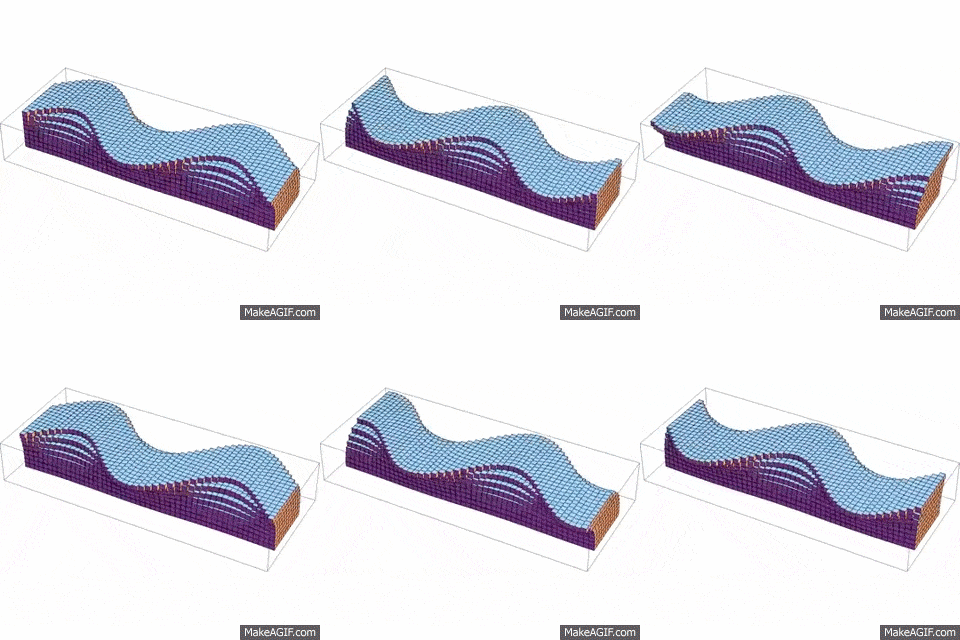
Energy released from the focus during an earthquake
magnitude
intensity
seismic wave
tsunami
Main type of waves that can travel the earth's inner layers.
surface waves
body waves
Love waves
Rayleigh waves
The point where the earthquake begins.
epicenter
fault
focus
seismic waves
What should you do during an earthquake to protect yourself from falling debris?
Jump and run
Climb a tree
Drop, Cover, and Hold On
Stand still
What should you do if you are in bed when an earthquake starts?
Hide under the bed
Stay in bed and cover your head with a pillow
Run outside immediately
Crawl towards open space
What should you do if you are driving when an earthquake occurs?
Stop and stay in your vehicle
Speed up and try to outrun the earthquake
Honk your horn continuously
Drive towards the nearest building
What does the Red Cross provide during an earthquake?
Financial compensation
Food and shelter
Medical treatment only
Transportation services
What should you do after an earthquake to stay safe?
Immediately re-enter your home
Ignore any bad feelings or stress
Check for gas leaks and light a match
Stay connected with friends and family
What should you do if you suspect a gas leak after an earthquake?
Stay in your home and wait for help
Light a candle to check for gas leaks
Turn on all the lights in your home
Leave your home and call 911
What should you have in a Go-Kit for earthquake preparedness?
A flashlight, glasses, and a whistle
Batteries and chargers for your devices
A 1-month supply of medication
At least 2 weeks of supplies
What should you do if you are trapped after an earthquake?
Signal for help and care for any injuries
Try to move heavy debris by yourself
Use a candle for light
Stay silent and wait for help
What should you do if you are near the coast when an earthquake occurs?
Take a boat and head out to sea
Wait for officials to issue a warning
Climb to safety and walk quickly to higher ground
Stay near the water to watch for tsunamis
What should you do if you are in a wheelchair or use a walker during an earthquake?
Try to stand up and move to a safe area
Lock your wheels and remain seated
Crawl towards open space
Run towards the nearest building
What should you do if your home has been damaged and is no longer safe after an earthquake?
Go outside to a clear area
Ignore any aftershocks
Light candles for light
Stay inside and wait for help
What should you do if you are unable to find a protected space during an earthquake?
Crawl to an interior wall away from windows
Stand near a window
Run outside immediately
Stay near heavy furniture
What should you do if you are outdoors when an earthquake occurs?
Climb a tree for safety
Run towards buildings for cover
Drop, then crawl towards open space if you can
Stay where you are and wait for help
What should you do if you are in immediate need of help after an earthquake?
Contact your local Red Cross
Wait for someone to find you
Ignore the need for help
Try to handle the situation by yourself
Ashes from an erupting volcano are all over your place. What should you do to protect yourself?
Wear a hat.
Wear sunglasses
Stay inside the house.
Cover your nose with a wet cloth or mask.
Your family is going to evacuate. You are told to bring along only a few things. Which of these will you bring?
pets, toys and books
food, water and clothes
chairs, tables and closets
candies, rags and matches
A bulletin was issued to warn people that a volcano may erupt within a week. What should the people living in the danger areas do?
Follow orders to evacuate.
Wait for the next bulletin.
Cover the roof with wet sacks.
Reinforce the roof of their houses.
What should you do to prepare for a typhoon?
Secure your home, stock up on emergency supplies, and have an evacuation plan in place.
Leave all windows and doors open to equalize the pressure
Go to the beach to watch the storm
Ignore the warnings and stay at home
What are the essential items to include in a typhoon emergency kit?
Candles and matches
Electronics and appliances
Heavy furniture and decorations
Non-perishable food, water, flashlight, batteries, first aid kit, medications, important documents, cash, and clothing
Why is it important to secure outdoor objects before a typhoon?
To prevent them from becoming projectiles and causing damage or injury.
To test the strength of the typhoon
To make the outdoor area look tidy
To provide entertainment for the typhoon
What should you do if you are advised to evacuate during a typhoon?
Go to the beach and watch the waves
Stay at home and wait for the typhoon to pass
Ignore the advice and continue with your daily activities
Evacuate to a safe location
How can you stay safe during a typhoon if you are unable to evacuate?
Go outside and find shelter under a tree
Stay indoors in a secure location away from windows and doors
Drive to a nearby beach to watch the waves
Stand near a window to watch the storm
Where are cyclones mostly generated?
North Indian Ocean Basin
Western North Pacific Ocean Basin
North Atlantic Ocean Basin
Southeastern Indian Ocean Basin
Why is Philippines very vulnerable to hydrometeorological hazards?
The government's emergency management plan is not well-defined.
Most of the cyclones that are created in the Pacific Ocean hit the Philippines.
The Philippines is surrounded with water.
The slight increase of the global temperatures intensified the formation of the cyclones.
Which of the following hydrometeorological hazards has the longest duration?
ENSO
Floods
Storm Surge
Thunderstorms
Which of the following is not a characteristic of a typhoon?
It is circular.
It has low atmospheric pressure.
It is accompanied with strong rain.
It becomes stronger when it hits the land.
Which of the following components is not needed in thunderstorm formation?
Humidity
Rising unstable air
Lifting mechanism to keep the air rising
Presence of intertropical convergence zone
If the notification indicates that there might be a need to evacuate due to the intense rainfall that is occurring in your area, how are you going to describe the possibility for flooding to happen?
Flooding is possible in certain areas.
Flooding is possible.
Flooding is threatening.
Serious flooding is expected in low lying areas.
If the notification indicates that there is a need for evacuation due to the torrential rainfall that is occurring in your area, how are you going to describe the possibility for flooding to happen?
Flooding is possible in certain areas.
Flooding is possible.
Flooding is threatening.
Serious flooding is expected in low lying areas.
Which of the following phenomena does not lead to storm surge?
Typhoon
Thunderstorm
Flooding
ENSO
What are greatly affected during the occurrence of ENSO cycle?
Global temperature and Atmosphere
Ocean and Atmosphere
Ocean and Biosphere
Global Temperature and Biosphere
2. What are the two seasons in the Philippines?
A. WET AND DRY
B. HOT AND COLD
C. SUMMER AND WINTER
D. AUTUMN AND SPRING
3. Why is the Philippines frequently visited by typhoon all year round? Because it is
A. HIGHLY POPULATED
B. COMPOSED OF MOSTLY ISLANDS
C. LOCATED NEAR THE PACIFIC OCEAN
D. NEAR THE WESTERN HEMISPHERE
10. Another term used to refer to tropical cyclones EXCEPT for
A. TYPHOON
B. FLASHFLOOD
C. HURRICANE
TROPICAL STORM
1. Which of the following is NOT a hydrometeorological hazard?
A. CYCLONE
B. TYPHOON
C. MONSOON
D. TSUNAMI
If the notification indicates that there might be a need to evacuate due to the intense rainfall that is occurring in your area, how are you going to describe the possibility for flooding to happen?
Flooding is possible in certain areas.
Flooding is possible.
Flooding is threatening.
Serious flooding is expected in low lying areas.
Which of the following hydrometeorological hazard has an overflow of water onto normally dry land in an existing waterway, such as a river, stream, or drainage ditch?
El Niño
Flood
La Niña
Storm surge
Which of the following Hydro meteorological hazard is characterized by localized storm cloud that produces lightning and thunder, and often brings heavy rain shower and strong gusty winds?
El Niño
La Niña
Storm Surge
Thunderstorm
Which of the following hydrometeorological hazards is the abnormal sea level rise occurring during tropical cyclones or "bagyo" and is caused by the strong winds and low atmospheric pressures that tropical cyclones produce?
El Niño
Flood
La Niña
Storm Surge
In the Philippines, it is associated with having less to no rain, dried up fields and dams having low water levels most especially during the dry season.
El Niño
La Niña
Forest Fire
Tornado
What should we do during floods?
Go outside and play.
Do not mind and just sleep whole day.
Prepare sufficient food, clean water, medicine, first aid kit, flashlight, and more.
Staying at higher altitude is safer in a thunderstorm
True
False
It is the movement or trembling of the ground produced by the sudden displacement of rock in the Earth's crust
earthquake
landslide
eruption
Measurement of damage of an earthquake
intensity
magnitude
Earthquakes can be predicted
Yes
No
Buildings can be made 100% earthquake resistant
Yes
No
Down slope movement of rock, debris and/or earth under the influence of gravity.
Landslide
Earthquake
Rockfall
Surface Rupture
It is the forward rotation of the slope mass about a point or axis below the center of gravity of the displaced mass.
topple
fall
slide
slump
Which of the following should be done during a landslide?
Go to a designated public shelter if you have been told to evacuate.
Stay away from the slide area as there may be danger of additional slides.
Check for injured and trapped persons near the slide, without entering the direct slide area.
Stay alert and awake. Many deaths from landslides occur while people are sleeping.
It is a series of water waves caused by the displacement of a large volume of a body of water, usually an ocean.
tsunami
landslide
earthquake
tornado
What is the Tamil counterpart of the word tsunami?
Aazhi Peralai
Aazhi Ohzowel
Aazhi Kumbaya
Which of the following are characteristics of a tsunami? Select 2
travels at about 800 km per hour
have great erosion potential, stripping beaches of sand, coastal vegetation
can be predicted by ships
when it approaches the coast its wavelength increases, but amplitude grows smaller
Make evacuation plans and a safe route for evacuation. Stay away from the beach.
Before a tsunami
After a tsunami
During a tsunami
A vent or chimney which transfers molten rock known as magma from depth to the Earth's surface.
Plume
Hotspot
Volcano
Mountain
When magma is very hot and runny, gases can escape and eruptions are gentle with considerable amounts of magma reaching the surface to form lava flows, it will form a ____?____ volcano.
shied
cinder
composite
Also known as strato-volcanoes
cinder
composite
shield
Which of the following should be done during a volcanic eruption?
Store emergency food and water in your home.
If you have to go outside, where a dust mask and eye goggles.
Close all windows and doors to keep ash out. Seal up drafts. Do what you can to keep ash out.
Create an evacuation plan. It is best to head for high ground away from the eruption to protect against flood danger.

