
 Worksheets
Muscular System Pre-Assessment
Total questions: 117
Worksheet time: 2hrs 36mins
The gap between the nerve cell and sarcolemma is the ____ ___.
Synaptic cleft
Neurotransmitter
Motor unit
Neuromuscular junction
What is the specific neurotransmitter that stimulates the movement of skeletal muscles?
GABA
Acetylcholine
Serotonin
Dopamine
What happens at the neuromuscular junction?
A sensory neuron communicates with a motor neuron
An action potential jumps from the muscle to the neuron
A nerve signal traveling down a motor neuron can jump over to the muscle cell
Muscle cells contract in response to a sensory neuron
Skeletal muscles are voluntary.
true
false
The epimysium covers
the entire muscle
the fascicle
the muscle fiber
the myofibril
Which connective tissue surrounds the fascicle?
epimysium
perimysium
sarcolemma
endomysium
wasting away of muscle tissue
atrophy
hypertrophy
lactic acidosis
unfused tetanus
Muscle fatigue is primarily due to a build-up of ______ during anaerobic respiration.
acetylcholine
ATP
creatine phosphate
lactic acid
occurs because there is no ATP to remove myosin cross bridges after death
atrophy
muscle spasms
myotonic dystrophy
rigor mortis
Inherited muscle-destroying diseases characterized by degeneration of individual muscle fibers (usually voluntary)
Lactic acidosis
Muscular dystrophy
Myasthenia gravis
Rigor mortis
autoimmune disease that attacks acetylcholine receptors leading to muscle weakness
Moebius disease
Muscular dystrophy
Myasthenia gravis
Sarin gas exposure
6th and 7th cranial nerve don’t develop; palsy on one (or both) side of face
lactic acidosis
Moebius disease
Muscular dystrophy
Myasthenia gravis
sudden, involuntary contraction of single muscle in large group
fasciculation
fibrillation
spasm
tic
muscles contract but have decreasing power to relax (become weak and waste away); symptoms more severe with each generation
atrophy
myasthenia gravis
myotonic dystrophy
rigor mortis
A ______ can be used to measure skeletal muscle contraction. (i.e. in the "chewing lab")
cardiogram
encephalogram
myogram
telegram
Sarin gas...
inhibits acetylcholinesterase.
inhibits the release of acetylcholine at the axon terminal.
inhibits the release of Ca+2 in the muscle cell
produces antibodies against acatylcholine receptors.
What muscle tissue is voluntary?
Skeletal
Smooth
Cardiac
Smooth and Cardiac Muscle Tissue are
voluntary
involuntary

What type of muscle tissue is this?
Skeletal
Smooth
Cardiac

What type of muscle tissue?
Skeletal
Smooth
Cardiac

What type of tissue is this?
Skeletal
Smooth
Cardiac
(Blank 1): attachment to bone that stays fixed when movement of joint occurs
(Blank 2): attachment to bone that moves when muscle contracts
(Blank 3): main part of muscle
CAPITALIZE :)
(a)

Label 1, 2, and 3 in order
(capitalize)
(a)

Label 1, 2, and 3
* Capitalize :) *
(a)
What happens in the resting of the sliding filament theory?
1. (A) is on myosin (B)
2. (A) breaks into (C)
(a)
What is troponin?
thin my-filament
thick my-filament
protein, binds actin and Ca
protein, blocks myosin binding when muscle is relaxed
What is tropomyosin?
thin myofilament
thick my-filament
protein, binds actin and Ca
protein, blocks actin binding when muscle is relaxed
Neuromuscular Junction:
1. Each (A) has 1 (B)
2. (C) separates (A) and (B)
3. (B) has (D) containing (E)
4. When nerve reaches (B), (E) releases into (C)
* don't have to capitalize *
(a)
Action Potential (energy/signal):
1. (A) channels open
2. (B) goes into (C)
3. (D) is released into (E)
(a)
Myosin-Actin Binding:
1. (A) binds into (B), changing its shape
2. (C) moves out of the way
3. Actin and myosin binds together thanks to (D)
(a)
Power Stroke:
1. Myosin (A) pivots so actin and myosin (B) by each other, shortening (C)
2. (D) releases, giving (E) energy
(a)
ATP binding stage:
A different (A) molecule binds to (B), letting go of (C)
(a)
Repeating:
1. The cycle will repeat if (A) is still available=still (B)
2. Returns to (D)
(a)
Going back to rest:
1. (A) will go back to it's original shape
2. (B) blocks (C)'s binding site
3. Muscle fibers (D)
(a)
What order does the sliding filament theory go?
A) Action Potential
B) Power Stroke
C)ATP binding
D) Resting
E) Myosin-Actin binding
F) Neuromuscular Junction
G) Going back to power stroke
H)Going back to resting
(a)

What muscle is highlighted in the picture?
Triceps
Biceps
Quads
Deltoids

What muscle is highlighted in the picture?
Triceps
Biceps
Quads
Deltoids

What muscle is highlighted?
Lats
Abdominals
Pectoralis
Quads
How many types of muscles are there?
2
4
3
1
What are the characteristics of the cardiac muscle?
Involunatary
Found in the heart
Banded Appearance
Dense connective tissue packaging
Smooth Muscle is found in the?
Heart
Facial
Organs
Legs
The connective tissue sheath that surrounds a muscle fasciculus is the
epimysium
endomysium
perimysium
given the following events:
1.acetycholine broken down
2.acetylcholine moves across the synaptic cleft
3.action potential reaches the terminal branch (presynaptic terminal)
4.acetylcholine combines with a receptor molecule on a skeletal muscle (postsynaptic membrane)
5.action potential produced in skeletal muscle cell
Choose the arrangement that lists the events in the order the occur at a neuromuscular injunction
2,3,4,1,5
3,2,4,5,1
3,4,2,1,3
4,5,2,1,3
Muscles that oppose one another are
synergist
hateful
prime movers
antagonists
Muscles are needed for what?
movement
decoration
pump blood
no one knows
Smooth muscle is located where?
heart
bones
toes
internal organs
The nerve releases a chemical called a
neurotransmitter
neuron
myofibril
cell

What system does the muscular system work in conjunction with to allow our body to move?
Digestive
Respiratory
Skeletal
Circulatory

How should you care for your muscular system. Select all that apply.
Exercise regularly.
Eat fast food on a daily basis.
Warm-up before and cool-down after exercise.
Stretch to remain flexible.
Eat healthy foods, especially foods high in protein.
Exercise is important for muscles because it
helps maintain strength and flexibility.
gives muscles more energy.
prevents muscles from becoming tired.
prevents muscle injuries.
What are the three types of muscles?
skeletal muscles, smooth muscles, and cardiac muscles
biceps muscles, triceps muscles, and quadriceps muscles
voluntary muscles, involuntary muscles, and respiratory muscles
flexor muscles, extensor muscles, and oblique muscles
Which type of muscle is responsible for voluntary movements?
Smooth muscles
Skeletal muscles
Adipose tissues
Cardiac muscles
Which type of muscle is found in the walls of hollow organs?
striated muscle
smooth muscle
skeletal muscle
cardiac muscle
What are the main functions of muscles?
The main functions of muscles are producing sound, vision, and taste.
The main functions of muscles are thinking, feeling, and sensing.
The main functions of muscles are movement, stability, and posture.
The main functions of muscles are digestion, respiration, and circulation.
Which muscle type is striated and multinucleated?
skeletal muscle
cardiac muscle
adipose tissue
smooth muscle
What is the basic unit of muscle structure?
Nucleus
Mitochondria
Golgi Apparatus
Sarcomere
What is the process called when a muscle shortens and generates force?
muscle contraction
muscle extension
muscle expansion
muscle relaxation
Which protein is responsible for muscle contraction?
keratin and collagen
hemoglobin and myoglobin
insulin and glucagon
actin and myosin
What is the role of calcium ions in muscle contraction?
Calcium ions inhibit the binding of troponin to actin, preventing muscle contraction.
Calcium ions bind to troponin, causing a conformational change that moves tropomyosin away from the myosin-binding sites on actin.
Calcium ions directly bind to myosin, causing muscle contraction.
Calcium ions have no role in muscle contraction.
What is the name of the neurotransmitter that stimulates muscle contraction?
Acetylcholine
Serotonin
Dopamine
GABA

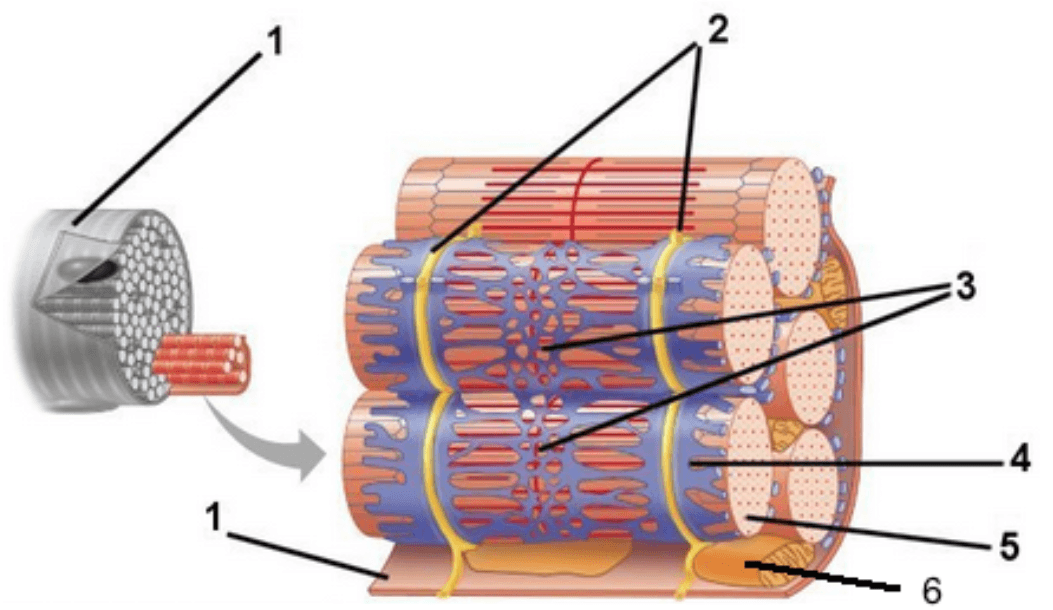
What is shown in the colored part of this diagram?
a whole muscle
five muscle fibers
five muscle fascicles
five myofibrils
What is labeled "4" (the blue/purple part) in the diagram?
sarcolemma
sarcoplasmic reticulum
transverse tubules
myofibril
Name the following in order from largest to smallest:
muscle, muscle fascicle, muscle cell, myofibril, filaments
muscle, muscle fascicle, muscle cell, filaments, myofibril
muscle, muscle cell, muscle fascicle, myofibril, filaments
muscle, muscle cell, muscle fascicle, filaments, myofibril
What is the length between Z-lines of an actin molecule called?
fascicle
sarcomere
myosin binding site
sarcoplasmic length
____________ attaches to actin to form the cross bridge.
Troponin
Tropomyosin
Myosin
Calcium

