wayground logo

Free Printable Worksheets

Font size

S
M
L
XL
Worksheets

Evolution and natural selection

Total questions: 113

Worksheet time: 2hrs 55mins

Name
Class
Date
1.
Who was the naturalist that traveled the world to study plants and animals?
a)
Albert Einstein
b)
Charles Darwin
c)
Charles Barkley
d)
Isaac Newton
2.
The gradual change in species over time is...
a)
Evolution
b)
Nucleotide 
c)
Adaptation
d)
Natural Selection
3.
Darwin wrote that organisms with traits that are best suited to the environment will ________________
a)
increase in number
b)
become extinct
4.
To adjust to a changing environment
a)
Mutation
b)
Adapt
5.
Another word for adapt is ____________.
a)
change
b)
create
6.
Which term refers to the process by which individuals that are better suited to the environment survive and reproduce therefore passing down their genes to their offspring? 
a)
Evolution 
b)
Variation 
c)
Adaptation
d)
Natural Selection 
7.
When an organism completely dies out, it is called.....
a)
Adaption
b)
Extinction
c)
Fossilization
d)
Mutation
8.
The white feathers of a snowy owl allow it to blend in with its environment during the winter months (snow). This is an example of ________________
a)
Species
b)
Environmental Change
c)
Adaptation
d)
Variation
9.
Genetic differences between organisms of the same species
a)
Variation
b)
Adaptation
c)
Behavior
d)
Environment
10.
What is the advantage of having different shaped beaks?
a)
To look different from other species.
b)
To be able to eat the food readily available in the environment.
c)
To protect itself against predators.
d)
To protect itself against prey.
11.
The struggle for existence against other members of an organisms species is
a)
Competition
b)
Natural Selection
c)
gene flow
d)
genetic drift
12.
Remains of ancient organisms are called
a)
Extinctions
b)
Fossils
c)
Mutations
d)
Variations
13.
A well-tested concept that explains a wide range of observations is called a(an):
a)
hypothesis
b)
experiment
c)
cause and effect
d)
scientific theory
14.
What is another name for natural selection?
a)
survival of the smartest
b)
survival of the fastest
c)
survival of the biggest
d)
survival of the fittest
15.
What is a change in an organism that allows for it to survive in its environment?
a)
homologous
b)
vestigial
c)
variation
d)
adaptation
16.
What is an organism that has similar characteristics and can reproduce?
a)
species
b)
organism
c)
embryology
d)
vestigial 
17.
What is this an example of?
a)
diversity of species
b)
variation
c)
vestigial structures
d)
DNA studies
18.
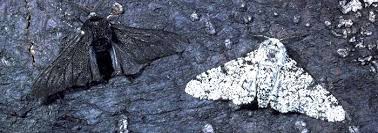
Predict which moth would increase in population
a)
light 
b)
dark
19.
Which term refers to the process by which individuals that are better suited to the environment survive and reproduce therefore passing down their genes to their offspring? 
a)
Evolution 
b)
Variation 
c)
Adaptation
d)
Natural Selection 
20.
Inherited trait that helps an organism survive is a(n) __________.
a)
Fossil
b)
Adaptation
c)
Ancestor
d)
Natural selection
21.
Individuals that are well adapted to their environment will survive and produce:
a)
Fewer mutations
b)
Stronger genes
c)
More offspring
d)
Better traits
22.
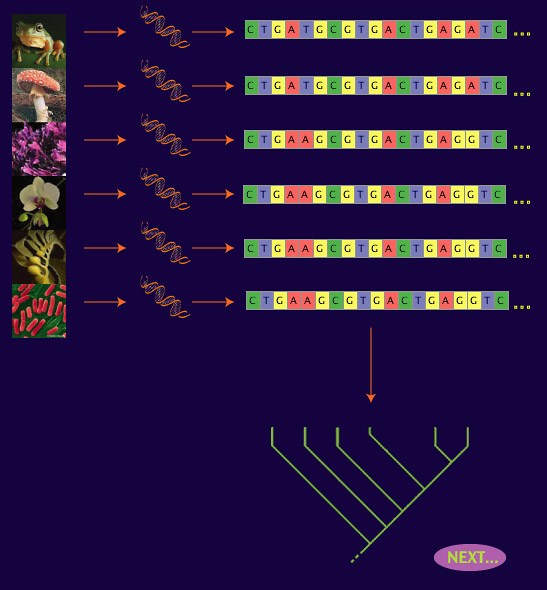
You look at two species and see very similar DNA. What does this likely tell you?
a)
These are the same animal.
b)
These animals have a common ancestor.
c)
These animals are not likely related.
d)
These animals are likely becoming one species.
23.
What does sexual reproduction allow for?
a)
Increased genetic diversity
b)
Increased offspring
c)
Decreased genetic diversity
d)
Decreased rate of evolution
24.
Horse breeding for specific desired traits is an example of which type of evolutionary evidence?
a)
Artificial selection
b)
Embryology
c)
Fossils
d)
Biochemical molecules
25.
An inherited characteristic that increases an organisms ability to survive and reproduce in its specific environment is called a(n)
a)
vestigial structure
b)
speciation
c)
analogous structure
d)
adaptation
26.
According to the theory of natural selection, some individuals more likely than others to survive and reproduce because they:
a)
pass on to their offspring their newly acquired traits.
b)
are better adapted to their environment than others and will pass on those adaptations to future offspring.
c)
do not pass on newly acquired traits.
d)
produce fewer offspring than others in the same environment.
27.
What was the name of the ship Darwin traveled the world on?
a)
HMS Beagle
b)
SS Beagle
c)
HMS Bugle
d)
SS Bugle
28.
Which of the following is a term for a group of similar organisms that can reproduce fertile offspring?
a)
individual
b)
population
c)
species
d)
fossil
29.
Common descent
a)
describes how a group of organisms share a most recent common ancestor
b)
Idk 
c)
No common ancestor
d)
None of the above
30.
Natural selection
a)
process by which individuals that are better suited to their environment survive and reproduce most successfully; also called survival of the fittest
b)
Humans select which animals live and die
c)
both 
d)
IDK
31.
speciation
a)
Formation of new species
b)
idk
c)
Formation of old species
d)
none of the above
32.
The finches on the Galapagos island were similar in form except for variations of their beaks. Darwin observed that these variations were useful for:
a)
 attracting a mate
b)
 defending territory
c)
 building nests
d)
 gathering food
33.
Definition: adaptation
a)
inherited characteristic that increases chances of survival
b)
organisms with traits well suited to their environment survive and reproduce at a greater rate
c)
a growing population causes a scarcity of resources
d)
differences in the DNA sequence
34.
Definition: competition
a)
inherited characteristic that increases chances of survival
b)
organisms with traits well suited to their environment survive and reproduce at a greater rate
c)
a growing population causes a scarcity of resources
d)
differences in the DNA sequence
35.
Definition: natural selection
a)
inherited characteristic that increases chances of survival
b)
organisms with traits well suited to their environment survive and reproduce at a greater rate
c)
a growing population causes a scarcity of resources
d)
differences in the DNA sequence
36.
Definition: fitness
a)
ability to survive and reproduce in a specific environment
b)
organisms with traits well suited to their environment survive and reproduce at a greater rate
c)
a growing population causes a scarcity of resources
d)
differences in the DNA sequence
37.
Definition: variation
a)
ability to survive and reproduce in a specific environment
b)
organisms with traits well suited to their environment survive and reproduce at a greater rate
c)
a growing population causes a scarcity of resources
d)
differences in the DNA sequence
38.
Definition: homologous structures
a)
remains of dead organisms
b)
related organisms have the same bone makeup
c)
in the early stages of development dogs, pigs, and humans resemble one another
39.
Definition: fossil record
a)
remains of dead organisms
b)
related organisms have the same bone makeup
c)
in the early stages of development dogs, pigs, and humans resemble one another
40.
Definition: embryology
a)
remains of dead organisms
b)
related organisms have the same bone makeup
c)
in the early stages of development dogs, pigs, and humans resemble one another
41.
A trait that makes a species better suited to survive in its environment is called a(n) _________.
a)
variation
b)
adaptation
c)
natural selection
d)
isolation
42.
A species is an organism that has different traits and cannot _______ with other organisms.
a)
breed
b)
exist
c)
survive
d)
evolve
43.
Which is necessary for speciation to occur?
a)
adaptation
b)
mass extinction
c)
isolation
d)
acquired traits
44.
____ is when members of a species that are best suited for their environment survive and reproduce at a higher rate than other members of the species
a)
natural selection
b)
artificial selection
c)
speciation
d)
adaptation
45.
Which of the following means "change over time"
a)
natural selection
b)
speciation
c)
evolution
d)
isolation
46.
The differences among a species, like different bird beaks, are called
a)
theories
b)
variations
c)
adaptations
d)
genes
47.
___ are mistakes in the DNA that cause variation within a species.
a)
mutations
b)
adaptations
c)
speciations
d)
isolations
48.
Any inherited trait that gives an organism an advantage in its environment is called ___.
a)
a mutation
b)
an adaptation
c)
evolution
d)
natural selection
49.
The evolution of a new species from an existing species is ____.
a)
natural selection
b)
isolation
c)
speciation
d)
genetic variation
50.
Organisms with the most beneficial traits will survive.  This is commonly known as ___.
a)
theory of evolution
b)
variations
c)
survival of the fittest
d)
ecosystems
51.
Most organisms have more offspring than will survive 
a)
True
b)
False
52.
Why are advantageous traits more likely to be passed on to the offspring?
a)
Because parents with those traits can teach their offspring
b)
Because parents with those traits can surive and reproduce better
c)
Because parents with those traits care more about their offspring
53.

The theory of evolution by natural selection means that what is changing over time?

a)

The inherited traits of a population.

b)

The speed of a species

c)

Hair color and eye color

d)

Attractive features.

54.
Why are advantageous traits more likely to be passed onto offspring?
a)
Because they are more likely to survive and reproduce.
b)
Because they come from dominant alleles.
c)
Because they come from recessive alleles.
d)
Because the trait is an acquired phenotype.
55.

What word describes a trait that helps an organism survive in its environment?

a)

natural selection

b)

mutation

c)

camouflage

d)

adaptation

56.
Do organisms "decide" to evolve and change?
a)
Yes, they know they need to change to survive 
b)
No, they change because of natural selection
57.
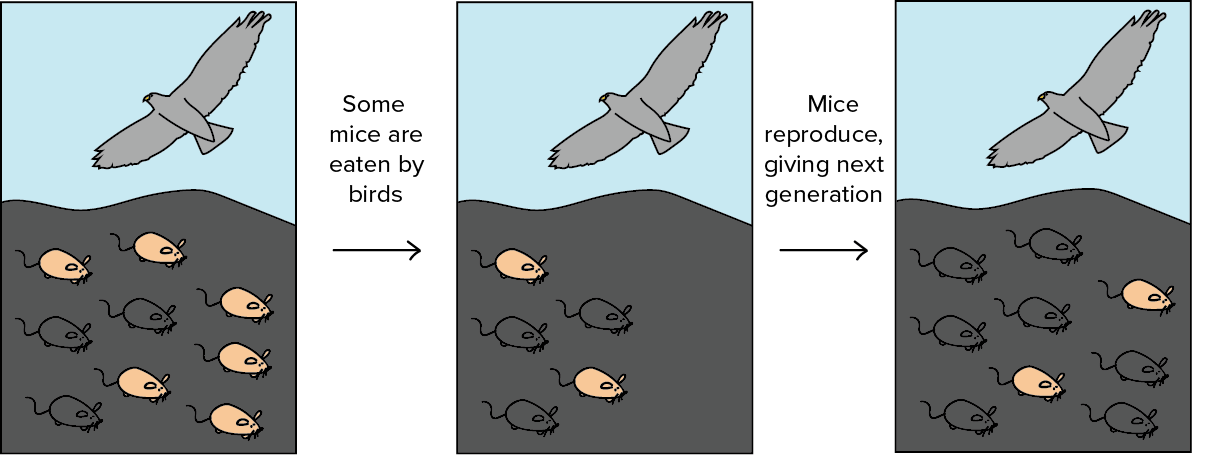
Why is the mouse population changing over time?
a)
The light mice can reproduce more successfully than the dark mice
b)
The hawks eat more dark mice than light mice because the dark mice taste better
c)
The hawks eat more light mice than dark mice because they can see the light mice more easily
d)
The hawks eat more dark mice than light mice because they can see the dark mice more easily
58.

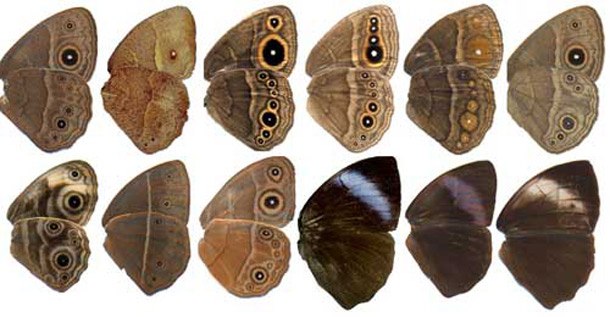
These moths are all the same species. The differences between their wings is an example of ________________

a)

Natural Selection

b)

Genetic Variation

c)

Homeostasis

d)

Extinction

59.
Which best describes the role of mutations in natural selection?
a)
Mutations help an organism to better survive in their environment
b)
An organism may acquire a helpful mutation by interacting with the environment
c)
A mutation may result in an adaptive trait that makes an organism more likely to survive and reproduce
d)
Organisms with certain traits are more likely to win competitions for mutations
60.

Natural selection is where ___________ decides which traits should be passed on

a)

Nature

b)

Humans

61.
Mutations are important because they bring about
a)
death of the organism in which they develop
b)
genetic variation needed for a population to evolve
c)
benefits for the individual, not for the population
d)
Hardey-Weinberg equilibrium within a population
62.
Which is not an example of an adaptation?
a)
A bird's beak allows it to crack open hard nuts.
b)
A zebra's stripes allow it to confuse its predators.
c)
A frog's large hind legs allow it to jump from danger.
d)
A cat sleeps on the sofa to avoid the vacuum cleaner.
63.

Which of the following is a term for a group of similar organisms that can reproduce fertile offspring?

a)

individual

b)

population

c)

species

d)

fossil

64.
Species have evolved into two different species when...
a)
the populations are separated geographically
b)
the populations look different
c)
the populations can no longer interbreed
d)
the populations adapt
65.
Evolution means...
a)
Change over time in a population.
b)
That everything is the same.
c)
That organisms never change.
d)
Negative traits are acquired in populations.
66.

Which of the following is an inherited trait.

a)

A bear searches in a different river than the other bears

b)

A bird has slightly longer wings than most of it's population

c)

A tortoise lives to be 200 years old

d)

A polar bear dies of starvation

67.

Which term refers to the passing of genetic characteristics (traits) from parent to offspring?

a)

Variation

b)

Heredity

c)

Natural Selection

d)

Overproduction

68.
Which layer is the oldest?
a)
1
b)
2
c)
3
d)
4
69.
Darwin wrote that organisms with traits that are best suited to the environment will ________________
a)
increase in number
b)
become extinct
70.
Two organisms that are closely related would have
a)
very similar DNA sequence
b)
exactly the same DNA sequences
c)
no proteins in common
d)
completely different DNA sequence
71.
A remnant or trace of an organism from the past is called a _______.
a)
Ancestor
b)
Skeleton
c)
Fossil
d)
Imprints
72.
The diagram shows fossils in different rock layers. Which of these statements about the age of these fossils is most likely correct?
a)
Fossil A and C are the same age
b)
Fossil B is older than fossil C
c)
Fossils A is older than fossil B
d)
Fossil D is older than fossil C
73.
Why are advantageous traits more likely to be passed onto offspring?
a)
Because they are more likely to survive and reproduce.
b)
Because they come from dominant alleles.
c)
Because they come from recessive alleles.
d)
Because the trait is an acquired phenotype.
74.
Which of the following traits is not inherited?
a)
Fur color
b)
Feathers
c)
Hair color
d)
A suntan
75.
This scientist developed the theory of evolution as he studied the finches.
a)
Charles Darwin
b)
Isaac Newton
c)
Albert Einstein
d)
Marie Curie
76.
The differences among a species, like different bird beaks, are called
a)
genes.
b)
variations.
c)
traits.
d)
theories.
77.

In your lab, why were some "birds" more adapted to their environment than others?

a)

their bird beak allowed them to eat more food, and most likely live to produce more offspring

b)

the birds could change their beak to suit the available food sources

78.

According to Natural Selection, light colored tree trunks would favor

a)

Light colored moths

b)

Dark colored moths

c)

Red colored moths

d)

Red and light colored moths

79.

Which beak is best suited to crack open nuts?

a)

1

b)

2

c)

3

d)

4

80.

Most permanent mutations are

a)

helpful

b)

harmful

c)

passed onto offspring

d)

selectively bred

81.

Which animal and feature did Darwin study on the Galapagos islands?

a)

Finches' wings

b)

Alligator's tail

c)

Finches' beak

d)

Penguin's teeth

82.

Mutations are a change in what?

a)

Genotype

b)

Phenotype

c)

tRNA

d)

DNA

83.

Evolution typically happens.....

a)

in a few weeks

b)

never

c)

over millions of years

d)

in 100 years

84.
Behavioral changes of individuals of a species that allow for better survival. (Acquired traits)
a)
Variation
b)
Adaptation
c)
Behavior
d)
Environment
85.
Where the better adapted organisms survive to pass traits along to offspring.
a)
Evolution
b)
Natural Selection
c)
Extinction
d)
Artifical Selection
86.

A giraffe has a long neck in order to better reach leaves to eat. This is an example of _____.

a)

an adaptation

b)

environment

c)

response

d)

stimulus

87.
An example of a behavioral adaptation is
a)
The long neck of a giraffe
b)
Penguins huddling together for warmth
c)
A camel's hump used to store water
d)
A polar bear's white fur used for camouflage
88.
An example of a physical adaptation is...
a)
a turtle hiding inside its shell
b)
The spikes on a porcupine fish
c)
a rabbit burrowing underground
d)
a viper biting when threatened
89.
A trait is :
a)
a removal
b)
a characteristic
c)
 a change
d)
a sequence
90.
To inherit means:
a)
To receive
b)
To change
c)
To create
d)
To give
91.

part of DNA that codes for a specific trait

a)

gene

b)

chromosome

92.
To inherit means:
a)
To receive
b)
To change
c)
To create
d)
To give
93.

part of DNA that codes for a specific trait

a)

gene

b)

chromosome

94.

1. The process of choosing parent organisms for desired characteristics is called

a)

natural selection

b)

Artificial selection

c)

random selection

d)

genetic manipulation

95.

What is an example of artificial selection?

a)

Letting dogs choose their own mate

b)

Letting plants pollinate on their own

c)

Crossing a labrador and a poodle to create a labradoodle

96.

1. Artificial selection has been a big factor in the evolution of:

a)

Dogs

b)

Panda bears

c)

Snakes

d)

Jellyfish

97.

The following is a similarity between artificial selection and natural selection

a)

Takes hundreds of years

b)

Humans determine traits

c)

Nature determines traits

d)

Offspring are produced

98.

Which statement is true comparing natural selection and artificial selection?

a)

In natural selection, traits benefit humans and in artificial selection, the traits benefit the species

b)

In natural selection, traits benefit the species and in artificial selection, the traits benefit humans

c)

In natural and artificial selection, the process takes hundreds of years to occur

d)

In natural and artificial selection, nature determines what traits will be passed down to offspring.

99.

Artificial selection takes

a)

a shorter period of time than natural selection

b)

a longer period of time than natural selection

c)

the same amount of time as natural selection

100.

Artificial selection is also known as

a)

natural selection

b)

selective hearing

c)

genetic manipulation

d)

selective breeding

101.

The theory that organisms acquire traits during their lifetimes that help them adapt to their environments

a)

theory of natural selection

b)

artificial selection

c)

evolution

d)

theory of acquired characteristics

102.

What is this an example of?

a)

theory of natural selection

b)

theory of acquired characteristics

103.

Inherited characteristics that increase an organism's chance of survival, or beneficial inherited variations

a)

acquired characteristics

b)

genes

c)

adaptations

d)

mutations

104.

What is this an example of?

a)

natural selection

b)

artificial selection

105.

What is this an example of?

a)

natural selection

b)

artificial selection

106.

All the genes of all members of a particular population make up the population's........

a)

relative frequency

b)

genotype

c)

phenotype

d)

gene pool

107.

In genetic drift, allele frequencies change because of....

a)

mutations

b)

natural selection

c)

genetic equilibrium

d)

chance

108.

When a farmer breeds only his or her best livestock, the process involved is.......

a)

natural selection

b)

artificial variation

c)

artificial selection

d)

survival of the fittest

109.

Darwin's theory of evolution explains all of the following EXCEPT.......

a)

how species became extinct

b)

how species change over time

c)

how inherited traits are passed from parent to child

d)

how evolution takes place in the natural world

110.

When lions prey on antelopes, some are killed and some survive. Darwin explained this by........

a)

acquired characteristics

b)

survival of the fittest

c)

reproductive isolation

d)

descent with modification

111.

Darwin called the ability of an organisms to survive and reproduce in its environment........

a)

diversity

b)

adaptation

c)

fitness

d)

evolution

112.

Mass extinctions encourage the rapid evolution of surviving species

a)

by changing developmental genes

b)

because they killed all organisms that coevolved

c)

by making new habitats available

d)

because they spared all organisms that evolved convergently

113.

A single species that has evolved into several different forms that live in different ways has......

a)

undergone adaptative radiation

b)

undergone punctuated equilibrium

c)

has coevolved

d)

been a victim of mass extinction