
 Worksheets
Fourth Review Quiz
Total questions: 110
Worksheet time: 18mins
What is the first step in conducting a Science Investigatory Project?
Conducting an experiment
Defining the research problem
Writing the conclusion
Creating a prototype
Toxicity was measured in terms of a decrease in the maximum standing crop. The effective concentration - 50% (EC 50) for Scenedesmus quadricauda was found to be 3.75% exhaust water; for Ankistrodesmus sp. 3.1% exhaust water using the bottle technique
Objectives
Materials & Methods
Results
Conclusion
Which Science Investigatory Project criteria is used to evaluate the adequacy of the data to support the conclusion?
Clarity
Thoroughness
Creativity ability
Scientific thought
1. Which is true about the hypothesis?
It may reject or accepts your prediction.
It is an educated guess or possible answer to the question.
It summarizes the result of the experiment.
It is the final answer to the question.
Recording and putting the result of the experiment, is the time when you (a) .
Maria wants to know if a tomato seed grows faster than a monggo seed. She then asks her father, which is a farmer about her question. Which steps of the scientific method does Maria perform?
Identify the problem and make a conclusion.
Identify the problem and conduct an experiment.
Identify the problem and make a hypothesis.
Identify the problem and do background research.
The scientific method starts when you ___________ about something that you observe.
ask a question
do background research
construct hypothesis
construct a conclusion
10. It is also known as manipulating variables. The condition you change during the investigation.
Control variable
Dependent variable
Independent variable
Responding variable

What do all waves transfer?
Matter
Heat
Electricity
Energy

What are the two types of waves?
longitudinal and transverse
sound and light

What is the frequency of this wave? You must count the number of complete waves.
1 Hz
5 Hz
10 Hz

What is frequency measured in?
Milliseconds
Miles
Hertz
Kilograms

Which type of waves have the longest wavelength?
Visible light
Radio waves
X-rays
Gamma-Rays

What is the distance between the calm sea and the highest wave called?
Wave
Frequency
Amplitude
Magnitude

What type of wave is this?
Transverse
Longitudinal
Rayleigh
electromagnetic


A disturbance that transfers energy from one place to another without transferring matter:
wave
trough
pitch
period
Longitudinal waves consists of .............
Compressions and rarefactions
Troughs and rarefactions
Crests and troughs
Compressions and crest
What is the law of reflection for waves?
The angle of incidence is greater than the angle of reflection
The angle of incidence is less than the angle of reflection
The angle of incidence is equal to the angle of reflection
The angle of incidence is perpendicular to the angle of reflection
What is refraction of waves?
The change in the direction of waves at the boundary between two different media
The reflection of waves at the boundary of the medium
The superposition of waves in the same medium
The interference of waves in the same direction
What affects the speed of sound waves in air?
The amplitude of the wave
The frequency of the wave
The temperature of the air
The wavelength of the wave
What is the frequency of a wave?
The maximum disturbance of a wave from its zero point
The time to complete one cycle of the wave
The number of cycles in a given time period
The length of one cycle of the wave
What is the speed of a mechanical wave dependent on?
The wave's wavelength
The properties of the medium it passes through
The wave's frequency
The wave's amplitude
Which of the following is NOT a region of the electromagnetic spectrum mentioned in the text?
Radio
Microwave
Sound
Gamma rays
What phenomenon can be explained by the dispersion of light in prisms?
Rainbows
Shadows
Echoes
Thunder
Sound travels fastest in...
solids
liquids
gases
A place where no sound exists is...
in the air
under water
space
Why is sound able to travel faster through a solid than a gas?
Gas molecules are packed tightly.
Sound does not travel faster through a solid than a gas.
Solid molecules are packed tightly.
The speed of sound depends on these two things:
The type of medium and the temperature of the medium
Speed of the medium and temperature of the medium
Temperature of the medium and sound of the medium
None of the above

Sonar and echolocation use ----- to detect objects under water.
Refraction
Reflection
Sound waves that are beyond the range of human ear are known as ----
Infrasonic waves
Ultrasonic waves
These waves travel faster through empty space than through solid, liquid, or gas.
Light
Sound
Both
Neither

__________ waves cause the medium to move parallel to the direction of the wave.
transverse
longitudinal
surface
What in the speed of sound in the air if the temperature is 10oC.
337oC
391oC
336oC
237oC
As the temperature of a medium increases, the speed of the sound waves _______________.
decreases
increases
remains the same

Pay attention to the picture.
Which wave has lower pitch?
Blue wave
Red wave
Which frequency range can be heard by a bat?
more than 20 Hz
between 20 - 20,000 Hz
more than 20,000 Hz
lower than 20,000 Hz
Can sound travel in space?
Yes
No
16. Which is NOT a characteristic of a plane mirror images?
Real
Upright
Laterally Revered
Same Size
A material that can transmit light waves.
opaque
transparent
translucent
The bending of light as it travels from one medium to another medium of different densities.
reflection
refraction
interference
diffraction
The spreading of light as it enters the opening of a barrier.
reflection
refraction
interference
diffraction
The process of separating the colors of white light using a prism.
reflection
interference
dispersion
diffraction
The third color of white light if they are arranged from longest to shortest wavelength.
blue
green
yellow
indigo
The third color of white light if they are arranged from shortest to longest wavelength.
yellow
blue
green
orange
The resulting color of light when blue is mix with green.
magenta
yellow
cyan
orange
The turning back of light upon hitting a barrier or an obstacle.
refraction
diffraction
reflection
interference
Which of the following is an example of an illuminated object?
moon
light bulb
fireflies
stars
Which of the following is NOT an electromagnetic wave?
radio wave
microwave
sound wave
UV rays
All electromagnetic waves travel through a vacuum at ________________
speeds that are proportional to their frequency.
speeds that are inversely proportional to their frequency.
the same speed.
None among the choices.
Which of the following has an arrangement of an increasing frequency?
gamma wave, x ray, UV ray, microwave
radio wave, infrared, gamma wave, microwave
radio wave, micro wave, UV rays, xray
gamma wave, x ray, UV ray, infrared
If the object is between f and the mirror, the image is ...
image is real, smaller, and inverted
image is virtual, larger, and upright
image is virtual, smaller, and inverted
image is real, bigger, and inverted
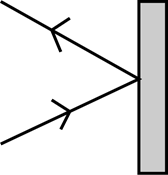
In the illustration, the light ray striking the object is-
What do you call a flat mirror?
plane mirror
convex mirror
concave mirror
If the object is between f and the mirror, the image is ...
image is real, smaller, and inverted
image is virtual, larger, and upright
image is virtual, smaller, and inverted
image is real, bigger, and inverted
(a) are formed when light is blocked by an object
It is the branch of Physics that deals with the properties of light.
Photometry
Optics
Physics
Chemistry
Which of the following is an opaque material?
Rock
Plastic cover
Eyeglasses
Magnifying glass
Which material uses concave mirror / lens?
Microscope
Ceiling dome mirror
Security inspection mirror
Dentist mirror
What do we call the part in a ray diagram of where light rays converge?
Vertex
Center of curvature
Principal axis
Focus
When a small object is placed on the principal axis of a concave mirror between the focus and the mirror, the image formed is _____________.
erect, magnified, and virtual
inverted, magnified, and real
inverted, reduced, and real
erect, reduced, and real
Where should the object be placed in front of a concave mirror to form a virtual and magnified image?
at the focus
at the center of curvature
between the focus and the vertex
between the center of curvature and focus
Which of the following is true of a concave mirror?
It will never form a real image.
An inverted image will be formed if the object distance is greater than the focal length.
An object can be magnified if placed at F.
These objects emit light from within
Luminous
Transparent
opaque
Illuminated
Light rays pass through it easily
Opaque
Translucent
Transparent
intensity
What should we use to create a real image?
Concave lens
concave mirror
convex lens
convex mirror
It is the horizontal axis points in ray diagramming
Principal axis
focal point
focal length
center of curvature
It is the distance from the focal point to the curvature along the principal axis
Principal axis
Image
Focal Point
Focal Length
Which optical instrument is modeled after the human eye?
binoculars
camera
microscope
What happens to light when it hits a surface through which it cannot pass?
It bends
It bounces back
It is absorbed

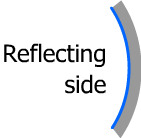

Type of mirror that can produce an inverted image...
Plane
Convex
Concave

Type of mirror used by a dentist to get magnified view of a patient's teeth...
Plane
Convex
Concave

What are the two principal rays illustrated on the diagram?
V-ray & P-F ray
P-F ray & F-P ray
C-C Ray & V-ray
Concave mirror is also known as ________________.
Plane Mirror
Diverging Mirror
Converging Mirror
Which of the following mirrors is used as side mirror to widen the area of the road?
plane
concave
convex
printed

Identify the mode of heat transfer in the given situation.
Floating hot air balloon
Conduction
Convection
Radiation

Identify the mode of heat transfer in the given situation.
Drying clothes under the sun
Conduction
Convection
Radiation

Identify the mode of heat transfer in the given situation.
Ironing a handkerchief
Conduction
Convection
Radiation
Which is an example of heat being transferred by conduction?
a furnace heating the air in a school
an ice cube melting in a person's hand
a pot of water on a stove boiling
the sun heating water in a swimming pool
Sarah is stirring her hot chocolate with a metal spoon, and she notices that the spoon is getting hot. This is most likely caused by which type of heat?
conduction
convection
radiation
insulation
How does heat energy from the Sun reach Earth?
radiation
solar wind
conduction
convection

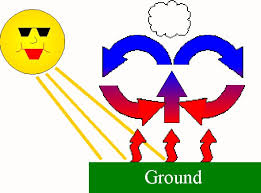
When do particles move faster?
In hot water
In cold water
Scientist believe that the motion of tectonic plates is caused by
pressure in Earth's crust
heat in the Earth's core
convection currents
conveyor belts
What is the source of heat in a mantle convection current?
the sun
the crust
the core
the moon
The uplifting and tearing apart of lithospere occurs at
transform fault boundary
convergent boundary
divergent boundary
mantle
Arrange the following events in the mantle convection process.
a. Heat moves from the core.
b. The process repeats as a cycle.
c. Heat slowly rises to the mantle and creates convection current.
d. The decomposition of radioactive elements causes heat in the interior of the Erath.
e. Lithospheric plates move in the asthenosphere due to the rising and sinking of materials.
a,b,c,d,e
d,c,a,e,b
d,a,c,e,b
d,b,c,e,a
A soft, weak and plastic-like layer, the upper part of the mantle where lithospheric plates float and moves.
mantle
asthenospherec
core
mesosphere
Which two scientists served as the proponents of seafloor spreading theory?
Alexander du Toit and J. Tuzo Wilson
Charles Darwin and James Hutton
. Eduard Suess and Alfred Wegener
Harry Hess and Robert Dietz
What geologic activity would most likely occur when the San Andreas Fault System moves?
Earthquake
Erosion
Seafloor spreading
Volcanic eruption
Which of the following is a driving force for plate motion at mid-ocean ridges as a result of the rigid lithosphere sliding down ?
slab pull
ridge push
convection current
seafloor spreading
The idea that Earth’s lithosphere is broken up into separate plates that float on the mantle is the theory of __________.
A. continental drift
B. seafloor spreading
c. tectonic movement
D. plate tectonics
The region in which one plate moves under another is ____________.
A. rift valley
B. subduction zone
C. magma chamber
D. vent
In a convection current, hot materials move ______________.
A. any direction
B. sideward
C. upward
D. downward

What is the name of the giant landmass shown on the map on the right?
Gondwanaland
Laurasia
Eurasia
Pangaea
How many continents are there on Earth today?
7
13
21
50
New seafloor is formed by
Convection
Ridging
Subduction
Seafloor spreading
Two plates move toward each other at a
Convergent boundary
Divergent boundary
Rift valley
Transform-fault boundary
Features formed at a divergent boundaries are
Magma chamber
Mountains
Rift valley
Subduction zones

