wayground logo

Free Printable Worksheets

Font size

S
M
L
XL
Worksheets

Geology Final Exam Review

Total questions: 106

Worksheet time: 1hrs 18mins

Name
Class
Date
1.
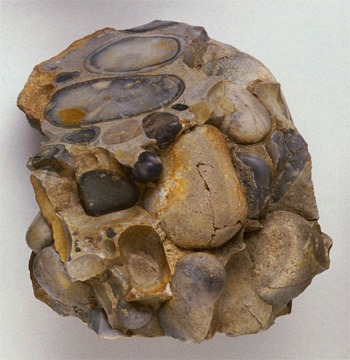
This rock was formed when heat and pressure changed its minerals around into new minerals. What type of rock is it?
a)
Metamorphic Rock
b)
Igneous Rock
c)
Sedimentary Rock
d)
Boring Rock
2.
What are the 3 major types of rocks?
a)
Igneous, Metamorphic, Sedimentary
b)
Metamorphic, Igneous, Cementation
c)
Brown, Red, Gray
d)
Streak, Hardness, Breakage
3.

Geology is the person who studies about rocks.

a)

True

b)

False

4.

The melted rock beneath the earth’s surface is called lava.

a)

True

b)

False

5.
The process by which water, ice, wind or gravity moves weathered rock and soil from one place to another.
a)
weathering
b)
erosion
c)
deposition
d)
dumptruck
6.
Which type of rock results from melting and cooling of magma?
a)
Igneous
b)
Metamorphic
c)
Sedimentary
d)
Extrusive
7.
Which type of rock forms from extreme heat and pressure?
a)
Igneous
b)
Sedimentary
c)
Organic
d)
Metamorphic
8.
This rock was formed by smaller pieces of rock that settled at the bottom of a lake millions of years ago. What type of rock is this?
a)
Sedimentary
b)
Igneous
c)
Metamorphic
9.
What is the rigid layer of the Earth's surface made up of the  crust and upper mantle called?
a)
asthenosphere
b)
lithosphere
c)
mesosphere
d)
continental crust
10.
Temperature _____________________ as you go deeper into the earth.
a)
increases
b)
decreases
c)
goes up and down depending on the layer
d)
stays the same
11.
Pressure ______________________ as you go deeper into the Earth
a)
increases
b)
decreases 
c)
goes up or down depending on the layer
d)
stays the same
12.
Which layer of Earth is characterized by rock that is plastic, or soft enough to flow?
a)
asthenosphere
b)
crust
c)
lithosphere
d)
inner core
13.
A dense ball of solid iron and nickel.
a)
crust
b)
inner core
c)
mantle 
d)
outer core
14.
The geologic time scale is divided by major changes or events such as
a)
mass extinctions
b)
the extinction of one species
c)
the development of one new species
d)
a small temperature change
15.

A broad volcano with gently sloping sides is a ________________

a)

Shield

b)

Cinder Cone

c)

Fire Fountain

d)

Composite

16.

A small volcano with steep sides.

a)

cinder cone

b)

composite

c)

strata

d)

shield

17.

A steep-sided volcano formed from layers of lava and ash.

a)

Strata or composite

b)

shield

c)

cinder cone

d)

fire fountain

18.

Lava that is very thin and runny probably

a)

has low silica content

b)

is high in silica

19.

Pyroclastic material forms when

a)

magma explodes into the air and travels down the mountain very fast

b)

lava flows calmly from a crack in the Earth´s crust

c)

magma remains underground too long

d)

lava flows underwater

20.

A combination of explosive and quiet eruptions will create a

a)

composite volcano

b)

shield volcano

c)

cinder cone volcano

21.

Where are volcanoes most likely to form?

a)

along plate boundaries

b)

near the center of continents

c)

near water

d)

on the moon

22.

One major belt of volcanoes that surrounds the Pacific Ocean

a)

Ring of Fire

b)

Ring of Asia

c)

Ring o' earthquakes

d)

Ring a ding ding

23.

A bowl shaped area that may form at the top of a volcano around the central vent

a)

crater

b)

vent

c)

tube

d)

leftovers

24.

An area where material from deep within Earth's mantle rises through the crust and melts to form magma.

a)

hot spot

b)

rift zone

c)

hot soup

d)

hot mamma

25.
What are scientists that study volcanoes called?
a)
doctor
b)
vet
c)
volcanologist
d)
volcano scientist
26.
What is the definition of dormant?
a)
sleeping
b)
extinct
c)
active
d)
invisible
27.
What is Magma when it reaches the surface of Earth?
a)
Lava
b)
Mafic Magma
c)
Felsic Magma
d)
None of these
28.
Dormant volcanoes might erupt in the future.
a)
True
b)
False
29.
Where is Mt. St Helens located?
a)
New Jersey
b)
Nebraska
c)
Washington state
d)
I didn't learn this so I give up 
30.
Volcanoes are found...
a)
on land
b)
under water
c)
on islands
d)
all of the above
31.
Lakes that form near volcanoes considered to be....
a)
Craters
b)
Conduits
c)
Vents
d)
Calderas
32.
Which one of these does NOT affect the temperature at which magma forms?
a)
Pressure
b)
Composition of material
c)
Water
d)
Viscosity
33.
Types of plutons include....
a)
Shields, Cones, and Composites
b)
Vents, Craters, and Calderas
c)
Dust, Ash, and Blocks
d)
Batholiths, Stocks, Sills, Dikes and Laccoliths
34.
What is letter C in the picture?
a)
Vent
b)
Crater
c)
Caldera
d)
Tephra
35.
What is letter D in the picture?
a)
Crater
b)
Vent
c)
Conduit
d)
Tephra
36.
What is letter E in the picture?
a)
Tephra
b)
Pyroclastic Flow
c)
Magma Chamber
d)
Vent
37.
What is letter F in the picture?
a)
Pyroclastic Flow
b)
Crater
c)
Vent
d)
Tephra
38.
Where can you find a rift or divergent area of volcanism?
a)
Mid-Atlantic Ridge
b)
Pacific Ocean
39.
What is the most explosive type of magma?
a)
Rhyolitic Magma
b)
Andesitic Magma
c)
Basaltic Magma
40.

back and forth motion

a)

S-wave

b)

P-wave

c)

elastic rebounding

d)

L-wave

41.

side to side motion

a)

L-wave

b)

S-wave

c)

P-wave

d)

focus

42.

where quake begins below surface

a)

elastic rebounding

b)

focus

c)

epicenter

d)

fault

43.

where quake begins on surface

a)

epicenter

b)

joint

c)

fault

d)

focus

44.

causes little damage

a)

focus

b)

P-wave

c)

S-wave

d)

L-wave

45.

causes severe damage

a)

S-wave

b)

focus

c)

P-wave

d)

L-wave

46.
Which stress force pulls on the crust and stretches rock?
a)
tension
b)
compression
c)
shearing
d)
folding
47.
What process occurs when an earthquake's shaking turns loose soil into mud?
a)
aftershocks
b)
tsunamis
c)
liquefaction
d)
deformation
48.
Stress that pushes a mass of rock in two opposite directions is called
a)
deformation
b)
tension
c)
compression
d)
shearing
49.
The best way to protect yourself in an earthquake is to 
a)
run as fast as you can
b)
drop, cover and hold
c)
stop, drop and roll
d)
go into the basement
50.
The type of seismic waves that arrive at a seismic station first and move by compressing and expanding the ground like an accordian are called
a)
S waves
b)
surface waves
c)
tsunami waves
d)
primary waves
51.
Which scale would most likely be used to tell how much earthquake damage was done to homes and other buildings?
a)
Richter scale
b)
moment magnitude scale
c)
Mercalli scale
d)
modified Mercalli scale
52.
Tension causes what type of fault to form?
a)
folds
b)
reverse fault
c)
strike slip fault
d)
normal fault
53.
At what plate boundary will a strike slip fault be found?
a)
divergent
b)
transform
c)
convergent
d)
all of them
54.
What is a convergent boundary?
a)
When two plates move away from each other.
b)
When two plates move toward each other.
55.
What is an epicenter? 
a)
Where an earthquake started
b)
The surface right above where an earthquake started 
56.
What is a fault?
a)
A crack in a plate.
b)
Where two plates move toward each other.
57.
Liquefaction is when...
a)
the soil behaves like liquid
b)
the ground becomes liquid
c)
magma rises to the surface
d)
buildings are damaged, crumbling like liquid
58.
Which travels fastest, always being the first detected by seismic stations?
a)
P waves
b)
S waves
59.
An instrument that detects and measures earthquakes is a 
a)
seismogram
b)
focus seismic map
c)
focus
d)
seismograph 
60.
Most earthquakes happen along the _________________. 
a)
coast
b)
faults
c)
desert
d)
directions
61.
Earthquakes under the water can cause _________________________________.
a)
tornadoes
b)
tsunamis
c)
lightening
d)
hailstorms
62.
Seismology
a)
Branch of science that studies earthquakes 
b)
Earthquakes 
c)
The sudden return to elastically deformed rock to its original shape. 
d)
Focus 
63.
Second waves to arrive that cause earthquakes
a)
P waves
b)
S waves
c)
Surface waves
64.
Smaller earthquakes that occur in the same area after a larger earthquake has occurred.
a)
aftershock
b)
liquefaction
c)
tsunami
65.
This earthquake is......?
a)
Convergent
b)
Transform
c)
Divergent
d)
Rift Zone
66.
What is the machine called that measures earthquakes?
a)
A seismoscale
b)
A seismoshake
c)
A seismograph
d)
A magnatuide scale
67.
What is this scale?
a)
Modern Magnitude Scale
b)
Mercalli Scale
c)
Richter Scale
d)
None of the above.
68.
What is this scale?
a)
Modern Magnitude Scale
b)
Mercalli Scale
c)
Richter Scale
d)
None of the above.
69.
Many earthquakes happen along the borders of...
a)
Countries
b)
Tetonic Plates
c)
Climate Zones
d)
None of the above.
70.
One of the results of an earthquake can be...
a)
Landside
b)
Tsunami
c)
Property Damage
d)
All of the above.
71.
_________ is another word for an earthquake's strength.
a)
Intensity
b)
Frequency
c)
Magnitude
d)
Pressure
72.
The most destructive seismic waves are_________.
a)
Shear waves
b)
Surface waves
c)
Primary waves
d)
None of the above
73.
What scale is used to measure the strength of an earthquakes?
a)
Modified Mercalli Intensity
b)
Gap hypothesis
c)
Seismicgraph
d)
Richter magitude
74.
The snapping back of deformed rock to its previous shape.
a)
elastic rebound
b)
plastic rebound
c)
rebound motion
d)
divergent boundary
75.
The fastest wave with a back and forth motion.
a)
Body waves
b)
Surface wave
c)
S wave
d)
P wave
76.
Which of the following is NOT something you should do before an earthquake?
a)
safeguard your home
b)
hide in the closet
c)
store food, water, and other useful things
d)
plan a place to meet others
77.
Amount of damage an earthquake can cause determines the _______ of an earthquake.
a)
Pressure
b)
Magnitude
c)
Intensity
d)
Focus
78.
This wave can also be called secondary or shear.
a)
S wave
b)
Surface wave
c)
P wave
d)
Seismic wave
79.

An earthquake scored high on the Richter scale but low on the Mercalli scale. Why?

a)

It probably happened in an area with no people.

b)

It was a fast earthquake.

c)

It damaged a lot of buildings.

d)

It is impossible to know.

80.

Which wave can travel through solids, liquids, and gases?

a)

P-Waves

b)

S-Waves

c)

Surface (L) Waves

d)
81.

The place where the earthquake is felt on the Earth's surface is called the...

a)

Epicenter

b)

Hypocenter (focus)

c)

Surface

d)

Crust

82.
The focus of an earthquake is
a)
The point below Earth's surface where rock first breaks
b)
The closest seismic station
c)
The place where the greatest damage occurs
d)
A fault
83.
Earthquakes happen every day. Most are too small for humans to notice.
a)
True
b)
False
84.

What is the minimum number of seismograph stations needed to locate an earthquake epicenter?

a)

2

b)

3

c)

4

d)

5

e)

6

85.
What is a table like pluton parallel to the rock it intrudes?
a)
Sill
b)
Batholith
86.
Where can you find a rift or divergent area of volcanism?
a)
Mid-Atlantic Ridge
b)
Pacific Ocean
87.
A chain of volcanic islands formed where two oceanic plates collide is called:
a)
island arc
b)
hot spot
c)
Hawaii
d)
geyser
88.
Inside a volcano, magma collects in a pocket called a:
a)
caldera
b)
pipe
c)
magma chamber
d)
vent
89.
These volcanoes form in long cracks where plates are pulled apart.
a)
Shield volcano
b)
Composite / Stratovolcano
c)
Cinder cone
d)
Fissure volcano
90.
Magma's resistance to flow, or how thick it is, is called:
a)
silica
b)
viscosity
c)
hot spot
d)
caldera
91.
The Hawaiian islands are made from this type of volcano.
a)
Composite
b)
Cinder Cone
c)
Shield
d)
Big
92.
Which is NOT a property of magma from an explosive eruption?
a)
thick and sticky
b)
high viscosity
c)
high silica content
d)
thin and runny
93.
Felsic (light-colored) magma has a...
a)
Low silica content
b)
High silica content
94.
Magma rises because it is...
a)
more dense than surrounding rock
b)
less dense than surrounding rock
95.
Mafic (dark-colored) magma has a...
a)
high silica content
b)
low silica content
96.

Most geologists think that the movement of Earth’s plates is caused by _______

a)

convection.

b)

continental drift.

c)

subduction.

d)

conduction.

97.

The geological theory of _______ states that pieces of Earth’s lithosphere are in constant, slow motion.

a)

subduction

b)

plate tectonics

c)

deep-ocean trenches

d)

sea-floor spreading

98.

He is the proponent of the Continental Drift Theory.

a)

Henry Cavendish

b)

Alfred Wegener

c)

Harry Hess

99.
Which layer of Earth is characterized by rock that is plastic, or soft enough to flow?
a)
asthenosphere
b)
crust
c)
lithosphere
d)
inner core
100.
The solid, outer layer of the Earth that consists of the crust and the rigid upper part of the mantle
a)
Lithosphere
b)
Mesosphere
c)
Mantle
d)
Crust
101.
Temperature _____________________ as you go deeper into the earth.
a)
increases
b)
decreases
c)
goes up and down depending on the layer
d)
stays the same
102.
Pressure ______________________ as you go deeper into the Earth
a)
increases
b)
decreases 
c)
goes up or down depending on the layer
d)
stays the same
103.

The lithosphere combines what two layers?

a)

Athenosphere & Crust

b)

Crust & Upper Mantle

c)

Mantel & Asthenosphere

104.
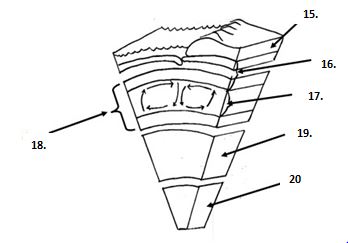
Identify layer  #20.
a)
mantle
b)
asthenosphere
c)
inner core
d)
outer core
105.

Sedimentary rocks are _______ .

a)

formed from magma

b)

a type of foliated igneous rock

c)

formed because of changes in temperature and pressure, or the presence of hot watery fluids

d)

formed when loose materials become pressed or cemented together or when minerals form from solutions

106.

Sedimentary rocks are changed to sediments by ________ .

a)

compaction

b)

weathering and erosion

c)

cementation

d)

heat and pressure