wayground logo

Free Printable Worksheets

Font size

S
M
L
XL
Worksheets

Biology Review Test

Total questions: 113

Worksheet time: 16hrs 39mins

Name
Class
Date
1.
This wolf has white fur and blue eyes.  Are these  traits dominant or recessive traits?
a)
dominant
b)
recessive
c)
neither
2.
Which of these are  an example of sexual reproduction?
a)
A protist splits in half and develops into two identical cells
b)
A dog has a litter of 8 puppies an they all look different
c)
A star fish regenerates its limbs after being cut off
3.
Which of the following reproduces asexually?
a)
flowers
b)
humans
c)
bacteria
4.
Where in the cell is genetic material found?
a)
cell membrane
b)
cytoplasm
c)
chromosomes
5.
How would you describe the offspring of asexual reproduction?
a)
diverse
b)
genetically identical to the parent organism
c)
single cell amoeba
6.
Almost all of a cell's genes are found where?
a)
ribosomes
b)
mitochondria
c)
nucleus
7.
Here you see a mama cat and daddy cat with their offspring.  Where do the offspring get their traits?
a)
mama OR daddy
b)
a monkey's uncle
c)
both mom and dad
8.
cells with no nucleus are called
a)
prokaryotic
b)
eukaryotic
c)
dead
d)
alive
9.
The smallest unit of life is a(n)
a)
atom
b)
cell
c)
snail
10.
Multicellular means
a)
made of many cells
b)
made of one kind of cell
c)
made of only one cell
11.
Which of the following is the correct equation for PHOTOSYNTHESIS?
a)
CO+ light + H2O --> O+ Sugar
b)
CO+ sugar + H2O --> O+ light
c)
O2 + light + H2O --> CO+ Sugar
d)
CO+ O2 + H2O --> Light+ Sugar
12.
Which organelle performs PHOTOSYNTHESIS?
a)
Chloroplast
b)
Mitochondria
13.
Which gas is removed from the atmosphere during photosynthesis?
a)
hydrogen
b)
oxygen
c)
nitrogen
d)
carbon dioxide
14.
What are the products of photosynthesis?
a)
water and carbon dioxide
b)
oxygen and glucose
c)
oxygen and carbon dioxide
d)
oxygen and water
15.
What is the correct equation for cellular respiration?
a)
6O2 + C6H12O6 -> 6CO2 + 6H2O + Energy
b)
6O2 + C6H12O6 + Energy -> 6CO2 + 6H2O
c)
6CO2 + 6H2O -> 6O2 + C6H12O6 + Energy
d)
6CO2 + 6H2O + Energy -> 6O2 + C6H12O6
16.
When glycolysis occurs,
a)
a molecule of glucose is split
b)
two pyruvate are made
c)
some ATP is produced
d)
all of these
17.
Cells produce ATP most efficiently in the presence of
a)
water
b)
carbon dioxide
c)
oxygen
d)
radiant energy
18.

In what process is mRNA synthesized?

a)

Transcription

b)

Translation

c)

DNA Replication

d)

Mitosis

19.

Where does TRANSCRIPTION occur?

a)

Nucleus

b)

Ribosome

c)

Cytoplasm

d)

Mitochondria

20.

Which of the following is a codon?

a)
b)

ATG

c)

AUG

d)

AUT

21.

How many codons equals 1 amino acid?

a)

1

b)

2

c)

3

d)

4

22.

On which molecule can an anticodon be found?

a)

mRNA

b)

DNA

c)

tRNA

d)

rRNA

23.

What is the purpose for anti-codons?

a)

to ensure the correct amino acid is dropped off

b)

to match the strand of DNA

c)

to decode a sequence of 4 nucleotides into an amino acid

d)

to make me hate biology

24.

Which two things are found on a molecule of tRNA?

a)

amino acids; anticodons

b)

amino acids; codons

c)

ribose sugar; proteins

d)

deoxyribose sugar; codons

25.
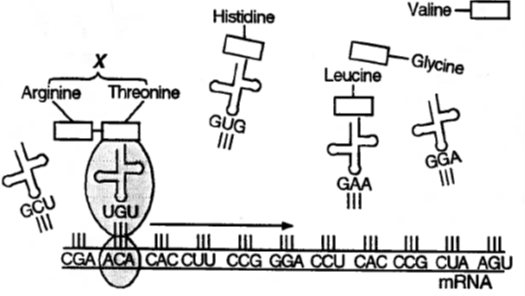
What process is going on in this photo? 
a)
Transcription 
b)
Translation 
c)
Replication 
d)
All the above 
26.
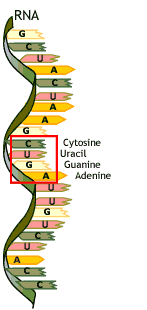
In RNA, Uracil pairs with ______. 
a)
cytosine
b)
adenine
c)
guanine
d)
thymine
27.
The process to go from mRNA to a protein is called ____
a)
transcription
b)
rRNA
c)
replication
d)
translation
28.
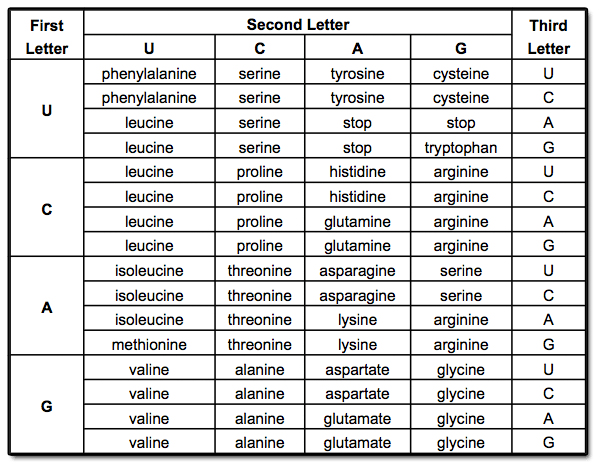
What amino acid is represented by the codon UUA?
a)
Phenylalanine
b)
Tyrosine
c)
Leucine
d)
Stop codon
29.
Glycerol and fatty acids combine to form...?
a)
Carbohydrates
b)
Lipids
c)
Proteins
d)
Nucleic Acids
30.
Glucose (sugar) is an example of a
a)
Carbohydrate
b)
Lipid
c)
Protein
d)
Nucleic Acid
31.
Which subunits make up the structure of all proteins?
a)
glucose
b)
amino acids
c)
carbohydrates
d)
fatty acids
32.
Carbon, Hydrogen, Oxygen and Nitrogen are elements in what biomolecule?
a)
Carbohydrate
b)
Lipid
c)
Protein
d)
Nucleic acid
33.
In a chemical reaction, a reactant binds to an enzyme at a region known as the
a)
catalyst.
b)
product.
c)
substrate.
d)
active site. 
34.

This egg has shrunk (gotten smaller), what type of solution was it placed in?

a)

hypotonic solution

b)

hypertonic solution

c)

isotonic solution

d)

active transport

35.
If a cell is placed in a HYPOTONIC solution, water will move _________ of the cell, causing it to ___________.
a)
into, swell
b)
out of, shrivel
c)
in and out of the cell, stay the same
36.

The cell below is in a _____________ solution.

a)

Hypertonic

b)

Hypotonic

c)

Isotonic

37.

What type of solution is this healthy looking red blood cell in?

a)

Isotonic

b)

Hypertonic

c)

Hypotonic

38.

The movement of water molecules out of a cell and into an environment with high salt concentration is

a)

facilitated diffusion

b)

osmosis

c)

phagocytosis

d)

exocytosis

39.

The 3 parts of the Cell Theory are...?

a)

All living things are composed of cells

Cells are the basic units of structure and function in living things

All cells are produced from other cells

b)

All living things are composed of cells

Cells are the basic units of dance and vibes in living things

All cells are destroyed from other aliens

c)

All living things are composed of Jell-O

Cells are the basic units of structure and function in living things

All cells are produced from factories in Canada

d)

All living things are composed of cells

Cells do karate and practice eating whole pies in their free time

All cells are produced from other cells

40.

There are how many main Bio-molecules that help make up cell organelles?

a)

2

b)

6

c)

4

d)

5

41.

Something that is non-living is called

a)

biotic

b)

abiotic

c)

cells

42.

An organism, either a green plant or bacterium, which is part

of the first level of a food chain is called

a)

decomposer

b)

consumer

c)

producer

43.

an organism that feeds on plants or other animals for energy.

a)

Eukaryotic Cell

b)

Consumer

c)

Decomposer

d)

Producer

44.

A community of animals and plants interacting with their environment

a)

population

b)

Organism

c)

Ecosystem

45.
What makes this individual's karyotype not normal?
a)
An extra sex chromosome
b)
An extra autosome
c)
A missing sex chromosome
d)
A missing autosome
46.
What is the sex of this individual?
a)
female
b)
male
47.
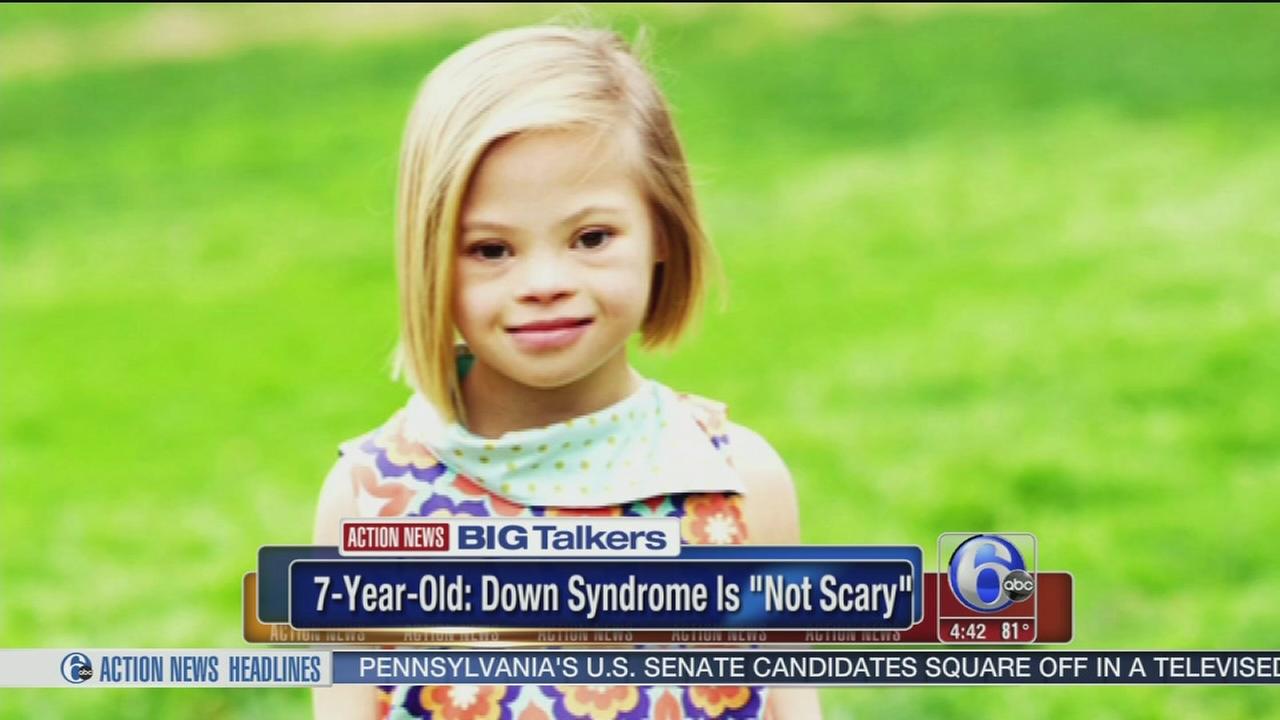
Down's syndrome occurs because of a(n)
a)
missing sex chromosome
b)
extra sex chromosome
c)
additional 21st chromosome
d)
additional 18th chromosome
48.
Chromosome pairs 1-22 are referred to as
a)
sex chromosomes
b)
sister chromatids
c)
a karyotype
d)
autsomes
49.
If T=Tall & t=short, what is the genotypic ratio?
a)
1:3
b)
3:1
c)
1:2:1
d)
2:2
50.

Some flowers are controlled by codominance. Red flowers (RR), blue flowers (BB) and Speckled flowers (RB).


Cross a red flower with a speckled flower. What is the phenotypic ratio?

a)

2 red, 2 speckled

b)

2 red, 2 blue

c)

2 blue, 2 speckled

51.
this image is an example of
a)
codominance
b)
dominance
c)
incomplete dominance
52.
What is the mode of inheritance shown here?
a)
Autosomal Dominant
b)
Autosomal Recessive
c)
Sex Linked Recessive
53.
What is the mode of inheritance shown here?
a)
Autosomal Recessive
b)
Autosomal Dominant
c)
Sex Linked
54.
What is the mode of inheritance shown here?
a)
Autosomal Recessive
b)
Autosomal Dominant
c)
Sex Linked
55.
Color Blindness is a sex linked disease.  Therefore, it HAS to affect which pair of chromosomes?
a)
21
b)
23
c)
24
d)
1-22
56.
a)
Not affected Female
b)
Not affected Male
c)
Affected Male
d)
Affected Female
57.
a)
Not Affected Male
b)
Not Affected Female
c)
Affected Male
d)
Affected Female
58.
The genotype of the affected son and daughter at the bottom of this pedigree...
a)
homozygous dominant
b)
homozygous recessive
c)
heterozygous
d)
Can't tell
59.
Choose which scientist corresponds best with the statement: 
survival of the fittest
a)
Darwin 
b)
Lamarck
60.
Choose which scientist corresponds best with the statement: 
use or disuse
a)
Darwin 
b)
Lamarck
61.

Canis lupus, the scientific name for a wolf, is in which genus?

a)

Canis

b)

lupus

c)

Animalia

d)

Mammalia

62.

Which category of classification has the largest variety of organisms?

a)

genus

b)

phylum

c)

species

d)

kingdom

63.

Also helped prove the idea of natural selection, but receives less credit now even tho he was just as big of a deal back in the day!

a)

Charles Darwin

b)

Charles Lyell

c)

Alfred Russel Wallace

d)

Aristotle

64.

Said that a growing population would lead to competition for resources. He called this a struggle for survival

a)

Alfred Russel Wallace

b)

Charles Lyell

c)

Thomas Malthus

d)

Charles Darwin

65.

Geologist that stated that the changing of the Earth was caused over long periods of time due to natural geological forces

a)

Charles Lyell

b)

Charles Darwin

c)

Thomas Malthus

d)

Aristotle

66.
Which scientist disproved spontaneous generation of large organisms by showing maggots came from flies not from rotting meat?
a)
Redi
b)
Needham
c)
Spallanzani
d)
Pasteur
67.
Which scientist designed a special flask that allowed air in but kept microbes out and once and for all disproved spontaneous generation?
a)
Redi
b)
Needham
c)
Spallanzani
d)
Pasteur
68.

_______first believed in spontaneous generation.

a)

Redi

b)

Jean Baptiste Van Helmont

c)

Aristotle

69.
Bird wings and butterfly wings are an example of
a)
Homologous structure
b)
Analogous structure
c)
Mimicry
d)
Camoflague
70.
Some organisms that share a common ancestor have features that have different functions, but similar structures.  These are known as
a)
vestigial structures
b)
analogous structures
c)
homologous structures
d)
fossil structures
71.

What is an embryo?

a)

An early stage of development of a multicellular organism.

b)

A sex cell that begins to grow and diversify.

c)

The genome of an organism before birth.

d)

The fluid sac surrounding a developing organism in its earliest stages.

72.

Which layer contains the oldest fossil?

a)

Layer 1

b)

Layer 2

c)

Layer 3

d)

Layer 4

73.

Fossils of fish are found under land where cows now live. What does this tell you?

a)

the fish were dropped their by flying birds

b)

this land was once under the ocean

c)

fish used to live on land

74.
In layers of sedimentary rock, the _________ layer is usually at the bottom. Each higher layer is _________ than the layers below it.
a)
oldest, younger
b)
youngest, older
c)
youngest, younger
d)
oldest, older
75.
The butterfly diagram on the right refer which model?
a)
Selection
b)
Gradualism
c)
Punctuated Equilibrium
d)
Adaptive
76.
Use the diagram to answer the question.
The Mayfly is a food source for which 3 organisms?
a)
Frog, Dragon Fly and snake
b)
Frog, trout and dragon fly
c)
Frog, salamander and trout
d)
Frog and phytoplankton
77.
Use the diagram to answer the question.
The trout is a source of food for the human and the eagle. When there are more than one organism vying for the same source we call this____?
a)
Population
b)
Resources
c)
Community
d)
Competition
78.
 Jenn is studying a population of fish found in a pond that has a decreasing carrying capacity.  Which of the following factors would not decrease the carrying capacity of her fish? 
a)
drought
b)
flooding
c)
food shortages 
d)
 a freeze  
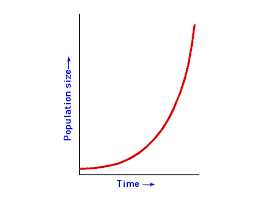
79.
What type of growth is shown in the diagram?
a)
exponential growth
b)
logistic growth 
c)
predator-prey cycle
d)
boom-bust curve
80.
Which type of growth is best illustrated by this rabbit population?
a)
exponential
b)
logistic
c)
S-shaped
d)
predator-prey
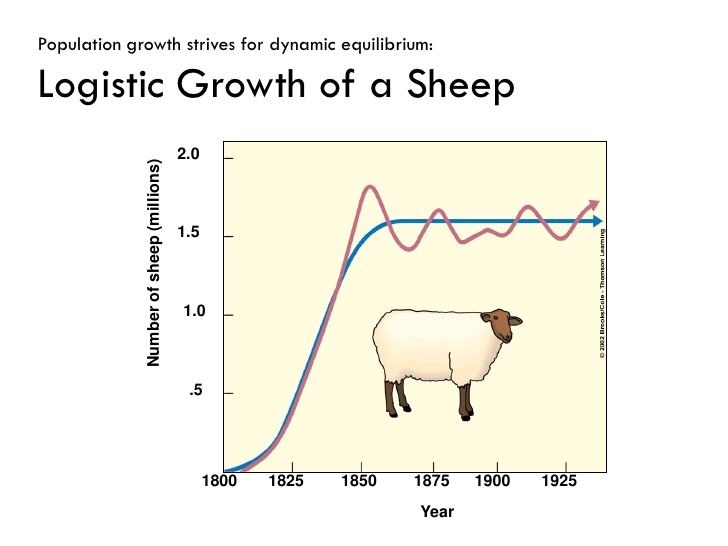
81.
What is the carrying capacity for this sheep population?
a)
1.8 million
b)
1.25 million
c)
1.6 million
d)
1.o million
82.
Recently, a family of bobcats moved into an area with a large rabbit population. What changes may occur in the ecosystem?
a)
The rabbit population may increase
b)
The rabbit population may decrease
c)
The rabbit population may increase first, then decrease
d)
The rabbit population will remain the same
83.

Many fish die due to a drastic change in water temperature.

a)

Density-Dependent

b)

Density-Independent

84.

An extensive drought in the plains threatens wildebeest, giraffe, zebra, and springbok populations.

a)

Density-Dependent

b)

Density-Independent

85.

Which of the following is a density-dependent limiting factor?

a)

human activities

b)

unusual weather

c)

competition

d)

natural disaster

86.

Which of the following would NOT be an example of a density dependent limiting factor?

a)

fire

b)

disease

c)

lack of food

d)

space

87.
A food pyramid represent the relative amount of energy in trophic levels. Which of the following correctly shows a food pyramid?
a)
A
b)
B
c)
C
d)
D
88.
In this energy pyramid, which organisms have the most energy available?
a)
Producers
b)
Carnivores
c)
Herbivores
d)
Top Predator
89.
In an ecological pyramid, which type of organism always has the least amount of energy available?
a)
Producers
b)
Herbivores
c)
Carnivores
d)
Top Predator
90.
How much of the energy in each level of a ecological pyramid gets lost as heat or used by the organism so that it cannot be passed on to the next trophic level?
a)
80%
b)
90%
c)
10%
d)
20%
91.
If there are 100 Kcal of energy available in the producers, how much energy would be available in the herbivores?
a)
10 Kcal
b)
1 Kcal
c)
100 Kcal
d)
1000 Kcal
92.
The diagram represents different levels of a marine food pyramid. Between which two levels is the least amount of energy transferred
a)
R and Q
b)
S and R
c)
T and S
d)
U and T
93.
The diagram represents a pyramid of energy in an ecosystem.  Which level would most likely contain organisms that do photosynthesis?
a)
A
b)
B
c)
C
d)
D
94.

What is the general term used to describe the interaction between two different organisms that are living in close physical association?

a)

photosynthesis

b)

symbiosis

c)

habitat

d)

prey

e)

omnivore

95.

An ecological symbiotic relationship between two organisms where one benefits and the other is harmed…

a)

parasitism

b)

herbivore

c)

mutualism

d)

carnivore

e)

commensalism

96.

What you would call an ecological symbiotic relationship between two organisms where one benefits, but the other is not helped or harmed?

a)

mutualsim

b)

predator

c)

commensalism

d)

parasitism

e)

herbivory

97.

What ecological relationship is depicted between Pumba (warthog) and the bugs?

a)

Competition, because pumba is in competition with the bugs for food sources

b)

Mutualistic, because Pumba and the bugs benefit each other

c)

Predator-Prey, because Pumba is a predator that consumes bug as prey

98.

Marlin and his son, Nemo, are clownfish that live in a sea anemone. Clownfish benefit by receiving protection and shelter from the sea anemone. The clownfish, in return, scares away predators of the sea anemone and provides nutrients for the sea anemone through its excrement (waste). The symbiotic relationship between Nemo and the sea anemone is known as -

a)

parasitism

b)

commensalism

c)

predator-prey

d)

competition

e)

mutualism

99.

The pearlfish receives protection from predators by living inside a sea cucumber. The sea cucumber is not affected during this interaction. This ecological relationship is known as -

a)

predator-prey because the pearlfish is prey to the sea cucumber

b)

mutualism because only the pearlfish benefits in this ecological relationship

c)

parasitism because the pearlfish causes harm to the host sea cucumber

d)

commensalism because only the pearlfish benefits while the sea cucumber is not affected

e)

competition because the sea cucumber and pearlfish often fight for living space

100.

A pair of red, male kangaroos are seen fighting over a potential mate. The ecological relationship between the two male kangaroos shown is -

a)

Commensalism

b)

Mutualism

c)

Predator-Prey

d)

Competition

101.

The term used to include all of the living things PLUS all the non-living things together in a specific environment...

a)

community

b)

biosphere

c)

habitat

d)

population

e)

ecosystem

102.
For a pyramid of numbers, the width of the bar shows the__________ of organisms present in each trophic level at a particular time. 
a)
number
b)
biomass
c)
energy
d)
volume
103.
The number of organisms _________ with each successive (higher) trophic level. 
a)
increases
b)
decreases
104.
Organisms of a lower trophic level have a comparatively __________ number compared to organisms of the higher trophic level in order to support them.
a)
larger
b)
smaller
105.
Which of the following shows the correct pyramid of numbers for the food chain?
a)
A
b)
B
106.
Which of the following shows the correct pyramid of biomass for the food chain?
a)
A
b)
B
107.
succession that occurs in an area with no soil
a)
ecological succession 
b)
primary succession 
c)
secondary succession
d)
pioneer speciles
108.
succession that occurs in an area where soil is already present
a)
ecological succession 
b)
primary succession 
c)
secondary succession
d)
pioneer speciles
109.
the first organisms that appear in an ecological community
a)
ecological succession 
b)
primary succession 
c)
secondary succession
d)
pioneer speciles
110.
starts with bare rock followed by lichen
a)
primary succession 
b)
secondary succession
c)
both types of succession
111.
reaches a climax community quicker because soil is already present
a)
primary succession 
b)
secondary succession
c)
both types of succession
112.
The picture shows what type of succession?
a)
primary
b)
secondary
c)
tertiary
d)
quadanary
113.
What type of succession is shown going from figure A to figure B?
a)
primary succession
b)
eutrophication
c)
secondary succession
d)
intermediate