
 Worksheets
ES Final Review 1: Rocks, Minerals, Landscapes, Earth Layers
Total questions: 118
Worksheet time: 59mins

Which type of rock is formed from the solidification of magma or lava?
igneous
sedimentary
metamorphic
bioclastic

Where is magma located?
above ground
below ground
in the stratosphere
in the thermosphere

Where is lava located?
above ground
below ground
in the core
in the mantle

Describe the texture of the following igneous rock.
smooth
coarse
vesicular
glassy

Describe the texture of the following igneous rock.
glassy
rough
vesicular
coarse

Describe the mineral composition of the following igneous rock.
felsic
mafic

Describe the mineral composition of the following igneous rock.
felsic
mafic

Describe the environment of formation for the following igneous rock (grain size > 10 mm).
intrusive
extrusive

Describe the environment of formation for the following igneous rock.
intrusive
extrusive

Describe the rate of cooling for the following igneous rock.
slow cooling
rapid cooling


Which causes rocks to physically weather in to sediments?
Water
Ice
Wind
All of the above


The movement of the tectonic plates is caused by
the rotation of the Earth.
convection currents in the Asthenosphere
the gravity of the iron-nickel core.
the Moho discontinuity.
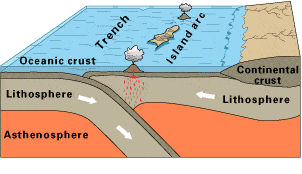
Observe this diagram of a plate boundary. One statement BEST describes what is happening. It is that
the oceanic crust is melting.
the denser ceanic crust is subducting under the less dense oceanic crust
volcanic islands are forming.
the tectonic plates are moving away from each other.
A place where two plates slip past each other, moving in opposite directions, is known as a _______
transform boundary
divergent boundary.
convergent boundary.
rift valley.

The place where two plates come together is known as a _______
transform boundary.
divergent boundary.
convergent boundary.
rift valley.

Below is a picture of sea-floor spreading. How are the ocean crusts moving?
Converging
Diverging
Sliding
No movement

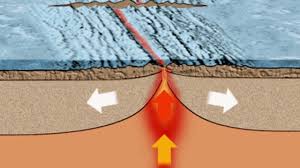
In sea-floor spreading, molten material rises from the mantle and erupts
along the edges of all the continents.
along mid-ocean ridges.
in deep-ocean trenches.
at the north and south poles.

What is the correct order (starting from the surface) of Earth’s layers?
crust, outer core, inner core, mantle
mantle, outer core, inner core, crust
crust, mantle, outer core, inner core
outer core, inner core, crust, mantle

The process by which the ocean floor sinks beneath a deep-ocean trench and back into the mantle is known as _______
convection.
continental drift.
subduction.
conduction.
The geological theory of _______ states that pieces of Earth’s lithosphere are in constant, slow motion.
subduction
plate tectonics
deep-ocean trenches
sea-floor spreading
Scientists think that convection currents flow in Earth’s
continents.
mantle.
lithosphere.
inner core.
How do rock particles move during the passage of a Primary wave (P-waves) through the rock?
the particles do not move
in a rolling circular motion
back and forth parallel to the direction of wave travel
back and forth perpendicular to the direction of wave travel
Which of the following sequences correctly lists the different arrivals of the waves from first to the last?
P waves → S waves → Surface waves
Surface waves → P waves → S waves
P waves → Surface waves → S waves
S waves → P waves → Surface waves
What is the useful information regarding the composition of the interior of the Earth can be derived from earthquake waves?
It changes radioactive decay rates of rocks.
It releases materials from within the Earth.
It travels through the Earth at a constant speed.
It travels at different rates through different materials.
Which layer of the Earth do S-waves not travel through?
core
crust
mantle
moho
Which of the following earthquake waves can travel through both solids and fluids?
P waves only
S waves only
Q-waves only
Both P and S waves
What do you call the motion or vibration of earthquake that travels outward from the focus?
chemical energy
electromagnetic waves
gravity waves
seismic waves
What is the most destructive earthquake wave?
S waves
P waves
Q waves
Surface waves
Which statement best explains why the P-wave of an earthquake arrives at a seismic station before the S-wave?
The S wave originates from the earthquake focus.
The P wave has a greater velocity than the S wave.
The P wave originates from the earthquake epicenter.
The S wave decreases in velocity as it passes through the liquid.
When a mineral breaks along rough, jagged surfaces it's called
fracture
cleavage
hardness
streak
#1 on the Mohs Hardness Scale and also used in baby powder.
halite
talc
graphite
gypsum
The least accurate way to identify a mineral.
color
hardness
streak
density
The measure of how easily a mineral can be scratched.
streak
color
luster
hardness
The way that a mineral reflects light. It can be metallic or non-metallic.
streak
hardness
fracture
luster
The color left by a mineral in its powdered form.
streak
density
hardness
smudge
Which mineral is easily identified by smell?
graphite
galena
halite
sulfur
Color and hardness are examples of a mineral's
chemical properties
molecular qualities
atomic structure
physical properties
In order to be classified as a mineral a substance must be
man-made
organic
able to be scratched by a penny
naturally occurring


Quartz
Mineral
Not Mineral

Glass
Mineral
Not Mineral

Wood
Mineral
Not Mineral

Grantite
Mineral
Not Mineral

Copper
Mineral
Not Mineral

Plastic
Mineral
Not Mineral

Iceberg
Mineral
Not Mineral

Gold
Mineral
Not Mineral

Bone
Mineral
Not Mineral

Coal
Mineral
Not Mineral

Steel
Mineral
Not Mineral

Oil
Mineral
Not Mineral

Sugar
Mineral
Not Mineral

The gradual movement or removal of sediment from a location by water is called...
erosion
runoff
slope
tributary
With a steeper slope, we would expect to see...
less erosion
more erosion
the same amount of erosion
no erosion at all
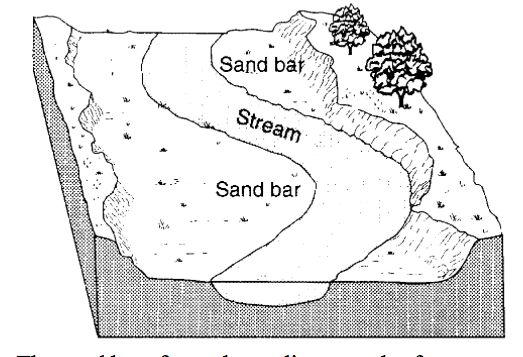
What is weathering?
The movement of sediment
The breaking of sediment
The dropping of sediment
Which of these is an example of erosion?
Light shinning onto a mountain
Rain breaking down rock
Wind blowing away sediment
All of the above


Chemical weathering is
caused by living things, like plants and animals
caused by chemical processes like acid rain & carbonic acid
caused by force, like pressure, pushing, and crashing
Weathering
breaks rocks
moves rocks
make rocks smell
An example of chemical weathering is...
acid rain
rocks falling down a hill
someone breaking rocks
rocks melting into magma
Which of these answers are Mechanical Weathering?
Wind Abrasion
Acid Precipatation
Carbon Dioxide
All of these
What can cause chemical weathering?
Oxygen
Carbon dioxide
Acid rain
All of these



