
 Worksheets
APES Review Units 1-3
Total questions: 118
Worksheet time: 4hrs 30mins
The study of environmental science primarily considers
interactions among human systems and those found in Earth
the effect of human systems
abiotic factors that influence the state of our environment
factors that affect global climate change
An ecosystem is a location on Earth that includes
only biotic components
only abiotic components
interacting biotic and abiotic components
positive and negative feedback loops
Which best describes the difference between an environmentalist and an environmental scientist?
the difference is unimportant because both care about Earth
an environmentalist follows a belief system; an environmental scientist is concerned with the methods of science
an environmentalist studies the humanities; an environmental scientist has a background in biology and chemistry
an environmentalist is concerned with abiotic factors; an environmental scientist studies biotic factors
Place the ecology levels of organization in proper order (smallest to largest)
organism > population > community > ecosystem > biosphere
community > organism > ecosystem > biosphere > population
organism > community > biosphere > population > ecosystem
population > biosphere > ecosystem > community > organism
A tapeworm lives in the small intestines where it feeds and grows, robbing the human of essential nutrients. This is a _____ type of relationship.
Commensalism
Parasitism
Symbiotic
Mutualism
The cattle egret follows herds of cattle and eat the insects that the cattle stir up as they move through the grassland. The cattle appear to be unaffected by the egrets. This is a _____ type of relationship.
Commensalism
Parasitism
Symbiotic
Mutualism
A positive feedback loop occurs
when a system responds to a change by returning to its original state
when feedback into a system decreases a rate of response
when a system is in a steady state
when feedback into a system increases a rate of response
Which is a biotic factor?
producers
pH
energy
humidity
Which best describes the concept of net primary production?
total amount of energy available from the Sun
total amount of cellular respiration conducted within an ecosystem
energy captured minus energy lost
total amount of energy available from the producer

In which biome would you expect to find an area with an average temperature of 10oC and 200 cm of precipitation annually?
Temperate seasonal forest
Temperate rainforest
Woodland/shrubland
Tropical seasonal forest
In which biome would you expect to find an area with an average temperature of 4oC and 50 cm of precipitation annually?
Tundra
Boreal forest
Temperate grassland/cold desert
Woodland/shrubland
What factors are used to classify a biome?
average temperature
average precipitation
distinctive plants adapted to area
all of these are correct
Which biome is characterized by the presence of permafrost?
temperate seasonal forest
woodland/shrubland
tundra
boreal forest
Terrestrial biomes are defined by ____ and ____ variables.
temperature; precipitation
temperature; animals
precipitation; plants
animals; plants
What is a herbivore?
receives energy from the sun
only eats meat
only eats plants
eats both plants and meat
The direction of an arrow in a food chain represents
the flow of energy from organism B to A
the movement of organisms
the directionality of the sun
the flow of energy from organism A to B
Which biome has warm temperatures, high precipitation, and little seasonal variation due to its location near the equator?
Boreal forest
Tropical rainforest
Woodland/shrubland
Subtropical desert
An experiment is designed to determine if wheat grows better when it is planted alone or with clover. The design calls for 3 pans of each treatment. Pans A, B, and C contain only wheat. Pans D, E, and F contain clover and wheat planted in alternating rows. Each pan contains a total of
100 seeds. All treatments contain the same type of soil, are planted in the same size pan, are exposed to the same amount of sunlight, and are maintained at the same temperature throughout the course of the experiment.
The treatments planted with only wheat are the
sample size.
control.
environmental variable.
replication.
An experiment is designed to determine if wheat grows better when it is planted alone or with clover. The design calls for 3 pans of each treatment. Pans A, B, and C contain only wheat. Pans D, E, and F contain clover and wheat planted in alternating rows. Each pan contains a total of
100 seeds. All treatments contain the same type of soil, are planted in the same size pan, are exposed to the same amount of sunlight, and are maintained at the same temperature throughout the course of the experiment.
Which statement provides a hypothesis for this experiment?
Wheat grows better when planted alone than when planted together with clover.
Clover grows better when planted alone than when planted together with clover.
Wheat grows better when planted together with soy beans.
Clover grows better when planted together with wheat.
An ecosystem contains
only one species
multiple species
living and non-living components
all the similar biomes across the world
A community contains
only one species
multiple species
living and non-living components
all the similar biomes across the world
A population contains
only one species
multiple species
living and non-living components
all the similar biomes across the world


What does a biomass pyramid compare?
the amount of biomass at each trophic level
the amount of energy available at each trophic level
the amount of biomass consumed at each trophic level
the amount of individuals at each trophic level
Which of the following ecological levels of organization are arranged from largest to smallest?
ecosystem, population, community
biosphere, ecosystem, community
community, population, ecosystem
biosphere, population, ecosystem
Compared with a population with low genetic diversity, a genetically diverse population is more likely to include individuals that
are distributed over a large area.
vary greatly by age.
vary greatly by appearance and behavior.
each carry a large number of genes.
Which of the following is most likely to give an individual a larger range of tolerance than other members of its population?
spending more time in extremely hot and cold conditions
having a relatively large number of offspring
genetic similarity to the rest of the population
genetic difference from the rest of the population
Genetic diversity, species diversity, ecological diversity, and functional diversity are best characterized as elements of
cultural diversity
abiotic resources
biological diversity
biospheres
A secondary consumer obtains X energy from eating a primary consumer with a total energy of Y. What is the relationship of X and Y?
X > Y
X < Y
X = Y
2Y = X
Which of the following organisms is usually first to suffer when an ecosystem is disrupted?
producers
primary consumers
tertiary consumers
decomposers
All of the following help determine an animal's niche EXCEPT
physical damage it has sustained
its temperature-range tolerance
its adaptive traits
species that act as its predators and prey
Only 5% of a population of lizards survive a major flood, and by chance, the majority of the survivors are green. If the original population was composed mostly of brown individuals, what type of phenomenon has occured?
evolutionary divergence
a bottle-neck event
parallel evolution
natural selection
A species is most likely to go extinct in a changing environment if it has
high genetic diversity
a large niche
a narrow niche
recent evolutionary adaptations
One species benefits from its relationship with another species for whom the relationship does no harm nor good. This relationship is best described as
commensalism
parasitism
mutualism
competitive exclusion
During primary succession, which of the following organisms often serve as pioneer species?
lichens
grasses
bushes
trees
Southeast Asian flying foxes are responsible for pollinating durian tree flowers and spreading durian seeds. Durian trees and fruit are critical for the survival of many species and a decline in the flying fox population would be devastating to the local ecology. Flying foxes can be considered
an indicator species
an invasive species
a keystone species
a pioneer species
Coastal wetlands are ecologically important because they do all of the following EXCEPT
harbor a high level of biodiversity
reduce the impact of storms coming inland
provide refuge for large marine mammals like blue whales
help to cycle nutrients
Wolves were reintroduced to Yellowstone National Park in 1995. This keystone species restored the park’s ecosystem. What is the ecological value of a keystone species?
they influence the survival of many other species in an ecosystem.
they prevent the ecosystem from changing and growing.
they protect land and water resources within the ecosystem.
They decrease the number of unwanted species in an ecosystem.
A healthy forest ecosystem in the Northwest is home to elk, mule deer, chipmunks, ground squirrels, and a variety of plants. What is the relationship between biodiversity and available resources?
Biodiversity is not affected by changes to available resources.
Biodiversity decreases the amount of available resources.
Biodiversity increases with abundant resources and decreases when resources are scarce.
Biodiversity decreases with abundant resources and increases when resources are scarce.
Sometimes when a bee pollinates a flower, this action is beneficial to humans. Bees are the main pollinators of many plants that humans eat, such as blueberries, potatoes, apples, celery, and strawberries. What are the benefits that humans receive from the ecosystem called?
ecological restoration
sustainability
ecosystem services
ecology
Which of the following represents a cultural ecosystem service?
timber
water cycle
pollination
recreational opportunities
Which of the following is true about island biodiversity?
Small islands are more likely to have more immigrated species
Small islands have higher biodiversity than large islands
Small islands have more resources and as a result may have more species
Small islands have fewer resources and as a result may have fewer species
What prediction is correct about island biogeography?
Smaller islands have more resources, and will have more biodiversity
Larger islands have more space for resources, but will have less biodiversity due to competition
Islands closer to mainland will be more diverse due to more successful dispersal.
There is more diversity far away from the mainland because some species fly.


Which is the best description of the two communities shown?
Community 1 has a higher evenness but lower richness than Community 2.
Community 1 has a higher evenness and equal richness to Community 2.
Community 2 has a higher evenness and higher richness than Community 1.
Community 2 has a higher evenness but lower richness than Community 1.
The relative abundance of individuals within each species refers to the
Species Richness
Genetic Diversity
Species Evenness
Ecological Diversity

This zone has few organisms where the temperature is either too low or too high. The old and weak fish die in this zone.
Zone of Physiological Stress
Zone of Intolerance
Zone of Optimum Range
Zone of Invalidity
Products obtained from nature that humans can use such as lumber, medicines and food crops are
ecological benefits.
provisions.
supplies.
services.

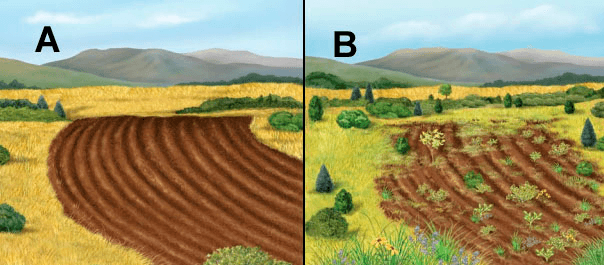
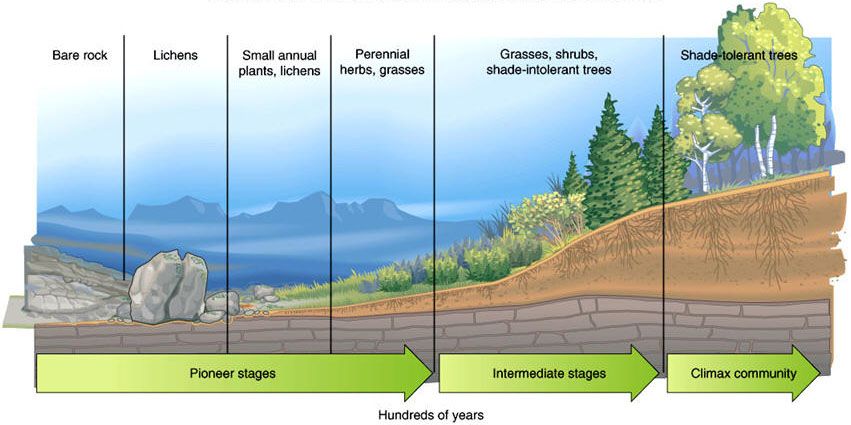
What is an example of an area that is likely to undergo primary succession?
Glaciers melt and leave exposed rock
Plants die from drought and decompose
Land is bulldozed and soil remains
A forest fire occurs
Which factor below is least likely to affect birth and fertility rates today?
number of people 60 or older
cost of raising and educating children
religious beliefs
educational and employment opportunities for women
average age at marriage
Which of the following pairs of indicators best reflects the availability of health care in a country?
Crude death rate and growth rate
Crude death rate and crude birth rate
Growth rate and life expectancy
Infant mortality rate and life expectancy
Infant mortality rate and crude death rate
Which of the following characteristics are typical of developed countries?
I High technology use
II Low GDP
III Small-scale sustainable agriculture
I only
II only
I and III only
II and III only
I, II and III
Which of the following statements about total fertility rate is correct
TFR is equal to the crude birth rate minus the crude death rate.
TFR is the average number of children each woman must have to replace the current population.
TFR is generally higher in developed countries than in developing countries
TFR is equal to the growth rate of a country
TFR is the average number of children each woman will give birth to during her childbearing years.
At current growth rates, which country will probably be the most populous in the world after 2050?
China
Brazil
India
Indonesia
United States
Which of the following countries best exemplifies phase 4 of a demographic transition?
Argentina
China
India
Mexico
Japan
Using the rule of 70, a population growing at 10% would double in
7 years
10 years
17 years
15 years
not enough information to tell
Populations whose age structure diagrams are narrower at the bottom than at the top have
high death rates
the same proportion of individuals in each age group
a declining population
a high growth rate
all of the above
A particular country has a Total Fertility Rate equal to replacement level fertility and emigration equal to immigration. Which of the following must be true?
The population will begin shrinking within ten years, based on the Rule of 70.
The population must be stable.
The population will begin growing as soon as TFR = 2.1.
Infant mortality must also be less than Crude Death Rate.
There is not enough information to tell.


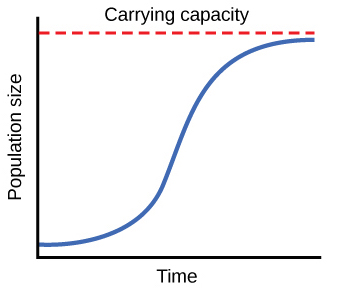
What point on the graph represents the carrying capacity?
A
B
C
D

What is happening at the 'A' on the graph?
the population overshoots above the carrying capacity
the population stops growing
growth begins to slow down due to limited resources
growth is speeding up due to an abundance of resources

Identify two main contributors for the dramatic increase in the world population over the last century.
increased access to birth control
development of modern medicine
increased immigration
introduction of the Industrial Revolution

Closest to the current world population
1 million
1.4 billion
7 billion
330 million

According to the graph, what can have the greatest impact on reducing global TFR?
increasing access to healthcare
increasing access to immigration
women empowerment
What is the maximum number of individuals of one species that the environment can support?
overload capacity
top capacity
population
carrying capacity
The part of the environlent that keeps a population's size at a level below its full potential
limiting factor
stopping factor
carrying factor


When a population grows past the ecosystem's carrying capacity, what happens to the population?
Continues to grow
The population starts to die off to return to carrying capcity
The population will go extinct due to lack of resources
Which one is an effect of rural exodus?
Overcrowded cities
People eat better in rural areas
There are more jobs in rural areas
Which one shows the relation between population and square kilometres?
Natural increase
Life expectancy
Population density
What is the dispersion pattern of herding animals, birds that flock together, and fish that form schools?
clumped
random
uniform
unpredictable
Which factor would be considered density independent?
an intestinal parasite
a fatal virus
a severe drought
severe overcrowding
Which factor would be considered density dependent?
competition
drought
water quality
pH of the soil

What is the horizontal line on the graph called?
exponential growth
geometric growth
carrying capacity
straight-line growth
What is the horizontal line on the graph called?
exponential growth
geometric growth
carrying capacity
straight-line growth
If angel fish produce hundreds of young several times a year, which statement below is true?
Angelfish have a k-strategy reproductive pattern
Angelfish have an r-strategy reproductive pattern
Angelfish probably have a low mortality rate
Angelfish provide a lot of care for their young
The size, density, and birth and death rates of human population are studied during
age structure graphs
demography
exponential growth
k strategist reproduction
What term refers to the number of males and females in various reproductive age groups?
age structure
carrying capacity
reproductive dispersal
birth rates

Type III survivorship is characterized by
extremely high juvenile mortality
mortality that is not age dependent
most mortality occurring among the elderly
most juveniles surviving to a critical age


What would promote a high Total Fertility Rate (TFR)?
Elimination of tax benefits for families with more than two children
Free public housing to families with more than two children
Government advocacy of abstinence to discourage teen pregnancy

