wayground logo

Free Printable Worksheets

Font size

S
M
L
XL
Worksheets

HPS Unit 5 & 6 Test

Total questions: 122

Worksheet time: 4hrs 44mins

Name
Class
Date
1.
Balance this equation:  H2 + N2 → NH3
a)
 H2 + 4N2 → NH3
b)
 H2 + 3N2 → 2NH3
c)
 3H2 + N2 → 2NH3
d)
 2H2 + 2N2 → 2NH3
2.
How many total atoms are represented?         4Al2O3
a)
2
b)
8
c)
5
d)
20
3.
Substances that enter into a chemical reaction (found to the left side of the arrow) 
a)
product
b)
reactant
c)
chemical
d)
balanced equation
4.
The large number in front of a chemical formula or compound is the ___________. 
a)
coefficient
b)
product
c)
physical
d)
chemical
5.
In every balanced chemical equation, each side of the equation has the same number of ____.  
a)
coefficients
b)
moles
c)
molecules
d)
atoms of each element
6.
Is the following equation balanced or unbalanced?
Fe + S --> FeS
a)
balanced
b)
unbalanced
7.
When balancing equations what does
 -->
mean?
a)
subscript
b)
equals
c)
it is just an arrow
d)
yield
8.
What is the part of the chemical equation in green called? 
Fe + S --> FeS
a)
products
b)
reactants
c)
yield
d)
chemical formula
9.
How many atoms of aluminum are on each side of the following equation: 4Al + 3O--> 2AlO3
a)
2
b)
6
c)
1
d)
4
10.
How many atoms are there TOTAL in:
H2SO4
a)
6
b)
5
c)
7
d)
3
11.
___________________ are the elements or compounds that are formed in a chemical
reaction.
a)
Polymers
b)
Bonds
c)
Reactants
d)
Products
12.
Balance this equation,            Al2O3 ---> Al + O2 
a)
Cannot be balanced
b)
2Al2O3 ---> 2Al + 3O2 
c)
2Al2O3 ---> 4Al + 3O2 
d)
3Al2O3 ---> 2Al + O2 
13.
_BaS + _PtF2  _BaF2 + _PtS
a)
1 BaS + 1 PtF2 → 1 BaF2 + 1 PtS
b)
4 BaS + 2 PtF2 → 1 BaF2 +  1 PtS
c)
1 BaS + 2 PtF2→ 2 BaF2 +  2 PtS
d)
1 BaS + 3 PtF2 →1 BaF2 +  2 PtS
14.
_Al + _HCl →_H2 + _AlCl3
a)
2 Al + 2 HCl → 2 H2 + 6 AlCl3
b)
3 Al + 3 HCl → 6 H2 + 2 AlCl3
c)
1 Al + 1 HCl → 3 H2 + 1 AlCl3
d)
2 Al + 6 HCl → 3 H2 + 2 AlCl3
15.
_K + _Cl2 _KCl
a)
2 K + 16 Cl2 → 8 KCl
b)
2 K + 1 Cl2 → 2 KCl
c)
3 K + 4 Cl2 → 3 KCl
d)
1 K + 1 Cl2 →1 KCl
16.
_AgNO3 + _Cu _Cu(NO3)2 + _Ag
a)
2 AgNO3 + 2 Cu → 3 Cu(NO3)2 + 1 Ag
b)
2 AgNO3 + 1 Cu → 1 Cu(NO3)2 + 2 Ag
c)
1 AgNO3 + 2 Cu → 2 Cu(NO3)2 + 1 Ag
d)
3 AgNO3 + 2 Cu → 3 Cu(NO3)2 + 2 Ag
17.
_AlBr3 + _K2SO _KBr + _Al2(SO4)3
a)
6 AlBr3 + 1 K2SO4 → 6 KBr + 1 Al2(SO4)3
b)
2 AlBr3 + 3 K2SO→ 6 KBr + 1 Al2(SO4)3
c)
1 AlBr3 + 1 K2SO→ 2 KBr + 3 Al2(SO4)3
d)
2 AlBr3 + 3 K2SO→ 1 KBr + 2 Al2(SO4)3
18.
_SO2 + _Li2Se _SSe2 + _Li2O
a)
1 SO2 + 2 Li2Se → 1 SSe2 + 2 Li2O
b)
1 SO2 + 1 Li2Se → 2 SSe2 + 2 Li2O
c)
2 SO2 + 2 Li2Se → 2 SSe2 +  2 Li2O
d)
2 SO2 + 2 Li2Se → 1 SSe2 + 1 Li2O
19.
_P4+_O  _P2O3
a)
3 P4+1 O→ 2 P2O3
b)
1 P4+1 O→ 2 P2O3
c)
1 P4+ 3 O→ 2 P2O3
d)
1 P4+ 2 O→ 3 P2O3
20.
_NaF + _Br2 _NaBr + _F2
a)
1NaF + 2 Br2 →1 NaBr + 2 F2
b)
2NaF + 2 Br2 → 2 NaBr + 2 F2
c)
2 NaF + 3 Br2 → 1 NaBr + 2 F2
d)
2 NaF + 1 Br2 → 2 NaBr + 1 F2
21.
CaCO3 represents a chemical
a)
Symbol
b)
Formula
c)
Subscript
d)
Reaction
22.
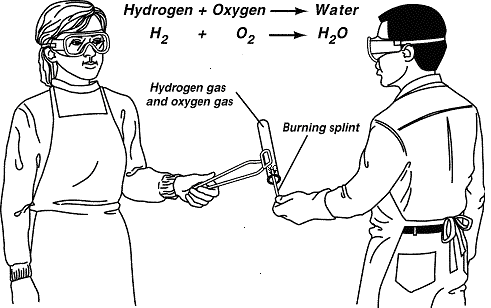
Identify the reactant(s) and product(s) of the reaction.
a)
All three are reactants and none are products.
b)
Hydrogen and water are the reactants, and oxygen is the product.
c)
Water and oxygen are the reactants, and hydrogen is the product.
d)
Hydrogen and oxygen are the reactants, and water is the product.
23.
How many Oxygen (O) atoms are in 2C2HO8Cl2
a)
2
b)
16
c)
8
d)
5
24.
How many Hydrogen (H) atoms are in NH3O5
a)
3
b)
4
c)
5
d)
1
25.
Which is the Law of Conservation of Matter?
a)
matter cannot be created or destroyed, it only changes form
b)
matter can be created but it cannot be destroyed, it never changes form
c)
matter can be destroyed but it cannot be created, it usually just changes form
d)
matter is an unproven theory created by Hans Geiger
26.
In this image, what are the symbols in red are called the_______.
a)
Products
b)
Reactants
c)
Subscripts
d)
Coefficients
27.
2 NH3+ 1 H2SO4 ----> 1 (NH4)2SO4
a)
Synthesis (or combination)
b)
Decomposition
c)
Single displacement
d)
Double displacement
28.
Na3PO4 + 3 KOH ----> 3 NaOH + K3PO4
a)
Synthesis (or combination)
b)
Decomposition
c)
Single displacement
d)
Double displacement
29.
2 C5H5 + Fe ----> Fe(C5H5)2
a)
Synthesis (or combination)
b)
Decomposition
c)
Single displacement
d)
Double displacement
30.
SeCl6 + O2 ----> SeO2 + 3Cl2
a)
Synthesis (or combination)
b)
Decomposition
c)
Single displacement
d)
Double displacement
31.
CaCO3 ----> CaO + CO2
a)
Synthesis (or combination)
b)
Decomposition
c)
Single displacement
d)
Double displacement
32.
P4 +  3 O2 ----> 2 P2O3
a)
Synthesis (or combination)
b)
Decomposition
c)
Single displacement
d)
Double displacement
33.
2 NaBr + 1 Ca(OH)2 ----> 1 CaBr2 + 2 NaOH
a)
Synthesis (or combination)
b)
Decomposition
c)
Single displacement
d)
Double displacement
34.
What is the right part of a chemical equation called...
2H2 + O2 --> 2H2O
a)
Reactants
b)
Products 
c)
Yields 
d)
Chemical Equation 
35.
What coefficient should go in the blank space to balance the chemical equation? 
2Al  +____  HCl   →    2AlCl3  +  3H2
a)
2
b)
4
c)
3
d)
6
36.

Balance the following equation:

___ H2+ ___ O2→___ H2O

a)

1, 1, 3

b)

2, 2, 2

c)

1, 2, 1

d)

2,1, 2

37.

Balance the following equation:

___ Mg+ ___ O2→___ MgO

a)

1, 1, 3

b)

2, 1, 2

c)

1, 2, 1

d)

2, 2, 2

38.

Balance the following equation:

___ SeCl6+ ___ O2→___ SeO2+____Cl2

a)

1, 1, 1, 3

b)

2, 1, 2, 1

c)

1, 2, 1, 2

d)

2, 2, 2, 4

39.

Is this equation balanced?

a)

Yes

b)

No

40.

To balance an equation you should:

a)

ONLY change subscripts.

b)

ONLY change coefficients.

c)

Change BOTH subscripts and coefficients.

41.

C2H6 + 5O2  2CO2 + 3H2O2C_2H_6\ +\ 5O_2\ \rightarrow\ 2CO_2\ +\ 3H_2O_2  
Given this chemical equation, what are the REACTANTS?

a)

C2H6 and 5O2C_2H_{6\ }and\ 5O_2  

b)

2CO2 and 3H2O22CO_2\ and\ 3H_2O_2  

42.

C2H6 + 5O2  2CO2 + 3H2O2C_2H_6\ +\ 5O_2\ \rightarrow\ 2CO_2\ +\ 3H_2O_2  
Given this chemical equation, what are the PRODUCTS?

a)

C2H6 and 5O2C_2H_{6\ }and\ 5O_2  

b)

2CO2 and 3H2O22CO_2\ and\ 3H_2O_2  

43.

Observe the reaction shown here. The formula for this equation is N2 + H2  NH3N_2\ +\ H_2\ \rightarrow\ NH_3  . Does this represent a balanced equation that obeys the Law of Conservation of Mass?

a)

No. The reactants and products are not equal in numbers of atoms of each element. 

b)

Yes. The reactants and products are equal in numbers of atoms of each element. 

44.

Complete the sentence.


During a chemical reaction, atoms ________.

a)

can appear

b)

can disappear

c)

get rearranged

d)

stop moving and vibrating

45.

What is the role of the arrow sign in a chemical reaction?

a)

Making sure atom counts on each side are the same.

b)

Separating products and reactants.

c)

Showing which substances were in the container first and which substances were added later.

d)

Showing which substances are solids and which are liquids or gases.

46.

How many Mn atoms are found in the reactants of the following equation as indicated by the coefficients?

3 Cr(MnO4)6 + 6 Na3N ----> ______________

a)

3

b)

4

c)

6

d)

18

47.
Is the following equation balanced?...
Al + O2 --> 2Al2O3
a)
Yes!
b)
No!
48.
Which of the following shows the correct way to balance the chemical equation?
Fe + O2 -> Fe2O3
a)
4Fe + 3O2 -> 2Fe2O3
b)
2 Fe + 3O2 -> Fe2O6
c)
4 Fe + O6 -> 2Fe2O3
d)
None of the options are correctly balanced.
49.

__ Al + __ FeO → Al2O2 + __ Fe

a)

1, 1, 2

b)

2,1,2

c)

2, 2, 2

d)

2,4,2

50.
 Mg  +  ___ HCl  →   MgCl2  +   H2
a)
1
b)
2
c)
3
d)
4
51.
Balance this equation.
_SnO+_H2-->_Sn +_H2O
a)
1,1,2,1
b)
1,2,1,1
c)
1,2,1,2
d)
1,2,2,1
52.
Balance this equation.
_CF+ _Br-- _CBr+ _F2
a)
2,1,2,1
b)
1,2,2,1
c)
1,2,1,2
d)
2,2,2,2
53.
What is the little number after an element in a chemical equation called.
Example: H2
a)
Coefficient 
b)
Subscript
c)
Atom
d)
Equation
54.
What does the Law of Conservation of Mass state?
a)
Matter cannot be gained or lost in a chemical reaction.
b)
Matter can only be lost in a chemical reaction.
c)
Matter can only be gained in a chemical reaction.
d)
Matter can be gained and lost in a chemical reaction. 
55.
Balance this equation
_Al +_HCl --> _H+_AlCl3
a)
2, 6, 3, 2
b)
it is already balanced
c)
4, 12, 3, 4
d)
2, 1, 4, 5
56.
Balance this equation.
_CH4 + _O--> _CO+ _H2O
a)
1,2,1,1
b)
2,1,2,1
c)
1,2,1,2
d)
0,2,0,2
57.
Balance this equation.
_CF+ _Br-- _CBr+ _F2
a)
2,1,2,1
b)
1,2,2,1
c)
1,2,1,2
d)
2,2,2,2
58.
KNO3 --> KNO2 + O2
What coefficients are needed to balance the reaction?
a)
2, 2, 1
b)
2, 3, 2
c)
1, 2, 2
d)
1, 3, 1
59.
Balance this equation-
__P+ __O--> __P2O3
a)
it is already balanced
b)
2, 1, 3
c)
1, 2, 3
d)
1, 3, 2
60.
Balance this equation.
_Mg + _Cl--> _MgCl2
a)
1, 2,1
b)
already balanced
c)
2,1,1
d)
1,1,2
61.
Balance this equation.
_CH4 + _O--> _CO+ _H2O
a)
1,2,1,1
b)
2,1,2,1
c)
1,2,1,2
d)
0,2,0,2
62.
Balance this equation:
 2Li + Cl2 -> LiCl
a)
2Li + Cl2 -> 4LiCl2
b)
2Li + Cl2 -> LiCl2
c)
2Li + Cl2 -> 2LiCl
63.
Balance this equation.
_CF+ _Br-- _CBr+ _F2
a)
2,1,2,1
b)
1,2,2,1
c)
1,2,1,2
d)
2,2,2,2
64.
Balance this equation
_N+ _H--> _NH3
a)
1,2,3
b)
1,3,2
c)
1,1,2
d)
2,1,1
65.
Balance this equation.
_SnO+_H2-->_Sn +_H2O
a)
1,1,2,1
b)
1,2,1,1
c)
1,2,1,2
d)
1,2,2,1
66.
Balance this equation-
_SeCl6+_O2>_SeO2+_Cl2
a)
1,2,1,2
b)
1,1,1,3
c)
1,2,1,1
d)
2,1,1,1
67.
Fill in the blanks with coefficient:
PCl5+_ H2O→_ HCl+H3PO4
a)
4, 5
b)
1, 6
c)
3, 8
d)
2,2
68.
Which elements are(is) not balanced?
LiNO3 +CaBr2 --> Ca(NO3)2 +  LiBr   
a)
Li
b)
Ca and Li
c)
O and N
d)
Ca
69.

The coefficient in 3 H2O is

a)

3

b)

H

c)

2

d)

O

70.

Sodium reacts with chlorine gas to produce sodium chloride.

a)

NaCl→ Cl + Na

b)

Na+ CO2 → NaCO2

c)

Na + Cl2→ NaCl

d)

Na + Cl → NaCl

71.
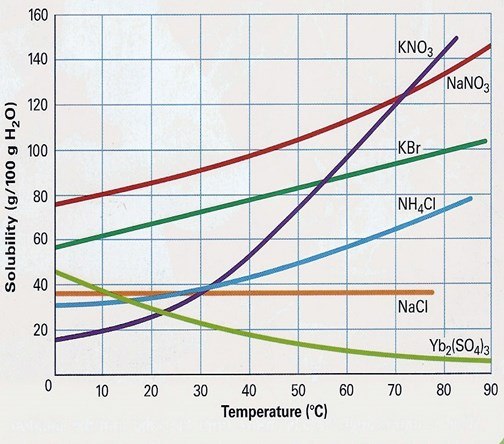
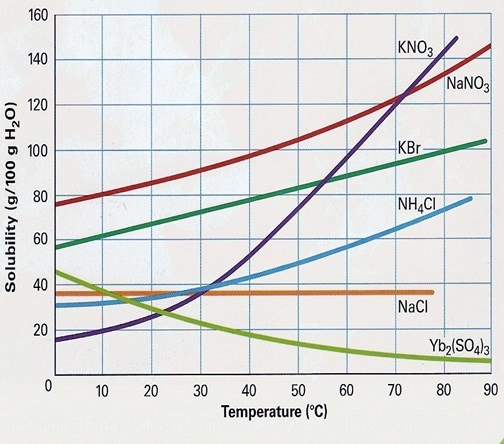
Which solute is the most soluble at 10 ⁰C?
a)
KI
b)
KClO3
c)
NH4Cl
d)
NH3
72.
Which solute is the least soluble at 90 ⁰C?
a)
SO2
b)
KClO3
c)
KI
d)
HCl
73.
Which solute does not increase in solubility as temperature rises?
a)
NH3
b)
NaNO3
c)
KNO3
d)
NaCl
74.
How many grams of SOcan dissolve at 50 ⁰C?
a)
5 g
b)
10 g
c)
20 g
d)
39 g
75.
How many more grams of KNOdissolve at 50 ⁰C compared to 0 ⁰C?
a)
85 g
b)
15 g
c)
70 g
d)
100 g
76.
What is the maximum temperature where at least 60 g of HCl can dissolve?
a)
45 ⁰C
b)
55 ⁰C
c)
35 ⁰C
d)
65 ⁰C
77.
What is the minimum temperature needed to dissolve at least 10 g of KClO3?
a)
25 ⁰C
b)
10 ⁰C
c)
5 ⁰C
d)
100 ⁰C
78.
Which of the following substances increase solubility at the slowest rate with increasing temperature?
a)
SO2
b)
NaCl
c)
KCl
d)
KNO3
79.

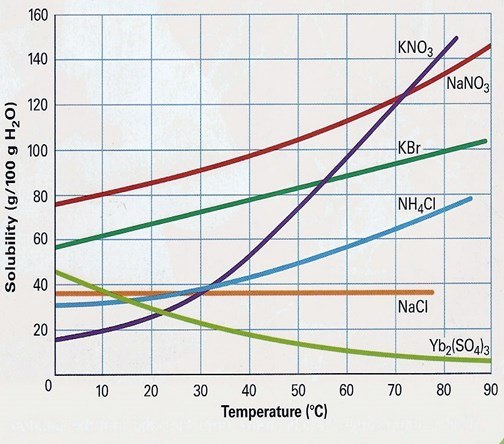
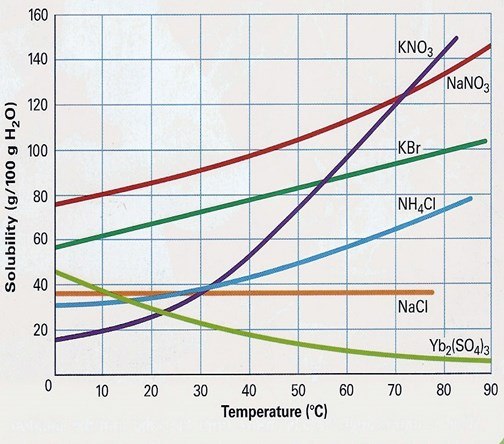
What is the solubility of NaNO3 at 20 C in 100 g of water?

a)

90 g

b)

80 g

c)

40 g

d)

160 g

80.

How many grams of SO2 can dissolve at 50 ⁰C in 100 g of water?

a)

5 g

b)

10 g

c)

20 g

d)

39 g

81.
Which salt is LEAST soluble at 0 ºC?
a)
K2Cr2O7
b)
KNO3
c)
 KClO3
d)
Ce2(SO4)3
82.
A solution of potassium chlorate, KClO3, has 20 grams of the salt dissolved in 100 grams of water at 70 ºC. Approximately how many more grams of the salt can be added to the solution before reaching the saturation point?
a)
10 grams
b)
30 grams
c)
80 grams
d)
60 grams 
83.

At 80'C, KBr's solubility is:

a)

100

b)

90

c)

80

d)

0

84.

At 10'C, NaNO3's solubility is 80 g/100 g of H2O. Based on this information, what would the solubility be in 200 g of H2O.

a)

40

b)

80

c)

160

d)

16

85.

Identify if the following solution would be saturated, unsaturated, or supersaturated: 103 g KBr at 70'C.

a)

Unsaturated

b)

Saturated

c)

Supersaturated

86.

When 40 grams of NaCl is dissolved in 100 grams of water at 90 ºC, the solution can be correctly described as:

a)

supersaturated

b)

saturated

c)

unsaturated

87.

Identify how many grams of KNO3 is required to make a saturated solution at 40'C.

a)

50 g

b)

45 g

c)

55 g

d)

33 g

88.

What is the maximum amound of Ce2(SO4)3 solute that can be solved at 80 degrees in 100 g of water?

a)

20

b)

15

c)

30

d)

2

89.

How much NaBr solute can be dissolved at 70 degrees?

a)

110

b)

120

c)

130

d)

140

90.

At what temperature can you fully dissolve 140g of NaNO3?

a)

62

b)

73

c)

81

d)

You cannot determine this

91.

If a solution has a [H+] of 9.3x10⁻¹¹, what is the pH?

a)

10.0

b)

4.0

c)

3.5

d)

8.2

92.

If a solution has a [OH-] of 2.3x10⁻⁴, it must be a(n)...

a)

Acid

b)

Base

c)

Neutral

93.
If the pH of a solution is 5.6 the pOH is
a)
6.5
b)
12.4
c)
8.4
d)
5.6
94.
A  pH and a pOH will add up to:
a)
0
b)
7
c)
14
d)
1.0 x 10⁻¹⁴
95.
If the [OH-] of a solution is 2.7 x 10⁻⁴ mol/L the pOH of the solution is
a)
10.44
b)
3.56
c)
1.00
d)
-4.43
96.

What is the equation for calculating pH?

a)

pH = [H+]

b)

pH = log [H+]

c)

pH = -log[OH-]

d)

pH = -log [H+]

97.
If the [H+] of a solution is 6.8 x 10⁻⁹ mol/L the pH is
a)
8.17
b)
8.2
c)
9.99
d)
8.62
98.
if the [H+] of a solution is 8.4 x 10⁻³ mol/L the pOH of the solution will be
a)
2.08
b)
11.92
c)
1.02
d)
12.98
99.

If the hydronium ion H3O+ concentration is equal to the hydroxide ion OH- concentration, the solution is a(n)

a)

acid

b)

base

c)

salt

d)

neutral solution

100.

The pH of a solution is 8.43. What is the hydronium ion H3O+ concentration?

a)

3.7 x 10⁻⁹ M

b)

2.7 x 10⁻⁶ M

c)

1.0 x 10-8.43 M

d)

1.0 x 10⁻¹⁴

101.

The pH of a solution is 8.43. What is the hydroxide ion OH- concentration?

a)

3.7 x 10⁻⁹ M

b)

2.7 x 10⁻⁶ M

c)

antilog (-pH)

d)

1.0 x 10⁻¹⁴/-pH

102.

How do you enter antilog on your calculator?

a)

push -log

b)

push ln (natural log)

c)

push 10^

d)

push second log

103.

A solution of Ca(OH)2 is 1.0 x 10⁻⁵ M. What is the hydronium ion concentration?

a)

1.0 x 10⁻⁵ M

b)

1.0 x 10⁻⁹ M

c)

5.0 x 10⁻¹⁰ M

d)

2.0 x 10⁻⁵ M

104.

What is the hydronium ion concentration of 4.0 M H2SO4?

a)

4.0 M

b)

8.0 M

c)

1.0 x 10⁻⁴ M

d)

2.5 x 10⁻¹⁵ M

105.

A solution has 1.0 x 10⁻⁸ M hydronium ions. Another solution has 1.0 x 10⁻³ M hydronium ions. Which solution has a larger number of hydronium ions? Hint this solution is an acid.

a)

1.0 x 10⁻³ M hydronium ion solution

b)

1.0 x 10⁻⁸ M hydronium ion solution

c)

Neither solution is an acid

106.
Limes have a [H3O+] of 1.3 x 10⁻² mol/L.  Their pOH is
a)
1.89
b)
12.11
c)
1.03
d)
12.97
107.

What is the [OH-] if the pH is 4.900?

a)

7.94 x 10⁻¹⁰ M

b)

1.00 x 10⁻⁴ M

c)

7.94 x 10⁻¹⁴ M

d)

4.90 x 10⁻¹⁰ M

108.

What is the range of the pH scale?

(a)  

109.

The pH scale is used to know what?

a)

Your temperature

b)

Know one knows

c)

The colors of acids and bases

d)

The strength of acids and bases

110.

Acids have a pH of _______________.

a)

below 7

b)

above 7

c)

exactly 7

111.

Bases have a pH of _______________.

a)

below 7

b)

above 7

c)

exactly 7

112.

Neutral solutions have a pH of _______________.

a)

below 7

b)

above 7

c)

exactly 7

113.

What ions are there more of in acidic solutions?

a)

H+ (H3O+)

b)

OH-

114.

What ions are there more of in basic solutions?

a)

H+ (H3O+)

b)

OH-

115.

Which one of the following is NOT a property of acids.

a)

Tastes sour

b)

Corrodes metals

c)

Conduct electricity

d)

Turns red litmus paper blue

116.

Which one of the following is NOT a property of basic solutions?

a)

Feels soapy/slippery

b)

Tastes sour

c)

Conducts electricity

d)

Turns red litmus paper blue

117.

Which one of these substances will have a NEUTRAL pH?

a)

Lemon juice

b)

Coffee

c)

Bleach

d)

Water

118.

How do acid base indicators work?

a)

They change smell in different pH values

b)

They change temperature in different pH values

c)

They do not do anything in different pH values

d)

They change color in different pH values

119.

Is the following substance an acid or a base? Ca(OH)2

a)

Acid

b)

Base

120.

Is the following substance an acid or a base? HCl

a)

Acid

b)

Base

121.

Is the following substance an acid or a base? H2(SO4)

a)

Acid

b)

Base

122.

Is the following substance an acid or a base? KOH

a)

Acid

b)

Base