wayground logo

Free Printable Worksheets

Font size

S
M
L
XL
Worksheets

DNA and Protien Synthesis Pre-Test

Total questions: 123

Worksheet time: 2hrs 7mins
Name
Class
Date
1.
Which of the following best describes a DNA molecule?
a)
double helix
b)
contains ribose
c)
made of amino acids
d)
contains Uracil
2.
Why is DNA important?
a)
it is very small and very complicated
b)
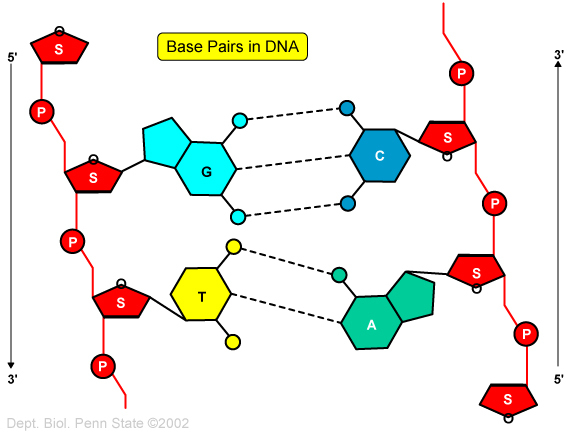
it's in everything
c)
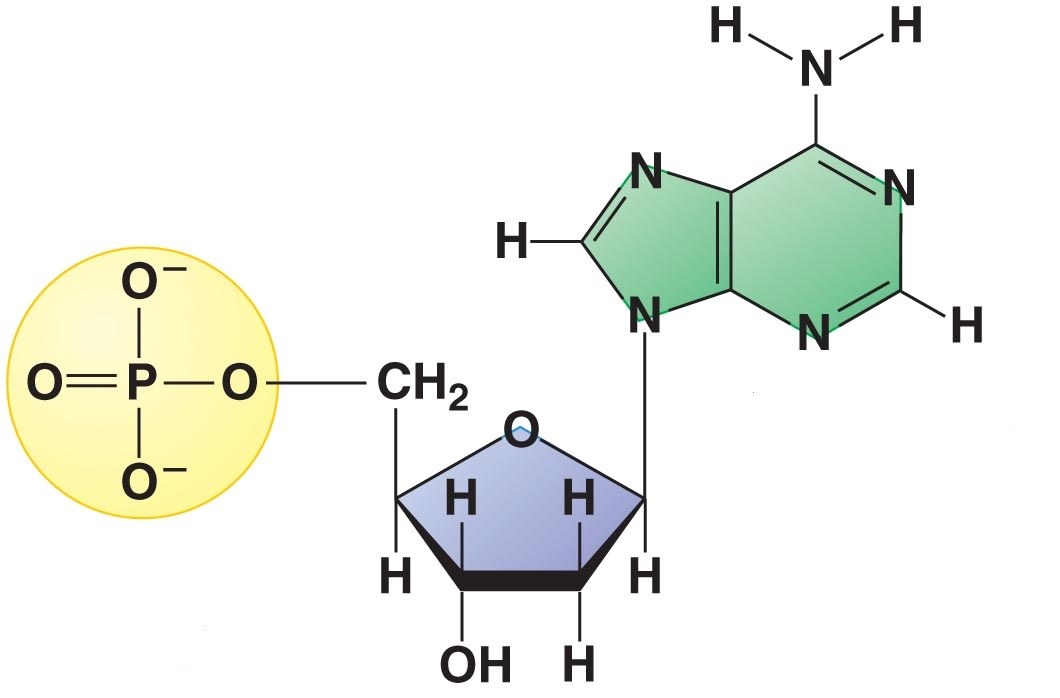
it serves as the blueprint for traits of all living things
d)
because we eat it every day for energy
3.
Which 2 molecules form the sides (backbone) of the DNA ladder?
a)
deoxyribose sugar and adenine
b)
deoxyribose sugar and a hydrogen bond
c)
deoxyribose sugar and the nucleus
d)
deoxyribose sugar and phosphate
4.
Nitrogenous bases are joined by which type of bond?
a)
polar bonds
b)
ionic bonds
c)
covalent bonds
d)
hydrogen bonds
5.
What does DNA stand for?
a)
Deoxyribonucleic acid
b)
Denitrogenous acid
c)
Deribonucleic acid
d)
Diribonucleic acid
6.
Which two scientists are accredited with correctly deducing the double helix model of DNA?
a)
Watson and Crick
b)
Wilkins and Franklin
c)
Wilkins and Crick
d)
Watson and Franklin
7.
Which 2 molecules forms the sides (backbone) of the DNA ladder?
a)
deoxyribose and adenine
b)
deoxyribose and a hydrogen bond
c)
sugar and the nucleus
d)
deoxyribose (sugar) and phosphate
8.
What are the three components of a nucleotide?
a)
sugar, hydrogen, nitrogen base
b)
sugar, oxygen, nitrogen base
c)
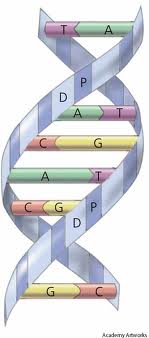
sugar, phosphate, nitrogen base
d)
sugar, phosphate, protein
9.
Cytosine always pairs with
a)
Adenine
b)
Thymine
c)
Uracil
d)
Guanine
10.
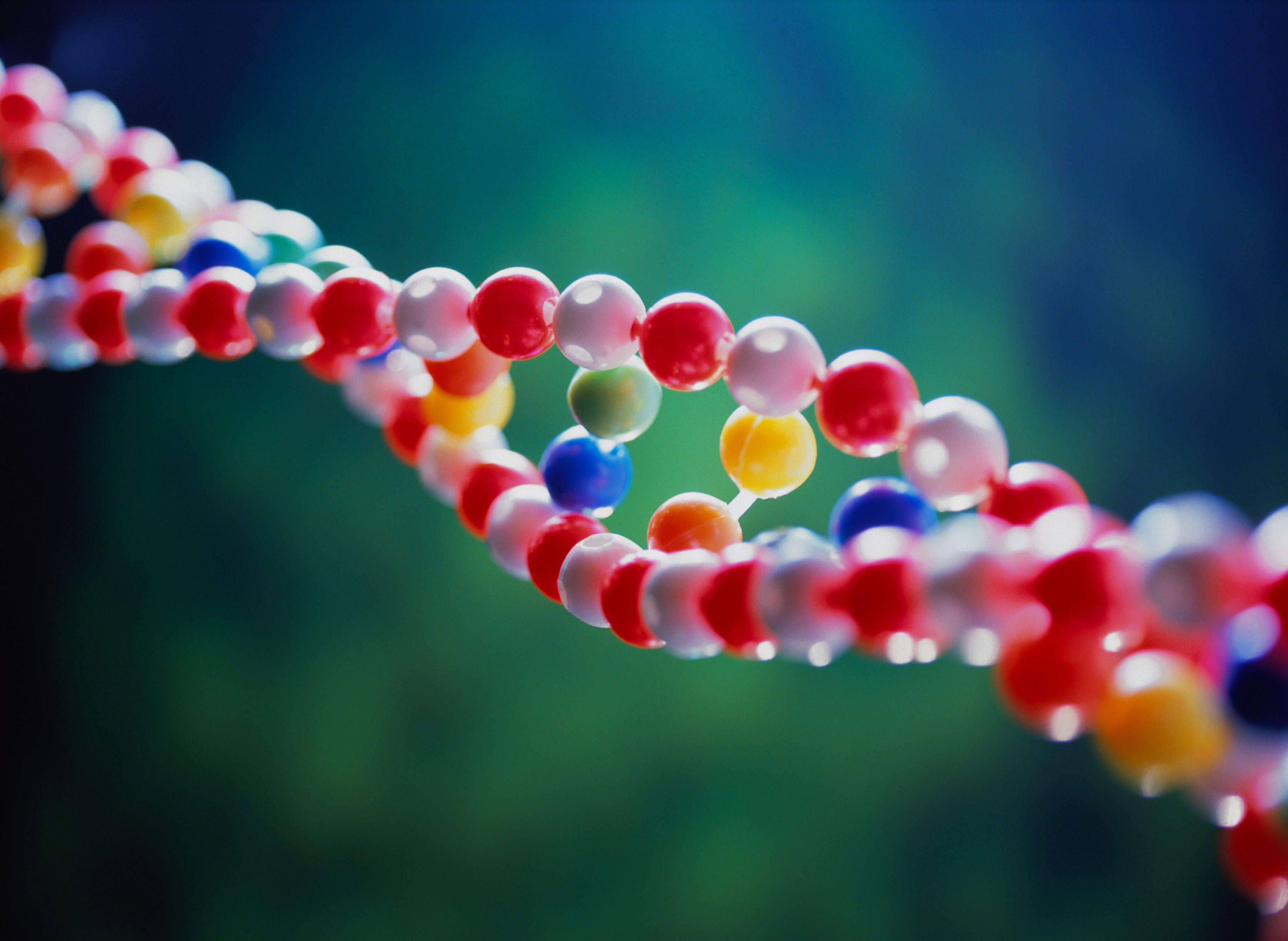
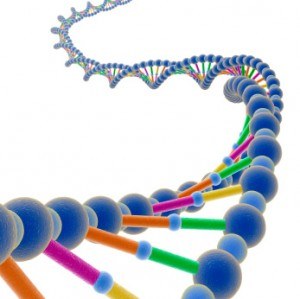
Name this structure
a)
double helix
b)
nucelotide
c)
twisted ladder
d)
hydrogen bond
11.
Which organelle is DNA usually found in?
a)
cell membrane
b)
vacuole
c)
ribosome
d)
nucleus
12.
Nucleotides are made up of a sugar, phosphate, and..?
a)
nitrogenous base
b)
nucleic acid
c)
cholesterol
d)
fatty acid
13.
Guanine bonds with ______________.
a)
Adenine
b)
Guanine
c)
Cytosine
d)
Thymine
14.
The two strands of DNA are held together by:
a)
Hydrogen Bonds
b)
Phosphodiester Bonds
c)
Glycolsyl Bonds
d)
Glycosidic Linkages
15.
What is the complement to the DNA strand below:
5'-ATGCCAT-3'
a)
5'-TACGGTA-3'
b)
3'-TACGGTA-5'
c)
3'-ATGGCAT-5'
d)
5'-ATGGCAT-3'
16.
What is the sugar in DNA called?
a)
Deoxyribose
b)

Ribose

c)
Diglyceride
d)

Cellulose

17.
Adenine pairs with...
a)
Thymine
b)
Cytosine
c)
Guanine
d)
It does not pair with any of them
18.
Which of these is controlled by your DNA?
a)
Color of your eyes
b)
What you ate yesterday
c)
Tattoos
d)
How many bonds carbon wants
19.
What is the monomer of nucleic acids?
a)

Fatty acids

b)
Monosaccharides
c)
Amino Acids
d)
Nucleotides
20.

What are the components of a nucleotide?

a)

nitrogen base, phosphate group, and 5-carbon sugar

b)

5 carbon sugar, purine, and pyrimidine

c)

nitrogen base and a phosphate group

d)

DNA, phosphate group, monosaccharide

21.
In a molecule of double-stranded DNA, the amount of Adenine present is always equal to the amount of
a)
cytosine
b)
guanine
c)
thymine
d)
uracil
22.
Guanine bonds with ______________.
a)
Adenine
b)
Guanine
c)
Cytosine
d)
Thymine
23.
Which 2 molecules form the sides (backbone) of the DNA ladder?
a)
deoxyribose sugar and adenine
b)
deoxyribose sugar and a hydrogen bond
c)
deoxyribose sugar and the nucleus
d)
deoxyribose sugar and phosphate
24.
What will the matching sequence be on a strand that reads AAGCTAT?
a)
AACGATA
b)
TTCGTTA
c)
CCTGATA
d)
TTCGATA
25.

What are the four nitrogen bases?

a)

adenine, thymine, guanine, cytosine

b)

adenine, lysine, prolene, guanine

c)

arganine, cytosine, lysine, purine

d)

lysine, cytosine, lucine, guanine

26.
Which shows the correct complementary base pairing for DNA?
a)
C-A, T-G
b)
A-G, C-T
c)
C-G, U-A
d)
T-A, G-C
27.
Which of the following monomers are repeatedly joined together to form a strand of DNA?
a)
amino acids
b)
nucleotides
c)
fatty acids
d)
polysaccharides
28.
The two strands of nitrogenous bases in DNA are joined by which type of bond?
a)
polar bonds
b)
ionic bonds
c)
covalent bonds
d)
hydrogen bonds
29.
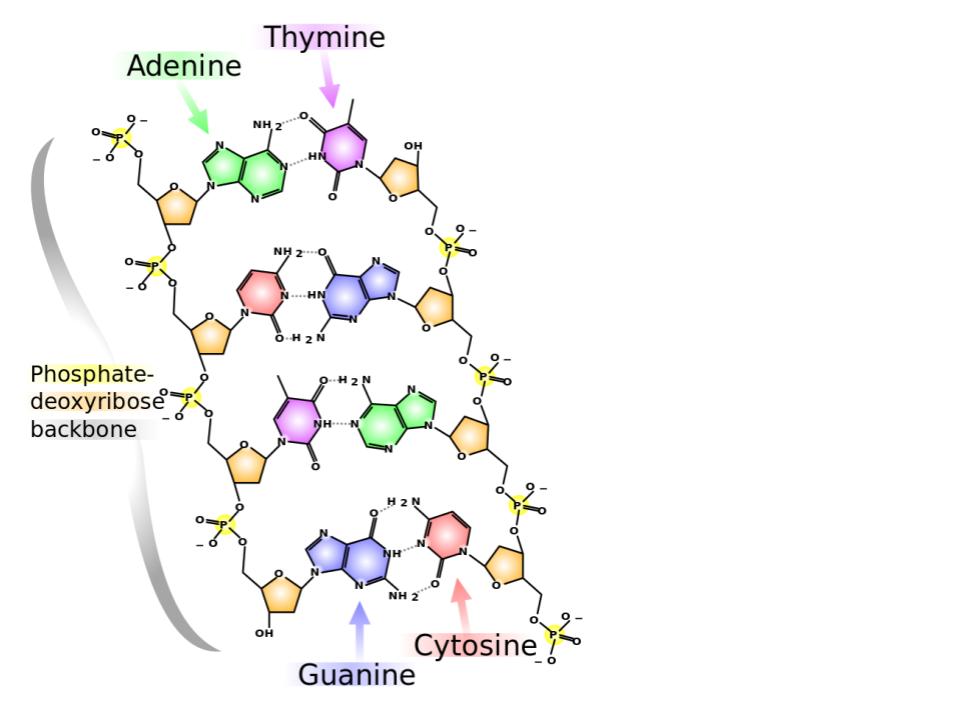
X outlines a(n) ___________.
a)
amino acid
b)
nitrogen base 
c)
nucleotide
d)
nitrogen base pair
30.
Identify #2.
a)
nitrogen base
b)
phosphate group
c)
deoxyribose sugar
d)
nucleotide
31.

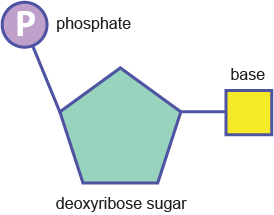
What part of the nucleotide is labled "A"

a)

Phosphate

b)

Nitrogenous Base

c)

Protein

d)

Sugar (Deoxyribose or Ribose)

32.

What part of the nucleotide is labled "B"

a)

Phosphate

b)

Nitrogenous Base

c)

Protein

d)

Sugar (Deoxyribose or Ribose)

33.

What part of the nucleotide is labled "C"

a)

Phosphate

b)

Nitrogenous Base

c)

Protein

d)

Sugar (Deoxyribose or Ribose)

34.
Which sequence of DNA bases would pair with this partial strand
ATG TGA CAG
a)
ATG TGA CAG
b)
TAC ACT GTC
c)
GTA AGT GAC
d)
CAT TCA CTG
35.

Dr. Tanaka discovered a new virus. The virus has a single strand of a nucleic acid, but she does not know if it is DNA or RNA. After running tests, she concludes that it is DNA. Which of the following would lead her to that conclusion?

a)

it contains uracil

b)

it contains adenine

c)

it contains thymine

d)

it contains cytosine

36.

This gene segment codes for a peptide in humans.

GCT GTG TGA GGC AGA

What is the expected mRNA sequence when the gene segment is transcribed in transgenic mice?

a)

GCT GTG AGG CAG AAC

b)

CGA CAC UCC GUC UUG

c)

CGA CAC ACU CCG UCU

d)

GCU GUG AGG CAG AAC

37.

Which best explains why DNA replication in the human body is significant?

a)

it is needed for cell division

b)

it is necessary for protein synthesis

c)

it replaces any damaged DNA cells

d)

it produces RNA strands

38.

What aspect of the DNA molecule encodes hereditary information concerning an organism’s traits?

a)

the molecular mass

b)

the sequence of base pairs

c)

the distribution of electrical charges

d)

the folded three-dimensional shape

39.

Which of the following aspects of a DNA molecule is responsible for determining the traits of an organism?

a)

number of phosphates

b)

amount of thymine

c)

sequence of nucleotides

d)

type of bond between bases

40.

Which part of a DNA molecule represents encoded information?

a)

phosphate

b)

sugar

c)

guanine

d)

hydrogen bond

41.

Transcription (the process of producing RNA) of the sequence TTAAG produces which sequence?

a)

TTAAG

b)

UUAAG

c)

AAUUC

d)

AATTC

42.

The DNA sequence ACTCG produces which mRNA sequence during transcription?

a)

TGAGC

b)

UGAGC

c)

ACTCG

d)

ACUCG

43.

How many sugar-phosphate strands exist in each RNA molecule?

a)

1

b)

2

c)

3

d)

4

44.

During semiconservative replication, the DNA sequence ACT results in which sequence on the new strand?

a)

ACT

b)

TCA

c)

TGA

d)

UGA

45.

A DNA strand undergoing replication contains the bases TACGTT. Which complementary strand does it produce?

a)

AUCGAA

b)

ATGCAA

c)

ATCGAA

d)

AUCGTT

46.

What is the repeating monomer of a DNA molecule?

a)

triglyceride

b)

dipeptide

c)

nucleotide

d)

phospholipid

47.

Which statement explains why the gene of a frog may be inserted into a bacterial chromosome?

a)

Nucleotides are the basic units of DNA for all organisms.

b)

DNA forms purines and pyrimidines in all organisms.

c)

One DNA allele produces one enzyme in all organisms.

d)

DNA has equal amounts of adenine and thymine for all organisms.

48.

In living things, smaller substances are linked to make up larger substances. Which of the following correctly describes a larger substance made by linking smaller substances?

a)

Nucleotides are linked to make up DNA.

b)

Amino acids are linked to make up DNA.

c)

Proteins are linked to make up nucleotides.

d)

Nucleic acids are linked to make up proteins.

49.

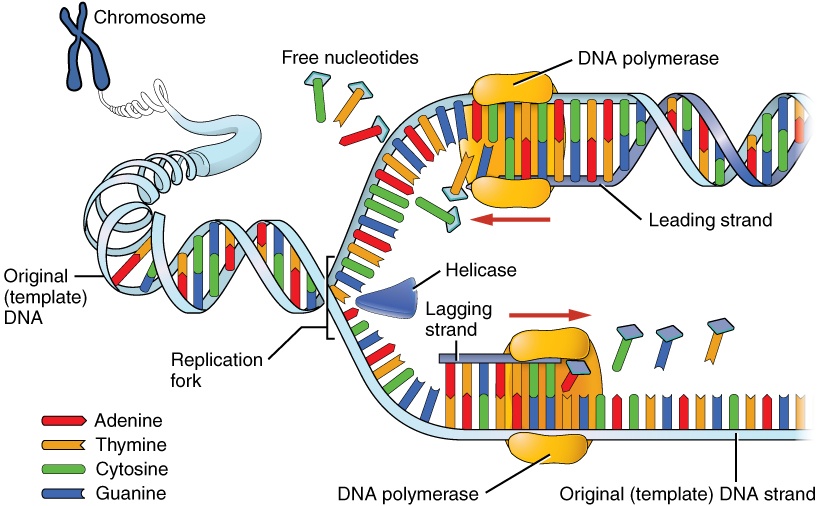
The enzyme that is responsible for adding the correct nucleotides to a replicating strand of DNA.

a)

Okazaki Fragments

b)

DNA Polymerase

c)

DNA Nuclease

d)

DNA Peptidase

50.

The partly open/partly closed area where the replication is actively happening.

a)

Okazaki Fragments

b)

Leading Strand

c)

Lagging Strand

d)

Replication Fork

51.

The nucleotides that form on the lagging strand.

a)

Okazaki Fragments

b)

Leading Strand

c)

Lagging Strand

d)

Replication Fork

52.

The replicating strand of DNA that is build seamlessly and continuously from the 5' to the 3'.

a)

Okazaki Fragment

b)

Lagging

c)

Leading

d)

Replication Fork

53.
DNA replication results in two DNA molecules,
a)
each one with two original strands
b)
each one with two new strands
c)
each one with one new strand and one original strand
d)
one with two new strands and the other with two original strands
54.
The copying of DNA to make two identical strands is called ___
a)
transformation
b)
translation
c)
transcription
d)
replication
55.
The copying of DNA into a strand of mRNA is called
a)
transformation
b)
transcription
c)
translation
d)
replication
56.
The synthesis of a protein from the information carried by  mRNA molecules.
a)
Transformation
b)
Transcription
c)
Translation
d)
Replication
57.
Which isn't true of DNA
a)
The sugar is deoxyribose
b)
It is single stranded
c)
It has the base thymine
d)
It is held in the nucleus
58.
In RNA, adenine bonds with 
a)
cytosine
b)
guanine
c)
thymine
d)
uracil
59.
Which of the following isn't a type of RNA discussed in your notes?
a)
mRNA
b)
pRNA
c)
tRNA
d)
rRNA
60.
RNA can be found in the ___
a)
nucleus
b)
cytoplasm
c)
both the nucleus and the cytoplasm
61.
What separates the DNA strands in transcription?
a)
DNA polymerase
b)
RNA polymerase
c)
microteeth
d)
a zipper
62.
A group of 3 mRNA that codes for an amino acid is called a __
a)
anticodon
b)
triad
c)
triplet
d)
codon
63.

What type of RNA carries the amino acids to the ribosome?

a)

mRNA

b)

tRNA

c)

pRNA

d)

rRNA

64.
What carries the genetic message out of the nucleus?
a)
DNA
b)
mRNA
c)
tRNA
d)
rRNA
65.
How many possible codons are there?
a)
36
b)
24
c)
48
d)
64
66.
How many amino acids are there?
a)
10
b)
20
c)
36
d)
48
67.
What do amino acids form?
a)
RNA
b)
DNA
c)
Proteins
68.

Which of the following is a pyrimidine?

a)

adenine

b)

thymine

c)

guanine and thymine

d)

cytosine and thymine

69.

A bacteriophage is a

a)

bacteria

b)

virus

c)

enzyme

d)

coil of RNA

70.

What causes a mutation?

a)

a repeat in base pairs

b)

a base pair being deleted

c)

base pairs being flipped in order

d)

Any change of sequence of base pairs

71.

Which of the following is the correct order?

a)

RNA -> DNA-> protein

b)

protein -> DNA -> RNA

c)

DNA -> protein -> RNA

d)

DNA->RNA-> Protein

72.

Which bases are found in DNA? (Check all that apply)

a)

Adenine

b)

Uracil

c)

Thymine

d)

Cytosine

e)

Guanine

73.

Which bases are found in RNA? (Check all that apply)

a)

Adenine

b)

Uracil

c)

Thymine

d)

Guanine

e)

Cytosine

74.
Where does transcription take place?
a)
nucleus
b)
cytoplasm
c)
ribosome
75.
what does mRNA do?
a)
carry info from genes to ribosomes
b)
carry amino acids to ribosomes
c)
help with RNA splicing
d)
make up ribosomes
76.
True or false:  RNA is double-stranded.
a)
true
b)
false
c)
it depends on the type
77.
Which of the following best describes a DNA molecule?
a)
double helix
b)
contains ribose
c)
made of amino acids
d)
contains Uracil
78.

What is the correct order to make a protein?

a)

Protein, DNA, RNA

b)

RNA, DNA, Protein

c)

DNA, RNA, Protein

d)

Protein, RNA, DNA

79.

Transcription and DNA replication both involve complex enzymes and complementary base paring.

a)

True

b)

False

80.
How would the DNA sequence GCTATA be transcribed to mRNA?
a)
GCUAUA
b)
CGATAT
c)
CGAUAU
d)
GCUTUT
81.
What are proteins composed of?
a)
nitrogen bases
b)
amino acids
82.
If a DNA strand reads ATT CGT CTA, what would the mRNA strand read?
a)
TAA GCA GAT
b)
CGA TGA GUT
c)
UAA GCA GAU
d)
TAA GCA GUT
83.

The mRNA bases that are found in groups of three bases are called...

a)

codons

b)

codes

c)

anticodons

d)

bases

84.
How many bases code for one amino acid?
a)
three
b)
four
c)
twenty-three
d)
eight
85.
This scientist(s) found a "transforming principle" that changed harmless bacteria into harmful bacteria
a)
Mendel
b)
Avery
c)
Chargraff
d)
Griffith
86.
The scientist(s) who settled the debate about whether it was proteins or DNA that was the genetic material of the cell
a)
Avery
b)
Hershey & Chase
c)
Watson & Crick
d)
Griffith
87.
This scientist(s) conducted experiments that involved injecting mice with S bacteria and R bacteria.
a)
Avery
b)
Griffith
c)
Watson & Crick
d)
Hershey & Chase
88.
By using radioactive isotopes, Hershey and Chase were able to conclude that __ is/are the carrier(s) of genetic information.
a)
nucleic acid
b)
Proteins
c)
Carbohydrates
d)
Lipids
89.
Griffith discovered that
a)
DNA is different than RNA.
b)
adenine = thymine.
c)
bacteria can transfer DNA.
d)
DNA is the genetic molecule.
90.

What letter represents a purine?

a)

W

b)

X

c)

Y

d)

Z

91.

Which color base represents thymine?

a)

dark green

b)

light green

c)

orange

d)

yellow

92.

What base is the orange nucleotide?

a)

adenine

b)

cytosine

c)

guanine

d)

thymine

93.

Which two bases are pyrimidines?

a)

adenine and thymine

b)

adenine and guanine

c)

cytosine and guanine

d)

cytosine and thymine

94.

The work of which scientist(s) determined that DNA is the hereditary material instead of proteins?

a)

Chargaff

b)

Griffith

c)

Hershey and Chase

d)

Franklin

95.

Which is NOT a component of a DNA nucleotide?

a)

phosphate group

b)

deoxyribose

c)

nitrogenous base

d)

amino acid

96.

The work of which scientist(s) determined base pairing rules?

a)

Chargaff

b)

Griffith

c)

Hershey and Chase

d)

Avery

97.

Which of these statements is false regarding photo 51?

a)

It confirmed that DNA was a helical shape.

b)

It confirmed the parts of a nucleotide.

c)

It confirmed the base-pairing rules.

d)

It confirmed that DNA is antiparallel.

98.

If a sample of DNA from a wheat plant has 23% cytosine, how much adenine should it also contain?

a)

23%

b)

27%

c)

54%

d)

77%

99.

Which scientist(s) determined that DNA is the transforming principle of cells?

a)

Avery

b)

Griffith

c)

Hershey and Chase

d)

Chargaff

100.

A strand of DNA has the sequence 3'GGCATAGC5'. What is the sequence of nucleotides on the other DNA strand when read in the same direction as the first strand?

a)

3'CCGTATCG5'

b)

5'CCGTATCG3'

c)

3'AATGCGAT5'

d)

5'AATGCGAT3'

101.

Which scientist coined the term "transformation" based on his work in which the genotype and phenotype of a cell is altered due to the assimilation of external DNA?

a)

Avery

b)

Crick

c)

Griffith

d)

Wilkins

102.

Which phrase describes the base pairings that occur in DNA?

a)

purine + purine

b)

pyrimidine + pyrimidine

c)

purine + pyrimidine

103.

Which carbon is involved in dehydration synthesis reactions for building a DNA polymer?

a)

1'

b)

3'

c)

4'

d)

5'

104.
What organism was Griffith using when he discovered that a harmless strain of bacteria could transform into a lethal strain of bacteria?
a)
pea plants
b)
fruit flies
c)
bacteriophages
d)
mice
105.
What did Avery use to destroy proteins, lipids, and carbohydrates to show that DNA was the transforming factor?
a)
Bacteriophages
b)
X-ray diffraction
c)
Enzymes
d)
Radioactive isotopes
106.
Which two radioactive isotopes were used to label the DNA and protein components of viruses called bacteriophages?
a)
Nitrogen and Phosphorus
b)
Phosphorus and Sulfur
c)
Nitrogen and Sulfur
107.

Who proposed that DNA was not a protein?

a)

Oswald Avery

b)

James Watson

c)

Martha Chase

d)

Harry Styles

108.

What was directly, quantitatively measured in Hershey and Chase experiment?

a)

Radiation concentration

b)

Number of bacterium

c)

amount of protein

d)

concentration of phosphorus

109.
This scientist(s) found a "transforming principle" that changed harmless bacteria into harmful bacteria
a)
Mendel
b)
Avery
c)
Chargraff
d)
Griffith
110.
The scientist(s) who settled the debate about whether it was proteins or DNA that was the genetic material of the cell
a)
Avery
b)
Hershey & Chase
c)
Watson & Crick
d)
Griffith
111.
Scientist(s) who used chemical analysis to show that the genetic material in bacteria was DNA
a)
Griffith
b)
Hershey & Chase
c)
Mendel
d)
Avery
112.
In the early 1900s, most scientists thought it was _____________ that carried traits form parent to offspring. 
a)
Carbohydrates
b)
Lipids
c)
Proteins
d)
DNA
113.
This scientist(s) conducted experiments that involved injecting mice with S bacteria and R bacteria.
a)
Avery
b)
Griffith
c)
Watson & Crick
d)
Hershey & Chase
114.
Avery added an enzyme known to break down proteins to his extract, and saw that the bacteria were ____________________
a)
still transformed
b)
not transformed
c)
all killed
d)
all sick
115.
From his work with mice and pneumonia-causing bacteria, Frederick Griffin coined the term
a)
Replication
b)
Transcription
c)
Transformation
d)
Translation
116.

Who proposed that DNA was not a protein?

a)

Oswald Avery

b)

James Watson

c)

Martha Chase

d)

Harry Styles

117.

Who utilized the "blender experiment" in their research?

a)

Erwin Chargaff

b)

Alfred Hershey & Martha Chase

c)

Francis Crick

d)

Rosalind Franklin

118.

The final proof as DNA as genetic material came from the experiment of

a)

Griffith

b)

Hershey and chase

c)

Avery, Mcleod, & McCarty

d)

Hargovind khorana

119.

Bacteriophages are

a)

Viruses

b)

Bacteria

c)

Prions

d)

Viroids

120.

Transformation is

a)

Formation of DNA from DNA

b)

Formation of mRNA from DNA

c)

Foreign DNA entryby Virus

d)

Genetic alteration of a cell

121.

In Hershey Chase exp.,Protein tagging was done by-

a)

Radioactive Phosphorus P37

b)

Radioactive sulphur S 34

c)

radioactive sulphur 35 S

d)

radioactive Phosphorus 32 P

122.

In Blender exp.,DNA tagging was done by-

a)

Radioactive phosphorus P 37

b)

Radioactive sulphur S 34

c)

Radioactive sulphur S 35

d)

Radioactive Phosphorus 32 P

123.

Hershey-Chase exp.confirms that-

a)

DNA is always formed from DNA in semiconservative manner.

b)

Sulphur and Protein both enter in bacterial cell progeny.

c)

DNA is genetic material,not protein.

d)

Radioactive Phosphorus was only found in surrounding.