wayground logo

Free Printable Worksheets

Font size

S
M
L
XL
Worksheets

PS Final Review

Total questions: 120

Worksheet time: 5hrs 59mins

Name
Class
Date
1.
This is what the experimenter is manipulating or changing in the experiment.
a)
Independent Variable
b)
Dependent Variable
c)
Constants
d)
Results
2.
This term describes what is produced in a chemical reaction.
a)
compounds
b)
chemicals
c)
reactants
d)
products
3.

Factor that you keep the same in an experiment

a)

Independent Variable

b)

Dependent Variable

c)

Controlled Variable

d)

Operational Definition

4.
What variable in an experiment is measured? - it is also called the responding variable.
For example: measuring the amount of mold on bread 
a)
Dependent variable
b)
Operational Definition
c)
Independent Variable
d)
Control Variable
5.
What variable in an experiment is the manipulated variable?
For example: keep bread at room temp, and keep another one in the refrigerator- here you are changing the temps on purpose to see what happens. 
a)
Operational Definition
b)
Control Variable
c)
Dependent Variable
d)
Independent Variable
6.
What does CER stands for?
a)
Claim, Evidence, and Regulating
b)
Claim, Evaluation, Reasoning
c)
Claim, Evidence, and Reasoning
d)
Claim, Evaluation, Regulating
7.
What does a line graph do?
a)
Show change over time.
b)
Collect categorical data.
c)
Compare quantities.
d)
Measure quantities. 
8.
The observations and measurements you make in an experiment.
a)
data
b)
operational definition
c)
hypothesis
d)
scientific inquiry
9.
The ongoing process of discovery in science; the diverse ways in which scientists study the natural world and propose explanations based on evidence they gather. 
a)
experiment
b)
hypthesis
c)
scientific inquiry
d)
communicating
10.
A possible explanation for a set of observations or answer to a scientific question. 
Must be something that can be tested. 
Typically worded as an if...... then........ statement. 
a)
hypothesis
b)
scientific inquiry
c)
data
d)
controlled experiment
11.
What is the SI unit for length?
a)
meter
b)
liter
c)
mass
d)
second
12.
What is the SI unit for mass?
a)
kilograms 
b)
meters
c)
pounds
d)
liters
13.
1000 mg = _____g
a)
0.001
b)
1
c)
1,000,000
d)
100
14.
7,000 g = ____ kg
a)
70
b)
700
c)
7
d)
0.07
15.
Is 55,000 mg greater than, less than, or equal to 5 kg?
a)
greater than
b)
equal to
c)
less than
16.

The SI unit for time is the __?__.

a)

hours (h)

b)

liter (L)

c)

gram (g)

d)

second (s)

17.
What prefix is represented by the following symbol:  k
a)
hecto
b)
kilo
c)
deci
d)
deka
18.
1 cm = ________mm
a)
1
b)
100
c)
10
d)
1000
19.
1 Km = ______m
a)
1
b)
10
c)
100
d)
1000
20.
100 cm = ______m
a)
1
b)
10
c)
100
d)
1000
21.
13 kg = ___ g
a)
13,000 g
b)
1.3 g
c)
0.13 g
d)
1,300 g
22.
Convert 0.25 m to mm
a)
25
b)
2.5
c)
250
d)
0.025
23.
convert 30 cm to m
a)
300
b)
3
c)
0.03
d)
0.3 m
24.
convert 12 mm to m
a)
0.12
b)
0.012
c)
1.2
d)
0.0012
25.
convert 0.7 cm to m
a)
70
b)
0.07
c)
0.007
d)
7
26.
What Unit do we measure Force in? 
a)
Newtons
b)
Joules
c)
Force
d)
Don't know
27.
Which of Newton's laws is illustrated when a magician pulls a tablecloth out from under the dishes without disturbing them?
a)
first
b)
second
c)
third 
d)
fourth
28.
You push on a tree with 20 N of force. If the tree doesn't move, the tree is pushing back on you with _____of force.
a)
20N 
b)
40N 
c)
10N 
d)
70N
29.
Which has more Inertia? 
a)
Truck
b)
Ant
c)
A cat
d)
A skateboard
30.
a push or pull
a)
inertia
b)
force
c)
movment
d)
friction
31.
True of False?
An object's inertia is effected by its mass.
a)
False
b)
True
32.
What law of motion does this picture represent?
a)
Newtons 3rd law
b)
Newtons 4th law
c)
Newtons 1st law
d)
Newtons 2nd law 
33.
Which of Newtons laws  best explains why football teams have big, large, fast athletes.
a)
Gravity
b)
second law
c)
first law
d)
Third law
34.
Which law best describes- A satellite orbiting the Earth.
a)
Law of Gravity
b)
1st law: law of inertia
c)
2nd law
35.
Friction and gravity are both examples of a force.
a)
True
b)
False
36.
Newton's third law states that any action will have a(n) _______ and ______ reaction
a)
Equal and similar
b)
Equal and opposite
c)
Equal and different
d)
Greater and opposite
37.
A bus hits a bug and the bug splatters on the windshield, which force is greater?
a)
The Bus
b)
The Bug
c)
They're the same
d)
Gravity acting on the bus
38.
Suppose two carts, one twice as massive as the other, fly apart when the compressed spring that joins them is released.  How fast does the heavier cart roll compared with the lighter cart?
a)
twice as fast
b)
the same
c)
half as fast
39.

The momentum of an object depends upon the object's ___________&_____________.

a)

size and shape

b)

mass and speed

c)

mass and veloctiy

d)

mass and energy

40.
Determine the momentum of 1000-kg car moving northward at 20 m/s......... 
a)
20000 N
b)
20000 Joules
c)
20000 Kg * m/s
d)
20000 kg * m/s north
41.
The definition of momentum is
a)
Mass in Motion
b)
The size of an object
c)
The velocity of an object
d)
A comparison between two objects
42.
The equation to calculate momentum is
a)
p=mv
b)
p=1/2mv2
c)
p=mgh
d)
p=mg
43.
In any collision (crash) the ______ is ALWAYS constant
a)
Total Momentum
b)
total speed
c)
total Velocity
d)
Energy
44.
Which scenario has KE?
a)
A rock sitting on a cliff
b)
A ball rolling down an alley
45.
Find the Kinetic Energy of an 8 kg ball rolling at 3 m/s.
a)
11 J
b)
16 J
c)
24 J
d)
36 J
46.
Which has more potential energy?
a)
An untouched spring
b)
A compressed spring
47.
Whenever you rub your hands together to warm them up, you are converting _______ energy into __________ energy.
a)
chemical to mechanical
b)
electrical to thermal
c)
mechanical to thermal
d)
thermal to chemical
48.
What letter represents the trough?
a)
A
b)
B
c)
C
d)
D
49.
What letter represents the Crest?
a)
A
b)
B
c)
C
d)
D
50.
What sequence would represent one wave length
a)
Crest to Trough
b)
Trough to Crest
c)
Middle to Top
d)
Crest to Crest
51.
Which is an example of KE being transformed into PE?
a)
ball rolling up a hill
b)
bending a paper clip
c)
coasting down a hill on a bike
d)
starting your car
52.
Which of the following does not contribute to an object's Potential Energy?
a)
Height
b)
Gravity
c)
Mass
d)
Velocity
53.
Which of the following does not contribute to an object's Kinetic Energy?
a)
Mass
b)
Gravity
c)
Velocity
54.
A 100 kg skier stands at the top of a 50 meter slope. How much PE does he have?
a)
100 J
b)
500 J
c)
20 J
d)
50000 J
55.
A 100 kg skier stands at the top of a 50 meter slope. How much KINETIC ENERGY does he have?
a)
2500
b)
1000
c)
750000
d)
0
56.
As a roller coaster slows down while climbing a hill, it is transferring _________ energy to __________ energy.
a)
Potential to Kinetic
b)
Kinetic to Potential
57.
What is the length of a wave called?
a)
Frequency
b)
Amplitude
c)
Wavelength
d)
Period
58.
What is the height of a wave called?
a)
Frequency
b)
Amplitude
c)
Wavelength
d)
Period
59.
When would a roller coaster have the most PE?
a)
At the top of the hill
b)
Before you start
c)
At the bottom of a hill
d)
Halfway down the hill
60.
When would a roller coaster have the most KE?
a)
At the top of a hill
b)
Before you start
c)
At the bottom of the hill
d)
Halfway down the hill
61.
When would a roller coaster have the LEAST PE?
a)
Top of the hill
b)
Bottom of the hill
62.
When would a roller coaster have the least KE
a)
Top of the hill 
b)
Bottom of the hill
63.
What unit does frequency have?
a)
Hertz
b)
Waves
c)
Seconds
d)
m/s
64.

Why are electrical cords covered in plastic or rubber?

a)

because plastic and rubber are insulators which keeps us safe

b)

because it looks nicer

c)

because plastic and wire help conduct electricity

d)

because wires are color coded based on voltage

65.

A series circuit will continue to work if one of the light bulbs is unscrewed.

a)

true

b)

false

66.

These magnets will...

a)

attract

b)

repel

c)

nothing will happen

67.

This is an example of what type of circuit?

a)

simple

b)

series

c)

parallel

68.
What is the purpose of a switch in an electric circuit?
a)
to allow the circuit to be opened or closed
b)
to change the direction of the current
c)
to provide a push for the current
d)
to increase the electric power to the load
69.
Each time a lightbulb is added to a series circuit, the other bulbs in the circuit 
a)
get brighter
b)
get dimmer
c)
stay the same brightness
d)
release more heat
70.
A string of lights is lit.  They are part of a series circuit.  One of the bulbs is removed.  The rest of the lights will
a)
go out
b)
stay lit
c)
get brighter
d)
get dimmer
71.
To complete a circuit the switch must be
a)
unattached
b)
open
c)
closed
72.
Where is the strongest attraction force of the magnet?
a)
at the poles
b)
in the middle
c)
above the magnet
d)
below the magnet
73.

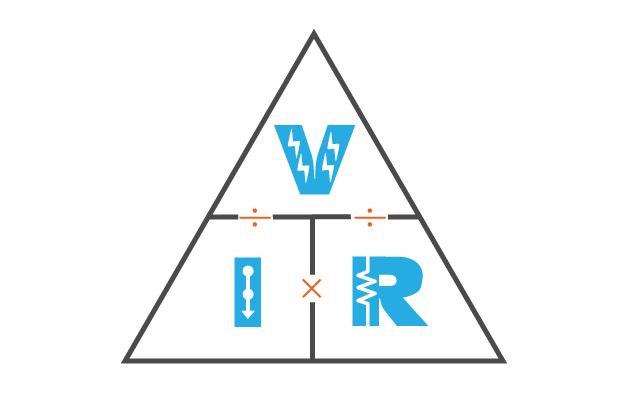
Which of the following represents Ohm’s law?

a)

I = V / R

b)

V = I x R

c)

R = V x I

d)

V = I / R

74.
What is the Voltage of a circuit that has a resistance of 5 Ω and a current of 2 A?
a)
25 V
b)
10 V
c)
2.5 V
d)
0.4 V
75.
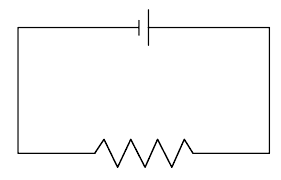
This circuit has a 24 volt battery and the resistor is 8 ohms. How many amps are running through the circuit?
a)
3 Amps
b)
192 Amps
c)
2 Amps
d)
4 Amps
76.
What size resistor would produce a 3 Amp current flow with a 12 Volt battery
a)
1 Ohm
b)
3 Ohms
c)
4 Ohms
d)
12 Ohms
77.

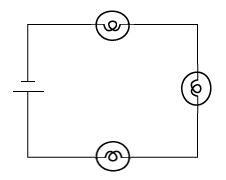
The picture shows an electrical circuit. This circuit is a series circuit because:

a)

It has 3 light bulbs.

b)

The same current flows through all three light bulbs.

c)

It uses a single battery.

d)

The electrical current has more than one path to flow through

78.

You can increase the strength of an electromagnet are increasing the current, adding iron to the core, and .....

a)

increasing the number of coils on the magnet

b)

Decreasing the number of coils on the magnet

c)

Dividing the number of coil

79.

We buy power from utility companies in....

a)

Power; Watts

b)

Energy; kWh

c)

Current; Amps

d)

Voltage; Volts

80.

A north pole of a magnet is attracted to a ...

a)

South pole of a magnet

b)

North pole of a magnet

81.

An electric current in a metal consists of moving

a)

protons

b)

neutrons

c)

quarks

d)

electrons

82.

A parallel circuit has ________ pathway(s) and a series circuit has ____________ pathway(s)

a)

multiple, a single

b)

a single, multiple

c)

multiple, multiple

d)

a single, a single

83.

A PARALLEL circuit has 3 light bulbs. You remove 2 of the lightbulbs from the circuit and now have a complete circuit with 1 light bulb. Will the remaining light bulb be brighter, dimmer, or stay the same?

a)

Brighter

b)

Dimmer

c)

Stay the same

84.

A SERIES circuit has 3 light bulbs. You remove 2 of the lightbulbs from the circuit and now have a complete circuit with 1 light bulb. Will the remaining light bulb be brighter, dimmer, or stay the same?

a)

Brighter

b)

Dimmer

c)

Stay the same

85.

A device that protects a circuit by from having too much current is called a

a)

switch

b)

short

c)

fuse or breaker

d)

resistor

86.
The positive particles of an atom are 
a)
electrons 
b)
positrons 
c)
neutrons 
d)
protons 
87.
Particles in an atom that are neutral and have no charge are 
a)
negatrons 
b)
electrons 
c)
neutrons 
d)
protons 
88.
The smallest particle of any particular type of matter is known by which of the following terms?
a)
Compound
b)
Atom
c)
Chemical
d)
Element
89.
If an atom has 3 electrons, how many protons does it have?
a)
1
b)
2
c)
4
d)
3
90.

What type of charge does a neutron have?

a)

negative

b)

positive

c)

no charge/neutral

91.

What is the mass number of this Carbon atom?

a)

8

b)

12

c)

6

d)

15

92.

The number 18 represents the

a)

Atomic number

b)

Neutrons

c)

Element Name

d)

Element symbol

93.

An arrangement of elements in order of their atomic numbers is called the _________________.

a)

Atomic Number

b)

Electron Cloud

c)

Periodic Table

d)

Nucleus

94.

The total number of protons and neutrons in the nucleus of an atom

a)

Atomic Number

b)

Mass Number

c)

Atomic Theory

d)

Electron Cloud

95.
What does the nucleus of an atom contain?
a)
Electrons and neutrons
b)
Protons and neutrons
c)
Neutrinos and positrons
d)
DNA and RN
96.

An atom of a certain element has 11 electrons, and a mass number of 23. This element is very reactive in room temperature. How many neutrons are in this atom?

a)

11

b)

12

c)

33

d)

23

97.

Which beaker has particles representing a solid?

a)
b)
c)
98.

Which has particles representing a liquid?

a)
b)
c)
99.

The amount of space accupied by a substance is called?

a)

Density

b)

MAtter

c)

Volume

d)

Space

100.

When vinegar and baking soda are combined, bubbles and foam are produced.

What evidence demonstrates that a chemical change has occurred?

a)

A color change occurs.

b)

A gas is formed.

c)

A solid is dissolved.

d)

A precipitate is formed.

101.

Flour, sugar, cocoa, oil, and eggs are mixed together and placed in the oven to make brownies.  When the brownies are removed from the oven, they no longer look like the original ingredients. 

Which of the following describes why the ingredients changed?

a)

A biological change occurred.

b)

No change occurred.

c)

A physical change occurred.

d)

A chemical change occurred.

102.

A student had a beaker with a small amount of baking soda.  The student added a few drops of pickle juice to the baking soda and observed fizzing and bubbling.  Based on observation, which of these can the student conclude?

a)

A chemical reaction produced a solid.

b)

No chemical reaction took place.

c)

Only a physical change happened.

d)

A chemical reaction produced a gas.

103.
the starting materials in a chemical reaction
a)
Products
b)
Reactants
c)
Starters
d)
Enders
104.
Number of C's in 2Na₂CO₃
a)
1
b)
2
c)
3
d)
5
105.

How many Hydrogens are on the product side of this chemical equation?

a)

1

b)

2

c)

3

d)

4

106.

How many Carbons are present on the reactant side?

a)

1

b)

2

c)

3

d)

4

107.
The right side of the equation below is called the
a)
products
b)
reactants
108.
The left side of the equation below is called
a)
Products
b)
Reactants
109.
Splitting a uranium atom is called - 
a)
fission
b)
fusion
110.
What is an advantage  of nuclear energy?
a)
radioactive waste
b)
no pollution
c)
we will never run out
d)
it is the safest way to make energy
111.

What nuclear process occurs in the sun?

a)

fission

b)

fusion

c)

endothermic

d)

atomic bomb

112.

The splitting of a nucleus into smaller, lighter nuclei is called

a)

fusion

b)

fission

113.

This is an example of

a)

Nuclear Fission

b)

Nuclear Fusion

c)

No reaction

114.

Which of the following terms best describes the other product besides energy of nuclear power?

a)

Useful

b)

Hazardous (unsafe)

c)

Harmless

d)

none

115.
The New Safe Confinement is an arch being built over which nuclear power plant?
a)
Chernobyl, Ukraine
b)
Fukushima, Japan
c)
3 Mile Island, Pennsylvania
d)
Hiroshima, Japan
116.
Nuclear power plants use __ as fuel.
a)
Uranium
b)
Krypton
c)
Barium
d)
Hydrogen
117.
Which of the following is NOT a positive use of nuclear energy?
a)
Cell phone communication
b)
PET scans
c)
smoke detectors
d)
Cancer treatment
118.
An example of an uncontrolled fission reaction is _______________
a)
Nuclear power plants
b)
Radio active decay
c)
Atomic Bomb
d)
On the surface of the sun
119.
The major drawback to nuclear fission reactors is ---
a)
the safe disposal of the radioactive waste
b)
finding large water sources to support the nuclear reactors
c)
mining the fossil fuels is dangerous for miners
d)
the pollution that is produced by the power plants
120.
One disadvantage of nuclear energy is ___.
a)
it is a fossil fuel
b)
it leaves behind radioactive waste
c)
it emits large amounts of pollution into the atmosphere
d)
there are no disadvantages