wayground logo

Free Printable Worksheets

Font size

S
M
L
XL
Worksheets

FINALS BIOLOGY 2

Total questions: 120

Worksheet time: 2hrs 0mins

Name
Class
Date
1.
Most plants appear green because chlorophyll
a)
absorbs green light.
b)
absorbs violet light.
c)
reflects green light.
d)
does not absorb violet light.
2.
Which animal is cold blooded?
a)
Mouse
b)
Hummingbird
c)
Human
d)
Snake
3.
What does Darwin's theory of evolution suggest?
a)
species change over time
b)
extinct species are not related to living species
c)
different species can interbreed
d)
animals that look alike are most closely related
4.
Which process creates an identical copy of DNA?
a)
Mutation
b)
Replication
c)
Transcription
d)
Translation
5.
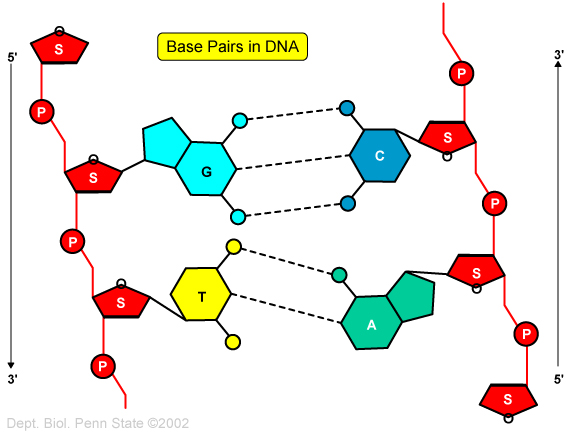
Transcribe this sequence:  ACTGTTC
a)
UGACAAG
b)
TGACAAG
c)
TGUCUUG
d)
AGUCUUG
6.
In a cross of two heterozygous parents, what proportion of the offspring will also be heterozygous?
a)
50%
b)
100%
c)
0%
d)
75%
7.
Which of the following DOES NOT require cell division?
a)
Growth
b)
Hunger
c)
Reproduction
d)
Cell repair
8.
Which is NOT a characteristic of all living things?
a)
Sleep
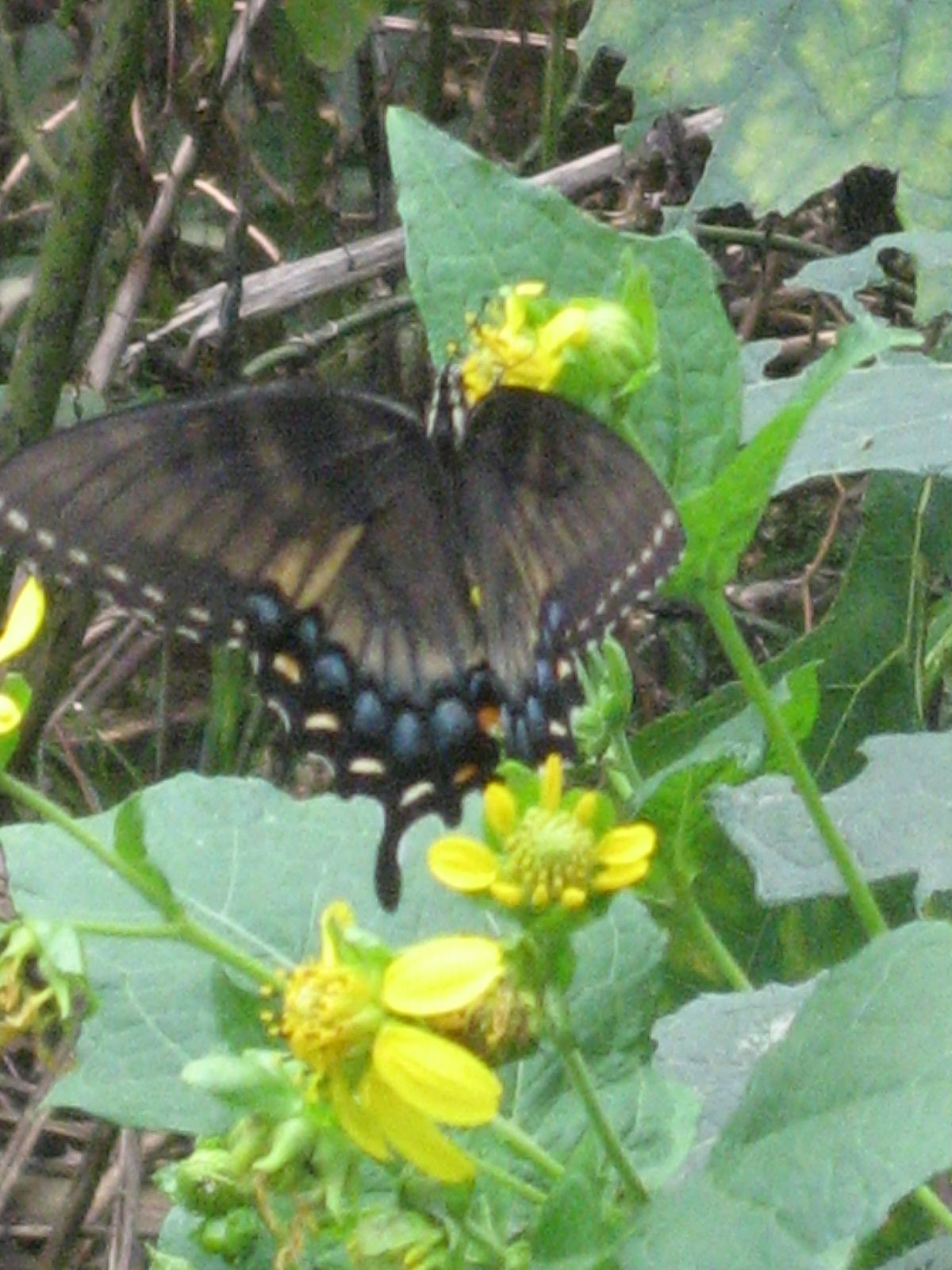
b)
Cells
c)
Reproduction
d)
Grow
9.
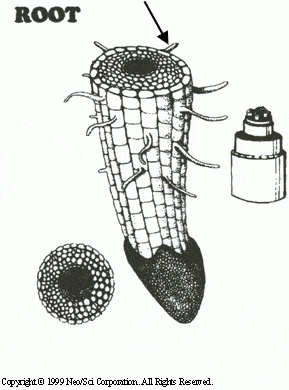
What do you call all of the chemical reactions of a living thing?
a)
Metabolism
b)
Homeostasis
c)
Energy
d)
Photosynthesis
10.
What do you call a change in an organism's DNA?
a)
Replication
b)
Mutation
c)
Codon
d)
Phenotype
11.
Which of the following alleles is homozygous (purebred) recessive?
a)
Tt
b)
tt
c)
TT
d)
t
12.
Which of the following is a phenotype?
a)
Aa
b)
red hair
c)
heterozygous genes
d)
mutated DNA
13.
Aa is
a)
homozygous (purebred)
b)
heterozygous (hybrid)
14.
In a heterozygous genotype, the ___________ allele takes over in the phenotype.
a)
recessive
b)
dominant
c)
lower case letter
d)
both 
15.
G = green, g = yellow
The genotype for a yellow plant is...
a)
GG
b)
Gg
c)
gg
d)
all of the choices result in yellow
16.
Who is considered the "father of genetics"?
a)
Gregor Mendel
b)
Reginald Punnett
c)
James Watson
d)
Justin Bieber
17.
T = tall an t = short
What is the phenotype for Tt?
a)
short
b)
tall
c)
medium sized
d)
neither tall or short
18.
How many alleles (letters) do each person carry for a trait?
a)
1
b)
2
c)
3
d)
4
19.
How many alleles (letters) does a child get from each parent for each trait?
a)
1
b)
2
c)
3
d)
4
20.
T - tall and t = short
In the punnett square below, what belongs in the missing square
a)
tt
b)
Tt
c)
Bb
d)
TT
21.
Which of the following is homozygous dominant?
a)
Yy
b)
Y
c)
yy
d)
YY
22.
In a Punnett square each box represents a(n)....
a)
offspring
b)
parent
c)
gene
d)
trait
23.
Is this punnet square true or false?
a)
False, because there should be 3 dominate alleles.
b)
True.
c)
False, because There should be 3 recessive alleles.
d)
I don't know....
24.
How many chromosomes are in a sex cell?
a)
46
b)
23
c)
26
d)
43
25.
The passing of physical characteristics from parent to offspring is __________.
a)
genetics
b)
heredity
c)
genes
d)
traits
26.
When a capital letter is used, what kind of allele is being represented?
a)
Recessive Allele
b)
Codominance
c)
Punnett Squares
d)
Dominant Allele
27.
When two identical alleles for a trait are in an organism, the organism is said to be ____________?
a)
Heterozygous
b)
Homozygous
c)
allele
d)
resseive
28.
characteristic that is inherited; can be either dominant or recessive
a)
genes
b)
allele
c)
chromosome
d)
trait
29.
outward appearance of an organism, regardless of its genes.
a)
phenotype
b)
genotype
c)
haploid
d)
deploid
30.
The genetic characteristics of recessive genes
a)
tend to mask the characteristics of dominant genes.
b)
are always expressed in the phenotype.
c)
are usually codominant.
d)
tend to be masked by the characteristics of dominant genes.
31.

Which of the following is the carrier of genetic information?

a)

DNA

b)

RNA

32.

Heredity is the passing of traits from ________ to _________.

a)

predator; prey

b)

parents; offspring

c)

one cell; another cell

d)

one species; another species

33.

Which of the following refers to the expression of traits by alleles?

a)

Phenotype

b)

Genotype

c)

Prototype

34.

Which of the following refers to the pair of alleles?

a)

Phenotype

b)

Genotype

c)

Prototype

d)

Bialleleism

35.

What do you call the trait that is always present and causes the other traits to disappear?

a)

Aggressive Trait

b)

Active Trait

c)

Recessive Trait

d)

Dominant Trait

36.

What does the notation Tt mean to a geneticist?

a)

two dominant alleles

b)

at least one recessive alleles

c)

two recessive alleles

d)

one dominant and one recessive allele

37.

Which of the following is NOT a nucleotide monomer in DNA?

a)

Cytosine

b)

Guanine

c)

Uracil

38.

In the DNA, adenine complements with _________.

a)

Guanine

b)

Thymine

c)

Cytosine

d)

Uracil

39.

What is the basic unit of heredity?

a)

gene

b)

chromosomes

c)

DNA

40.

How much of your DNA do you inherit from your mom?

a)

25%

b)

50%

c)

75%

41.

What type of inheritance pattern does the diagram represent?

a)

Incomplete Dominance

b)

Codominance

c)

Multiple Alleles

d)

Polygenic Inheritance

42.

What type of inheritance pattern does the ABO blood group represent?

a)

Incomplete Dominance

b)

Codominance

c)

Multiple Alleles

d)

Polygenic Inheritance

43.

The two cows on the top are the parents and the cow on the bottom is the offspring. What is the type of inheritance pattern is being exhibited?

a)

Incomplete Dominance

b)

Codominance

c)

Multiple Alleles

d)

Polygenic Inheritance

44.

If the image were real, it would represent what type of inheritance pattern?

a)

Incomplete Dominance

b)

Codominance

c)

Multiple Alleles

d)

Polygenic Inheritance

45.

What type of inheritance pattern does the image represent?

a)

Incomplete Dominance

b)

Codominance

c)

Multiple Alleles

d)

Polygenic Inheritance

46.

A roan (RW) bull mated with a red (RR) cow. What is the probability or producing a white (WW) cow?

a)

25%

b)

50%

c)

100%

d)

0%

47.

Mama Suga has a blood type of AB. What are Papa Daichi's possible blood types if their son has a blood type of B? Select all that applies.

a)

A

b)

B

c)

AB

d)

O

48.

Mama Isabella has a blood type of O. Her son, Norman, has also a blood type of O. What is the blood type of Norman's father?

a)

A

b)

B

c)

AB

d)

O

49.

The DNA in the skin cells of your hand is significantly different in sequence from the DNA in your liver cells.

a)

True

b)

False

50.

In humans, the gene for curly hair (H) is incompletely dominant to the gene for straight hair (h). Individuals that are heterozygous (Hh) have wavy hair.

Two wavy-haired heterozygous parents have a child.

What is the likeliness that the child will have wavy hair?

a)

1/4

b)

1/2

c)

3/4

d)

4/4

51.
Which sequence of DNA bases would pair with this partial strand
ATG TGA CAG
a)
ATG TGA CAG
b)
TAC ACT GTC
c)
GTA AGT GAC
d)
CAT TCA CTG
52.
Which of the following best describes a DNA molecule?
a)
double helix
b)
contains ribose
c)
made of amino acids
d)
contains Uracil
53.
Which of the following units are repeatedly joined together to form a strand of DNA?
a)
amino acids
b)
nucleotides
c)
fatty acids
d)
polysaccharides
54.
In a molecule of double-stranded DNA, the amount of Adenine present is always equal to the amount of
a)
cytosine
b)
guanine
c)
thymine
d)
uracil
55.
Adenine bonds with ______________.
a)
Guanine
b)
Thymine
c)
Cytosine
d)
Adenine
56.
Guanine bonds with ______________.
a)
Adenine
b)
Guanine
c)
Cytosine
d)
Thymine
57.
Why is DNA important?
a)
it is very small and very complicated
b)
it's in everything
c)
it serves as the blueprint for traits of all living things
d)
because we eat it every day for energy
58.
What determines the code, or information, of a DNA molecule?
a)
the shape (structure) of the nitrogen bases
b)
the order (sequence) of the nitrogen bases
c)
the color of the nitrogen bases
d)
the frequency (number) of nitrogen bases
59.
Which 2 molecules form the sides (backbone) of the DNA ladder?
a)
deoxyribose sugar and adenine
b)
deoxyribose sugar and a hydrogen bond
c)
deoxyribose sugar and the nucleus
d)
deoxyribose sugar and phosphate
60.
Which organelle is DNA usually found in?
a)
cell membrane
b)
vacuole
c)
chloroplast
d)
nucleus
61.
Nitrogenous bases are joined by which type of bond?
a)
polar bonds
b)
ionic bonds
c)
covalent bonds
d)
hydrogen bonds
62.
Replicate the following strand of DNA: 
AATCATGGA
a)
AATCATGGA
b)
TTAGTACCT
c)
UUAGUACCU
d)
GGATAUCUA
63.
The enzyme that unzips the DNA to prepare for replication
a)
helicase
b)
replicase
c)
polymerase
d)
synthase
64.
DNA replication results in two DNA molecules,
a)
each one with two original strands
b)
each one with two new strands
c)
each one with one new strand and one original strand
d)
one with two new strands and the other with two original strands
65.
order of replication
a)
3, 2, 1, 4
b)
2, 1, 4, 3
c)
2, 3, 1, 4
d)
3, 4, 1, 2
66.
A process in which DNA has the unique ability to make an exact copy of itself.
a)
Replication
b)
Translation
c)
Transcription
67.
What is the correct complimentary strand for the following DNA?ATCGAG
a)
TACGAG
b)
ATCGAG
c)
TAGCTG
d)
TAGCTC
68.
The drawing shows the structure of what molecule?
a)
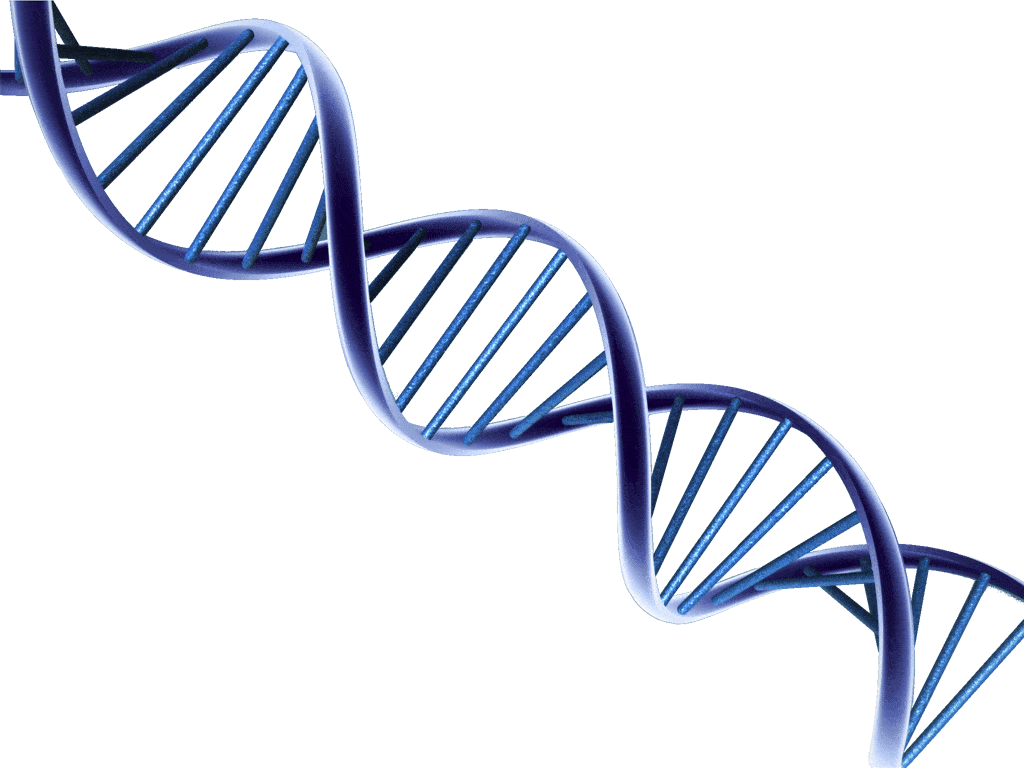
A DNA molecule
b)
A lipid molecule
c)
A carbohydrate molecule
d)
A protein molecule
69.
In what phase of the cell cycle does DNA replication take place?
a)
G1
b)
S
c)
G2
d)
M
70.
What are the three components of a nucleotide?
a)
sugar, hydrogen, nitrogen base
b)
sugar, oxygen, nitrogen base
c)
sugar, phosphate, nitrogen base
d)
sugar, phosphate, protein
71.

Change over time...

a)

Evolution

b)

Nucleotide

72.
Charles Darwin came up with this theory 
a)
Natural Selection
b)
Mutation
73.
To adjust to a changing environment
a)
Mutation
b)
Adapt
74.
Darwin wrote that organisms with traits that are best suited to the environment will ________________
a)
increase in number
b)
become extinct
75.
Another word for adapt is ____________.
a)
change
b)
create
76.
Which of the following is NOT an example of natural selection? 
a)
People selectively breeding hamsters.
b)
Insect populations developing resistance to certain pesticides.
c)
Bacteria becoming resistant to antibiotics.
d)
Male birds of certain species developing colorful feathers to attract female mates.
77.
What characteristic did Darwin observe about the finches on the Galapagos Islands?
a)
Their feathers 
b)
Genotypes 
c)
Their beaks
d)
Their body sizes
78.
Which term refers to the process by which individuals that are better suited to the environment survive and reproduce therefore passing down their genes to their offspring? 
a)
Evolution 
b)
Variation 
c)
Adaptation
d)
Natural Selection 
79.
When an organism completely dies out, it is called.....
a)
Adaption
b)
Extinction
c)
Fossilization
d)
Mutation
80.
Two organisms that are closely related would have
a)
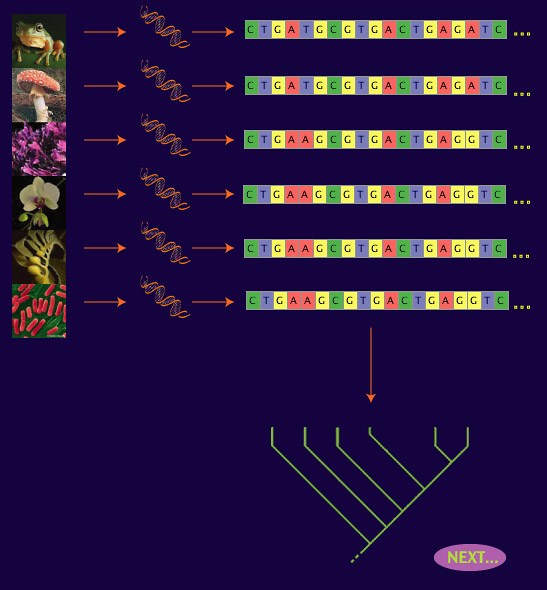
very similar DNA sequence
b)
exactly the same DNA sequences
c)
no proteins in common
d)
completely different DNA sequence
81.
The scientific theory of evolution is supported by different types of evidence. The diagrams below show the skeletons of two different animal species. How does comparing the skeletons of these animals provide support for the scientific theory of evolution?
a)
 It provides information about the organisms' habitats.
b)
 It shows possible common ancestry between organisms.
c)
It provides information to determine the organisms' ages.
d)
It shows possible chromosomal similarities between organisms.
82.
Which one of these isn't one of the 5 kingdom names?
a)
Animalia
b)
Protista
c)
FUngi
d)
Virusia
83.
Bacteria is included in what type of Kingdom?
a)
Animalia Kingdom
b)
Plant Kingdom
c)
Monera Kingdom
d)
Protista Kingdom
84.
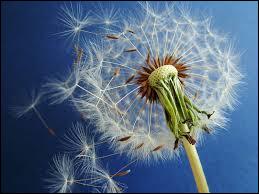
Dandelion, What kingdom does it belongs to?
a)
Plant Kingdom
b)
Animal Kingdom
c)
Fungi Kingdom
d)
Protista Kingdom
85.
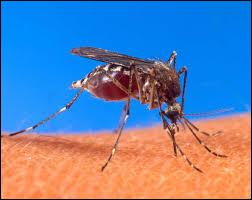
Mosquito  belongs to what kingdom?
a)
Animal Kingdom
b)
Plant Kingdom
c)
Fungi Kingdom
d)
Protista Kingdom
86.
Autotrophs- make their own  food.
Heterotrophs- obtain food from other animals.
Observing the table above, Fungi and Animals are________?
a)
Autotrophs
b)
Heterotrophs
87.
Vertebrates can be classified in......
a)
5 groups: Mammals, Birds, Fish, Reptiles and Amphibians
b)
5 Groups: Dogs, Birds, Fish, Reptiles, and Amphibians
c)
4 Groups: Mammals, Birds, Fish and Ampbibians
88.

In which kingdom does the organism below belong?

a)

Animalia

b)

Fungi

c)

Plantae

d)

Eubacteria

89.
All of the following are characteristics of all living things except....
a)
Have cell(s) 
b)
Need energy and water
c)
Need oxygen 
d)
Reproduce
90.
Organisms in this smallest taxonomic group share many characteristics.
a)
domain
b)
kingdom
c)
species
d)
class
91.
Which organisms are most closely related?
a)
Equus caballas (Horse) & Equus burchellii (Zebra)
b)
Cyanea artica (Jellyfish) &
Ctenodiscus crispatus (Mud Starfish)
c)
Naja naja (cobra) & Glycine max (soya bean)
d)
Ophiocomina nigra (black brittle star) & Brassica nigra (black mustard)
92.
The science of describing, classifying, and naming living things is called:
a)
Geology
b)
Biology
c)
Taxonomy
d)
Chemistry
93.
The scientific name for an organism is made from the:
a)
class and family name
b)
genus and species name
c)
domain and kingdom name
d)
kingdom and phylum name
94.
The 8 levels of classification, broadest to most specific.
a)
Domain, Genus, Family, Order, Class, Phylum, Kingdom, Species
b)
Domain, Species, Kingdom, Genus, Phylum, Family, Class, Order
c)
Domain, Kingdom, Phylum, Class, Order, Family, Genus, Species
d)
Order, Kingdom, Species, Domain, Phylum, Family, Class, Genus
95.

What part of the plant is the main support and anchor and helps absorb water?

a)

Tap Root

b)

Lateral Roots

c)

Root Hairs

d)

Stem

96.

Which part is the main structure of the plant?

a)

Stem

b)

Tap Root

c)

Flower

d)

Fruit

97.
Which plant parts are the tubes that carry water throughout the plant?
a)
xylem
b)
phloem
c)
roots
d)
leaves
98.
What is the name of the part of the root that allows water and minerals enter?
a)
root hairs
b)
epidermis
c)
phloem
d)
phyla
99.
Organsisms maintain a balance between their cells and the external environment through the process of ----
a)
growth
b)
pH
c)
cellular respiration
d)
homeostasis
100.
Which is not a type of tissue in plants?
a)
Dermal
b)
Connective
c)
Vascular
d)
Ground
101.

How many bones human skeletal system consists

a)

204

b)

209

c)

207

d)

206

102.

Benefits of exercise on skeletal system. Which of the following is wrong answer

a)

Skeletal is increases flexibility

b)

It gives good posture

c)

It brings unhealthy lifestyle

d)

Exercise strengthens joints

103.

_____________ deals with the FORM or STRUCTURE (morphology) of the body and its ORGANIZATION.

a)

Physiology

b)

Anatomy

c)

Body composition

d)

BMI

104.

__________________ studies the FUNCTION of these the parts/structures of the body.

a)

Physiology

b)

Anatomy

c)

Body composition

d)

BMI

105.

What is the correct order for the levels of organization in the body

a)

atom, molecule, macromolecule, cell, organelle, tissue, organ, organ system, organism

b)

atom, macromolecule, molecule, organelle, cell, tissue, organ, organ system, organism

c)

atom, molecule, macromolecule, organelle, cell, tissue, organ, organ system, organism

d)

atom, molecule, macromolecule, tissue, organelle, cell, organ, organ system, organism

106.

A branch of science that deals about the study of life

(a)  

107.

Any self regulatory process by which a biological or mechanical system maintains stability while adjusting to changing environment

(a)  

108.

It is anything in the environment that causes a response in an organism

(a)  

109.

The biggest kingdom in the living world with at least 4 million species named and identified

(a)  

110.

The basic and fundamental unit of life

(a)  

111.

It is defined as the process or the state of adjusting or changing to become more suited to an environment; the trait as a result of the process

(a)  

112.

Mendel stated that physical traits are inherited as "particles" this particles is known as (a)  

113.

A branch of biology that study about heredity

(a)  

114.

A cross involving a single trait

(a)  

115.

DNA stands for (a)  

116.

It is the study of genomes

(a)  

117.

The three consecutive nucleotides that specify a single amino acids

(a)  

118.

any mistakes or change in DNA sequence is called (a)  

119.

The building blocks of proteins is the (a)  

120.

Scientific name of Human

(a)