
 Worksheets
A&P Golden Assignment- 3rd Cycle
Total questions: 127
Worksheet time: 3hrs 40mins

What do the bones make?
veins
cartilage
red blood cells
bone marrow
Which of the following is found in the axial skeleton?
Femur
Skull
Clavicle
Humerus
Match the following common names of bones to their scientific names
Kneecap
Patella
Thigh Bone
Femur
Collar Bone
Clavicle
Shoulder blade
Scapula
Which tissue cushions the end of bones?
tendons
ligaments
cartilage
joints
What do we call the place where two bones meet?
skeleton
joint
muscle
rib
Which is NOT a function of the skeletal system?
production of red blood cells
store calcium
digest food
movement, protection, and support
Which type of tissue connects bone to bone?
tendons
ligaments
skeletal mucscles
smooth muscles
What kind of joint is found at your elbow?
pivot
hinge
gliding
ball and socket
Which of the following describes the joints in the skull and ribs?
movable
hinge
pivot
immovable
What is the name of the outer membrane that surrounds bones?
compact bone
periosteum
spongy bone
bone marrow
Which bone disease causes bones to become weak and brittle?
artereosclerosis
arthritis
fracture
osteoporosis
Which type of joint is found at your shoulder and hip and allows for the greatest range of motion?
ball and socket
gliding
hinge
pivot
Where are red blood cells produced?
compact bone
red bone marrow
spongy bone
yellow bone marrow
Which part of the bone stores fat?
yellow bone marrow
red bone marrow
spongy bone
compact bone
The disease in which bones become irritated or inflamed because cartilage in the joints has worn away is called ___.
arthritis
cancer
osteoporosis
fracture

What is the name for the connector that attaches bone to bone?
ligament
tendon
joint
cartilage
All of the following are major functions of skeletal system EXCEPT
body movement
posture and balance
support and protection
storage of calcium, magnesium, sodium, potassium
Normally, there are about ______ bones in the human body.
206
200
32
31
Axial bones includes
scapula, clavicle, legs
head, neck, trunk
thigh, legs, arms
arms, legs scapula
The two main divisions of skeleton are
axial and appendicular skeleton
central and peripheral nervous
pectoral and pelvic girdle
long and short bone
The bones in the appendicular skeleton includes
head, neck, trunk
pectoral and pelvic girdle
vertebral column and thoracic cage
limbs and bones that connect to the pectoral and pelvic girdle
The two ends of the long bone is called
diaphysis
epiphysis
spongy bones
articular cartilage
Inside the long bone, the hollow chamber filled with bone marrow is called
compact bone
spongy bone
medullary cavity
red marrow
About how many bones does an adult have?
399
1,290
14
206
What is the purpose of the rib cage?
Helps us to think
Carries blood throughout the body
Protects our brain
Protects our vital organs
What does the cranium protect?
heart
eyes
brain
liver

What bone is highlighted?
Skull (Cranium)
Mandible
Clavicle
Scapula

Where is new blood cells created?
In the scapula
In bone marrow, located inside the bone
In the patella
In bone marrow, located inside the muscle tissue

What is cartilage?
joints that connect bone to tissue
Connective tissue that acts as balance for the body
Connective tissue near joints that act as a shock absorber
a piece of tissue that is attached to the scapula

Where is cartilage, a connective tissue, located?
Outside of the bone
Around the muscle fibers
In between bone and joints
In between muscle and bone

What are the joints in the skeletal system?
Ball and socket, gliding, pivot, fused, hinge
ball ad socket, screw, wrench, metatarsals
ball and socket, gliding, immovable (fused) and juking
None of the choices are correct
The gap between the nerve cell and sarcolemma is the ____ ___.
Synaptic cleft
Neurotransmitter
Motor unit
Neuromuscular junction
What is the specific neurotransmitter that stimulates the movement of skeletal muscles?
GABA
Acetylcholine
Serotonin
Dopamine
What happens at the neuromuscular junction?
A sensory neuron communicates with a motor neuron
An action potential jumps from the muscle to the neuron
A nerve signal traveling down a motor neuron can jump over to the muscle cell
Muscle cells contract in response to a sensory neuron
Skeletal muscles are voluntary.
true
false
The epimysium covers
the entire muscle
the fascicle
the muscle fiber
the myofibril
Which connective tissue surrounds the fascicle?
epimysium
perimysium
sarcolemma
endomysium
Inherited muscle-destroying diseases characterized by degeneration of individual muscle fibers (usually voluntary)
Lactic acidosis
Muscular dystrophy
Myasthenia gravis
Rigor mortis
autoimmune disease that attacks acetylcholine receptors leading to muscle weakness
Moebius disease
Muscular dystrophy
Myasthenia gravis
Sarin gas exposure
sudden, involuntary contraction of single muscle in large group
fasciculation
fibrillation
spasm
tic
What muscle tissue is voluntary?
Skeletal
Smooth
Cardiac
Smooth and Cardiac Muscle Tissue are
voluntary
involuntary
What is troponin?
thin my-filament
thick my-filament
protein, binds actin and Ca
protein, blocks myosin binding when muscle is relaxed
What is tropomyosin?
thin myofilament
thick my-filament
protein, binds actin and Ca
protein, blocks actin binding when muscle is relaxed

What muscle is highlighted in the picture?
Triceps
Biceps
Quads
Deltoids

What muscle is highlighted in the picture?
Triceps
Biceps
Quads
Deltoids

What muscle is highlighted?
Lats
Abdominals
Pectoralis
Quads
How many types of muscles are there?
2
4
3
1
What are the characteristics of the cardiac muscle?
Involunatary
Found in the heart
Banded Appearance
Dense connective tissue packaging
Smooth Muscle is found in the?
Heart
Facial
Organs
Legs
The connective tissue sheath that surrounds a muscle fasciculus is the
epimysium
endomysium
perimysium
given the following events:
1.acetycholine broken down
2.acetylcholine moves across the synaptic cleft
3.action potential reaches the terminal branch (presynaptic terminal)
4.acetylcholine combines with a receptor molecule on a skeletal muscle (postsynaptic membrane)
5.action potential produced in skeletal muscle cell
Choose the arrangement that lists the events in the order the occur at a neuromuscular injunction
2,3,4,1,5
3,2,4,5,1
3,4,2,1,3
4,5,2,1,3
Muscles that oppose one another are
synergist
hateful
prime movers
antagonists
Muscles are needed for what?
movement
decoration
pump blood
no one knows
Smooth muscle is located where?
heart
bones
toes
internal organs
The nerve releases a chemical called a
neurotransmitter
neuron
myofibril
cell

What system does the muscular system work in conjunction with to allow our body to move?
Digestive
Respiratory
Skeletal
Circulatory

What are the main functions of muscles?
The main functions of muscles are producing sound, vision, and taste.
The main functions of muscles are thinking, feeling, and sensing.
The main functions of muscles are movement, stability, and posture.
The main functions of muscles are digestion, respiration, and circulation.
Which muscle type is striated and multinucleated?
skeletal muscle
cardiac muscle
adipose tissue
smooth muscle
What is the basic unit of muscle structure?
Nucleus
Mitochondria
Golgi Apparatus
Sarcomere
What is the process called when a muscle shortens and generates force?
muscle contraction
muscle extension
muscle expansion
muscle relaxation
Which protein is responsible for muscle contraction?
keratin and collagen
hemoglobin and myoglobin
insulin and glucagon
actin and myosin
What is the role of calcium ions in muscle contraction?
Calcium ions inhibit the binding of troponin to actin, preventing muscle contraction.
Calcium ions bind to troponin, causing a conformational change that moves tropomyosin away from the myosin-binding sites on actin.
Calcium ions directly bind to myosin, causing muscle contraction.
Calcium ions have no role in muscle contraction.
What is the name of the neurotransmitter that stimulates muscle contraction?
Acetylcholine
Serotonin
Dopamine
GABA

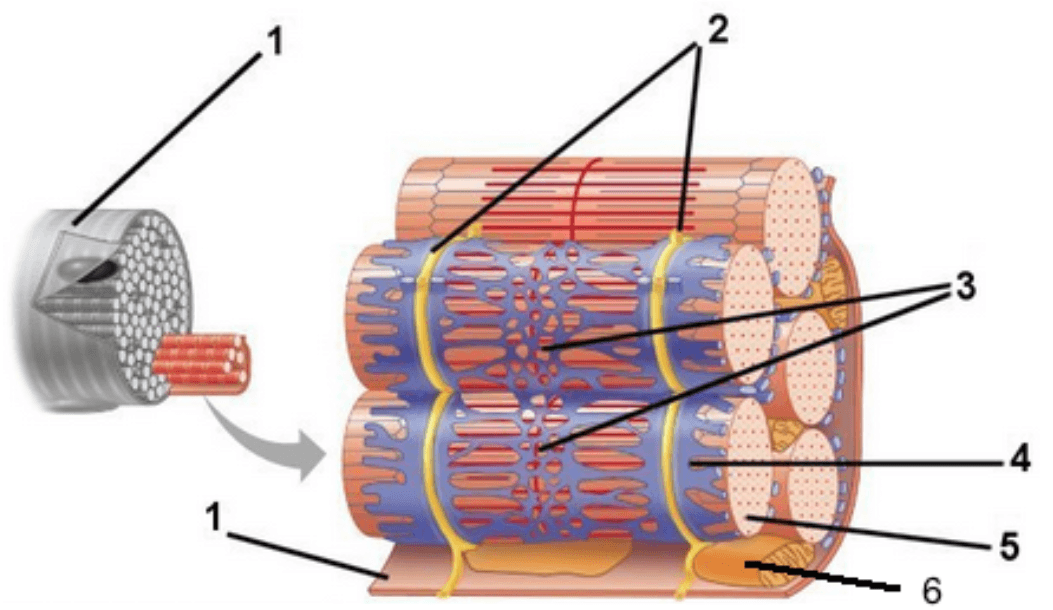
What is shown in the colored part of this diagram?
a whole muscle
five muscle fibers
five muscle fascicles
five myofibrils
What is labeled "4" (the blue/purple part) in the diagram?
sarcolemma
sarcoplasmic reticulum
transverse tubules
myofibril
Name the following in order from largest to smallest:
muscle, muscle fascicle, muscle cell, myofibril, filaments
muscle, muscle fascicle, muscle cell, filaments, myofibril
muscle, muscle cell, muscle fascicle, myofibril, filaments
muscle, muscle cell, muscle fascicle, filaments, myofibril
What is the length between Z-lines of an actin molecule called?
fascicle
sarcomere
myosin binding site
sarcoplasmic length
____________ attaches to actin to form the cross bridge.
Troponin
Tropomyosin
Myosin
Calcium
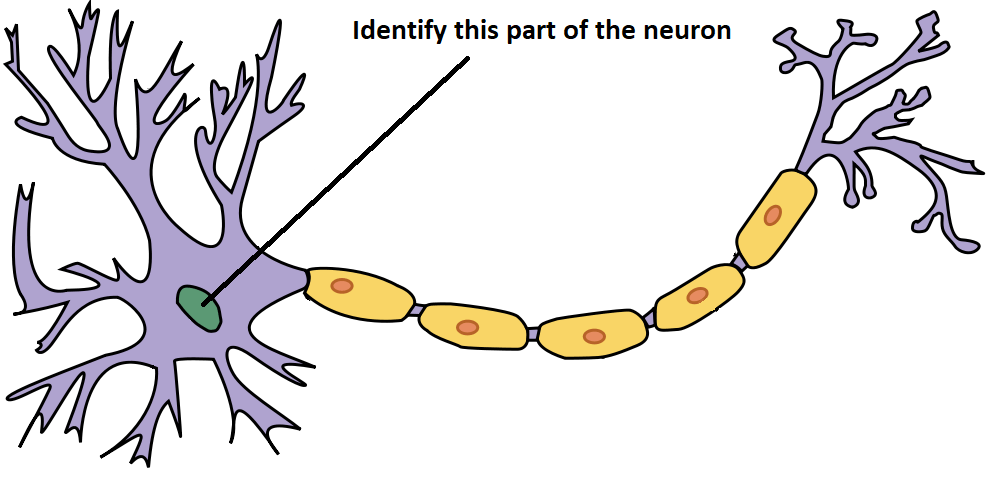
Nucleus
Cell Body
Axon
Node of Ranvier
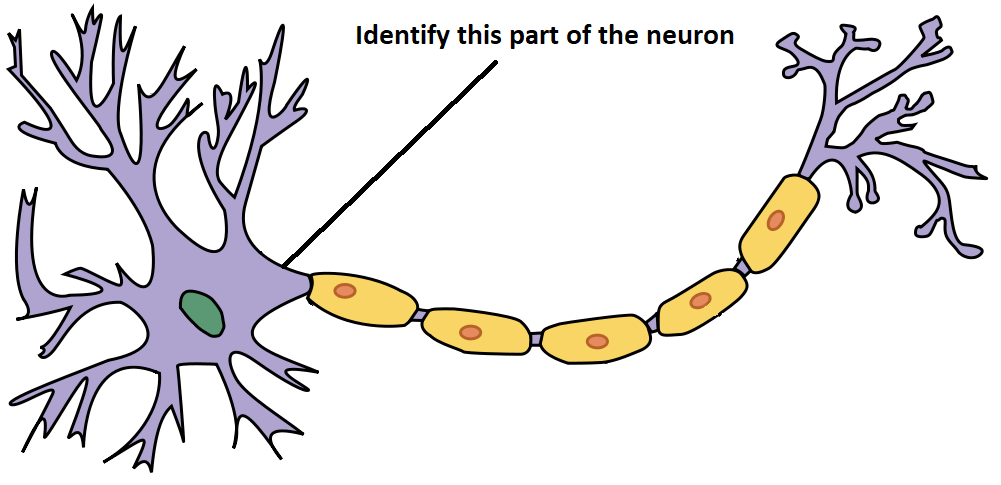
Nucleus
Cell Body
Axon
Node of Ranvier
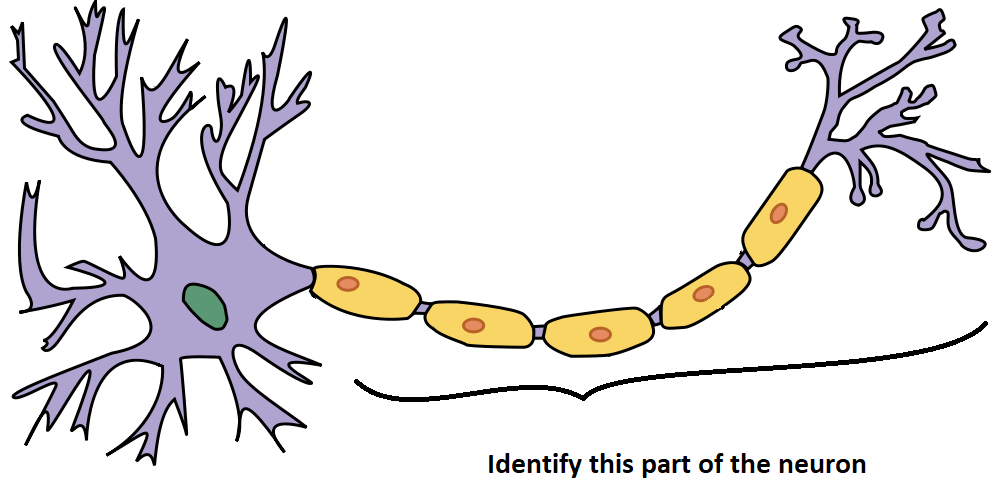
Nucleus
Cell Body
Axon
Node of Ranvier
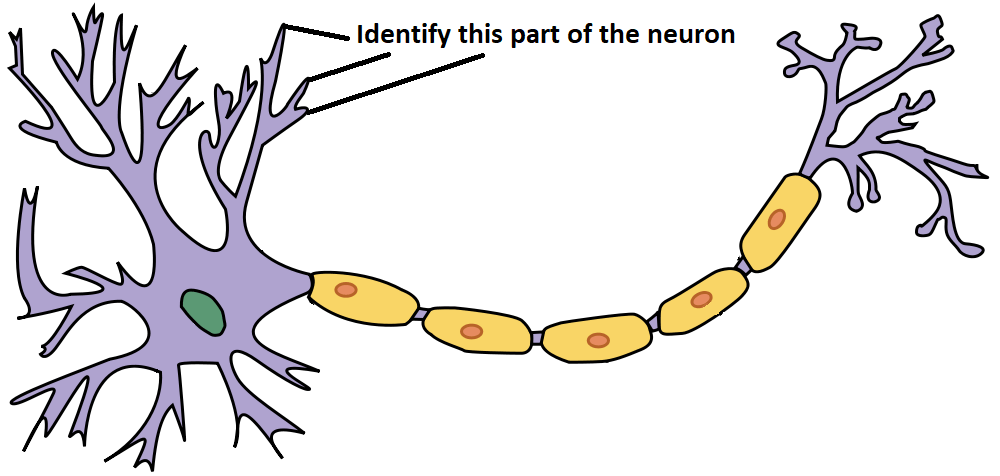
Dendrites
Axon Terminals
Myelin Sheath
Schwann Cells
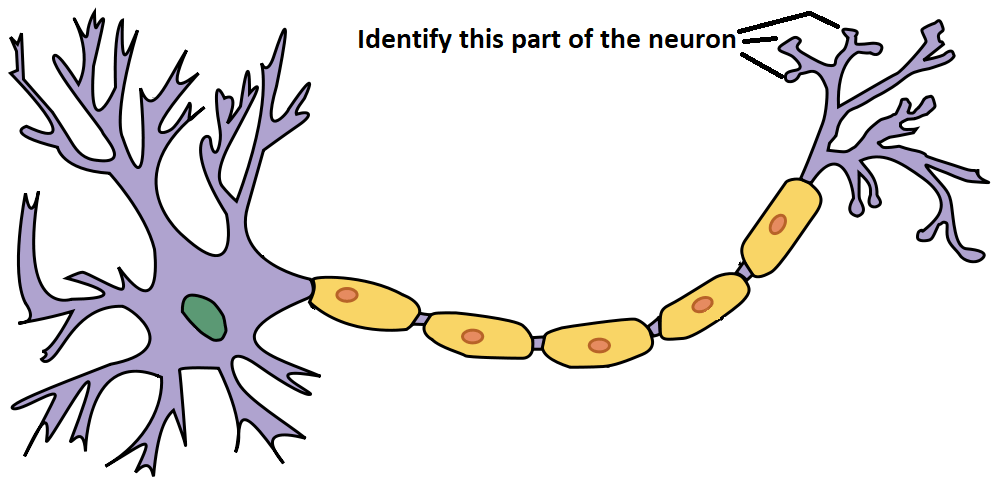
Dendrites
Axon Terminals
Myelin Sheath
Schwann Cells
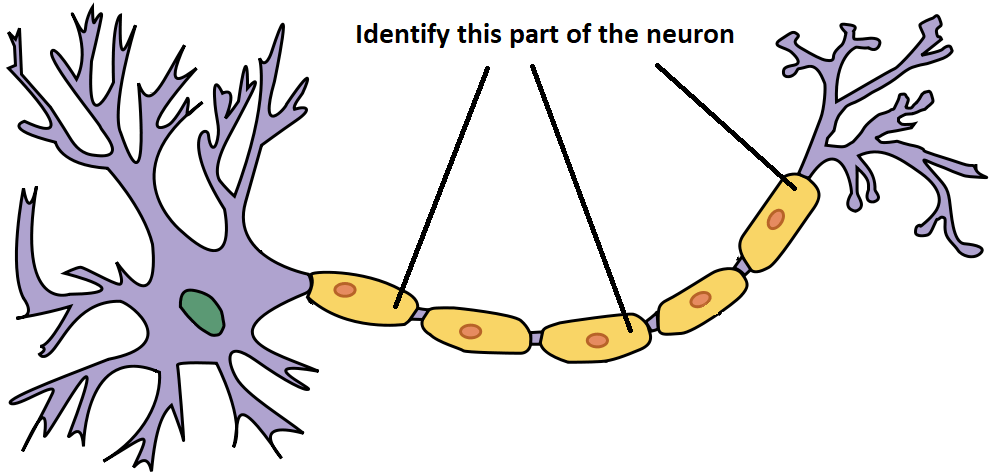
Dendrites
Axon Terminals
Myelin Sheath
nuclei
What does the neuron's Myelin Sheath do?
Controls the actions of the neuron
Produces food for the neuron
Carries information from the cell body to other neurons
Surrounds and insulates the axon
What do Dendrites do?
Receives information from other neurons via neurotransmitters
Produces fatty tissue for the Myelin Sheath
Sends information to the next cell
Controls the speed of electrical signal through the axon
What do Axon Terminals do?
Receives information from other neurons
Produces fatty tissue for the Myelin Sheath
Sends information to the next cell
Controls the speed of electrical signal through the axon
The space between the axon terminal of the sending neuron and the dendrite or cell body of the receiving neuron.
axon
synapse
dendrite
cell body

