
 Worksheets
APES Third Quarter Golden Assignment
Total questions: 125
Worksheet time: 2hrs 14mins


What does the whole right side of the population pyramid represent?
Males
Females
Unemployed
Young people

What age group does the top of the population pyramid represent?
The working people
The rich people
The elderly
The young people

What age groups does the bottom of a population pyramid represent?
The elderly
The working adults
The children
Males
Does this age structure diagram show a country with
Rapid Growth
Decreasing Growth
Zero Growth
Does this age structure diagram show a country with
Zero Growth
Rapid Growth
Decreasing Growth
Does this age structure diagram show a country with
Decreasing Growth
Zero Growth
Which of the following age structure diagrams demonstrates zero growth in the population?


none of the above
Which of the following age structure diagrams demonstrates decreasing growth in the population?
none of the above
Which of the following age structure diagrams demonstrates POSITIVE, RAPID growth in the population?
none of the above

Which country will have the most rapid population growth?
Sweeden
United States
Mexico
None
Does this age structure diagram show a country with
Rapid Growth
Zero Growth
Decreasing Growth
Does this age structure diagram show a country with
Zero Growth
Decreasing Growth
Does this age structure diagram show a country with
Rapid Growth
Zero Growth
Decreasing Growth
Does this age structure diagram show a country with
Rapid Growth
Zero Growth
Decreasing Growth
Does this age structure diagram show a country with
Rapid Growth
Zero Growth
Decreasing Growth
Does this age structure diagram show a country with
Decreasing Growth
Zero Growth
Rapid Growth
Better sanitation (access to clean water)

Predict the future population growth of this country.
Negative Growth (the population will shrink)
Slow/No Growth (the population will stay about the same)
Fast Growth (the population will explode)

Using the age structure diagrams, Which country has a greater population in the “reproductive” age group?
United States
Guatemala
In an age structure diagram, ___________are on the left and ___________________ are on the right.
females, males
males, females
young, old
elderly, infants

Figure C shows an age structure diagram for a population that is _________?
diminishing
expanding
stable
birthrate is higher than deathrate
Which of the following age structure diagrams demonstrates little to no growth in the population?
none of the above
Which of the following age structure diagrams demonstrates NEGATIVE growth in the population?
none of the above
Which of the following age structure diagrams demonstrates POSITIVE, RAPID growth in the population?
none of the above
Which country will have the most rapid population growth?
Sweeden
United States
Mexico
None
In what stage of the DTM are traditional tribes?
1
2
3
4
5
What does DTM stand for?
Demographic Transnational Modelling
Demographic Transition Model
Decreasing Thermal Medicines
Developing Transition Model
Which describes the birth and death rate of Stage 1 of the DTM?
The death rate is high but the birth rate is low
Both the death and birth rate are high
The death rate is low but the birth rate is high
Both the death and birth rate are low
Which describes the birth and death rate of Stage 2 of the DTM?
The death rate is decreasing and birth rate remains high
Both the death and birth rate are high
The death rate is low but the birth rate is high
Both the birth rate and death rate are decreasing
Which describes the birth and death rate of Stage 3 of the DTM?
The death rate is decreasing and birth rate remains high
Both the death and birth rate are high
The death rate is low but the birth rate is high
Both the birth rate and death rate are decreasing
Which describes the birth and death rate of Stage 4 of the DTM?
The death rate is decreasing and birth rate remains high
Both the death and birth rate are high
Both the death and birth rate are low and fluctuating
Both the birth rate and death rate are decreasing
In which stage of the DTM is the population growth the most rapid?
1
2
3
4
5
Which of these does the DTM not include?
Birth rate
Population
Migration
Death rate
In which stage would it be typical for vaccines and healthcare to be adequate?
1
2
3
4
5

In which stage of the DTM is this population pyramid?
1
2
3
4
5

In which stage of the DTM is this population pyramid?
1
2
3
4
5

In which stage of the DTM is this population pyramid?
1
2
3
4
5

In which stage of the DTM is this population pyramid?
1
2
3
4
5

In which stage of the DTM is this population pyramid?
1
2
3
4
5

Which describes the birth and death rate of Stage 1 of the demographic transition model?
The death rate is high but the birth rate is low
Both the death and birth rate are high
The death rate is low but the birth rate is high
Both the death and birth rate are low

Which describes the birth and death rate of Stage 2 of the DTM?
The death rate is decreasing and birth rate remains high
Both the death and birth rate are high
The death rate is low but the birth rate is high
Both the birth rate and death rate are decreasing
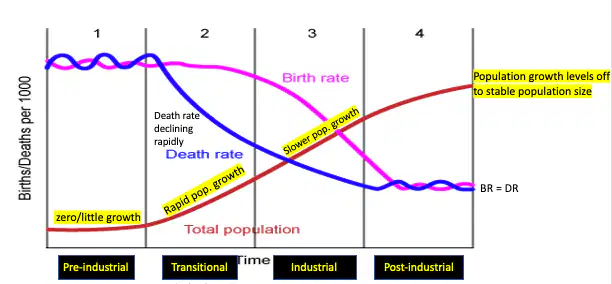
Which describes the birth and death rate of Stage 3 of the DTM?
The death rate is decreasing and birth rate remains high
Both the death and birth rate are high
The death rate is low but the birth rate is high
Both the birth rate and death rate are decreasing

Which describes the birth and death rate of Stage 4 of the DTM?
The death rate is decreasing and birth rate remains high
Both the death and birth rate are high
Both the death and birth rate are low and fluctuating
Both the birth rate and death rate are decreasing
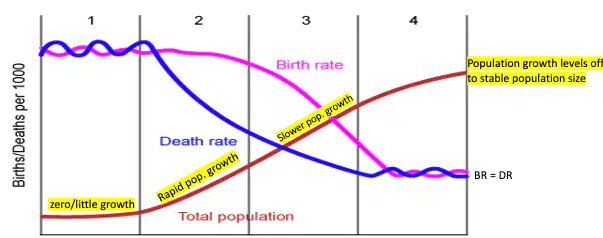
In which stage of the DTM is the total population growth the most rapid?
1
2
3
4
5
Which of these does the DTM not include?
Birth rate
Population
Migration
Death rate

In Stage 1, the birth rate is...
High
Falling
Low

In Stage 1, the death rate is...
High
Falling
Low

In Stage 1, the Total Population is...
Mostly stable - growing slowly
Growing quickly
Decreasing

In Stage 2, the birth rate is...
High
Falling
Low

In Stage 2, the Death rate is...
High
Falling Quickly
Low

In Stage 2, the Total Population is...
Growing Slowly
Growing Quickly
Not Growing

In Stage 3, the Birth Rate is...
High
rapidly Dropping
Low

In Stage 3, the Death rate is...
High
Dropping slowly
Low

In Stage 3, the Total Population is...
Growing quickly
Slowing down
Decreasing

In Stage 4, the Birth rate is...
High
Rising
Low

In Stage 4, the Death rate is...
High
Rising
Low

In Stage 4, the Total Population is...
Growing Quickly
Leveling Out
Decreasing Quickly
In Stage 5, scientists believe the Total Population will...
Increase
Stay Steady
Decrease
In Stage 1, the Population Pyramid would look like. . .


In Stage 5, the Population Pyramid would look like. . .
A country has begun to get access to health care for women and children and there is better access to food resources and clean water. However, it is still very expensive to get access to reliable birth control so most women do not use it. What stage of the demographic transition is this country likely in?
Stage 1-Pre industrial
Stage 2- Transitional
Stage 3 - Industrial
Stage 4 - Post industrial
Which type of soil would water move through more quickly?
Soil made of only large particles
Soil made of only small particles
Soil made of only medium size particles
Soil made of a mix of small and large particles
The layers of soil that are different compositions and textures are called
(a)
How does sandy soil feel to the touch?
Sticky
Gritty
Smooth
What soil can only be seen using a microscope?
Clay
Top soil
Silt
Sand
The mineral portion of a soil is composed of 23% clay and 55% sand. What is the % that consists of silt?
(a)

The mineral portion of a soil is composed of 30% clay, 30% silt, and 40% sand. What type of soil is this?
loam
sandy clay loam
silty clay loam
clay loam
The most biologically active region in the soil is the
B horizon
Bedrock
A horizon
C horizon
Which property of soil can you determine by rubbing a sample between your fingers?
Ability to support life
Formation process
Texture
Color
Which property of soil determines how much water it will retain?
Texture
Porosity
Humus
pH
The desert is missing what horizon of soil
(a)
Sand feels...
Silt feels...
Clay feels...
Soil texture is the look and feel of the soil and is linked to the proportion of , silt and ______
sand and clay
sand and biomass
biomass and nutrients
nutrients and clay

Using the soil triangle below state what type of soil has 33% clay, 43% silt and 24% sand.
(do not assume the arrows drawn in red, yellow and blue relate to this soil).
clay
sandy loam
clay loam
silty clay

Which of the statements gives an accurate description of the proportions of the soil a X?
Sand: 12% Silt: 9% Clay: 79%
Sand: 16% Silt: 30% Clay: 40%
Sand: 12% Silt: 9% Clay: 79%
Sand: 32% Silt: 48% Clay: 29%
Sand: 22% Silt: 18% Clay: 50%
What comes from the weathering of the parent material.
water
gasses
organic matter
Minerals
Carbon dioxide, nitrates, and ammonia compounds in the soil.
water
gasses
organic matter
Minerals
What comes from the living organisms that are on and in the soil?
water
gasses
organic matter
Minerals
Which type of soil is more gritty?
sand
silt
clay
loam
Which type of soil has the smallest particles and drains poorly?
sand
silt
clay
loam
Which type of soil is smooth feeling?
sand
silt
clay
loam
Which type of soil is ideal for agriculture?
sand
silt
clay
loam
Mineral matter accounts for _____ of the soil.
30%
25%
45%
5%
Soil air accounts for ____ of the soil.
40%
25%
45%
5%
The ability of a soil to retain water for use by plants is called _______.
Permeability
Water-holding capacity
Soil Texture
Soil Workability
The process by which soil is moved is called _____.
Erosion
Turgor
Density
Displacement
Which of the following is NOT a cause of erosion?
Wind
Temperature
Water
Glacial movement

The blue dot is indicating what percentage of CLAY in this soil texture?
40
10
50
90

The blue dot is indicating what percentage of SILT in this soil texture?
10
70
20
30
Soil water accounts for ____ of the soil.
40%
25%
45%
5%

The blue dot is indicating what percentage of SAND in this soil texture?
30
70
40
60
Organic matter accounts for ____ of the soil.
5%
25%
45%
60%

