
 Worksheets
PS Unit 1 Review
Total questions: 130
Worksheet time: 2hrs 10mins
A block has a mass of 20.0 g and a volume of 40.0 cm3. What is its density?
2.0 g/cm3
1.2 g/cm3
0.5 g/cm3
4.0 g/cm3
3 g/cm
8 g
263.5 g/cm3
2.804 g
Jack has a rock. The rock has a mass of 14g and a volume of 2cm3. What is the density of the rock?
9 mL
7 g/cm3
28 g/cm3
1/7 g/cm3
A piece of copper has a mass of 89g and a volume of 10.0 cm3. What would be the density of the copper?
0.89 g/cm3
89 g/cm3
8.9 g/cm3
890 g/cm3

Use the density chart to identify the substance. If the substance has a volume of 5 cm3 and a mass of 52.5.
lead
aluminum
silver
water

As part of a classifying elements lab Joe was finding the density of different samples. One sample had a mass of 26.4 and a volume of 12 mL. What element is it?
Sulfur
Carbon
Boron
Krypton
Find the density of a 2 cm x 2 cm x 2 cm cube with a mass of 64 g.
(Hint: find the volume first!)
13 g/cm3
2 g/cm3
10 g/cm3
8 g/cm3
If a block of wood has a density of 0.6 g/cm3 and a mass of 120 g, what is its volume?
300 cm3
200 cm3
100 mL
150 cm3

Which box has a higher density?
A
B
They both have the same density.
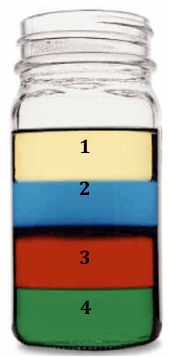
Why do objects sink or float in H2O?
Because their densities are higher or lower than compared to water
Because their densities are using gravity to pull down
Because their densities are heavier or lighter
Because their mass and volumes are equal

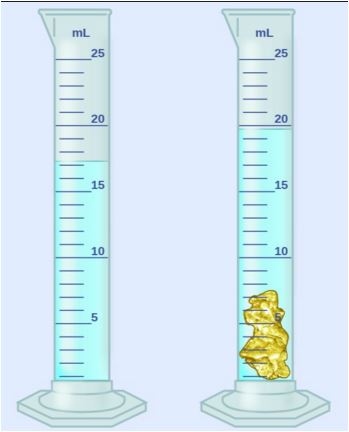
The slope of a mass vs volume graph represents which physical property?
mass
volmue
density
temperature

What is the density of the object depicted in the graph?
0.2 g/cm3
5.0 g
2 g
5.0 g/cm3

Which has the greatest density?
A
B
C
All the same density
1,221 km = ________ m
1,221 m
1,221,000 m
1.221 m
12,210 m
435 mL = _____ cL
4350 cL
43.5 cL
4.35 cL
0.435 cL
29 mm = ______ m
0.029 m
290 m
0.29 m
0.0029 m
117 cm = _____ dm
1.17 dm
0.117 dm
1170 dm
11.7 dm
35,400 mg = ________g
3.5400 g
3,540 g
35.4 g
354,000 g
0.563 L = _____ mL
5,630 mL
5.63 mL
56.3 mL
563 mL
2319 kL = _______ mL
2,319,000 mL
2,319,000,000 mL
2.319 mL
0.0002319 mL
34 m = _____ mm
340 mm
3400 mm
0.034 mm
34,000 mm
The base unit for volume is the ______?
milliliter
centiliter
deciliter
liter
1 mL = _____L
0.001 L
0.1 L
0.01 L
1000 L
To convert from the base unit to milli you multiply by how many factors of ten?
1
2
3
0
Which measurement is the smallest?
1 mm
0.01 cm
0.001 m
0.0001 km
The base measurement for mass is...
kilogram
liters
grams
meters
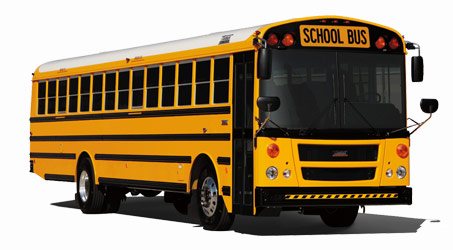
I would measure this bus in
centimeters
milimeters
kilometers
meters
Select the largest unit.
kilogram
centigram
decigram
decagram
Using the conversion chart, as the units move to the left, the decimal place moves to the ____________.
Right
Sometimes to the right, sometimes to the left
Left
The decimal place doesn't change between units
Metric unit used to measure the volume of a liquid.
Meter
Liter
degree Celsius
Second

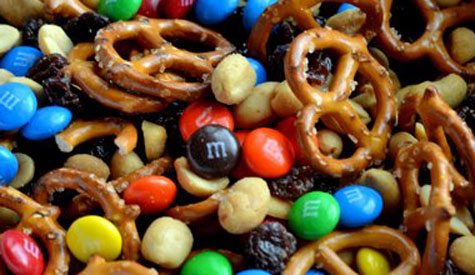
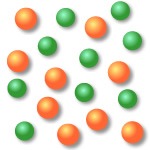
What is a compound?
Two different elements bonded together.
Two of the same elements bonded together.
A mixture of different substances.
Two substances stuck together with glue.

What does this pic illustrate?
Element
Mixture of Compunds
Mixture of elemets
Compounds
Which of the following represents an element?
H2O
HCl
NaCl
Au
CaCO3
Which two types of matter are pure substances?
elements and compounds
mixtures and elements
homogenous mixtures and elements

The diagram shows
element
mixture
compound
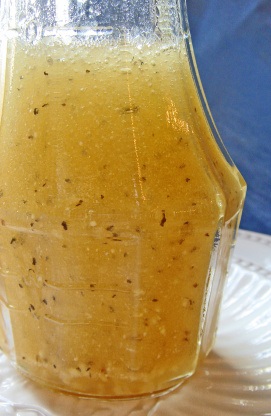
What is a type of mixture in which different parts can easily be seen (Ex. Vegetable soup)?
Heterogeneous mixture
Homogeneous mixture
Solution
Colloid
Matter can be classified as either a __________ or a _____________.
Element or a Compound
Compound or a Solid
Pure Substance or a Mixture
Mixture or a Solid
A material made up of two more more substances that can be easily separated by physical means is called?
Mixture
Element
Compound
Pure Substance
A mixture that is uniformly mixed is called?
Element
Compound
Homogeneous
Heterogenous
Water and sugar dissolved is an example of:
Compound
Homogeneous mixture
Substance
Heterogeneous mixture
A chocolate chip cookie is an example of:
Substance
Compound
Homogeneous mixture
Heterogeneous mixture
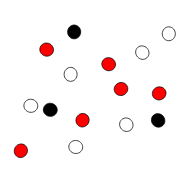
A mixture that is NOT evenly distributed is called a:
compound
homogeneous mixture
heterogeneous mixture
pure substance
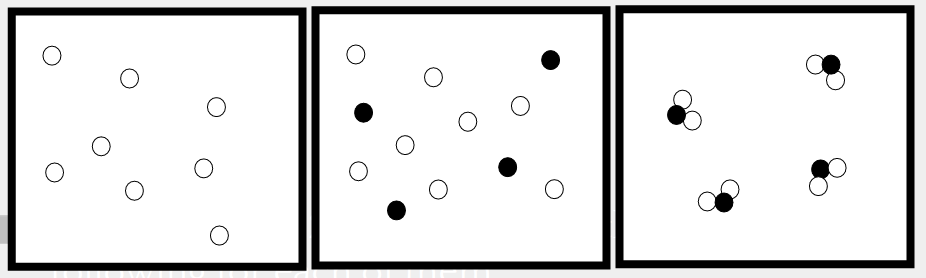
What particle view below is a mixture?


What is the best classification of this substance? H2SO4
An element
A compound
A mixture
What is the best classification of this substance? CO2 & H2S
An element
A compound
A mixture of 2 compounds
A mixture of many elements
What is an example of a physical property?
Silver is shiny
Alcohols are flammable
Alkali metals are reactive with water
Acids are sometimes corrosive
What is an example of a chemical change?
Tearing paper
Dissolving salt in water
Melting ice
Burning wood

Does this image represent a chemical or a physical change?
Chemical change
Physical change

Does this image represent a chemical or physical change?
Chemical change
Physical change
Which below shows a CHEMICAL change?


How many different TYPES of ATOMS are in this image?
1
2
3
4
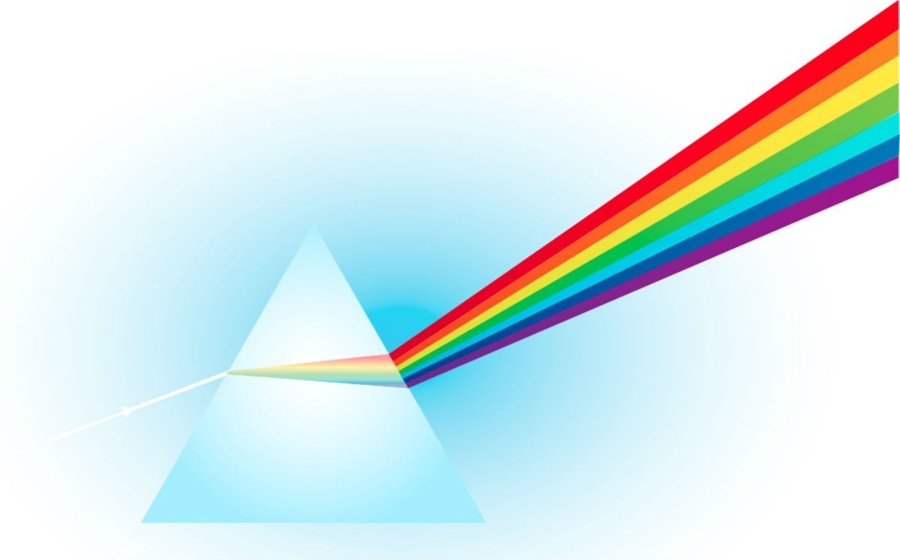
Color is what type of property?
Physical
Chemical
Reactivity is what type of property?
Physical
Chemical
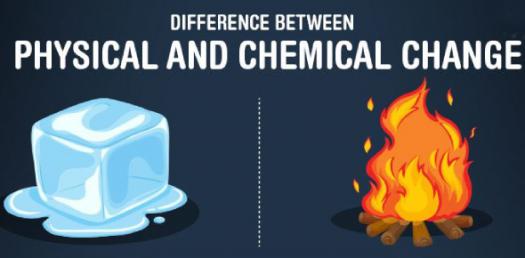
What is a sign of a physical change?
Bubbles forming
Color changing
Stretching
Producing heat

What is a sign of a chemical change?
Stretching
Tearing
Compressing
Bubbles
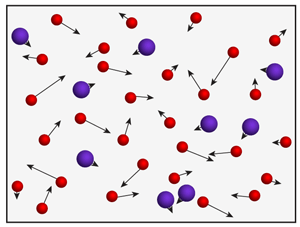
What happens to the atoms of a substance in a physical change?
Atoms get bigger
Atoms change their arrangement and motion
Atoms get smaller
Atoms bond together differently
What happens to the atoms of a substance in a chemical change?
Atoms get bigger
Atoms change their arrangement and motion
Atoms get smaller
Atoms bond together differently
Which of the following changes is a physical change of matter?
water evaporating
paper burning
a nail rusting
a silver spoon tarnishing
Which of these observations would likely be an indication of a chemical change?
A change in odor when two substances are mixed
A change in temperature when a hot substance is left standing in air
A change in volume as a substance is heated
The disappearance of a liquid as it boils

You mixed two liquids and a precipitate formed, what kind of change occured?
Physical
Chemical
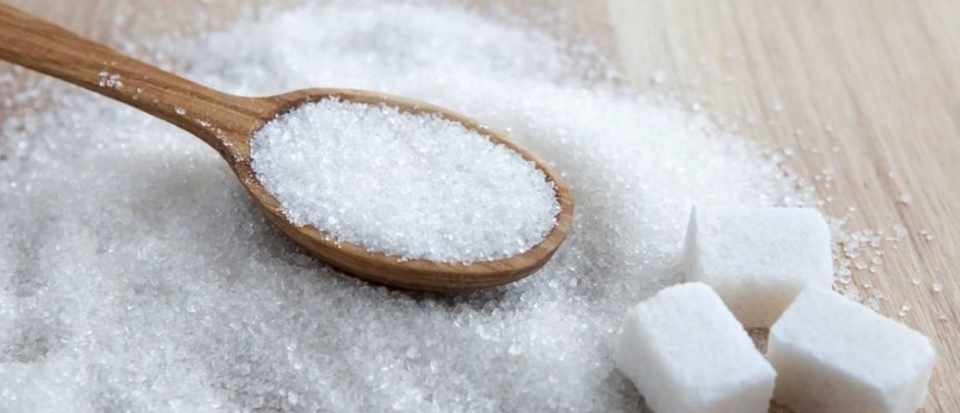
What happens when sugar dissolves in water?
Physical change because a new substance is formed
Chemical change because a new substance is formed
Physical change because the sugar is just getting smaller
Chemical change because the sugar is just getting smaller
Signs of a physical change:
Compress
Shatter
Tear
Precipitate
Signs of a chemical change:
Precipitate
Light
Heat
Shatter
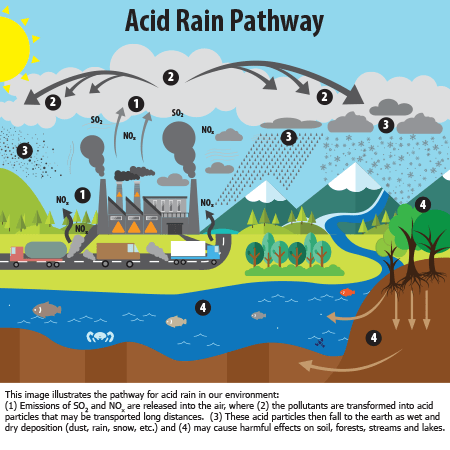
Acid Rain
Physical Change
Chemical Change
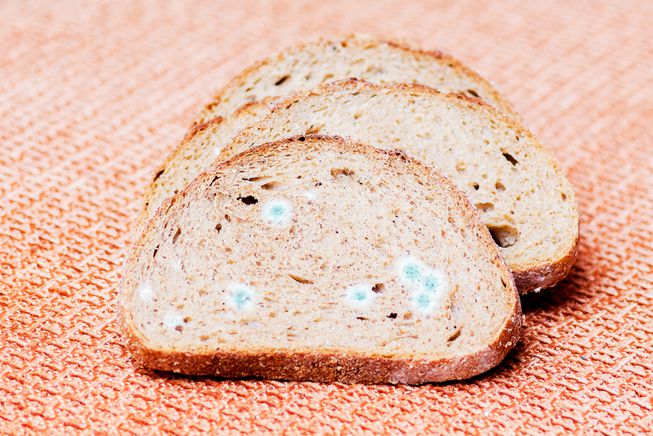
Moldy Bread
Physical Change
Chemical Change

At 30 atmospheres pressure, the boiling point of this substance is:
-105
0
50
200
If the temperature of the substance is held constant at -15 ºC, the phase change that would occur with a pressure increase from 1 atmosphere to 30 atmospheres is:
MELTING
SUBLIMATION
DEPOSITION
CONDENSATION
WHAT IS THE PHASE CHANGE FROM A TO C?
MELTING
SUBLIMATION
DEPOSITION
CONDENSATION
WHAT IS THE PHASE CHANGE FROM C TO A?
MELTING
SUBLIMATION
DEPOSITION
CONDENSATION
WHAT IS THE PHASE CHANGE FROM A TO B?
MELTING
FREEZING
VAPORIZATION
CONDENSATION
WHAT IS THE PHASE CHANGE FROM B TO A?
MELTING
FREEZING
VAPORIZATION
CONDENSATION
WHAT IS THE PHASE CHANGE FROM B TO C?
MELTING
FREEZING
VAPORIZATION
CONDENSATION
WHAT IS THE PHASE CHANGE FROM C TO B?
MELTING
FREEZING
VAPORIZATION
CONDENSATION
WHAT IS THE PRESSURE FOR THE TRIPLE POINT?
1
6
-105
300
WHAT IS THE TEMPERATURE FOR THE TRIPLE POINT?
200
-15
-105
50
WHAT STATE OF MATTER IS A?
SOLID
LIQUID
GAS
SUPER FLUID
WHAT STATE OF MATTER IS B?
SOLID
LIQUID
GAS
SUPER FLUID
WHAT STATE OF MATTER IS C?
SOLID
LIQUID
GAS
SUPER FLUID

What happens along the AC line?
Melting/Freezing
Boiling/Condensing
Boiling/melting
freezing/condensing

The critical point is found at point.....
A
B
C
D
What is being measured on the x axis?
Pressure
Temperature
Energy
Mass


From C to D, what phase of matter is the substance?
Solid
Liquid
Gas
Plasma
Normal freezing/melting and boiling points occur at standard pressure, which is
1 atm
5 atm
10 atm
15 atm
A phase change can be all of the following EXCEPT
Change in amount of energy
Physical change
Chemical change
Change in state

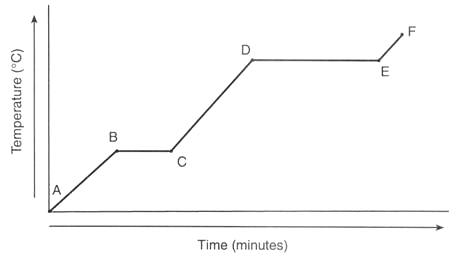
Are the particles moving faster or slower as time goes on?
Faster
Slower


According to the graph, what can happen at 100 degrees Celsius?
Water Melt or Freeze
Water can go through vaporization or condensation
Water can go through Sublimation or Depostion

What would the state of this substance be at 1 ATM of pressure at a 80 degrees Celsius?
Solid
Liquid
Gas
Michigan

At what temperature do all three phases coexist?
0 degrees C
0.01 degrees C
100 degrees C
374 degrees C

The slower molecules move,
the higher the temperature
the less temperature
the same temperature

The faster molecules move,
the higher the temperature
the less temperature
the same temperature
The temperature and pressure conditions at which the solid, liquid, and gas phases of a substance exist at the same time is called the
Critical point
Triple point
Melting point
Boiling point
The point that a liquid and gas can no longer be distinguished from each other.
Critical point
Triple point
Melting point
Boiling point

Is the substance gaining or losing energy? (Diagram D)
Gaining
Losing

What will occur when the substance changes from 1 atm to 30 at a constant temperature of -15oC? (Diagram A)
condensation
deposition
melting
sublimation
What will occur when the substance changes from 0o C to 100oC at a constant pressure of 30 atm? (Diagram A)
condensation
evaporation
melting
freezing

What is the normal boiling point of this substance? (Diagram C)
150 °C
100 °C
-50 °C
0 °C
What is the normal melting point of this substance? (Diagram C)
150 °C
100 °C
-50 °C
0 °C

