
 Worksheets
ESS B Final Exam Review Game
Total questions: 130
Worksheet time: 2hrs 36mins
Label: erosion, weathering, and deposition
Circle the items that are not agents of erosion


deflation

abrasion

desert varnish

Which type of mass wasting is shown in the image?
Creep
Slump
Debris flow
Rock Avalanche

What type of mass wasting is shown in the image?
debris flow
mudflow
rockfall
rockslide

Identify the landform shown in the image.
Alluvial fan
Delta
Drumlin
Kettle lake
Label the glacial formations.

Use the images below to describe how sea stacks form through wave erosion.
Label the wave deposition features
How do rivers transport sediment?

Which river cause more erosion?
River A because rivers with steeper slopes have a faster velocity
River B because rivers with steeper slopes have a faster velocity
River A because rivers with gentler slopes have a faster velocity
River B because rivers with gentler slopes have a faster velocity

Which rock would you expect to erode quickly? Be sure to explain your reasoning.
Which of the following factors would lead to faster movement of a glacier? (Select all that apply)
steep slopes
rough ground texture
smooth ground texture
shallow slopes
large glacial mass
Describe the difference between plucking and abrasion erosion.
Cirque
A bowl-shaped depression formed by a glacier
Arete
A jagged, narrow ridge formed as a glacier plucks rock and soil from a rounded ridge.
Striations
Grooves formed when rocks embedded in a glacier scrape the bedrock below.
U-shaped valley
Formed as glaciers erode pre-existing V-shaped valleys, scooping out its round shape.
Horn
A jagged, pointed mountain top formed by a glacier
The air pressure decreases as the altitude
Decreases
Increases
Remains constant
They are not related
The lowermost layer of the atmosphere
Stratosphere
Mesosphere
Troposphere
Exosphere
The ozone layer is found in
Stratosphere
Thermosphere
Exosphere
Troposphere
Meteors from the space burn in which layer?
Troposphere
Exosphere
Stratosphere
Mesosphere
Satellites orbit in which layer?
Troposphere
Stratosphere
Thermosphere
Mesosphere

Troposphere
Thermosphere
Mesosphere
Stratosphere

What layer protects us from the harmful ultraviolet (UV) rays from the sun?
Troposphere
Greenhouse Gases
Ionosphere
Ozone Layer

Movement of heat from one material to another through direct contact.
Radiation
Conduction
Convection

Which point on Earth will get the most heat from the sun due to solar radiation?
A
B
At warmer temperatures, liquid water molecules move faster and turn into water vapor that stays in the air. This moisture in the air is called ___.
precipitation
humidity
air mass
front
The fact that it's less dense than cold air
The fact that it weighs more than cold air
The fact that it has higher pressure than cold air
The fact that it's more dense than cold air
Check all weather associated with a high pressure system.
sunny
clear skies
calm winds
warm, moist air

What kind of pressure system is South of Panama City Beach?
high
low
warm front
cold front
Check all weather associated with a low pressure system.
warm, humid air
strong winds
cloudy, stormy skies
sunny, clear skies
What are the three things that describe a high pressure system? Check all that apply.
air cools
air becomes more dense
air sinks
air rises
air warms

What type of pressure system is modeled in the picture?
high
low

What does this weather map symbol represent?
warm front
cold front
stationary front
occluded front
What kind of weather is generally associated with a cold front?
heavy rain possible thunderstorms
sunny skies
warmer air temperature
no wind
The short term state of the atmosphere including temperature, humidity and wind.
thunderstorm
climate
weather
hurricane

What type of pressure system does the model represent?
low pressure system
high pressure system
Differences in longitude
Shock waves from clouds
Differences in air temperature and pressure
The rotation of earth

Deep Currents
Convection Currents
Surface Currents
Wave Currents

The Coriolis Effect
Cold and Warm Water
Convection
Wind

Winds
Cooling
Heating
Rotation

Warm Currents
Deep Currents
Shallow Currents
Surface Currents

Oxygen
Climate
Upwelling
Sunlight
Which of the following will decrease ocean salinity:
Evaporation
Sea ice formation
Precipitation (Rain)
Runoff
Icebergs melting
______ causes deep ocean currents
The Coriolis Effect
gravity
wind
density differences
Gyres in the southern hemisphere are surface currents that turn _________ due to the Coriolis Effect.
clockwise
counterclockwise
toward the right
toward the bottom of the ocean
The large, circular surface-current pattern found in each ocean produced by wind and the Coriolis effect
California Current
Upwelling
Gyre
Global Conveyor Belt
Which factors cause gyres?
prevailing winds
salinity
shape of the ocean basin
Coriolis effect
What does El Niño and La Niña's effect on ocean circulation heavily depend on?
Salt
Humans
Marine life
Wind Patterns
What does ENSO stand for?
Emergency National Security Organization
El Niño Southern Oscillation
El Niño Southbound Oscillation
El Niño Silver Oyster
What are the conditions for El Niño and La Niña?
El Niño has colder waters and La Niña has warmer waters
El Niño and La Niña both have warmer waters
El Niño has warmer waters and La Niña has colder waters
El Niño and La Niña both have cooler waters
An El Niño occurs when trade winds drop or even reverse
True
False

Thunderstorm clouds are known as _____.
cirrus clouds
stratus clouds
cumulonimbus clouds
cumulus clouds

The most dangerous aspect of a hurricane that comes ashore is the ________.
storm surge
eye wall
wind speed
rainfall

About 75% of the world's tornadoes happen in the United States during Springs and early Summer when cold, dry from Canada meets warm, moist air from the Gulf of Mexico. This relatively flat part of the country is known as ________________.
Tornado Paradise
Thunderstorm Lane
Tornado Alley
Hurricane Row
What are large thunderstorms that have winds already in rotation called?
supercells
blizzards
hurricanes
tornadoes
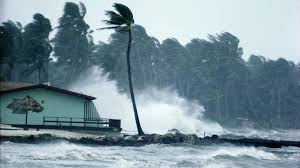
Wind
Sunlight
Warm Water
Cold Water
Tornadoes never form when there is rain, while hurricanes always form with rain.
Tornadoes form under low pressure, while hurricanes form under high pressure
Tornadoes form in a stable atmosphere, while hurricanes form in an unstable atmosphere
Tornadoes form over land, while hurricanes form over bodies of water

it will get stronger
it will get weaker
it will upgrade its category
it will morph into a typhoon
A natural hazard occurs when natural physical processes become:
dormant and inactive.
extreme and unpredictable.
scary!
faster than usual.
Which of the following are potential effects of a natural disasters (check all that apply)?
spread of disease due to reduced standards of sanitation
disruption of communication networks
disruption of government and its services
loss of jobs and businesses
Why is it beneficial to be able to predict when and where natural hazards will occur as much as possible?
Communities can be notified to evacuate
So that we can stop them from happening again
So that scientists know where to go in order to study them
So that we can harness their power for renewable energy
In order for a hurricane to form, the water must be:
Cool
Warm
Cold
Hot
Which of the following is NOT a natural hazard?
Hurricane
Tornado
House Fire
Earthquake

Hurricane
Flood
Wildfire
Tsunami

A line on a weather map that connects points of equal air temperature
A line on a map that shows which areas of the United states get more sun
A line on a weather map that connects points of equal air pressure
A line of latitude on a map that shows the different zones; tropic, temperate and polar

Which city would have the most unstable atmospheric
conditions and the greatest chance of precipitation?
A
B
C
D

The wind direction at station A is
A) southeast
B) northeast
C) southwest
D) northwest

High pressure system
Low pressure system
Cold front
Warm front

High pressure system
Low pressure system
Cold Front
Warm Front

Cold front

Warm front

Occluded front

Stationary front
What is the Greenhouse Affect?
As carbon dioxide concentrations increase, temperatures increase
Condition that is caused by carbon dioxide, methane, and water vapor trapping heat in the Earth's atmosphere
causes sea levels to rise because it adds water to the ocean.
The cooling of Earth due to air pollution.
Which of the following events would be MOST likely to add Greenhouse Gases to the atmosphere?
Hurricane
Tsunami
Forest Fire
Ecological Succession
Why is Carbon Dioxide considered to be a Greenhouse Gas?
It is a combination of natural and human forces
It has a biogeochemical cycle
It is a type of weather that occurs during a particular season
It absorbs and reradiates infrared radiation to warm the Earth
The water causes cooler summers and colder winters.
The water causes cooler summers and warmer winters.
The water causes hotter summers and warmer winters.
The water causes warmer summers and colder winters.
The _______ of a mountain range is the side that receives a lot of precipitation.
windward side
leeward side
What type of pressure zone is associated with a dry climate?
Low-pressure
High-pressure
Polar pressure
Prevailing winds

Identify the factor that influence the temperature of these two areas
Latitude
Elevation
Distance from Large Bodies of Water
Ocean Currents
Which city will have a cooler average temperature
Chapel Hill
Havana
The water causes cooler summers and colder winters.
The water causes cooler summers and warmer winters.
The water causes hotter summers and warmer winters.
The water causes warmer summers and colder winters.
What are four factors that affect climate?
latitude
proximity (closeness) to large body of water
earthquakes
ocean currents
elevation
The following are Greenhouse Gases:
Carbon Dioxide
Methane
Salt
Phosphorus
Water vapor
When the northern hemisphere is tilted towards the sun, which hemisphere is in the summer?
Northern
Southern
Eastern
Western
What is the approximate tilt of the Earth's Axis?
23.5 Degrees
30 Degrees
60 Degrees
10 Degrees
Which BEST describes why latitudes closest to the equator have warmer climates?
they are at lower elevations
they receive high angle sunlight
they are nearer to ocean currents
they get more winds that carry energy in the form of heat
What is one way volcanic eruptions can effect climate?
When a volcano errupts, secondary succession begins
Lava is hot which makes the community hotter
Ash blocks sunlight, causing temperatures to drop
Even without human activity, there is naturally occurring greenhouse effect. Without it, the Earth would be ____________.
When a volcano errupts, secondary succession begins
6 to 11°C cooler
28 to 33°C warmer
28 to 33°C cooler
soil samples
ocena sediment
fossil gases
ice core bubbles

Which of the following best explains the graph (select two)
Average Temperatures have cooled down significantly since 1951
Average Temperatures have risen significantly since 1951
From 2015 onwards we are more likely to see colder weather than hotter weather
From 2015 onwards we are more likely to see extremely hot weather than colder weather
Where have some of the strongest and earliest impacts of global warming occurred?
The tropics
The Northern latitudes
The subtropics

Efficient infrastructure can help mitigate climate change. Infrastructure is:
planes, trains, and automobiles.
buildings, roads, water treatment plants, and irrigation systems.
plants, trees, and animals.
As average global temperature rises, ___________.
average precipitation increases
average precipitation decreases
average precipitation decreases
How is climate change affecting biodiversity?
decreasing
increasing
it is not affecting it

Burning fossil fuels puts ________ into the atmosphere.
oxygen (O)
carbon dioxide (CO2)
helium (He)
Increased production of greenhouse gasses has lead to (Select two)
No major change in Earth's climate
Poorer health conditions for people in areas of higher pollution
An increase of approximately 1.5 degrees celcius on a global scale
Better harvesting conditions for food
Why does global warming cause sea levels to rise? [Choose 1 to 4 options.]
Warm ocean waters expand more.
Seismic activity in the ocean increases in warmer temperatures.
Glacial ice is melted and this adds water to the oceans.
The Earth's core expands in warm temperatures, elevating the ocean floor.

Mitigation is:
the act of increasing harmful actions.
the act of decreasing harmful actions.
doing nothing about harmful actions.
burning more fossil fuels
cutting down trees
raising livestock
burning gasoline

Sustainable buildings use more energy efficient materials and can reduce the amount of energy people use.
True
False

Which type of organism will have issues reproducing due to rising temperatures in the ocean? Use the provided graph for information.
Marine life by coastal areas
terrestrial life
Human being
wookies
What two factors are affecting the oceans due to climate change?
decrease in temperature and increase in pH
increase in salt levels and decrease in sea levels
increase in temperature and decrease in pH
How does the human body return carbon to the atmosphere in the carbon cycle?
Waste products
Photosynthesis
Cellular respiration
Formation of glucose
In the carbon cycle, animals can release carbon back into the cycle through __________ or through __________.
burning . . . photosynthesis
fixation . . . decomposition
decomposition . . . photosynthesis
respiration . . . decomposition
respiration . . . photosynthesis
Which of the following is an example of human impact on the carbon cycle?
The increased production of methane gases from cattle farms
The burning of fossil fuels
The cutting down of trees for lumber
Driving automobiles
All of the above
How do organisms (living things) move carbon through the carbon cycle?
Respiration only
Decomposition only
Photosynthesis, respiration, and decomposition
Decomposition and sedimentation
Respiration, decomposition, sedimentation, and photosynthesis
What kind of organism takes out the most carbon from the atmosphere?
Plants
Bacteria
Animals
Humans
All of the carbon in existence is continually recycled in the carbon cycle.
True
False
water
nutrients
air
fossil fuels
Which term best describes coal, water, and wood?
man-made resources
renewable resources
non-renewable resources
natural resources
True or False: The main disadvantage with nonrenewable resources is that they can take as long as 10 years to replenish.
True
False
Which of the following is not a fossil fuel
biogas
natural gas
coal
petroleum
Why must batteries become more advanced for alternative energy to fully thrive?
Current batteries are likely to explode if overused.
Batteries are needed to efficiently convert electricity from coal-fired power plants into a cleaner alternative energy.
Batteries are required to provide the electricity needed to make windmills and solar panels work.
Large quantities of energy need to be able to be stored for times when energy production conditions are not optimal.
Which of the following is not an example of a nonrenewable resource.
plants
coal
natural gas
oil
Which of the following is NOT and example of a renewable resource?
wind
water
oil
plants

It's cheaper than fossil fuels
The sun's energy would not run out for billions of years
Solar energy recharges batteries
All of them
Solar
Wind
Hydroelectric
water
Energy that comes from harnessing the movement of the air
Energy that comes from the Sun
A source of renewable energy, such as solar, wind, or geothermal energy
Fuel from plant material
All of the following are considered renewable energy sources EXCEPT –
Wind
Coal
Biomass
Solar
What are some benefits of Solar energy? (Select all that apply)
Non-polluting
Expensive
Scarce
Abundant
Some of the main advantages of wind power are that ___________________.(Select all that apply)
It is non-polluting
It is hard to find.
Winds will always blow.
It is expensive
Some of the disadvantages of using windmills for electricity are.......(Select all that apply)
Windmills can be noisy
They can take away from the natural beauty of the land.
They can cause an increase in migratory bird deaths.
They can be put anywhere.
Biomass includes which of the following? (Select all that apply)
manure
lumber
crop residue
paper by-products
True or false: An ecosystem with high genetic diversity is healthier than an ecosystem with low genetic diversity.
True
False
extinct species
the variety of species on Earth
nonrenewable resources
the rate of species decline
Invasive Species are native to an area.
Invasive species are prey to many animals.
Invasive species have no predators.
Invasive species keep the ecosystems in equilibrium.
How does habitat fragmentation reduce genetic diversity in species?
Habitat fragmentation makes nonnative species introduction possible.
Habitat fragmentation opens migration routes.
Habitat fragmentation isolates a large population into smaller groups.
Habitat fragementation encourages open gene flow.
bidiversity
species diversity
extinction
genetic diversity
genetic diversity
ecosystem diversity
extinction
species diversity
Which image best represents infrastructure?


Select all that are correct.
Select two correct benefits of urbanization
Opportunity - Careers & Education
Safety - Police, Fire, Medical
Air Quality - Air quality is more clean in cities
Efficiency - Every is spread far apart
Heat Islands - Cities are warmer than surrounding areas
Select all that are correct.
Select two correct downsides of urbanization
Opportunity - Careers & Education
Safety - Police, Fire, Medical
Air Quality - Air quality is much more polluted in cities
Efficiency - Everything is spread far apart
Heat Islands - Cities are warmer than surrounding areas
Sustainability is the idea that we are responsible to...
maintain the environment for future generations
maintain the environment for past generations
destroy the environment to punish future generations for things that haven't happened yet
maintain the future for past generations

