
 Worksheets
Moles Review Quiz
Total questions: 129
Worksheet time: 6hrs 23mins
A water molecule has the chemical formula H₂O. This means that the water molecule is made up of
Two hydrogen atoms and one oxygen atom
Two oxygen atoms and one hydrogen atom
Two hydrogen atoms and two oxygen atoms
Two molecules of water
The atoms in a water molecule are held together by covalent bonds. This means that the bonded atoms
Lose protons
Lose electrons
Share electrons
Switch neutrons
The water molecule is a polar molecule. A water molecule is polar because
The electrons are shared equally
Oxygen has a stronger attraction for electrons than hydrogen
It is very cold
Hydrogen atoms have a stronger attraction for electrons than oxygen
The water molecule is
Slightly negative near the hydrogen atoms and slightly positive near the oxygen atom
Slightly positive in all areas of the molecule
Slightly negative near the oxygen atom and slightly positive near the hydrogen atoms
The same charge in all areas of the molecule
Water molecules are attracted to each other because
They are all positively charged
Each water molecule has the same number of protons as electrons
The positive area of one water molecule is attracted to the negative area of another
All water molecules are neutral
A paper clip can stay on the surface of water because of water's strong surface tension. Water's surface tension is mostly a result of
Water's temperature
The motion of water molecules
The attraction of water molecules
The impurities in the water
Water cannot dissolve all substances that are made from ionic bonds. This is probably because
Some water molecules are not as strong as others
Water needs to be stirred to dissolve all ionic substances
Some ionic bonds are too strong for the attractions of water molecules to pull them apart
Water needs to be heated to dissolve all ionic substances
What type of intermolecular force does water experience?
dispersion
dipole
covalent
hydrogen "bond"
Why does oil and water not mix together?
because both compounds are polar
because both compounds are nonpolar
because water is polar and oil in nonpolar
because water is nonpolar and oil in polar
When an ionic compound dissolves in water, the ions _________________.
remain together
break apart
Which type of compounds are typically electrolytes?
ionic compounds
metallic compounds
molecular (covalent) compounds
Which type of compounds are do not conduct electrical charge when dissolved?
ionic compounds
molecular (covalent) compounds
Why does ice stay at the top of oceans instead of sinking to the bottom?
Ice is colder than liquid water
Ice is less dense than liquid water
Ice is more dense than liquid water
Ice is warmer than liquid water

A water strider can skate along the top of a pond because....
covalent bonds result in water cohesion (surface tension)
hydrogen bonds result in water cohesion (surface tension)
water striders have adapted to become lighter than water
low surface tension of water

Attractions between water molecules are called ....
Covalent bonds
Ionic bonds
Polar bonds
Hydrogen bonds
What kind of molecule is water?
Ionic
Polar Covalent
Nonpolar Covalent
Metallic
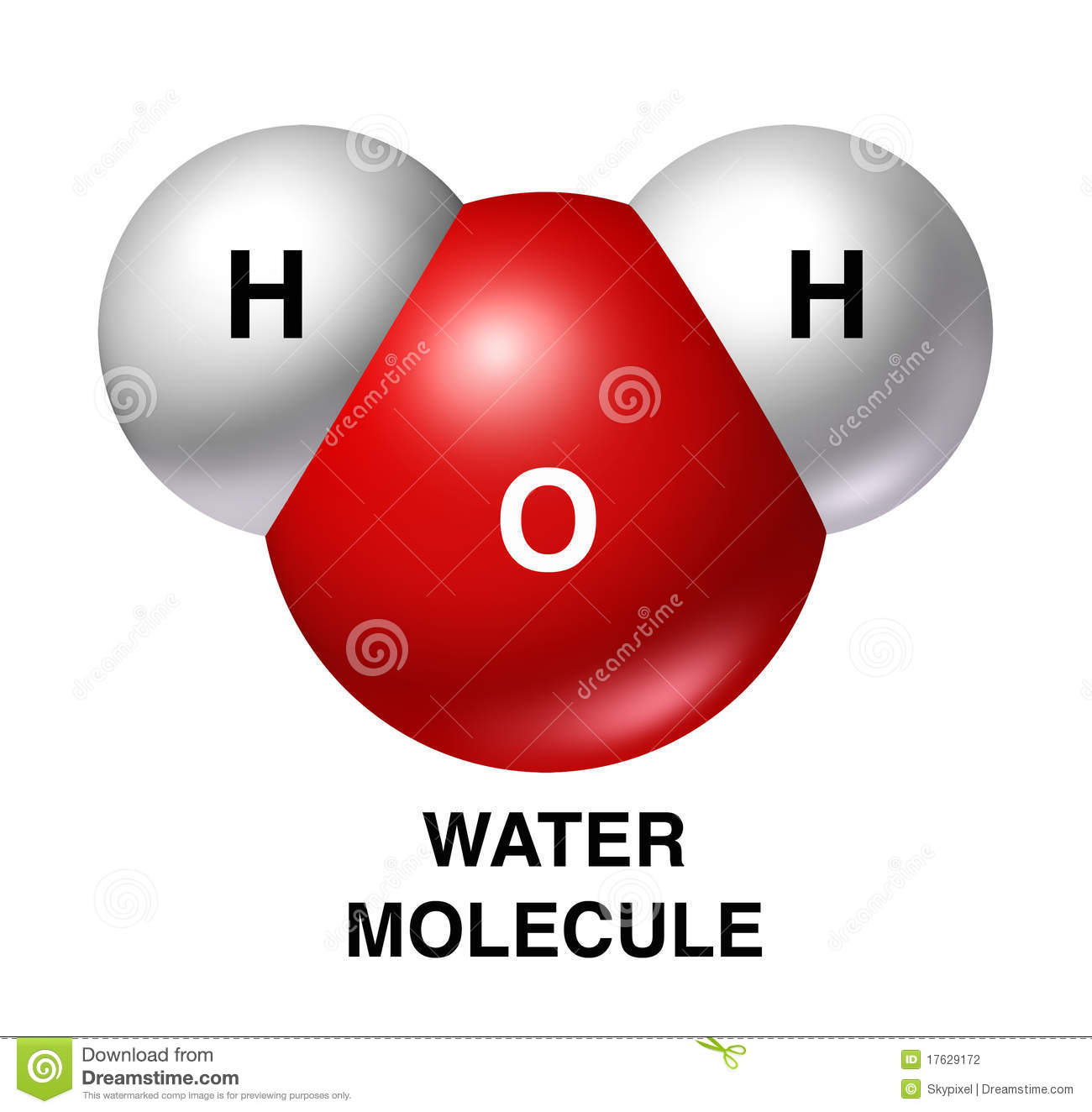
Which part of a water molecule has a Positive Charge?
The Hydrogen
The Oxygen
The Top
The Bottom
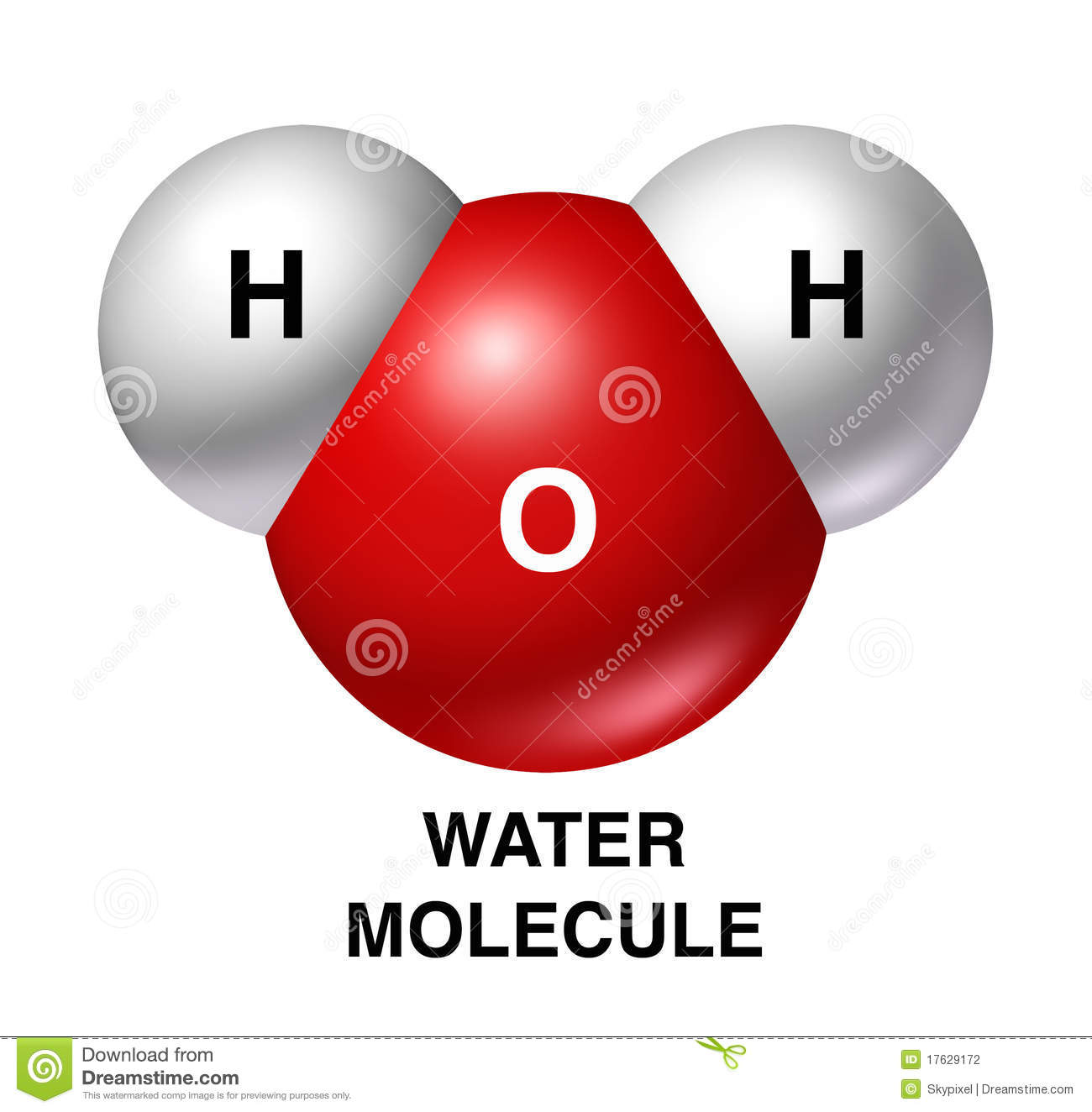
Which part of a water molecule has a Negative Charge?
The Hydrogen
The Oxygen
The Left
The Right
This is the part of the solution that causes the dissolving to occur.
solute
solvent
salt water
the saturant


Water dissolves __________ well.
polar substances (like sugar)
nonpolar substances (like oil)
bricks

Water doesn't dissolve __________ well.
polar substances (like sugar)
nonpolar substances (like oil)
ice

Loose ions that carry charge well (like in Gatorade) are called
Powerade
aqueous solutions
electrolytes

__________ electrolytes break apart completely and conduct electricity very well.
Strong
Weak
Acid
__________ electrolytes only break apart partly and conduct electricity a little bit.
Strong
Weak
Acid

Things that don't conduct electricity at all in a solution are called_______________.
acid
science
nonelectrolytes
If I dissolve carbon dioxide in water, what is the solvent?
Carbon Dioxide
There is no solvent
Oxygen
Water
If I dissolve salt in water, what is the solvent?
salt
water
salt & water
none of the above
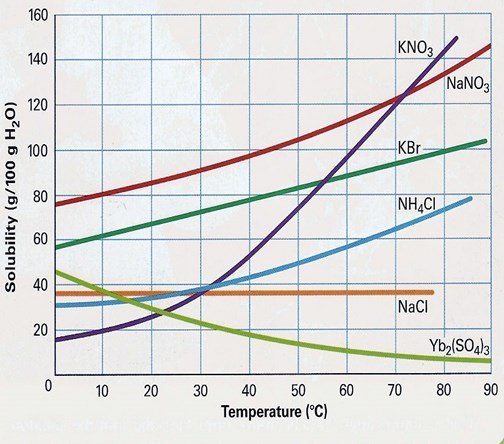
At which temperature do KBr and KNO3 have the same solubility?
60
55
50
Never
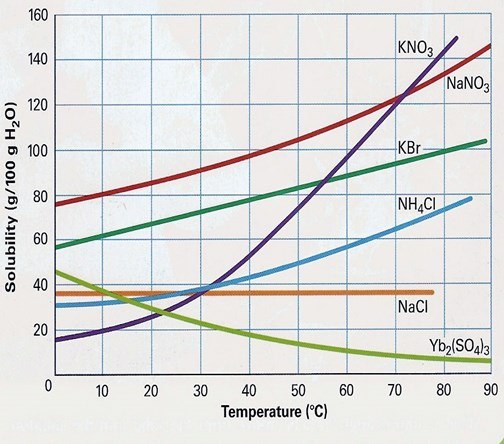
At 30'C, which substance has the lowest solubility?
KNO3
KBr
NaCl
Yb2(SO4)3
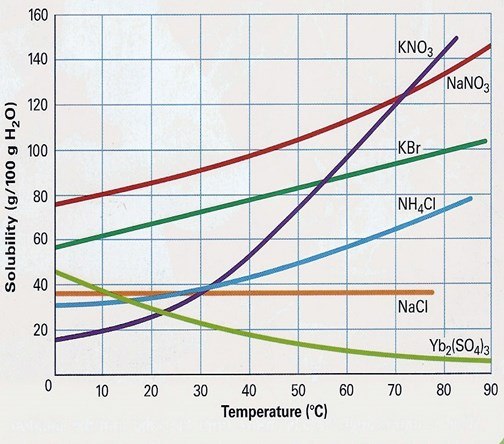
At 80'C, KBr's solubility is:
100g
90g
80g
0g
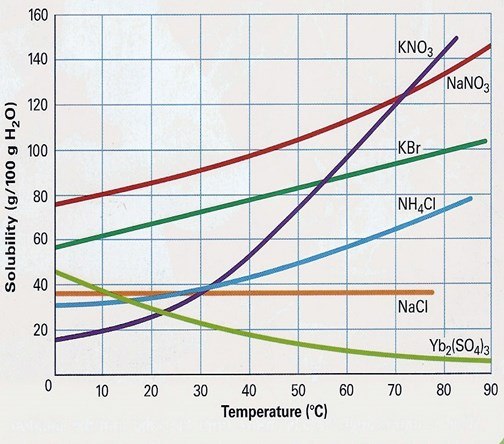
Identify if the following solution would be saturated, unsaturated, or supersaturated: 103 g KBr at 70'C.
Unsaturated
Saturated
Supersaturated
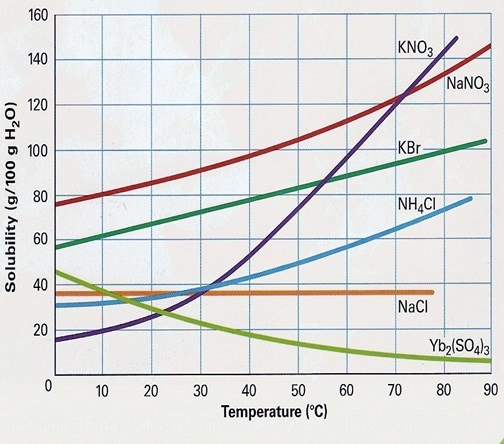
Identify how many grams of KNO3 is required to make a saturated solution at 40'C.
50 g
45 g
60 g
33 g


What type of a solution is 180g sugar at 0ºC in 100g H2O?
Saturated
Unsaturated
Supersaturated
What type of a solution is 180g sugar at 0ºC in 100g H2O?
Saturated
Unsaturated
Supersaturated
A sample of a metal is 74% Aluminum. If the sample weighs 200 g, what is the mass of Aluminum in the sample?
74 g
200 g
148 g
100 g
An element sample is 44% Zinc. If the sample has a mass of 5.0 g, what the mass of the Zinc in the sample?
5.0 g
220 g
2.2 g
There is no Zinc
What is the percentage of oxygen in carbon dioxide? (CO2)
What is the percentage of iron in iron(III)oxide (Fe2O3)?
Find the percentage composition of Mg in Mg3(PO4)2.
27.48% Mg
43.11% Mg
16.00% Mg
12.63% Mg
Which element in the compound potassium cyanide, KCN, has a percent composition of 60.97%?
K
C
N
None of the above
What percentage of the total atomic mass of carbon monoxide (CO) is composed of carbon?
29%
43%
57%
73%
How many molecules are in 2.5 mol of NaCl?
1.5 x 1024 molecules
1.5 molecules
4.15 molecules
1.5 x 10²³ molecules
2.40 g of an explosive, J, contains 0.473 g of nitrogen. J also contains 33.8% carbon and 1.41% hydrogen by mass. The remainder of J is oxygen.
What is the empirical formula of J?
C4HNO2
CH2N2O
C2HNO2
CHNO
2.40 g of an explosive, J, contains 0.473 g of nitrogen. J also contains 33.8% carbon and 1.41% hydrogen by mass. The remainder of J is oxygen.
What is the empirical formula of J?
C4HNO2
CH2N2O
C2HNO2
CHNO
If Justin can type 408 words in 4 minutes, how many words can he type per minute? (Find the unit rate!)
102 words per minute
100 words per minute
400 words per minute
412 words per minute
Which of the following statements regarding the mole is INCORRECT?
A mole is a unit of quantity equal to 6.02 x 10²³ particles.
The number of particles in a mole is known as Avogadro’s number.
A mole of particles of an element is numerically equal to the atomic mass of the element.
none of the above
The mass of one mole of an element is equal to
its atomic number from the periodic table, but in amus.
its atomic mass from the periodic table, but in amus.
its atomic mass from the periodic table, but in grams.
its atomic number from the periodic table, but in grams.
What is a mole? - in chemistry -
6.022 x 10²³ particles of any substance
A small burrowing animal
A dark spot on your skin
A spy
Which of these elements has the highest molar mass?
hydrogen
iron
carbonate
cobalt
What is the molar mass of PbSO4?
303.27 g/mol
255.27 g/mol
163.87 g/mol
372.27 g/mol

Which of the following dimensional analysis setups will correctly convert 27.76 g of Li to atoms of Li?
A
B
C
D
How many grams are in 1.2 moles of neon (Ne)?
0.059 grams
7.2 x 10²³ grams
2.0 x 10⁻²⁴ grams
24 grams
Converting moles to grams: How many grams are in 4 moles of sulfur (S)?
256.24 grams
128.12 grams
64.06 grams
512.48 grams
Converting moles to grams: How many grams are in 2 moles of carbon (C)?
48.04 grams
24.02 grams
36.04 grams
12.01 grams
How many moles are in 6.02 x 10²³ molecules of H2O?
1 mole
2 moles
6.02 moles
602000000000000000000000 moles
What is Avogadro's number?
6.02 x 10²³
1 mole
600 million
6.02
A mole is:
The SI unit for mass
The SI unit for the amount of a substance
The SI unit for volume
The SI unit for area
Which has the most particles?
1 mole H2
1 mole Na1+
1 mole Al(OH)3
These are all the same

Why is the mole used in chemistry?
The mass of atoms is in AMUs which is too hard to convert to grams.
A dozen is not a scientific amount.
Chemists needed to make chemistry easier to understand.
It makes counting large numbers of small particles easier.
How is moles abbreviated?
M
m
mol
ml
5.11 x 10²³ atoms of lithium (Li) is equal to how many moles?
1.18 moles
0.351 moles
1.34 moles
0.849 moles
0.75 mole of copper (Cu) is equal to how many atoms?
8.03 x 10²³ atoms
6.02 x 10²³ atoms
4.51 x 10²³ atoms
3.11 x 10²³ atoms
What is the mass of one mole of potassium (K)?
19 grams
39.10 grams
30.97 grams
38 grams
0.50 moles of carbon (C) is equal to how many grams?
6.0 grams
12.0 grams
8.0 grams
14.0 grams
36.0 g of beryllium (Be) contains how many moles?
0.25 mol
4.0 mol
45 mol
320 mol
How many molecules are in 2.5 mol of Sodium Chloride?
1.505x10²³
146
4.15
1.5x1024
How many moles are in 1459 grams of Na?
63.46 moles
60.36 moles
10 moles
1 mole
What is the molar mass of Al2S3?
150.17 g/mol
59.05 g/mol
138.23 g/mol
75.27 g/mol
(a) grams are in 2 moles of NaCl.
Convert 50 grams of H2O to moles.
2.78 moles
5.0 moles
25 moles
0.5 moles
How many moles are in 100 grams of CaCO3?
0.999 moles
1.999 moles
2.5 moles
0.5 moles

Organize these units into the right categories
Mol
Gram
Atoms
Nuclei
Molecules
Formula Units
Ions
How is the molar mass of a compound calculated?
By determining the temperature at which the compound changes state.
By adding the atomic masses of all the atoms in a molecule of the compound.
By measuring the volume of the compound at standard temperature and pressure.
By weighing a single atom of the compound.
What is the significance of Avogadro's number in relation to molar mass?
It is the temperature at which a substance changes state.
It is the mass of one mole of a substance.
It is used to calculate the volume of a gas at standard temperature and pressure.
It represents the number of atoms or molecules in one mole of a substance.

How many grams are in 2.50 moles of sodium chloride?
What is the molar mass of H₂O₂ used in the calculations?
34.02 grams
18.02 grams
44.01 grams
28.02 grams

How many atoms are there in 1.25 grams of tungsten?
3.75 x 10¹⁹ atoms
1.00 x 10²² atoms
2.50 x 10²⁰ atoms
4.09 x 10²¹ atoms
How many grams are in 7.5 moles of LiCl?
0.178 grams
42 grams
315 grams
462 grams
A mole of carbon =
6.02 x 10²³ carbon atoms
12.011 carbon atoms
one big ol' diamond

Calculate the molar mass of boron trichloride
BCl3
13 g/mol
0.116 g/mol
116 g/mol
56 g/mol
What is the molar mass when you have 4 moles of CO2?
176 grams
54 grams
128 grams
280 grams
Calculate the moles in 12.7g of CaF2
0.20 mol
1,000.76 mol
6.14 mol
0.16 mol
How many moles are in 100.0 g of dinitrogen oxide (N2O)?
2.272 mol N2O
6.25 mol N2O
7.14 mol N2O
44.013 mol N2O
What is the mass of 2.50 mol of oxygen gas (O2)?
40.0 g
80.0 g
16.0 g
32.0 g

Determine the number of moles of AlNO3 that are in 264 g of the compound.
2.97 mol
3.45 mol
2.73 mol
1.86 mol

Determine the amount of moles of BaCl2 that are in 436 g of the compound.
3.5 mol
2.1 mol
4.6 mol
2.7 mol

Find the mass of 3.8 mol of H2O. Round to the nearest tenth.
57.9 g
54.8 g
68.4 g
62.3 g

Find the mass of 3.6 mol of Au.
843.6 g
709.2 g
435.9 g
196.9 g

