
 Worksheets
AP Bio Golden Assignment 1st 9 weeks
Total questions: 128
Worksheet time: 1hrs 20mins
Carbohydrates are made up of which three elements?
Iron, Magnesium, Zinc
Carbon, Hydrogen, Oxygen
Nitrogen, Phosphorus, Sulfur
Sodium, Potassium, Chlorine
What is the main function of carbohydrates in living organisms?
Lots! Structural support, speed up chemical reactions, cell communication, etc.
Short-term energy storage
Store genetic information
Regulate body temperature
What are main functions of lipids in most living things?
Short-term energy storage
Cell communication, structural supports, speed up chemical reactions
Carry genetic information
Energy storage (long-term), insulation, and formation of cell membranes
What are the building blocks of proteins?
Fatty acids
Nucleotides
Amino acids
Glucose
What are macromolecules and how are they different from other molecules?
Molecules that are not complex in nature
Large molecules essential for life with complex structure
Molecules that are not essential for life
Small molecules with simple structure
Match the following macromolecule pictures to their name

Lipid

Carbohydrate

amino acid
Unlike carbohydrates and lipids, all proteins contain __________ in addition to Carbon, Hydrogen, and Oxygen
phosphorus
sulfur
silica
nitrogen
Which of the following elements is NOT found in carbohydrates
Carbon
Hydrogen
Oxygen
Nitrogen
What is the ratio of elements found in carbohydrates?
1:1:1
1:2:1
2:1:2
2:2:2
What monomer are all carbohydrates composed of?
Fat
Oil
Sugar
Protein
How are carbohydrates stored in animals?
Starch
Glycogen
Cellulose
Chitin
How are carbohydrates stored in plants?
Starch
Glycogen
Cellulose
Chitin
Which carbohydrate makes up the cell wall of plants?
Glucose
Chitin
Cellulose
Glycogen
How many sugars are in a disaccharide?
1
2
3
4
How many sugars are in a monosaccharide?
1
2
3
4
What is the main function of carbohydrates in the body?
Main source of energy
Long term energy storage
Genetic material
Building muscles
A carbohydrate composed of MORE than two sugars is called
Monosaccharide
Polyunsaturated
Disaccharide
Polysaccharide

The glucose molecule shown is a
Monosaccharide
Disaccharide
Trisaccharide
Polysaccharide

The picture shown is of a
polysaccharide
Monosaccharide
Disaccharide
Trisaccharide

The picture shown is of a
Monosaccharide
Polysaccharide
Disaccharide
Trisaccharide
Which carbohydrate is the cell wall of fungus composed of?
Cellulose
Chitin
Starch
Glycogen
How do the number of H atoms compare to the number of O atoms in a carbohydrate?
Twice as many H
Three times ad many H
Twice as many O
The same amount as O
The most common polysaccharide in the world is found in the cell wall of plants.
Starch
Glycogen
Cellulose
Chitin
All carbohydrate names end with
ase
ese
ise
ose
All polymers are made up of
Monosaccharides
Monomers
Cellulose
Proteins
Fructose
Monosaccharide
Disaccharide
Polysaccharide
Glucose
Monosaccharide
Disaccharide
Polysaccharide
Chitin
Monosaccharide
Disaccharide
Polysaccharide
Starch
Monosaccharide
Disaccharide
Polysaccharide
Sucrose
Monosaccharide
Disacharide
Polysaccharide
Cellulose
Monosaccharide
Disaccharide
Polysaccharide
Glycogen
Monosaccharide
Disaccharide
Polysaccharide
Maltose
Monosaccharide
Disaccharide
Polysaccharide

What is a long chain of amino acids called?
Polysaccharide
Lipid
Carbohydrate
Polypeptide
Nucleic acid
Alpha helix and beta sheet are examples of what type of protein structure?
Primary
Secondary
Tertiary
Quaternary
Which protein structure describes a protein's three-dimensional shape?
Primary
Secondary
Tertiary
Quaternary
Which reaction is needed to break the bond between two amino acids?
Dehydration
Dehydrogenation
Hydration
Hydrolysis
Which protein structure is only found in proteins with more than one polypeptide chain?
Primary
Secondary
Tertiary
Quaternary

Each amino acid is different from the other due to....
The R group
The amino group
The carboxyl group
The central carbon


The protein structure that results from hydrogen bonds forming beta pleated sheets and alpha helix is:
primary structure
secondary structure
tertiary structure
quaternary structure

Proteins are composed of_______ . Select all that applies.
carbon
hydrogen
nitrogen
phosphorus

The order of amino acids determines the ______ and ultimately the function of a protein.
shape
color
flavor
texture

Proteins are polymers of __________.
amino acids
fatty acids
carboxylic acids
nucleic acids

All proteins
have a unique structure that determines their unique function.
are exactly the same in function but different in structure.
are exactly the same in structure but different in function.
are enzymes.
The order of amino acids determines the ______ and ultimately the function of a protein.
shape
color
flavor
texture
What is the function of nucleic acids?
Energy
Energy Storage
Building Cell Structures
Information Storage
What are 2 types of nucleic acids?
Fatty Acids and Glycerol
DNA and RNA
Amino Acids and Enzymes
Monosaccharides and Polysaccharides
The monomers of nucleic acids are
Nucleotides
Amino Acids
Glycerol
Glucose
What contains information for making the body's proteins?
Proteins
Nucleic Acids
Carbohydrates
Lipids
Which of the following is NOT part of a nucleotide?
Nitrogenous Base
Phosphate Group
Pentose Sugar
Fatty Acid
What is the shape of DNA?
Double Hyperbola
Paraolic
Double Helix
Linear
What sugar is found in DNA?
Glucose
Ribose
Deoxyribose
Fructose
What sugar is found in RNA?
Ribose
Deoxyribose
Glucose
Galactose
The sides of a DNA molecule are made of
Fatty Acid and Glycerol
Sugar and Phosphate
Amino Acids and Peptides
Nitrogenous Bases and Enzymes
Which base is ONLY found in DNA?
Cytosine
Guanine
Thymine
Adenine
Which base is only found in RNA?
Uracil
Thymine
Adenine
Guanine
What is used by cells for energy?
DNA
ATP
RNA
ADP

What molecule is shown here?
Peptide
Amino Acid
Nucleotide
Carbohydrate

What is A?
Phosphate Group
Pentose Sugar
Nitrogenous Base
Adenosine Triphosphate

What is B?
Phosphate Group
Pentose Sugar
Nitrogenous Base
Adenosine Triphosphate

What is C?
Phosphate Group
Pentose Sugar
Adenosine Triphosphate
Nitrogenous Base
A lipid is a macromolecule that is used to...
give cells/systems energy.
build cell parts.
give cells/systems long term energy storage.
help cells with chemical processes.
When reading the nutrition facts on food packaging total fats is a measure of...
Carbohydrate
Lipids
Water
Protein

What macromolecule is shown?
Protein
Nucleic Acid
Lipid
Carbohydrate
What is the monomer of a lipid?
Amino Acid
Fatty Acid
Monosaccharides
Glucose
What is the function of nucleic acids?
Short Term Energy
Storing Genetic Information
Long Term Energy
Speeding Up Chemical Reactions

What macromolecule is shown?
Nucleic Acids
Lipids
Proteins
Carbohydrates

What macromolecule is shown?
Carbohydrate
Nucleic Acid
Protein
Lipid

What macromolecule is shown?
Proteins
Nucleic Acids
Lipids
Carbohydrates
Which of the following is NOT a macromolecule?
Fiber
Carbohydrates
Amino Acid
Monosaccharides
This reaction occurs during digestion as large molecules are broken down.
hydrolysis
dehydration synthesis
photosynthesis
Diels-Alder
This carbohydrate is used by animals to store energy in the liver.
chitin
glycogen
glucose
starch


Also known as simple sugars, these carbohydrate monomers are called....
lipids
nucleotide
monosaccharide
monomer


Which biomolecule is this?
carbohydrate
lipid
protein
nucleic acid

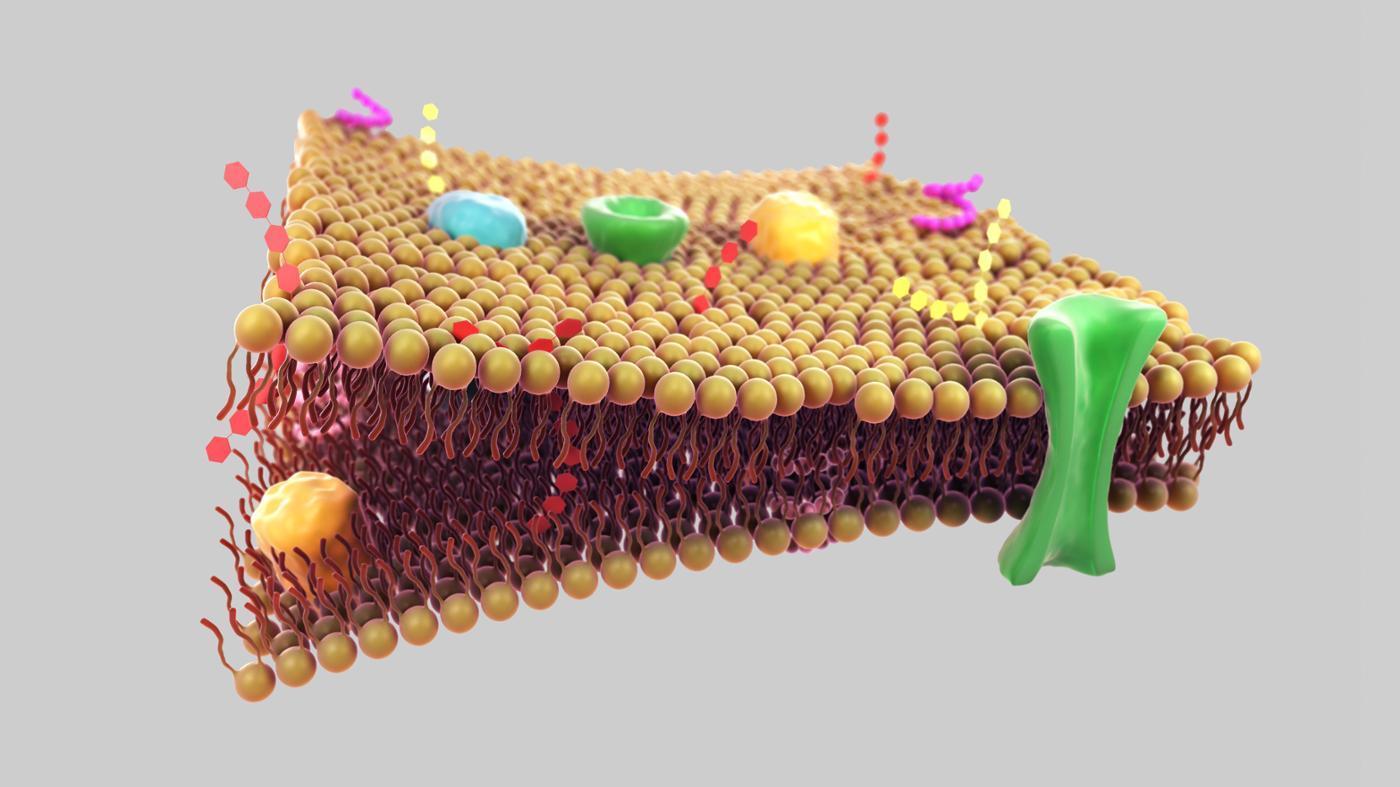
In a phospholipid, the phosphate head is...
Esterified
Hydrophobic
Hydrophilic
Hydrogenated
Saturated fats have ____ bonds between atoms.
single
double
multiple
none
Unsaturated fats have ____ bonds between atoms.
single
double
multiple
none
Unsaturated fats
have a bent structure
have double bonds
are liquids at room temperature
all of these

Which diagram is a triglyceride?


Which of the following bonds can be found in unsaturated fats?
N-O
C=C
H-H
N-N
Which of the following bonds can NOT be found in saturated fats?
C-C
H-C
C=C
C-O
Fats are
Non-polar
Polar
Hydrophilic
Hydrophobic
What is the result of bonding between three fatty acids and a glycerol?
Palmitic Acid
Trans Fats
Triglyceride
Water
Does the following reference Polar, Nonpolar, or both:
"affected by an electrical charge"?
Polar
Nonpolar
Both
Does the following reference Polar, Nonpolar, or both:
"equal sharing of electrons"?
Polar
Nonpolar
Both
True or False
Attractions between polar molecules are Weaker than attractions between nonpolar molecules.
True
False
Water has an unusually high boiling point for a molecular compound because it has
hydrogen bonding
ion-ion attractions
a high density
a large gram formula mass
A water molecule has the chemical formula H2O. This means that the water molecule is made up of
Two hydrogen atoms and one oxygen atom
Two oxygen atoms and one hydrogen atom
Two hydrogen atoms and two oxygen atoms
Two molecules of water
Capillary Action is key for
Water moving from roots to leaves in plants
Air moving from mouth to lungs
Ice floating on water
Water moving to lower areas
Cohesive means ........
the water molecules stick to each other
the water molecules stick to other surfaces
the water molecules are less dense
the water molecules are far apart
Adhesive means ........
the water molecules stick to each other
the water molecules stick to other surfaces
the water molecules are less dense
the water molecules are far apart
Water striders can walk on water because of ____________.
capillary action
adhesion
surface tension
universal solvent
Water can bounce on water because of surface tension.
True
False
Why is water so good at dissolving so many substances?
it is polar
it is less dense as a solid
cohesion
adhesion


Which end of the water molecule has a slightly negative charge?

