Wayground logo

Free Printable Worksheets

Font size

S
M
L
XL
Worksheets

Unit 3 Review Quizizz

Total questions: 125

Worksheet time: 2hrs 2mins

Name
Class
Date
1.
Lipids can be digested into what smaller subunits?
a)
nucleic acids
b)
amino acids
c)
fatty acids
d)
glucose
2.

Enzymes belong to which class of macromolecules?

a)

lipids

b)

carbohydrates

c)

proteins

d)

nucleic acids

3.
Proteins are made of monomers called ___________
a)
Nucleotides
b)
Monosaccharides
c)
Amino Acids
d)
Glycerol and fatty acids
4.
Nucleotides are monomers of
a)
Carbohydrates
b)
Lipids
c)
Proteins
d)
Nucleic Acids
5.
What is the function of nucleic acids?
a)
store genetic information
b)
store energy (long-term)
c)
store energy (short-term)
d)
build skin, hair, nails, muscles
6.

What are different examples of lipids?

a)

monosaccahrides, disaccharides, starch, cellulose

b)

polypeptide, amino acids, enzymes

c)

DNA, RNA

d)

triglycerides, phospholipids, saturated fats

7.
Which of the following organic compounds is the main source of energy for living things?
a)
carbohydrates
b)
lipids
c)
nucleic acids
d)
proteins
8.
All polymers are made up of...
a)
monosaccharides
b)
monomers
c)
proteins
d)
None of these
9.
Waxes, oils and fats are examples of
a)
Carbohydrates
b)
Lipids
c)
Proteins
d)
Nucleic Acids
10.

The bond that joins amino acids are called:

a)

Phosphodiester Bond

b)

Ester Bond

c)

Glycosidic Linkage

d)

Peptide Bonds

11.

Which macromolecule is shown?

a)

lipid

b)

protein

c)

nucleic acid

d)

carbohydrate

12.
Which major macromolecule is being represented in this image? 
a)
carbohydrate
b)
lipid
c)
protein
d)
nucleic acid
13.

Sugar belongs to which class of macromolecules?

a)

proteins

b)

lipids

c)

nucleic acids

d)

carbohydrates

14.
All organic compounds contain the element
a)
carbon
b)
nitrogen
c)
phosphorus
d)
sulfur
15.
Building blocks of the body, hair , muscles etc.
a)
protein
b)
nucleic acid
c)
lipids
d)
carbohydrates
16.
Monosaccharides are monomers of
a)
Carbohydrates
b)
Lipids
c)
Proteins
d)
Nucleic Acids
17.
Which is an example of a lipid?
a)
Candy
b)
Olive Oil
c)
DNA
d)
Meat
18.
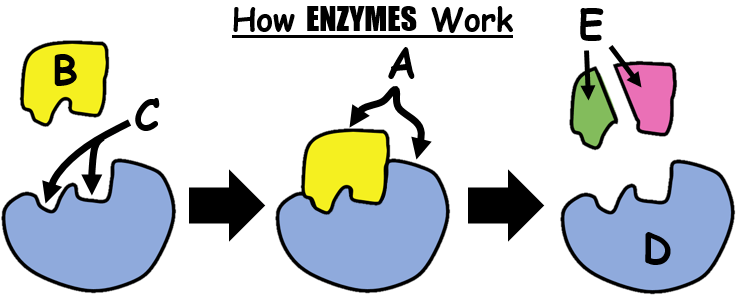
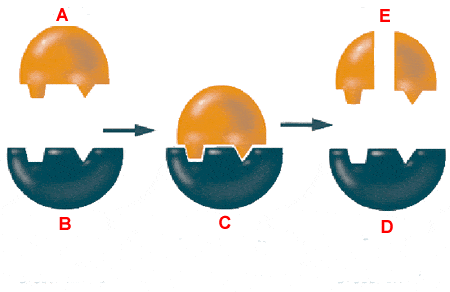
Letter D...
a)
active site
b)
enzyme
c)
substrate
d)
products
19.
Letter B...
a)
active site
b)
enzyme
c)
substrate
d)
products
20.
Which of these categories includes all of the others shown?
a)
disaccharide
b)
carbohydrate
c)
starch
d)
polysaccharide
21.

Which of these is not a function of lipids?

a)

Quick energy

b)

Sturctural components in cell membranes

c)

Insulation to keep an organism warm

d)

Long term energy storage

22.

How many fatty acid chains are in this triglyceride?

a)

one

b)

two

c)

three

23.
Which of the following about UNSATURATED fats is true?
a)
They are more common in animals than in plants.
b)
They have double bonds in their fatty acid chains.
c)
They generally solidify at room temperature.
d)
They contain more hydrogen than saturated fats having the same number of carbon atoms.
24.

How how carbohydrates and lipids similar?

a)

both contain C, H, O, N, P and store energy

b)

both contain C, H, O, N and give energy

c)

both contain C, H, O, N, S and store energy

d)

both contain C, H, O and give energy

25.
Important to the structural integrity of plant cells, this is the single most popular polysaccharide in the world.
a)
Starch
b)
Glycogen
c)
Cellulose
d)
Chitin
26.
Choose the protein
a)
C5H12O6 
b)
C6H12O6 
c)
C3H7NO2 
d)
C26H65O3 
27.
What is not a type of carbohydrate?
a)
Fat
b)
Fiber
c)
Starch
d)
Sugar
28.

Which substances are macromolecules?

a)

sugars

b)

proteins

c)

vitamins

d)

minerals

29.
This is an example of 
a)
Lipid 
b)
Carbohydrate 
c)
Protein
d)
Nucleic Acid
30.

One function of lipids is to store energy. What is another function of lipids in the human body?

a)

To form plasma (cell) membranes

b)

To make energy from the sun

c)

To control chemical reactions

d)

To provide quick energy for the cell

31.

What kinds of environmental factors can denature an enzyme?

a)

Water and salt

b)

Temperature and pH

c)

Lipids and Carbohydrates

d)

Blood

32.
Which is a least likely primary function of proteins?
a)
to act as an organic catalyst
b)
to supply short-term energy
c)
to build and repair damaged cells
d)
to defend against foreign invaders
33.

Which is shown in the picture?

a)

Fatty Acid

b)

Monsaccharide

c)

Amino Acid

d)

Nucleotide

34.
Which substance is a lipid?
a)
RNA
b)
sugar
c)
cholesterol
d)
DNA
35.
Which macromolecule is this?
a)
carbohydrate
b)
lipid
c)
protein
d)
nucleic acid
36.
A large macromolecule that does not dissolve in water
a)
lipid
b)
protein
c)
carbohydrate
d)
nucleic acid
37.
A fatty acid chain with only C-C bonds (single bonds) is ________________ and makes the molecule a solid at room temperature, like butter or lard.
a)
saturated
b)
unsaturated
38.
Which substance makes up 75% of the volume of cells?
a)
lipids
b)
water
c)
nucleic acids
d)
carbohydrates
39.

Which of these is a lipid?

a)
b)
c)
d)
40.

A small chemical unit that makes up a polymer

a)

monomer

b)

polysaccharide

c)

starch

d)

lipid

41.

A molecule composed of many monomers; make up macromolecules

a)

monomer

b)

polymer

c)

monosaccharide

d)

lipid

42.

A compound make of carbon, hydrogen, and oxygen; types of nutrients that are the major source of energy to the body

a)

lipids

b)

proteins

c)

carbohydrates

d)

nucleic acids

43.

Translates to "one sugar"

a)

glycerol

b)

fatty acid

c)

polysaccharide

d)

monosaccharide

44.

Translates to "many sugars"

a)

glycerol

b)

fatty acid

c)

polysaccharide

d)

monosaccharide

45.

Which of the following is an example of a carbohydrate?

a)

starch

b)

fat

c)

DNA

d)

enzyme

46.

A macromolecule made mostly from carbon and hydrogen atoms; includes fats, oils and waxes

a)

carbohydrates

b)

lipids

c)

proteins

d)

nucleic acids

47.

Which of the following TWO components make up a lipid?

a)

monosaccharide

b)

glycerol

c)

nucleotide

d)

fatty acids

48.

A macromolecule that contains carbon, hydrogen, oxygen and nitrogen; needed by the body for growth and repair

a)

carbohydrates

b)

lipids

c)

nucleic acids

d)

proteins

49.

Which of the following is the monomer for proteins?

a)

monosaccharides

b)

glycerol and fatty acids

c)

amino acids

d)

nucleotides

50.

A protein catalyst that speeds up the rate of specific biological reactions.

a)

substrate

b)

enzyme

c)

active site

d)

solvent

51.

The spot on an enzyme where the substrate binds is called a(n)

a)

substrate

b)

active site

c)

catalyst

d)

product

52.

A macromolecule containing carbon, hydrogen, oxygen, nitrogen and phosphorus

a)

carbohydrate

b)

lipid

c)

nucleic acid

d)

protein

53.

Which of the following is the monomer that makes up nucleic acids?

a)

nucleotide

b)

monosaccharide

c)

fatty acids

d)

amino acids

54.

Which of the following are examples of nucleic acids? Select all that apply.

a)

DNA

b)

RNA

c)

waxes

d)

glucose

55.
Why are macromolecules also known as "polymers?"
a)
They are large molecules made up of many monomers. 
b)
They are large molecules added together. 
c)
There are many types of macromolecules. 
d)
Many organisms have macromolecules.
56.
Which of the following is NOT a biological macromolecule?
a)
Water
b)
Lipid
c)
Carbohydrate
d)
Nucleic Acid
57.
All biological macromolecules are organic, meaning they have ________ and hydrogen bonds.
a)
Carbon
b)
Hydrogen
c)
Nitrogen
d)
Oxygen
58.
True or False: The building blocks of macromolecules are also known as "monomers".
a)
True
b)
False
59.
What are the monomers (building blocks) of CARBOHYDRATES?
a)

Monosaccharides/Glucose (simple sugars)

b)
Amino Acids
c)
Nucleotides
d)
Triglycerides/No true monomer
60.
What are the monomers (building blocks) of PROTEINS?
a)
Monosaccharides (simple sugars)
b)
Amino Acids
c)
Nucleotides
d)
Triglycerides/No true monomer
61.
What are the monomers (building blocks) of NUCLEIC ACIDS?
a)
Monosaccharides (simple sugars)
b)
Amino Acids
c)
Nucleotides
d)
Triglycerides/No true monomer
62.
What are the monomers (building blocks) of LIPIDS?
a)
Monosaccharides (simple sugars)
b)
Amino Acids
c)
Nucleotides
d)

Triglycerides(made of 3 fatty acids)/No true monomer

63.
What is the primary function of CARBOHYDRATES?
a)
Source of energy
b)
Long term storage of energy
c)
Transmitting genetic information
d)
Cell processes and cell signaling
64.
What is the primary function of PROTEINS?
a)
Source of energy
b)
Long term storage of energy
c)
Transmitting genetic information
d)
Cell processes and cell signaling
65.
What is the primary function of LIPIDS?
a)
Source of energy
b)
Long term storage of energy
c)
Transmitting genetic information
d)
Cell processes and cell signaling
66.
What is the primary function of NUCLEIC ACIDS?
a)
Source of energy
b)
Long term storage of energy
c)
Transmitting genetic information
d)
Cell processes and cell signaling
67.
The food in the image is full of which macromolecule?
a)
Carbohydrates
b)
Lipids
c)
Proteins
68.
The food in the image is full of which macromolecule?
a)
Carbohydrates
b)
Lipids
c)
Proteins
69.
The food in the image is full of which macromolecule?
a)
Carbohydrates
b)
Lipids
c)
Proteins
70.
The food in the image is full of which macromolecule?
a)
Carbohydrates
b)
Lipids
c)
Proteins
71.

What are the building blocks (or monomers) of carbohydrates?

a)

Nucleotides

b)

Monosaccharides (Glucose)

c)

Amino Acids

d)

Glycerols

72.
Why are the four biological macromolecules essential for life?
a)
They all provide an organism with oxygen.
b)
They do many important jobs to keep an organism functioning.
c)
They provide an organism with food.
d)
They are all broken down for energy.
73.
Examples of which biological macromolecule include glucose, fructose, starch, and glycogen?
a)
Lipids
b)
Carbohydrates
c)
Nucleic Acids
d)
Proteins
74.

Which type of food would you choose for a quick energy boost?

a)

apple

b)

steak

c)

cheese sticks

d)

pizza

75.

Which of the following statements is true about catalysts (enzymes)?

a)

Catalysts slow down the rate of chemical reactions.

b)

Enzymes help regulate pH.

c)

Catalysts are used up during a chemical reaction.

d)

Catalysts lower the activation energy of a chemical reaction.

76.

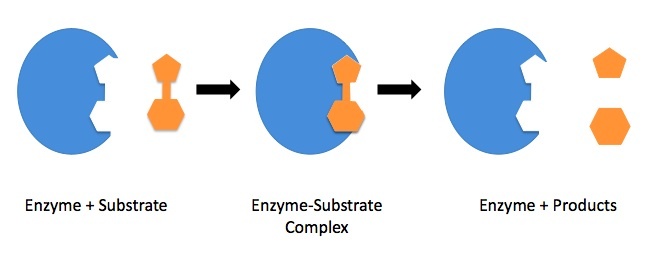
An enzyme and substrate can be compared to

a)

lock and key

b)

a faucet

c)

a door hinge

d)

light switch

77.
Each enzyme only has 1 substrate that will fit its active site.  What is this called?
a)
reusable
b)
catalyst
c)
specific
d)
fragile
78.
Any substance that is acted upon by an enzyme is called a(n)?
a)
Coenzyme
b)
Substrate
c)
Vitamin
d)
Polypeptide
79.
After the enzyme and substrate bind together and perform the reaction, what does the substrate become?
a)
a substrate
b)
an enzyme
c)
a product
d)
an active site
80.
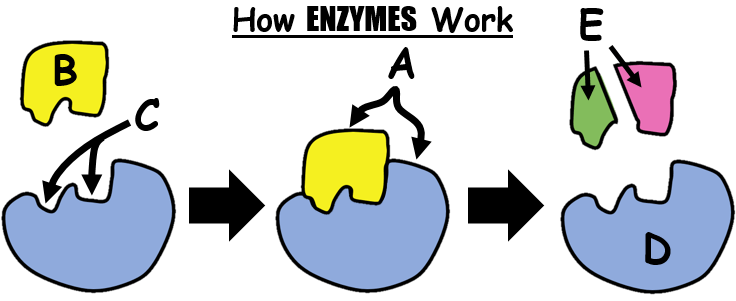
Letter B...
a)
active site
b)
enzyme
c)
substrate
d)
products
81.
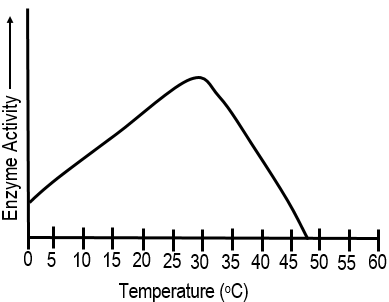
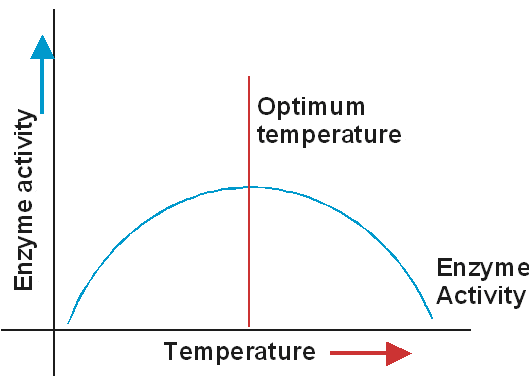
Based on the graph, what is the optimal temperature for this enzyme? 
a)
15oC
b)
40oC
c)
30oC
d)
35oC
82.
Which factor denatures a enzyme?
a)
Excessive heat
b)
Nothing can
c)
Exposure to light
d)
Exposure to bacteria
83.
Which line represents an enzyme-catalyzed reaction? 
a)
Line 1
b)
Line 2
84.
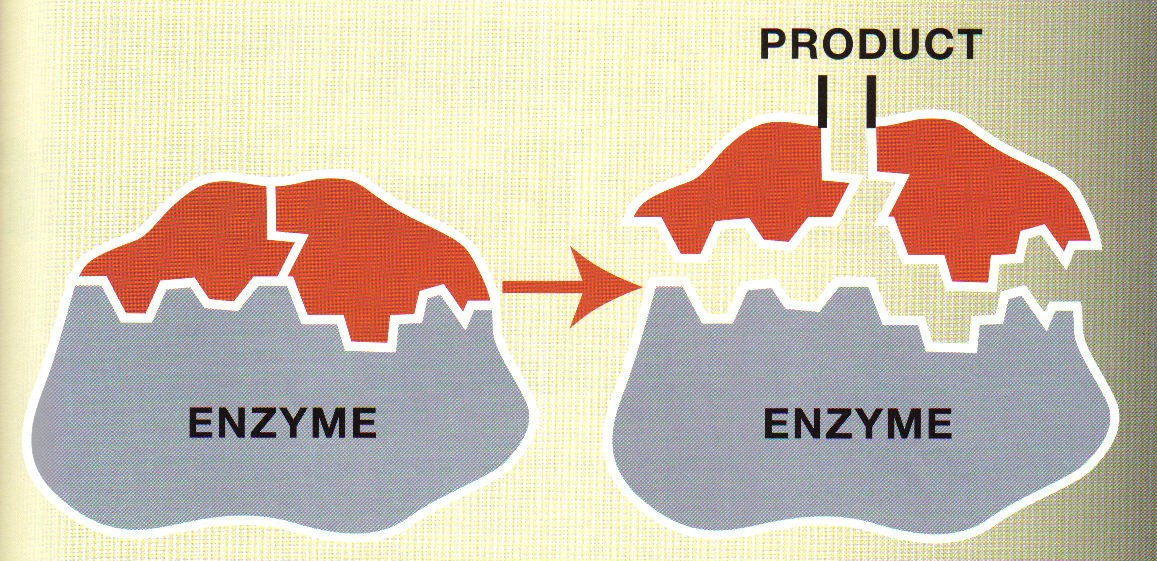
The "lock and key hypothesis" attempts to explain the mechanism of?
a)
Vacuole formation
b)
Pinocytosis
c)
Sharing of electrons
d)
Enzyme are specific to a substrate
85.
Which of the following conclusions can be drawn from this graph?
a)
The optimum pH of the enzyme is 6.6.
b)
The optimum pH of the enzyme is 5.8
c)
The enzyme’s activity increases as pH increases 5.0 to 9.0
d)
The enzyme’s activity is greater around pH of 8.0 .
86.
Based on the graph, what is the optimal temperature for this enzyme? 
a)
15oC
b)
40oC
c)
30oC
d)
35oC
87.
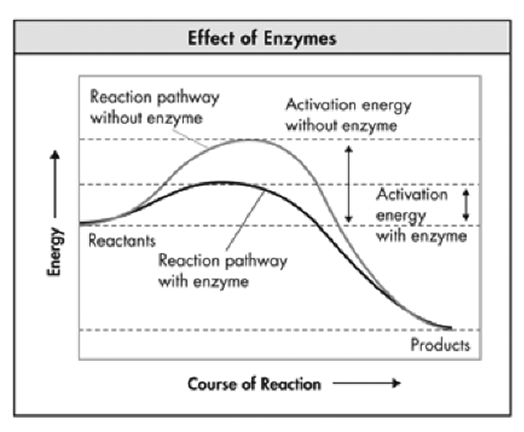
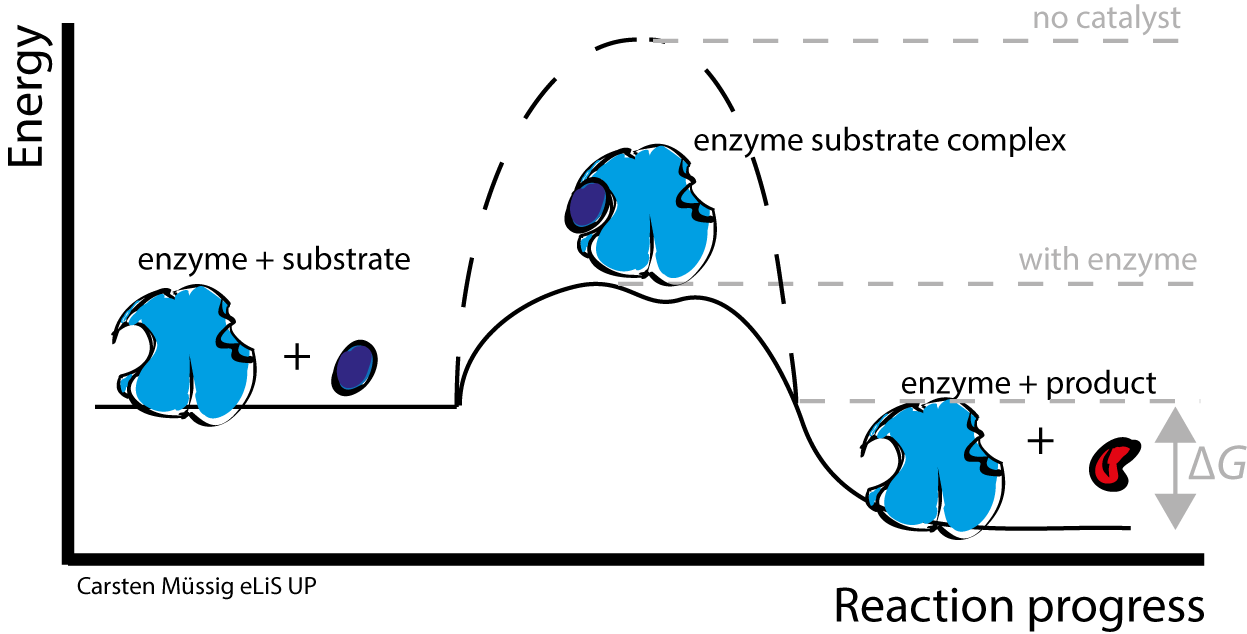
The graph shows how enzymes affect reactions in cells. Which statement best summarizes the information shown in the graph?
a)
Enzymes increase the energy of the reactants.
b)
Enzymes decrease the energy level of the products.
c)
Enzyme decrease the activation energy of the reaction.
d)
Enzymes reverse the direction of the reaction.
88.
Most enzymes have the ending:
a)
-ase
b)
-ose
c)
-ic acid
d)
-ate
89.
At high temperatures enzyme activity declines because of:
a)
Denaturation
b)
Decreased Kinetic Motion
c)
Increased H-Bonding
d)
Dissociation of Ionic Compounds
90.
Enzymes catalyze reactions by ___________ Activation Energy.
a)
Increasing
b)
Decreasing
91.
The area that the substrate fits into on the enzyme is called the:
a)
Active Site
b)
Allosteric Site
c)
DiSulphide Bridge
d)
β-Pleated Sheet
92.

An enzyme speeds up a reaction by______?

a)

Lowering the activation energy.

b)

Raising the activation energy.

c)

Releasing energy.

d)

Absorbing energy.

93.

What happens when enzymes are heated to a high temperature?

a)

The enzymes die.

b)

The shape of the enzyme are changed and it denatures.

c)

The enzymes' amino acid sequence changes.

d)

The enzymes remain the same.

94.

Which of the following is not one of the four major classes of macromolecules?

a)

Lipids/Fats

b)

Carbohydrates

c)

Nucleic Acids

d)

Bacteria

e)

Proteins

95.

Which macromolecule is best to eat for quick, short-term energy?

a)

Lipid

b)

Protein

c)

Carbohydrate

96.

When reading the ingredients on a nutrition facts label carbohydrates are written as a type of

a)

food additive

b)

fat

c)

sugar

d)

protein

97.

When an enzyme is outside of its temperature range (it is too hot or cold), it can denature. Denaturing means...

a)

The enzyme no longer functions

b)

The substrate changes shapes

c)

The enzyme changes shapes

d)

The active site still functions

98.

Another word for substrate is...

a)

Reactant

b)

Product

99.
Which of these is NOT true?
a)
Enzymes can denature (change shape) when the temperature gets too high.
b)
Enzymes can only be used once in a chemical reaction. 
c)
Extreme pH can denature enzymes.
d)
Enzymes speed up chemical reactions. 
100.

What is underlined in the chemical equation below?

Na + Cl ---> NaCl

a)

Products

b)

Reactants

101.

In the chemical equation below, the product is....

Na + Cl ---> NaCl

a)

Na

b)

NaCL

c)

Cl

d)

NaCl

102.
What is the activation energy?
a)
The energy of the products
b)
The energy of the reactants
c)
The minimum energy needed by the reactants to form the products.
d)
The energy lost in the reaction
103.

Select all the products

a)
b)
c)
104.

Select all the Reactants

a)
b)
c)
105.

Which of the following best explains why enzymes are necessary for reactions in our cells?

a)

The reactions are too slow to meet the needs of the cell if enzymes are missing.

b)

Enzymes supply the oxygen necessary for the reactions.

c)

Enzymes change reactants from solid to liquid during the reactions.

d)

The reactions take up too much space in the cell if enzymes are missing.

106.

The _____________________ mechanism describes how an enzyme slightly changes shape once the substrate is bonded.

a)

hammer and nail

b)

induced fit

c)

jigsaw puzzle

d)

lock and key

107.

All of the following affect the functioning of an enzyme EXCEPT:

a)

pH

b)

temperature

c)

metabolism

d)

enzyme concentration, substrate concentration

108.

Once a new product leaves an enzyme, the enzyme is unchanged and ready for the next substrate. What is this called?

a)

fragile

b)

reusable

c)

specific

d)

catalyst

109.

Enzymes are _______________ that _____________________ chemical reactions by ____________ the amount of activation energy required to start the reaction.

a)

carbohydrates, slow down, lowering

b)

proteins, speed up, increasing

c)

lipids, speed up, lowering

d)

proteins, speed up, lowering

110.

Imagine you are working in a lab and you come across a substance called catalase. What would you identify it as?

a)

An enzyme that breaks down hydrogen peroxide into water and oxygen.

b)

A type of medication used to treat allergies.

c)

A hormone that regulates blood sugar levels.

d)

A type of bacteria that causes food poisoning.

111.

What does the term 'enzyme specificity' refer to?

a)

The concentration of an enzyme in a solution.

b)

The ability of an enzyme to bind to a specific substrate.

c)

Rate at which an enzyme breaks down substrates.

d)

Measure of the catalytic ability of an enzyme

112.

Increasing substrate concentration initially increases enzyme activity, but it plateaus once the enzyme becomes saturated with substrate.

a)

True

b)

False

113.

What is the role of catalase in the appearance of bubbles?

a)

Catalase prevents the formation of bubbles.

b)

Catalase converts water and oxygen into hydrogen peroxide, resulting in the appearance of bubbles.

c)

Catalase has no role in the appearance of bubbles.

d)

Catalase breaks down hydrogen peroxide into water and oxygen, resulting in the appearance of bubbles.

114.

What is the role of catalase in the breakdown of hydrogen peroxide in a lab experiment?

a)

It increases the size of the bubbles produced.

b)

It changes the color of the bubbles produced.

c)

It accelerates the reaction, leading to more bubbles produced per unit of time.

d)

It reduces the number of bubbles produced per unit of time.

115.

At which stage does hydrogen peroxide enter the enzyme's active site for the first time?

a)

1

b)

2

c)

3

d)

4

116.

At which stage does the active site lose its shape if the enzyme becomes denatured?

a)

1

b)

2

c)

3

d)

4

117.

At which stage do the products of H2O2 decomposition release from the catalytic action of the enzyme catalase?

a)

1

b)

2

c)

3

d)

4

118.

In the following chemical equation, what are the products of this reaction? 2 H2O2 🡪 2 H2O + O2 (gas)

a)

hydrogen peroxide and water

b)

oxygen and hydrogen peroxide

c)

water and oxygen

d)

hydrogen peroxide, water and oxygen gas

119.

From what you know from the notes in this unit, what does the enzyme lactase breakdown?

a)

Peroxide

b)

Lactose

c)

Sucrose

d)

Deoxyribose

120.

Rohan, Jackson, and Evelyn are conducting a science experiment in their biology class. They are studying the catalase reaction in enzymes. How can they measure the reaction rate for this experiment?

a)

By observing the amount of O2 formed over time

b)

By observing the amount of H2O2 formed over time

c)

By observing the amount of CO2 formed over time

d)

By observing the amount of H2O formed over time

121.

Benjamin, Arjun, and Lily are conducting a science experiment in their biology class. They are studying the effect of varying the concentration of catalase on the reaction rate. What do they observe as they increase the concentration of the enzyme?

a)

The reaction rate decreases

b)

The reaction rate becomes unpredictable

c)

The reaction rate increases

d)

The reaction rate remains constant

122.

In a science experiment at school, Aiden and Rohan are using filter paper disks. What is the purpose of using these filter paper disks in their experiment?

a)

To prevent the reaction from occurring

b)

To measure the reaction time

c)

To soak up excess catalase

d)

To hold the catalase solution

123.

In a science experiment, Luna, Aiden, and Grace are studying the effect of catalase enzyme on the breakdown of hydrogen peroxide. They decide to dilute the catalase enzyme. What could be the purpose of this step in their experiment?

a)

To decrease the rate at which hydrogen peroxide breaks down

b)

To prevent the breakdown of hydrogen peroxide

c)

To increase the rate at which hydrogen peroxide breaks down

d)

To test the effect of varying enzyme concentration on the reaction rate

124.
What was the substrate in our enzyme lab?
a)
Hydrogen peroxide
b)
Catalase
c)
Yeast
d)
Oxygen gas
125.

What is the name of the enzyme that speeds up the reaction in this lab

a)

catalase

b)

catalyst

c)

potato

d)

hydrogen peroxide (H2O2)