wayground logo

Free Printable Worksheets

Font size

S
M
L
XL
Worksheets

Spring Semester Final Review

Total questions: 120

Worksheet time: 30hrs 0mins

Name
Class
Date
1.
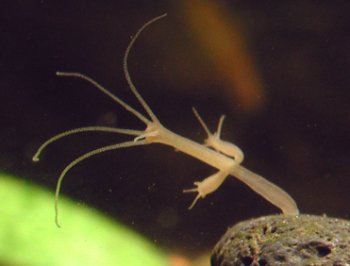
The image provided is an example of a(n):
a)
Producer
b)
Autotroph
c)
Consumer
d)
Insect
2.

Algae, grasses and trees are all __________.

a)

decomposers

b)

consumers

c)

producers

d)

pyramids

3.
Name the phase:
a)
Anaphase
b)
Telophase
c)
Metaphase
d)
Prophase
4.

What is the NEXT phase of mitosis after the phase shown?

a)

Prophase

b)

Metaphase

c)

Anaphase

d)

Telophase

5.
Name this phase of mitosis:
a)
Prophase
b)
Metaphase
c)
Anaphase
d)
Telophase
6.
In mitosis, the two resulting cells are
a)
different from the starting cell and identical to each other.
b)
different from the starting cell and different from each other.
c)
identical to the starting cell and different from each other.
d)
identical to the starting cell and identical to each other.
7.
The cell spends most of its time in which phase?
a)
anaphase
b)
interphase
c)
prophase
d)
metaphase
8.
Where in the cell can the genetic material (DNA) be found?
a)
nucleus
b)
nucleolus
c)
cytoskeleton
d)
golgi
9.
Which of the following does not occur by the process of mitosis?
a)
growth
b)
production of gametes
c)
repair
d)
development in the embryo
10.
If a cell has 24 chromosomes at the beginning of meiosis how many chromosomes will it have at the end of meiosis?
a)
6
b)
12
c)
24
d)
the number varies with the species.
11.

Which phase of meiosis is this showing?

a)

metaphase I

b)

metaphase II

c)

anaphase II

d)

prophase I

12.
Look carefully at the diagram.  Then identify the phase of meiosis this is.
a)
anaphase II
b)
metaphase II
c)
metaphase I
13.
The cell membrane pinches in, dividing the cytoplasm into 2 cells
a)
Metaphase
b)
Anaphase
c)
Telephase
d)
Cytokinesis
14.
Which best describes the process shown?
a)
mutation in which the DNA content of the gene is ltered
b)
segregation of sister chromatids
c)
condensation and segregation of the alleles
d)
crossing-over which alleles are exchanged
15.
Which of the following best describes meiosis?
a)
It is carried out in all tissues theat require cell replacement
b)
It occurs only in cells in the reproductive structures of an organism
c)
It happens in all of the tissues except the brain and spinal cord
d)
It is the first stage of mitosis
16.
A male shark has 40 chromosomes in each of its sex cells. How many would be present in its body cells?
a)
20
b)
40
c)
80
d)
160
17.
A guinea pig cell has 64 chromosomes.  After mitosis, each daughter contains ___ chromosomes.
a)
128
b)
64
c)
32
d)
16
18.
Why do cells undergo meiosis?
a)
to help repair the cell
b)
to produce sex cells: egg and sperm
c)
to help the cell grow
d)
none of these
19.
How many daughter cells are produced in meiosis?
a)
4 daughter cells
b)
none of these
c)
3 daughter cells
d)
2 daughter cells
20.
Meiosis produces ___________ while mitosis produces __________.
a)
Sex cells, body cells
b)
Body cells, sex cells
21.
Which process and type of resulting cells are represented?
a)
mitosis, gametes
b)
mitosis, body cells
c)
meiosis, gametes
d)
meiosis, body cells
22.
Fruit fly body cells have 8 chromosomes. After mitosis, you would expect a resulting fruit fly daughter cell to have -
a)
16 chromosomes.
b)
46 chromosomes.
c)
8 chromosomes.
d)
4 chromosomes.
23.
Using the diagram, which type of asexual reproduction is being demonstrated by the bacterial cell?
a)
Budding
b)
Cleavage
c)
Regeneration
d)
Binary Fission
24.
If an organism reproduces asexually, its offspring will most likely be:
a)
produced as a result of fertilization
b)
Genetically identical to the parent
c)
Genetically different from each other
d)
Produced from specialized cells known as gametes
25.
What advantages do sexually reproducing organisms have over asexually reproducing organisms?
a)
Genetic variation
b)
Genetic stability
26.
Which statement below is correct about asexual reproduction and sexual reproduction?
a)
Asexual reproduction and sexual reproduction both involve one parent
b)
Sexual reproduction involves making clones and asexual reproduction creates unique offspring
c)
Asexual reproduction creates clones and sexual reproduction creates unique offspring
27.
When a starfish grows a new body off a broken arm, what kind of reproduction is this?
a)
Sexual
b)
Differentiation
c)
Asexual 
d)
Specialization
28.

What type of reproduction only needs one parent.

a)

asexual reproduction

b)

sexual reproduction

c)

both

29.
This is when a new organism grows by cell division on the body of its parent. The bud, or offspring is identical to the parent. The bud, when large enough, can break off of the parent and live on its own.  Examples of this include yeast, hydra and potatoes.
 
a)
Regeneration
b)
Vegetative propagation
c)
Fission
d)
Budding
30.
If an environment suddenly changes, which type of reproduction would be most beneficial? Why?
a)
Asexual, because asexual organisms always have variation within species.
b)
Sexual, because sexual organisms have variation within species.
c)
Both Asexual and Sexual reproduction would be beneficial, because they both have variation within species.
d)
Asexual, because asexual organisms have no variation, so they can adapt to a changing environment.
31.

A homozygous dominant genotype is represented by ________, a heterozygous genotype is represented by _______, and a homozygous genotype is represented by ________.

a)

bb, Bb, BB

b)

BB, Bb, bb

c)

BB, bb, Bb

32.

Which of the following crosses would result in a homozygous recessive offspring?

a)

AA x aa

b)

Aa x AA

c)

Aa x Aa

33.

If a mother is homozygous recessive for a recessive X-linked trait, what are the chances of her passing on the X-linked recessive trait to her son?

a)

100%

b)

0%

c)

50%

34.

When one trait is not completely dominant over the other and a blending of the traits occurs, this is...

a)

complete dominance

b)

incomplete dominance

c)

codominace

35.
What is the phenotype in the bottom right square? (Yellow is dominant and green is recessive)
a)
yy
b)
Yy
c)
yellow
d)
green
36.
Which of the following is the genotype for a homozygous recessive trait?
a)
gg
b)
Gg
c)
GG
37.
What % of the offspring in the Punnet square are heterozygous?
a)
25%
b)
50%
c)
75%
d)
100%
38.
What are traits that aren't dominant over each other but whose heterozygous outcome is a combination of the two equally but separately?
a)
pure dominance
b)
incomplete dominance
c)
co-dominance
d)
simple dominance
39.
What is one or more alternative forms of a gene?
a)
chromosome
b)
genotype
c)
phenotype
d)
allele
40.
What is the study of heredity?
a)
genetics
b)
cell biology
c)
chemistry
d)
botany
41.
Who was the father of genetics?
a)
Mendel
b)
Einstein
c)
Redi
d)
Pasteur
42.
If there is a cross of a red and white chicken, and the trait is co-dominant, what will be the result?
a)
a blended color
b)
a speckled chicken
43.

Two chromosomes that are similar in shape, size and location of genetic material are

a)

sister chromatids

b)

sex chromosomes

c)

homologous chromosomes

d)

homozygous chromosomes

44.
A plant with orange flowers was crossed with a plant with blue flowers. All of the offspring have orange flowers. Which of these terms describes the blue flower trait?
a)
Recessive
b)
Dominant
c)
Codominant
d)
Incomplete Dominance
45.
XC- not colorblind  Xc- colorblindness allele Color blindness is a sex linked trait, if a woman who is heterozygous (a carrier) for color blindness marries a normal man, what is the probability of one of the son’s being colorblind?
a)
0
b)
25
c)
50
d)
75
46.

Which of the following traits are not purebred for at least one trait?

a)

BbHh

b)

Bbhh

c)

BBHH

d)

BBHh

47.
The physical appearance of the allele combination the offspring receives
a)
genotype
b)
homozygous
c)
phenotype
d)
dominant
48.

What is the missing genotype?

a)

BB

b)

Bb

c)

bb

49.

Mutations are...

a)

Changes in the sequence of DNA

b)

Broken chromosomes

c)

Bad genes

50.

When Mendel crossed a tall plant with a short plant, what were the F1 results?

a)

all short

b)

all tall

c)

75% tall 25% short

d)

50% tall 50% short

51.

Males have an X chromosomes and a Y chromosome while females have two X chromosomes.

a)

True

b)

False

52.

Which of the following phases exist in mitosis?

a)

prophase

b)

metaphase

c)

anaphase

d)

all of these

53.

Pink colored flowers are obtained from a cross between a red flowered snapdragon and a white flowered snapdragon. The appearance of the pink colored flower is called

a)

codominance

b)

incomplete dominance

c)

complete dominance

d)

all of the above

54.

Color blindness is an example of a

a)

codominant trait

b)

mendelian trait

c)

sex-linked trait

d)

polygenic trait

55.
What is cancer?
a)
The heart does not receive enough blood.
b)
Sudden disruption of blood flow to part of the brain.
c)
Blood filled weak spot.
d)
Uncontrolled growth and spread of abnormal cells.
56.
Cancer creates abnormal cells by disrupting
a)
the cell cycle
b)
red blood cell formation
c)
DNA replication
d)
ATP synthesis
57.
An abnormal mass of cancer cells is called a 
a)
tumor
b)
cyst
c)
lesion
d)
polyp
58.

What is the process (equation) for photosynthesis?

a)

6CO2 + C6H12O6 --> 6H2O + 6O2

b)

6H2O + 6CO2 --> C6H12O6 + 6O2

c)

6CO2 + C6H12O6 --> 6H2O + Energy

d)

6O2 + C6H12O6 --> 6CO2 + 6H2O

59.
What is the energy molecule?
a)
DNA
b)
ATP
c)
RNA
d)
AAA
60.

Cellular respiration is the process that our cells use to ….

a)

convert sugar (glucose) into energy (ATP)

b)

break food down into smaller molecules (sugars)

c)

makes acid

d)

breathe

61.

Choose the statement that best describes light reaction.

a)

It converts CO2 to sugar molecule

b)

It converts light energy to chemical energy of ATP and NADPH

c)

It takes place in the stroma

62.

Which of the following colors is not absorbed by chlorophyll pigments?

a)

green

b)

blue

c)

violet

63.

Based on the diagram, when a curve has a peak, much of the light at the wavelength is

a)

reflected

b)

absorbed

c)

lost

64.
The two main stages of photosynthesis are the
a)
light reactions and respiration
b)
dark reactions and the Calvin cycle 
c)
light reactions and the Calvin cycle
d)
dark reactions and fermentation
65.

Label the diagram for photosynthesis.

66.

Organize the options into reactants and products for light dependent reactions.

Categorize the following

water

NADP+

ADP

NADPH

oxygen

ATP

glucose

carbon dioxide

Reactants
Products
Not part of Light Dependent Reactions
67.

Complete the equation for photosynthesis:

​ (a)   + ​ (b)   \rightarrow ​ (c)   + ​ (d)  

Choose from the below words

6 CO26\ CO_2  

6 H2O6\ H_2O  

C6H12O6C_6H_{12}O_6  

6 O26\ O_2  

ATPATP
NADPHNADPH
NADP+NADP+
ADPADP
68.

Light dependent reactions require energy from (a)   and occur in the ​ (b)   of the chloroplast. Light-independent reactions create ​ (c)   from ​ (d)   in the ​ (e)   .

Choose from the below words
light
thylakoid membrane
sugars
carbon dioxide
stroma
ATP
NADPH
69.

The goal of light-​dependent reactions is to produce the energy molecules ​ (a)   to be used later in light-independent reactions to make ​ (b)   .

Choose from the below words
ATP & NADPH
glucose
ADP & NADP+
oxygen
70.
Lactic acid fermentation occurs in your muscles after a workout because your cells are struggling to get...
a)
Glucose
b)
Sunlight
c)
Oxygen
d)
Water
71.
When respiration occurs with oxygen, it is called _______
a)
anaerobic
b)
aerobic
c)
light-dependent
d)
fermentation
72.
What is a disadvantage of fermentation as a process? 
a)
It produces too much ATP
b)
It only produces 2 ATP
c)
It occurs in the absence of oxygen
d)
It is only for quick bursts of energy
73.

Select all of the advantages of anaerobic respiration.

a)

Produces ATP quickly

b)

Allows organisms to live in places with little to no oxygen

c)

Produces ATP in the mitochondria

d)

Produces approximately 38 ATP per glucose

74.
The first step in getting energy in the cell by breaking down glucose is known as
a)
the Krebs cycle
b)
electron transport
c)
fermentation
d)
glycolysis
75.
What is the correct equation for cellular respiration?
a)
6O2 + C6H12O6 -> 6CO2 + 6H2O + Energy
b)
6O2 + C6H12O6 + Energy -> 6CO2 + 6H2O
c)
6CO2 + 6H2O -> 6O2 + C6H12O6 + Energy
d)
6CO2 + 6H2O + Energy -> 6O2 + C6H12O6
76.

Label the Diagram of the first stage of aerobic cellular respiration:

77.

Label the Diagram of the second and third stage of aerobic cellular respiration:

78.

The starting molecule for glycolysis is

a)

ADP

b)

Pyruvic acid

c)

Glucose

d)

Citric acid

79.

Which of these processes takes place in the cytoplasm of a cell?

a)

Electron transport

b)

Glycolysis

c)

Krebs cycle

d)

Photosynthesis

80.

Which step of aerobic cellular respiration makes the most ATP?

a)
Glycolysis
b)
Krebs Cycle
c)
Electron Transport Chain
d)
Light Dependent Reactions
81.

Which organelle does aerobic cellular respiration happen in?

a)

Nucleus

b)

Mitochondria

c)

Chlorophyll

d)

Chloroplast

82.
Which structures shown in the Figure make up the ADP molecule?
a)
A and B
b)
A, B and C
c)
A, B, C, and D
d)
C and D
83.
What is the function of ATP in living things?
a)
provides energy for cells
b)
stores genetic information
c)
provides structure in the nucleus
84.

What is the result of a frame-shift mutation?

a)

Change in the reading frame of RNA

b)

Change in one amino acid

c)

Change in the DNA structure

d)

Change in multiple amino acids

85.

Which type of mutation changes an amino acid from one to another?

a)

Frame-shift mutation

b)

Non-sense mutation

c)

Point mutation

d)

Missense mutation

86.

What is the effect of a non-sense mutation?

a)

Formation of a stop codon

b)

Change in multiple amino acids

c)

Change in one amino acid

d)

No effect on the protein

87.

What level do mutations originate at?

a)

Protein level

b)

DNA level

c)

Organism level

d)

Cell level

88.

What type of mutation occurs when, one nucleotide is replaced with a different nucleotide?

a)

addition

b)

substitution(point)

c)

deletion

d)

inversion

89.

When a portion of the DNA is shifted in one direction due to a deletion or insertion?

a)

frameshift

b)

gene

c)

deletion

d)

substitution

90.

What mutation has occurred here? 
old - T-G-A-C-C-A
new - T-G-A-G-C-A

a)
Substitution
b)
Deletion
c)
Insertion
d)
Frameshift 
91.
DNA molecule segment is : TTACGCAAG
The mutated DNA segment is TTCGCAAG. This is an example of ___ mutation.
a)
Substitution
b)
Deletion
c)
Insertion
d)
Inversion
92.

A point mutation that does not change the amino acid sequence is known as a(n) ____________ mutation.

a)

Frameshift

b)

Nondisjunction

c)

Inversion

d)

Silent

93.

DNA molecule segment is : TTA-CGC-AAG

The mutated DNA segment is TTC-GCA-AG. This is an example of ___ mutation.

a)

Substitution

b)

Deletion

c)

Insertion

d)

Inversion

94.

Mutations can be a result of...

a)

Environmental Exposure

b)

Lack of sleep

c)

Not enough exercise

95.

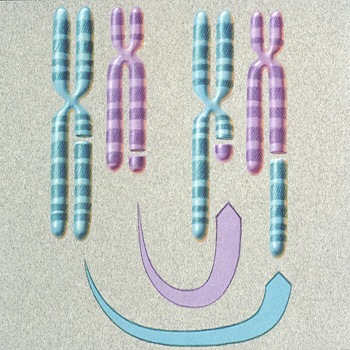
Identify the mutation....

a)

Chromosomal Inversion

b)

Chromosomal Duplication

c)

Chromosomal Deletion

d)

Chromosomal Translocation

96.

What is the mystery mutation?

a)

Nonsense

b)

Missense

c)

Frameshift

d)

Run-on

97.

A change in a single amino acid due to mutation is known as:

a)

Missense

b)

Nonsense

c)

Frameshift

d)

Silent

98.
Why are insertion and deletion mutations so harmful?
a)
They change all of the codons from the mutation on down the line, which changes the amino acid sequence
b)
They insert things that an organism doesn't need.
c)
They often delete things that organisms need.
d)
Insertion and deletions are not any more harmful than substitution mutations.
99.

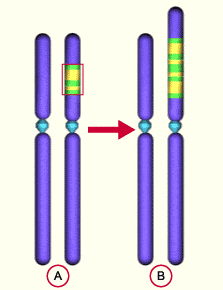
This type of chromosomal mutation produces an extra copy of part of the chromosome:

a)

multiplication

b)

replication

c)

duplication

d)

inversion

100.

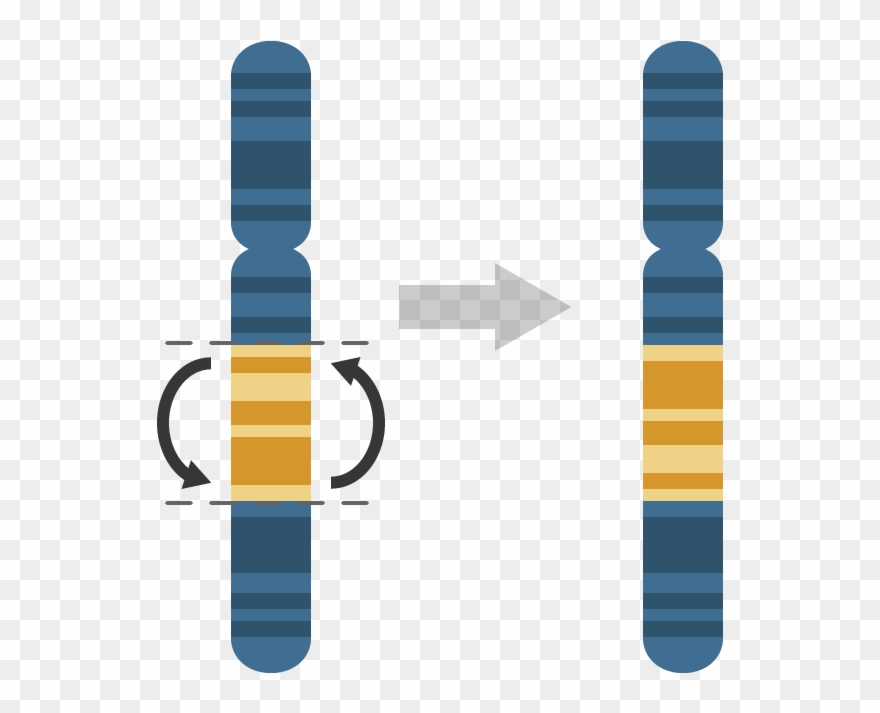
If part of the chromosome is turned around in the opposite direction this is called:

a)

inversion

b)

translocation

c)

deletion

d)

duplication

101.

______________________________________ is a type of chromosomal mutation when part of the chromosome breaks off and attaches to another chromosome.

a)

duplication

b)

translocation

c)

subtraction

d)

deletion

102.

Chromosome mutation involving loss of a piece of chromosome.

a)

Deletion

b)

Inversion

c)

Translocation

d)

Removal

103.
a)

Deletion

b)

Inversion

c)

Translocation

d)

Duplication

104.

Which organelle is the location where protein is made?

a)

Ribosome

b)

Nucleus

c)

Cytoplasm

d)

Nucleotide

105.

During transcription, this type of ribonucleic acid is responsible for copying the DNA and brining it out of the nucleus.

a)

tRNA

b)

mRNA

c)

rRNA

d)

dRNA

106.

When these bond together, they form a protein

a)

Amino Acids

b)

Peptide Bonds

c)

Ribose

d)

Nucleotides

107.

mRNA occurs during this process

a)

Translation

b)

Transcription

c)

Replication

d)

Delivery

108.

Which of the following is the complementary mRNA sequence to this DNA strand: AACTGAA

a)

UUGACUU

b)

TTGACTT

c)

AACTGAA

d)

AACUGAA

109.
What is the term for a three-nucleotide sequence that codes for an amino acid?
a)
base
b)
codon
c)
amine
d)
serine
110.
The process to go from DNA to mRNA is _______
a)
translation
b)
transcription
c)
replication
111.
The process to go from mRNA to a protein is called ____
a)
transcription
b)
rRNA
c)
replication
d)
translation
112.
Genetic info flows in one direction. Which best represents this flow?
a)
DNA-protein-RNA
b)
Protein-RNA-DNA
c)
RNA-protein-DNA
d)
DNA-RNA-protein
113.
What is the location in the cell for transcription?
a)
nucleus
b)
cytoplasm
c)
ribosome
d)
mitochondria
114.

What brings the amino acids to the ribosome to assemble a protein?

a)
mRNA
b)
tRNA
c)
rRNA
d)

DNA

115.

How many nucleotides code for 1 amino acid?

a)

1

b)

2

c)

3

d)

4

116.

What is the location in the cell for translation?

a)

Cytoplasm

b)

Nucleus

c)

Lysosome

d)

Golgi apparatus

117.

The reverse codon found on the tRNA.

a)

Codon

b)

Anticodon

c)

Mitosis

d)

Meiosis

118.

Three nucleotide bases that code for the beginning

of a strand of protein.

a)

Uracil

b)

Stop Codon

c)

Anticodon

d)

Start Codon

119.
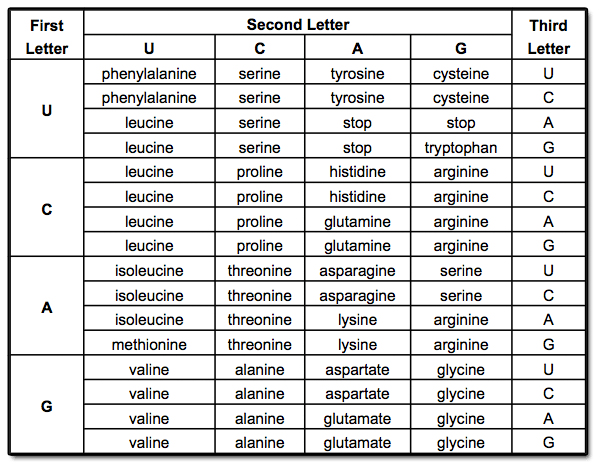
What amino acid is represented by the codon UUA?
a)
Phenylalanine
b)
Tyrosine
c)
Leucine
d)
Stop codon
120.

What is the location in the cell for translation?

a)

nucleus

b)

mitochondria in cytoplasm

c)

ribosome in cytoplasm

d)

chloroplast in cytoplasm