
 Worksheets
Spring Final Review
Total questions: 123
Worksheet time: 3hrs 52mins
Mattias Schleiden
Which organelle contains DNA and controls the cell?
Endoplasmic Reticulum
Golgi Apparatus
Nucleus
Vesicles
In passive transport, substances always move...
from an area of higher concentration to an area of lower concentration
from an area of lower concentration to an area of higher concentration
from an area with fewer of the molecules to an area with more of the molecules

If a person's blood cells shrivel (shrink) their blood is likely
isotonic
hypotonic
hypertonic


Organs work together to make _________.
body tissue
cells
other organs
organ systems
Which sequence BEST describes the levels of organization from simplest to most complex?
Organism, Organ System, Organ, Tissue, Cell
Cell, Tissue, Organ, Organ System, Organism
Cell, Organ, Tissue, Organism, Organ System
Organism, Cell, Organ System, Organ, Tissue

What is the equation for aerobic respiration?
Carbon Dioxide + Light + Water --> Sugar + Oxygen
Carbon Dioxide + Water + Energy --> Sugar + Oxygen
Sugar + Oxygen --> Carbon Dioxide + Water + Energy
Sugar + Carbon Dioxide --> Oxygen + Water + Energy
All offspring of asexual reproduction are identical
True
False


Which of the following cells is undifferentiated?
cardiac muscle cell
nerve cell
liver cell
stem cell
What does "pluripotent" mean?
able to divide and make all different types of body cells
not able to divide
can only divide and make one cell type
if it divides, it will make a cancerous tumor
Is the use of embryonic stem cells controversial in the US today?
Yes
No
___________________________ is the field of science that studies of how traits are passed on, or inherited.
Dominant traits
Ratio
Phenotype
Genetics

_____ is known as the father of modern day genetics.
Charles Darwin
Robert Hooke
Gregor Mendel
Louis Pasteur
What is a gene?
An entire chromosome that codes for a trait.
A piece of clothing worn on the legs.
A sequence of DNA on a chromosome that codes for a trait.
Chemical messengers in your brain that code for a trait.
The physical appearance or the way a combination of genes will look is known as it's....
genotype
allele
gene
phenotype

A ________________________ is used to predict the outcome of a cross from certain parents
Mendel Grid
Genetic Tic Tac Toe
Punnett Square
Pedigree Plot

G = dominant green and g = recessive yellow
A fish has a Gg genotype. What will its phenotype be?
yellow
green
greenish-yellow
red


In the punnett square below, what belongs in the missing square


Type of inheritance when there are more than 2 alleles for a specific trait.
codominance
incomplete dominance
polygenetics
multiple alleles
sex linked

This picture is example of what type of inheritance? (no this is not how pandas are made)
codominance
incomplete dominance
polygenetics
multiple alleles
sex linked

This picture is example of what type of inheritance?
codominance
incomplete dominance
polygenetics
multiple alleles
sex linked
A human usually has _____ chromosomes.
4
6
22
46
What kind of cells are made in meiosis?
Haploid Gametes
Diploid Somatic Cells
Skin Cells
Liver Cells
If a somatic (body) cell in a butterfly contains 24 chromosomes, a butterfly egg would contain
3
6
12
24
In DNA, adenine bonds with ______________.
Guanine
Thymine
Cytosine
Adenine
In DNA, guanine bonds with ______________.
Adenine
Guanine
Cytosine
Thymine
ATG TGA CAG
In eukaryotes, which organelle is DNA usually found in?
cell membrane
vacuole
chloroplast
nucleus
DNA makes a copy of itself in a process called _____?
translation
replication
transcription
division
In RNA, adenine binds with ?
thymine
uracil
cytosine
guanine
The process of making mRNA from DNA is called?
replication
translation
transcription
duplication
What type of RNA travels from the nucleus to the cytoplasm?
transfer
messenger
ribosomal
nuclear
The actual decoding of mRNA to a protein is called ?
translation
replication
transcription
nuclear fission
The three letter "words" in genetic code are called ?
scripts
codons
tri codes
genes
Use Transcription: TAT GGC ATC
UUU CCG UUG
AUA CCG UAG
GCG AAU CGU
ATA CCG TAG
DNA molecule segment is: TGACCA
Mutated DNA segment is: TGAGCA.
This is an example of ___ mutation.
Substitution
Deletion
Insertion
Frameshift
DNA molecule segment is: TTACGCAAG
Mutated DNA segment is: TTCGCAAG. This is an example of ___ mutation.
Substitution
Deletion
Insertion
Inversion

Which is another term for selective breeding?
Artificial selection
Natural Selection
Intelligent selection

The evolution of dogs from wolves is due to:
Natural Selection
Sexual Selection
Artificial Selection
Vestigial Structures

Who created the theory of evolution?
Charles Darwin
Gregor Mendel
Dmitri Mendeleev
Carl Linnaeus

Charles Darwin’s observation that finches of different species on the Galápagos Islands have many similar physical characteristics supports the hypothesis that these finches
have the ability to interbreed.
acquired traits through use and disuse.
all eat the same type of food.
descended from a common ancestor.
How well an organism can survive and reproduce in its environment
fossil
fitness
inherited trait
Inherited characteristic that increases an organism's chance of survival
adaptation
evolution
fitness

Evolution is called a theory because
we are not sure if it is true
there's not enough evidence yet
scientific theories are supported by a large amount of evidence
none of these is true
What is is the study of how and why plants and animals live where they do?
Evolution
Adaptive Radiation
Biogeography
Biogeology
_________________ show clear changes in an organism over time, the environment organisms lived in, the time period the organism lived in, and where the organism lived.
DNA
Vestigial structures
Fossils
Homologous structures

What type of evidence is represented in the picture above:
Fossils
Vestigial Structures
DNA
Homologous Structures

Does the presence of homologous structures in genetically different animals suggest common ancestry?
Yes
No
A category of structures that have a similar function, but are structurally different.
Homologous structures
Analogous structures
Vestigial structures
Common core structures
A type of structure that is physically present, but does not seem to serve a significant function for an organism.
Homologous structure
Analogous structure
Vestigial structure
Standard structure

What type of evidence are shown in the picture above?
Fossils
Embryology
Homologous Structures
Vestigial Structures

What type of evidence is shown in the image above?
Fossils
Vestigial structures
Homologous Structures
DNA
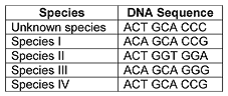
According to this data, the unknown bacterial species is most closely related to:
Species I
Species II
Species III
Species IV
Define population
A group of individuals of the different species that live in the same area and and not able to interbreed sexually
A group of individuals of the same species that live in the same area and unable to interbreed sexually
A group of individuals of the same species that live in the same area and able to interbreed sexually, producing fertile offsprings
Gene pool
Total number of alleles of the genes that are present in a population of a particular species of organism at a given time
The condition of a population in which allele and genotype frequencies remain constant from one generation to the next
The number of phenotypes present in a population of a species at a given time
Fossil records show that black bears increased in size during the Ice Age and decreased in size with warmer temperatures. What type of selection do these changes in size represent?
Allopatric
Directional
Disruptive
Stabilizing
Babies birth weight is an example of
Disruptive selection
Adaptive radiation
Stabilizing selection
Directional selection

The graph shows variations in beak size for the bird Geospiza fortis on an island in the Galápagos archipelago. What evidence from the graph indicates that disruptive selection is occurring?
An intermediate (medium) beak size is less common.
Median beak size is the most common.
Smaller beaks are favoured.
Larger beaks are favoured.
Allele frequencies in a gene pool do not change, this is
random change
random genetic make up
genetic equilibrium
punctuated equilibrium
What conditions will lead to evolution? (hint: use your hand mnemonic)
Large Populations
Random Mating
Mutations
No movement in or out of population
Natural Selection

The formation of new species is called
Speciation
Evolution
Natural selection
Mutations
Which of the following does NOT lead to reproductive isolation
Behavioural isolation
Competitive isolation
Geographic isolation
Temporal isolation
An example of behavioural isolation
Toads that mate at different times of the year
Plants that have separate pollination times
Birds that have specific songs
Turtles that are separated by a mountain


Who is the closest relative to the birds?
crocodiles
sharks
fish
amphibians


How old is the earth?
2.5 million years
4.6 billion years
1.5 billion years
4.6 million years


How many mass extinctions has the earth been through?
3
1
5
8
Mass extinction would most likely result from which of the following events?
A disease kills off a single species of predator within an ecosystem
A wildfire burns a national park
Global temperatures drop several degrees after several massive volcanic eruptions
A massive earthquake strikes North America
A single species that has evolved into several different forms that live in different ways (have different niches) has undergone
Punctuated equilibrium
Adaptive radiation
co-evolution
Mass extinction

A process by which two species evolve in response to changes in each other over time is
Coevolution
Convergent Evolution
Macroevolution
Symbiotic Evolution

