
 Worksheets
Unit 4: Cell Regulation Exam
Total questions: 118
Worksheet time: 2hrs 20mins

The main characteristic that sets eukaryotes apart from prokaryotes is
The presence of DNA
The presence of ribosomes
Smaller size in eukaryotes
The presence of organelles

Organize the following organelles and structures into their respective cell type: plant, animal, or both.
Cell wall, centrioles, large central vacuole, mitochondria, lysosomes, plastids

What is the correct order of the phases of Mitosis?
Anaphase, Telophase, Metaphase, Prophase
Metaphase, Prophase, Anaphase, Telophase
Prophase, Metaphase, Anaphase, Telophase
Prophase, Anaphase, Telophase, Metaphase

This figure shows the phases of the cell cycle and division out of order. List the phases in the correct order using the letters labeled on each phase.

List a difference in cytokinesis between plant and animal cells. Use the labels provided in the diagrams!!!

The following shows the number of cells in each phase of mitosis after 100 hours. Based on this data, which phase do you think is the longest? Explain.

Which of the following are a part of interphase? Select all that apply.
G1
S
G2
M

A cell was allowed to move forward with DNA replication even though it was too small. Which checkpoint was most likely defective?
G1
S
G2
M

Which of the following is true about cell differentiation?
Different cells contain different DNA, which leads to specialization
All cells eventually reach G0 and stop dividing
Different cells have the same DNA, but express different genes--leading to specialization
Even though a cell is differentiated, it can always turn into another cell type

Which of the following best explains what cancer is and how it is related to the cell cycle?
Cells that have been stopped at G0 and are no longer dividing
Unregulated cell division, where cells grow and divide much quicker than they normally would
Mutated cells that do not grow or divide as efficiently as they normally would
None of the above

Starting with Gap 1, what is the correct order of the cell cycle?
G1 > G2 > S > M
G1 > S > G2 > M
G1 > M > S > G2
G1 > S > M > G2
What happens during G1?
The cell grows and carries out normal functions
The DNA in the cell is copied
The cell grows a little bit more
The cell divides itself
What happens during S?
The cell grows and carries out normal functions
The DNA in the cell is copied
The cell grows a little bit more
The cell divides itself
What happens during G2?
The cell grows and carries out normal functions
The DNA in the cell is copied
The cell grows a little bit more
The cell divides itself

Which phase of mitosis is being shown?
Prophase
Metaphase
Anaphase
Telophase
Cytokinesis
What happens during telophase?
Chromosomes condense
Chromosomes line up in the middle of the cell
Sister chromatids separate and move to opposite sides
Chromosomes unwind
What happens during anaphase?
Chromosomes condense
Chromosomes line up in the middle of the cell
Sister chromatids separate and move to opposite sides
Chromosomes unwind
What happens during metaphase?
Chromosomes condense
Chromosomes line up in the middle of the cell
Sister chromatids separate and move to opposite sides
Chromosomes unwind
What happens during prophase?
Chromosomes condense
Chromosomes line up in the middle of the cell
Sister chromatids separate and move to opposite sides
Chromosomes unwind

Which phase of mitosis is being shown?
Prophase
Metaphase
Anaphase
Telophase
Cytokinesis

Which phase of mitosis is being shown?
Prophase
Metaphase
Anaphase
Telophase
Cytokinesis

Which phase of mitosis is being shown?
Prophase
Metaphase
Anaphase
Telophase
Cytokinesis
_____ shows a pattern of growth, DNA replication, cell division that occurs in a eukaryotic cell.
Cell cycle
Cancer
Mitosis
Carcinogen
What happens during prophase?
Chromosomes condense
Chromosomes line up in the middle of the cell
Sister chromatids separate and move to opposite sides
Chromosomes unwind
Which of the following best represents a replicated chromosome?


Which of the following best represents a sister chromatid?
_____ is a region of condensed chromosomes that looks pinched; where spindle fibers attach during mitosis and meiosis.
Telomere
Centromere
Histone
Growth factor
_____ is a protein that organizes chromosomes and around which DNA wraps.
cell differentiation
Cancer
Growth factors
Histones
Which organelle is responsible for shipping, sorting and packaging proteins in the cell?
Which organelle is responsible for converting the energy in glucose into cellular energy?
Which organelle is responsible for making proteins and transporting them throughout the cell?
Which organelle is the site of photosynthesis?
Which organelle stores water for photosynthesis?
Which organelle supports and protects the cell?
genetic material
ribosomes
cell membrane
cytoplasm
small and simple
large and complex
golgi apparatus
BACTERIA
Rough and smooth ER
lysosomes
nucleus
vacuoles
Organize these options into the right categories. Plants (4) Animals (2), and All (6)
central vacuole
choloroplast
cell wall
lysosomes
no cell wall
carry out photosynthesis
rER
sER
Nucleus
Golgi
Mitochondria
Big 4 - ribosomes, DNA, cytoplasm, and cell membrane
There are four organelles that every cell has. The (a) controls what enters and exits the cell. The (b) make proteins for the cell. (c) is the jelly-like substance that suspends all the organelles, and (d) is a genetic material that instructs the cell what to do.
The (a) houses DNA. The (b) is responsible for transporting things throughout the cell. The (c) transports proteins while the (d) transports lipids. The (e) is responsible for sorting packaging and sending proteins.
The ribosomes make proteins and can be found floating in the (a) or attached to the (b) . (c) are responsible for digesting waste in the cell, and the (d) are responsible for making cellular energy.
What is the purpose of the cell cycle?
Growth of an organism and Repair of damaged tissue
To help the body get rid of extra cells
To increase the amount of classwork you have to do
To get rid of the nucleus
What is the main purpose of the cell cycle?
During a cell’s lifetime, it spends most of the time growing and copying DNA and organelles. When it is time, the cell divides its DNA and organelles to create two new cells with identical DNA, helping an organism grow and to make repairs.
The cell cycle is a process by which cells grow and replicate organelles and DNA in order to stay alive and maintain homeostasis. The process ensures that organisms have appropriate temperature and water level regulation.
The process of the cell cycle is essential to keep a multicellular organism alive. It allows organisms to multiply their cells in a manner that different DNA is added to the differentiated cells like blood cells and bone cells. Then, all cells can carry out their function appropriately.
The process of the cell cycle ensures that all cells in the body have an identical number of organelles and are able to divide rapidly to keep the organism functioning. It leads to differentiated cells like nerve cells and bone cells that work together to keep a multicellular organism functioning.

The diagram below represents the cell cycle. When cells leave the cell cycle, they exit during G phase and then enter G phase, a resting 1 0 period. Most normal cells can leave G phase and reenter the cell cycle at G phase before 0 1 entering S phase. Cancer cells are different because they cannot enter G phase and are likely 0 to do which of the following?
Fail to complete S phase
Mutate during G phase
Repeat the cell cycle continuously
Die after completing mitosis
Label the following drawing
Mitosis
G2 - Interphase
S Phase
G1 - Interphase
Cell differentiation is critical during embryonic development. The process of cell differentiation results in the production of many types of cells, including germ, somatic, and stem cells. Cell differentiation is most directly regulated by —
ATP
DNA
lipids
sugars
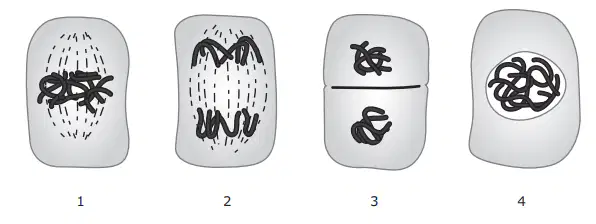
The diagram shows cells in different phases of mitosis. A student is trying to find a cell in a particular phase of mitosis. The student is looking for evidence that spindle fibers are separating the chromosomes to ensure that each new nucleus has one copy of each chromosome. Which cell is in the phase of mitosis that the student is searching for?
Cell 1
Cell 2
Cell 3
Cell 4
Oncogenes are mutated forms of genes. Oncogenes can transform a cell into a tumor cell. Some tumor cells are benign, while others are malignant. How does the presence of an oncogene lead to the formation of a tumor?
ATP production is inhibited.
Cell division is unregulated.
Somatic cell growth is inhibited.
Antibody activity is unregulated.
The diagram shows the major stages of the cell cycle and the percentage of time spent in each phase. Which statement best describes why a cell spends the majority of its time in interphase?
The cell is growing and carrying out processes such as metabolism and DNA replication.
The cell is aging and processes are stopping as lysosomes clear dead cell matter away.
The cell needs time to synthesize spindle fibers to complete mitosis
The cell needs time to complete cytokinesis.
Reorder the following into the correct order for mitosis.
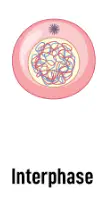
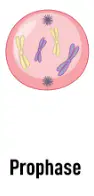
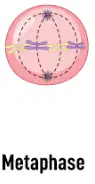
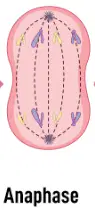
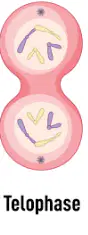
Describe the main stages of the cell cycle and briefly explain what happens during each stage
Describe the key events that occur during the interphase stage of the cell cycle.
Discuss the consequences of disruptions in the cell cycle, especially concerning uncontrolled cell division. Provide an example of a disease that can result from such disruptions.
Compare and contrast the roles of DNA replication and mitosis in the cell cycle. How are they interconnected, and why are both processes essential?
Describe the connection between the cell cycle and the regeneration of body tissues after injury.
Your friend is really irritable while sitting in class. He feels lightheaded and dizzy. He is also feeling a bit of confusion and brain fog.
What inferences are most realistic to make about the biomolecules in your friend's body?
He is running low on fast sources of energy
Proteins are being broken down or reshaped
The coding information in the cell is incorrect or incomplete
There is not enough insulation or energy storage
Your friend is really irritable while sitting in class. He feels lightheaded and dizzy. He is also feeling a bit of confusion and brain fog.
What biomolecule does your friend need?
Carbohydrates
Lipids
Proteins
Nucleic Acids
Carbs and lipids are similar because they...
Are a source of energy for living organisms
Help with immune response
build structures such as cellulose and chitin
Contain the same elements (CHO)
Match the following functions to the biomolecule
Act as hormones
Lipid
Build muscle
Protein
Carry genetic information
Nucleic acid
Energy source (cellular respiration)
Carbohydrate
Label the parts of the enzyme model
Click on the temperature that this enzyme is having optimum activity.
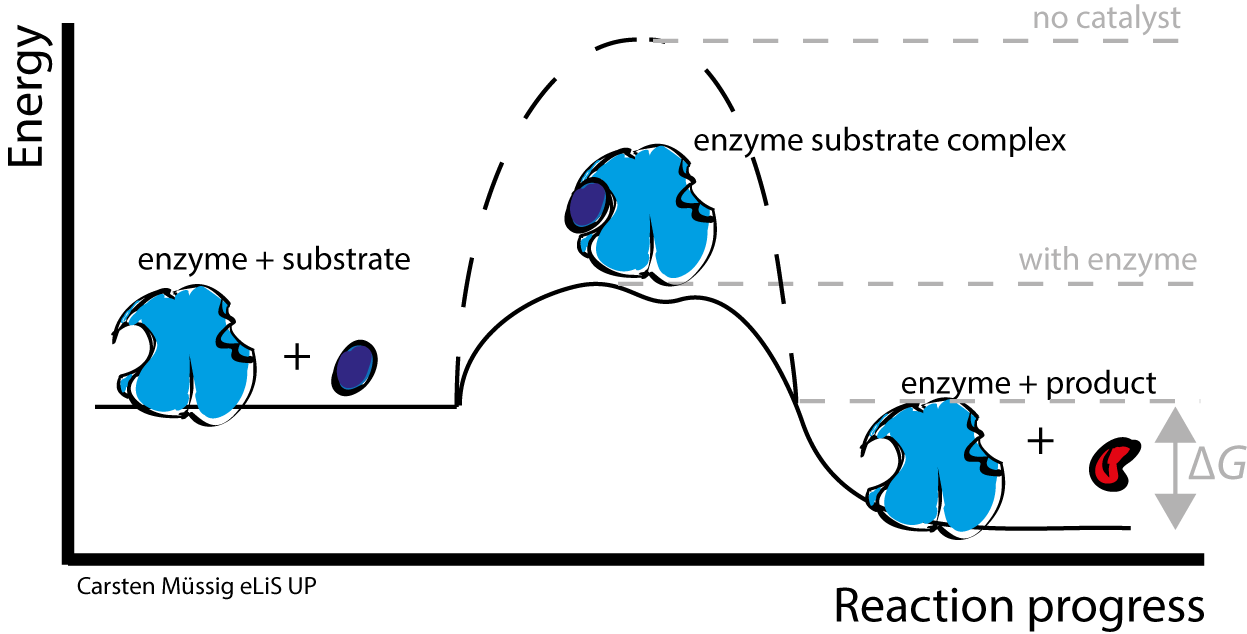
Enzymes are (a) that (b) chemical reactions by (c) the amount of activation energy required to start the reaction.
Label the parts of the flower.
The leaf's waxy cuticle
stores water
reduces evaporation and dehydration
transports water into the leaf
absorbs water for the leaf

Which of the following is the function of the guard cells on the lower surface of the leaf?
synthesizing proteins
transporting water and minerals
control how much water is lost from the leaf
allowing light to enter the leaf

If the phloem found beneath the bark of a tree is removed, what will happen to the tree?
It will go dormant
It will generate new phloem
food would not be able to reach the roots and it will die
No change will be seen

Plants curling around a pole or mailbox is an example of:
Phototropism
Germination
Turgor pressure
Thigmotropism

The movement or growth of a plant in response to the light coming from this window is called __.
Thigmotropism
Geotropism
Phototropism
Hydrotropism

Which type of tropism is represented in the GIF?
Hydrotropism
Thigmotropism
Phototropism
Gravitropism

Which type of tropism is represented in the GIF?
Hydrotropism
Thigmotropism
Phototropism
Geotropism

Which type of tropism is represented in the GIF of a Venus Fly Trap?
Hydrotropism
Thigmotropism
Phototropism
Gravitropism
What is the correct description of pollination?
Pollen grains are transferred from anther to the ovary
Pollen grains are transferred from the anther to the stigma
Pollen grains are transferred from the ovary to the stigma
Pollen grains are transferred from the stamen to the anther

The diagram shows a section of a flower that has been cross pollinated.
Which statements about this flower are correct?
1. The pollen produced by this flower will be genetically different from the pollen on the stigma
2. The pollen was carried to the stigma by wind
3. This flower is insect- pollinated because the stigma is enclosed by the petals.
4. The pollen was produced by another flower on the same plant
1,2, and 4
1 and 3
3 only
2 and 4 only
Why is osmosis not the same thing as diffusion?
A partially permeable membrane is needed for osmosis
A partially permeable membrane is needed for diffusion
Osmosis involves oxygen only
Diffusion involves water only
Osmosis is the movement of which molecule?
Water
Oxygen
Hydrogen
Any

If plants do not get watered, they will start to wilt because their central vacuoles are empty. When they get water again, they will stand back up because their vacuoles have filled back up. What process allows their vacuoles to fill back up with water?
active transport
photosynthesis
osmosis
diffusion
Which plant structures are DIRECTLY involved in the production and transport of glucose? Select TWO correct answers.

Students set up a controlled experiment by growing the same type of seedling in two different locations. After a period of time, the students observed the seedling and recorded their observations in the table shown. What caused the shoots of the seedling on the windowsill to bend toward the window?
hormones produced in response to a light stimulus
sugars produced in response to a gravity stimulus
carbon dioxide produced in response to a water stimulus
water produced in response to a nitrogen stimulus

A chart of some plant functions is shown
Complete the chart by indicating which system is responsible for each of the functions listed. Option 1 is __ (a) ____, option 2 is (b) , and option 4 is (c) .

A corn plant produces both male and female flowers. The male flower forms the tassel and the female flower forms the ear of corn. the silks that emerge from the ear are the stigma of the female flower. Each silk leads to an ovule that can become a corn seed.
Which of these must happen for corn seeds to develop on the ear?
More tassels than silks need to be present
Pollen grains must fall from tassels and land on the
silks of the ear.
Pollen must be transported from the tassel to the silk
through the phloem
The tassels must come into direct contact with the
silks of the ear.
Organize the following steps in the correct sequence
The petals attract pollinators
Pollen is deposited on the stigma
The pollen grain grows and fuses with the ovule

A student reads this advertisement for a product containing a plant micronutrient that can be added to soil. Based on this information, the student can conclude that boron is absorbed by plant roots from soil then-
transported to reproductive tissues by the plant’s shoot system
stored in plant stems until the flowers are pollinated
concentrated in the roots until the plant’s reproductive tissues mature
transported by the phloem to the stomata in leaves, where it attracts pollinators
Plants called sundews have rounded green leaves with many hair-like structures. The ends of these structures contain enzymes in a sticky liquid that looks like nectar or moisture, as shown in the picture. The hairs do not react to dust or nonliving material but will bend inward when insects get caught in the sticky liquid. Sundews digest trapped insects over a period of a few days. Based on this information, what functions do the specialized leaves of sundews perform?
provide water to the plant and perform photosynthesis
respond to stimuli and anchor the plant
provide nutrients to the plant and respond to stimuli
release pollen to insects and perform photosynthesis

A flower that has both male and female reproductive structures is shown. Which statement best describes an interaction that will allow a flowering plant to reproduce by self-pollination?
An anther is transferred from a filament to another filament within the same flower.
An ovule is transferred from the ovary to a petal on a different flower.
A pollen grain is transferred from an anther to the stigma of the same flower.
An ovary is transferred from a flower on one plant to a flower on a different plant.
The process by which cells use oxygen to produce energy from glucose is called?
photosynthesis
transpiration
cellular respiration
germination
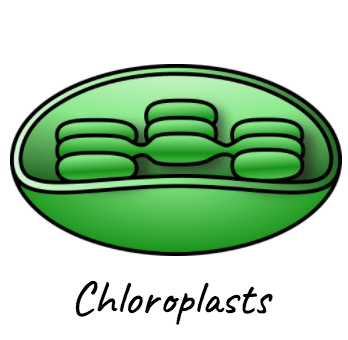
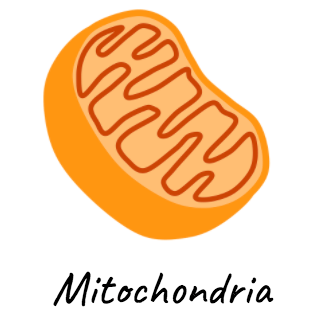
Mitochondria are (a) .
What is the purpose of cellular respiration?
To turn energy from the sun into glucose
To turn oxygen into glucose
To turn ATP into glucose
To turn glucose into energy in the form of ATP
Match the NAME of the chemical to its chemical formula
O2
Oxygen
CO2
Carbon Dioxide
H2O
Water
C6H12O6
Glucose

What chemical reaction is this?
Photosynthesis
Cellular Respiration

What chemical reaction is this?
Photosynthesis
Cellular Respiration

Process X represents (a) which occurs in the (b) . Process Y represents (c) which occurs in the (d) . Do both plant and animals cells complete cellular respiration? (e)
The chemical formula for cellular respiration: (a) + (b) → (c) + (d) + (e)
The chemical formula for photosynthesis: (a) + (b) + (c) → (d) + (e)
In living cells, chemical processes, such as synthesis, all require the action of (something to speed a reaction up)
Specialized antibodies
hormones
biological catalysts
Label the images below
Active Transport
Simple Diffusion
Product of Photosynthesis
Glucose(sugar)
+
Oxygen (stomata)

Photosynthesis
Product of Respiration
Carbon Dioxide
+
Water
+
ATP

Respiration
Xylem = (a)
Phloem = (b)
Match the biomolecule to its function.
Carbohydrate
Quick Energy
Protein
Builds Structures
Lipid
Stored Energy
Nucleic Acid
Genetic Information
Match the plant organ to its function.
Photosynthesis
Leaf
Transport of water and nutrients
Stem
Absorption of water
Root
Reproduction
Flower

A model of two structures that perform cellular processes is shown.
What are the products of the cellular processes in these organelles?
I: glucose and carbon dioxide
II: oxygen and water
I: carbon dioxide and oxygen
II: glucose and water
I: oxygen and glucose
II: water and carbon dioxide
I: carbon dioxide and water
II: glucose and oxygen


The particles in this diagram are too large to pass through the semipermeable membrane, so water moves across instead to achieve equal concentrations on both sides. This is an example of:
simple diffusion
facilitated diffusion
osmosis
active transport
Essential nutrients move through a cell membrane by both passive transport and active transport. Which of the following correctly describes the transport of materials across a cell membrane?
Active transport requires chemical energy to move nutrients from areas of low concentration to areas of high concentration.
Passive transport requires chemical energy to move nutrients from areas of low concentration to areas of high concentration.
Active transport moves nutrients from areas of high concentration to areas of low concentration without the use of chemical energy.
Passive transport moves nutrients from areas of low concentration to areas of high concentration without the use of chemical energy.
Match the following:
active transport
requires ATP
passive transport
does not require ATP
diffusion
molecules move from high to low
endocytosis
molecules move from low to high

Three potato slices with the same mass were each placed in three beakers, each labeled with its number and contents. After 30 minutes, the potato slices were removed from the solutions, dried with a paper towel, and the mass was determined. The results are shown in the table.
Why did the potato in Beaker 1 gain mass but the potatoes in Beaker 2 and Beaker 3 did not?
Cells employ different methods to transport substances in and out of the cell. Facilitated diffusion is one such method. Explain what facilitated diffusion is and how it operates within the cell membrane to transport specific molecules, such as glucose, into the cell. Describe the role of transport proteins in this process.
Cells use different methods to move materials into and out of the cell. The sodium-potassium pump is an example of one of these methods. What type of transport method does the sodium-potassium pump use and explain this method?
Vegetables at the grocery store are sprayed with water to prevent wilting. What transport method do the celery cells undergo when sprayed with water? Explain why this process occurs.

The picture below is an example of
diffusion
active transport
facilitated diffusion
osmosis
In passive transport, materials move from an area of _____________ concentration to an area of ___________ concentration through a cell membrane.
higher, lower
lower, higher
negative, positive
positive, negative


