wayground logo

Free Printable Worksheets

Font size

S
M
L
XL
Worksheets

Semester 2 Review for Final

Total questions: 122

Worksheet time: 2hrs 13mins
Name
Class
Date
1.

What is the main organ of the circulatory system?

a)

small intestine

b)

bone

c)

lungs

d)

heart

2.

Arteries carry oxygen rich blood away from the heart.

a)

True

b)

False

3.

Veins carry oxygen poor blood back to the heart.

a)

False

b)

True

4.
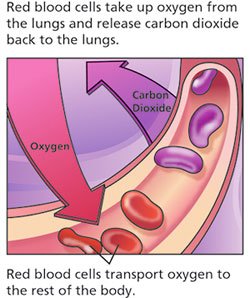
The circulatory system works with the ___________ system to provide our body with oxygen.
a)
respiratory
b)
digestive
c)
muscular
d)
skeletal
5.
These cells, in the blood, carry oxygen and give the blood its color.
a)
white blood cells
b)
plasma
c)
platelets
d)
red blood cells
6.

These are the smallest and most numerous of your blood vessels.

a)

Veins

b)

Capillaries

c)

Arteries

7.

What is a heart attack?

a)

When an artery is blocked and cannot carry oxygen to the heart.
b)

When a vein is blocked and cannot carry oxygen to the heart.

c)

When capillaries are blocked and cannot carry oxygen to the heart.

8.

What is the main function of the respiratory system?

a)

to provide oxygen and remove carbon dioxide from the body

b)

o break down food and absorb nutrients

c)

to remove oxygen from the body and deliver carbon dioxide

9.

What are the main organs of the respiratory system that allow us to breathe and for gas exchange to happen?

a)

diapragm

b)

lungs

c)

trachea

10.

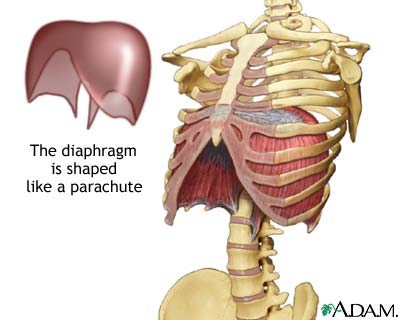
What is function of the dome-shaped diaphragm muscle?

a)

This is where gas exchange happens.

b)

Air passes through the diaphragm on the way to the lungs.

c)

It attaches to the lungs and contracts and relaxes to help in breathing.
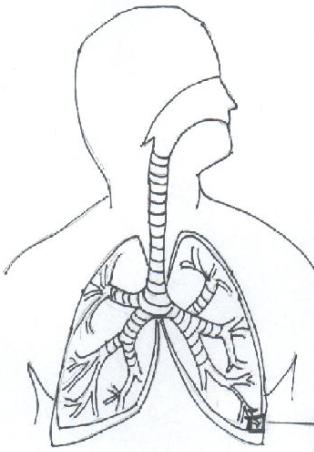
11.
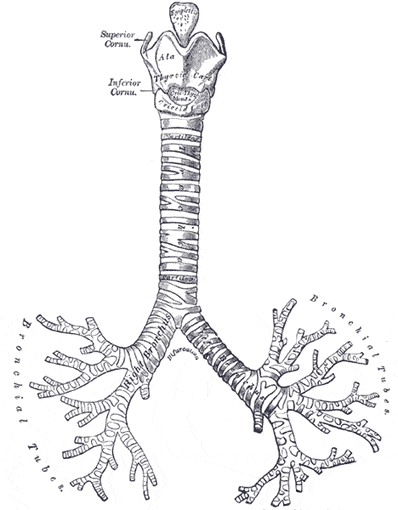
What is the function of the bronchi?
a)
Transport air from nose to lungs
b)
Transport air from trachea to lungs
c)
Transport air from lungs to alveoli
d)
Transport air from alveoli to blood
12.

These are the two two main branches from the trachea (one to each lung)

a)

bronchi

b)

alveoli

c)

capillaries

d)

bronchioles

13.
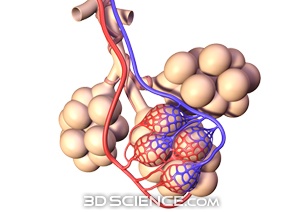
The air sacs that are covered with capillaries where gas exchange takes place
a)
bronchi
b)
lungs
c)
oxygen
d)
alveoli
14.
What is tube that is also known as your wind pipe?
a)
esophogus
b)
bronchi
c)
trachea
d)
alveoli
15.

Flap of tissue that covers the opening to the windpipe during swallowing

a)

Pharynx

b)

Trachea

c)

Epiglottis

16.
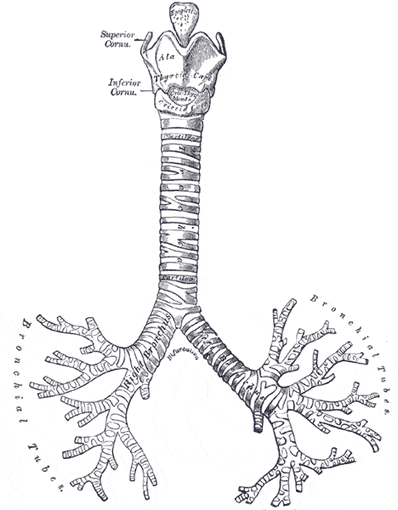
Letter D is pointing to which Respiratory organ?
a)
Alveoli
b)
Diaphragm
c)
Lung
d)
Bronchi
17.
a)
pancreas
b)
esophagus
c)
stomach
d)
liver
18.
a)
esophagus
b)
liver
c)
stomach
d)
pancreas
19.
a)
stomach
b)
pancreas
c)
large intestine
d)
small intestine
20.
a)
large intestine
b)
small intestine
c)
rectum
d)
esophagus
21.
What does the cerebrum control?
a)
controls thoughts and voluntary actions
b)
controls vital and involuntary actions 
c)
controls balance
d)
controls the uvula
22.
Which part of the brain controls vital functions such as breathing and heart rate?
a)
Diencephalon
b)
Frontal Lobe
c)
Brain Stem
d)
Cerebellum
23.
This part is known as the "Little Brain" and is in charge of balance and coordinating movements.  
a)
Thalamus
b)
Reticular Formation
c)
Hypothalamus
d)
Cerebellum
24.

If you are having trouble with your BALANCE and COORDINATION, which part of your brain should be checked?

a)

cerebrum

b)

cerebellum

c)

brain stem

d)

spinal cord

25.
How many daughter cells are produced in mitosis?
a)
4 new cells
b)
2 new cells
c)
One new cell
d)
none of these
26.
How many daughter cells are produced in meiosis?
a)
4 daughter cells
b)
none of these
c)
3
d)
1
27.
The end of meiosis results in  ________ to each other.
a)
2 cells that are identical
b)
4 cells that are identical
c)
2 cells that are not identical
d)
4 cells that are not identical
28.
The first stage of the cell cycle during which the cell matures and prepares to divide and copies its DNA; The stage the cell stays in the most
a)
interphase
b)
prophase
c)
metaphase
d)
anaphase
29.
What process does a multi-cellular organism use to replace its damaged body cells?
a)
mitosis
b)
meiosis
c)
replication
d)
transcription
30.
Which of these lists presents the stages of the cell cycle in the correct order?
a)
interphase, mitosis, cytokinesis
b)
cytokinesis, mitosis, interphase
c)
mitosis, interphase, cytokinesis
d)
interphase, cytokinesis, mitosis
31.
Matt uses a microscope to look at slides of plant cells.  He sees a cell with two nuclei that have visible chromosomes. In which stage of cell division is this cell?
a)
anaphase
b)
prophase
c)
telophase
d)
interphase
32.
Identify the stage of mitosis.
a)
interphase
b)
prophase
c)
metaphase
d)
anaphase
33.
Chromatid pairs line up in the middle of the cell.
a)
Metaphase
b)
Telophase
c)
Anaphase
d)
Interphase
34.
What phase of mitosis is shown in the picture?
a)
Prophase
b)
Anaphase
c)
Telophase
d)
Metaphase
35.
How many chromosomes does a human cell have?
a)
42
b)
46
c)
24
d)
64
36.
How many daughter cells are produced in mitosis?
a)
1
b)
2
c)
4
d)
6
37.

What do all cells have in common? (Choose all that apply)

a)

DNA

b)

Cell membrane

c)

Ribosomes

d)

Cytoplasm

e)

Chloroplast

38.

The number of chromosomes found in egg and sperm cells for humans.

a)

11

b)

12

c)

23

d)

46

39.
Autosomes are
a)
chromosomes found in autotrophs, only
b)
chromosomes that automatically correct all errors in the DNA
c)
chromosomes that determine traits other than sex
d)
chromosomes that determine the sex of the individual
40.

Chromosomes are made from protein and what other molecule?

a)

Ammonia

b)

ATP

c)

DNA

d)

Carbon Dioxide

41.

How many pairs of chromosomes are in a human being?

a)

23

b)

44

c)

89

d)

72

42.
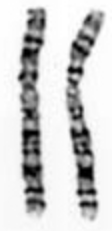
Determine the sex of the individual whose karyotype is displayed in the image.
a)
female
b)
male
43.
Determine the sex of the individual whose karyotype is displayed in the image.
a)
female
b)
male
44.
A pair of identical chromosomes shown in a karyotype, one inherited from mom, and one inherited from dad are called
a)
sister chromotids
b)
centromeres
c)
homologous chromosomes
d)
autosomes
45.
A sperm contains
a)
Both an X and a Y chromosome
b)
Two X chromosomes
c)
An X OR a Y chromosome
d)
only a Y chromosome
46.
What makes this individual's karyotype not normal?
a)
An extra sex chromosome
b)
An extra autosome
c)
A missing sex chromosome
d)
A missing autosome
47.
Chromosome pairs 1-22 are referred to as
a)
sex chromosomes
b)
sister chromatids
c)
a karyotype
d)
autsomes
48.
Aa, DD, bB, yy are all examples of
a)
genotypes
b)
phenotypes
49.
In a flowering plant species, red flower color (R) is dominant over white flower color (r). What is the genotype of any red-flowering plant resulting from this species?
a)
rr
b)
R
c)
RR
d)
RR or Rr
50.
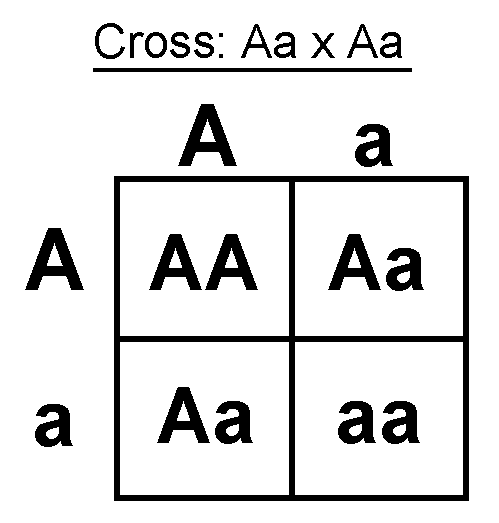
What is the phenotype of the offspring? (A-Brown hair; a-blond hair) 
a)
50 % Brown Hair and 50% Blond Hair 
b)
25 % Brown Hair and 75% Blond Hair 
c)
75 % Brown Hair and 25% Blond Hair 
d)
0% Brown Hair and 100% Blond Hair 
51.
A green pea plant (GG) is being crossed with a green pea plant (Gg). What is the phenotype?
a)
100 % rainbow 
b)
50% yellow and 50% green 
c)
100% green
d)
100% yellow 
52.
A calico cat shows both the traits for orange fur and black fur. What kind of allele expression is this?
a)
Incomplete Dominance
b)
Co dominance
c)
Independent assortment
d)
Recessive inheritance
53.
This type of inheritance pattern is a MIXTURE of both traits.
a)
incomplete dominance
b)
co-dominance
c)
complete dominance
d)
recessive pattern
54.
What did Gregor Mendel use to discover the principles that rule heredity?
a)
Pea Plant
b)
Pigeons
c)
Pear trees
d)
Photosynthesis
55.
What did Mendel call the two kinds of traits exhibited by the pea plants (one coming from the father, one from the mother)?
a)
Genesis
b)
Elective traits
c)
Alleles
d)
Quadrants
56.
What do we call the table used to calculate the probability of an offspring's genotype?
a)
Punnett square
b)
Venn diagram
c)
Golden ratio
d)
Fibonacci sequence
57.
A trait that is not expressed when a dominant allele is present.
a)
Recessive
b)
Co-dominant
c)
Incomplete Dominant
d)
Dominant
58.
The physical or behavioral appearance of a trait
a)
Phenotype
b)
DNA
c)
Genotype
d)
Genetics
59.
What causes genetic variation in meiosis?
a)
chromosomes lining up
b)
crossing over of chromosomes
c)
separation of chromosomes
d)
chromosomes pulling apart
60.
The process of crossing over occurs in what phase of meiosis?
a)
anaphase 1
b)
prophase 1
c)
prophase 2
d)
telophase 1
61.
When homologous chromosomes match up, they form a structure call a ___________.
a)
tetrad (pair of chromosomes, one from mom and one from dad)
b)
triad
c)
diploid
d)
quad (group of 4 replicated chromosomes, 2 from mom and 2 from dad)
62.
Crossing over creates
a)
male genotype
b)
genetic variation (differences)
c)
DNA replication
d)
mitosis
63.
Which cellular process is shown?
a)
meiosis
b)
endocytosis
c)
mitosis
d)
phagocytosis
64.
Which of the following best describes meiosis?
a)
It is carried out in all tissues theat require cell replacement
b)
It occurs only in cells in the reproductive structures of an organism
c)
It happens in all of the tissues except the brain and spinal cord
d)
It is the first stage of mitosis
65.
What phase is represented?
a)
metaphase 1
b)
metaphase 2
c)
anaphase 1
d)
anaphase 2
66.
What phase is  shown in the picture?
a)
metaphase 2
b)
anaphase 2
c)
metaphase 1
d)
telophase 1
67.
How many daughter cells does Meiosis create?
a)
2
b)
4
c)
8
d)
1
68.
How many chromosomes are in the new cells of meiosis?
a)
46
b)
23
69.
What is one of the advantages, of reproducing sexually versus asexually?
a)
survival of the fittest
b)
overproduction
c)
genetic variation
d)
cloning
70.
Which of the following cell types is formed by meiosis?
a)
skin cells
b)
sperm cells
c)
blood cells
d)
muscle cells
71.
Which of the following describes fertilization? 
a)
cell differentiation to form a blastula
b)
formation of germ layers in a deuterostome
c)
a sperm joining an egg to form a zygote
d)
sperm and egg production
72.
Where does fertilization usually occur?
a)
ovary
b)
uterus
c)
vagina
d)
fallopian tube
73.
reproductive glands in which eggs are produced
a)
penis
b)
ovaries
c)
menstrual cycle
d)
fertilization
74.
Which produces egg cells and female hormones?
a)
cervix
b)
fallopian tube
c)
vagina
d)
ovaries
75.

True or False: Males can continue to make sperm for most of their lives once they have reached puberty.

a)

True

b)

False

76.

True or False: Females can continue to produce eggs for most of their lives once they have reach puberty.

a)

True

b)

False

77.
Enzymes are considered to be 
a)
Lipids
b)
Carbohydrate
c)
Protein
d)
Nucleic Acid
78.
What is the purpose  of an enzyme?
a)
give permission for the reaction
b)
raise activation energy
c)
speed up reactions
d)
control how many reactions occur
79.
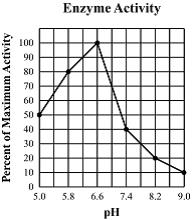
Which of the following conclusions can be drawn from this graph?
a)
The optimum pH of the enzyme is 6.6.
b)
The optimum pH of the enzyme is 5.8
c)
The enzyme’s activity increases as pH increases 5.0 to 9.0
d)
The enzyme’s activity is greater around pH of 8.0 .
80.
At high temperatures enzyme activity declines because of:
a)
Denaturation
b)
Decreased Kinetic Motion
c)
Increased H-Bonding
d)
Dissociation of Ionic Compounds
81.
How do enzymes increase the speed of chemical reactions?
a)
reducing the number of products   
b)
reducing the activation energy
c)
increasing the temperature of the cell
d)
increasing the concentration of reactants 
82.
What is a substance called if it speeds up a chemical reaction?
a)
reusable
b)
catalyst
c)
specific
d)
fragile
83.
Which of these is NOT true?
a)
Enzymes can denature (change shape) when the temperature gets too high.
b)
Enzymes can only be used once in a chemical reaction. 
c)
Extreme pH can denature enzymes.
d)
Enzymes speed up chemical reactions. 
84.
What happens when enzymes are heated to a high temperature?
a)
The enzymes die.
b)
The shapes of the enzyme are altered or denatured
c)
The enzymes' amino acid sequence changes.
d)
The enzymes remain the same
85.

Describe lactose intolerance.

a)

A painful sore that forms when the lining of the stomach or beginning of the small intestine breaks down and tissues are exposed to stomach acid.

b)

Scar tissue prevents the liver from functioning properly. Causes include fatty liver disease (excess fat in the liver), alcoholism, and hepatitis C (a virus that harms the liver).

c)

Small pebble-like masses form in the gallbladder. Stones may be as small as a grain of salt or as big as a golf ball.

d)

The inability to produce the enzyme required to digest lactose, which is a sugar in milk and other dairy products. May be genetic or due to infection.

86.

What causes lactose intolerance?

a)

Cholesterol and other substances found in bile form stones. When the stone passes from the gallbladder into the small intestine or become stuck in the biliary duct it can cause pain.

b)

Alcohol and viral hepatitis B and C are common causes, though there are others.

c)

An infection with the bacterium Helicobacter pylori (H. pylori) long-term use of nonsteroidal anti-inflammatory drugs (NSAIDs), such as aspirin, ibuprofen, or naproxen.

d)

The Small intestine doesn't produce enough of an enzyme (lactase) to digest milk sugar (lactose).

87.
Males are more likely to suffer from a sex-linked disease or disorder because
a)
males are the weaker sex
b)
males have less DNA
c)
males have 1 X chromosome, so the disorder is more likely to be expressed
88.
If a gene is found only on the X chromosome and not the Y chromosome, it is said to be 
a)
sex-linked trait
b)
polygenic trait
c)
codominant trait
d)
incomplete dominance trait
89.
Hemophilia is a recessive x-linked disorder.
Which genotype represents a female who is a carrier for hemophilia?
a)
XHXh
b)
XhXh
c)
XHXH
d)
XhY
90.
Hemophilia is a recessive x-linked disorder.
Which genotype represents a male with hemophilia?
a)
XHXh
b)
XhXh
c)
XHY
d)
XhY
91.
Which individual in the first generation is a carrier?
a)
The male
b)
The female
c)
individual 1
d)
None of the above
92.
How many girls did the mother and father from the first generation have?
a)
2
b)
4
c)
5
d)
6
93.
What do half colored symbols represent?
a)
The individual is a carrier.
b)
The individual expresses the trait.
c)
The individual has both recessive alleles.
d)
The individual has both dominant alleles.
94.
Proteins are made of monomers called ___________
a)
Nucleotides
b)
Monosaccharides
c)
Amino Acids
d)
Glycerol and fatty acids
95.
The element _______is found in all of the organic compounds.
a)
Iron
b)
Nitrogen
c)
Carbon
d)
Oxygen
96.
DNA and RNA are examples of 
a)
Carbohydrates
b)
Lipids
c)
Proteins
d)
Nucleic Acids
97.
Nucleotides are monomers of
a)
Carbohydrates
b)
Lipids
c)
Proteins
d)
Nucleic Acids
98.
Monosaccharides are monomers of
a)
Carbohydrates
b)
Lipids
c)
Proteins
d)
Nucleic Acids
99.

Which macromolecule is shown?

a)

lipid

b)

protein

c)

nucleic acid

d)

carbohydrate

100.
What type of macromolecule are enzymes?
a)
Protein
b)
Carbohydrate
c)
Lipid
d)
Nucleic Acid
101.
I am single stranded.
a)
DNA
b)
RNA
c)
Both DNA and RNA
102.
I am found ONLY in the nucleus of eukaryotic cells.
a)
DNA
b)
RNA
c)
Both DNA and RNA
103.
I am a nucleic acid.
a)
DNA
b)
RNA
c)
Both DNA and RNA
104.
I am arranged as a double helix or "twisted ladder."
a)
Both DNA and RNA
b)
DNA
c)
RNA
105.
I have the sugar ribose.
a)
RNA
b)
DNA
c)
Both DNA and RNA
106.
I have the sugar deoxyribose.
a)
RNA
b)
DNA
c)
Both DNA and RNA
107.
I include the bases guanine, cytosine, and adenine.
a)
DNA
b)
RNA
c)
Both DNA and RNA
108.
In eukaryotic cells, I travel out of the nucleus to a ribosome.
a)
Both DNA and RNA
b)
DNA
c)
RNA
109.
I have the base uracil.
a)
RNA
b)
DNA
c)
Both DNA and RNA
110.
I have the base thymine.
a)
Both DNA and RNA
b)
RNA
c)
DNA
111.
Which sequence of DNA bases would pair with this partial strand
ATG TGA CAG
a)
ATG TGA CAG
b)
TAC ACT GTC
c)
GTA AGT GAC
d)
CAT TCA CTG
112.
Guanine bonds with ______________.
a)
Adenine
b)
Guanine
c)
Cytosine
d)
Thymine
113.
In a molecule of double-stranded DNA, the amount of Adenine present is always equal to the amount of
a)
cytosine
b)
guanine
c)
thymine
d)
uracil
114.
Why is DNA important?
a)
it is very small and very complicated
b)
it's in everything
c)
it serves as the blueprint for traits of all living things
d)
because we eat it every day for energy
115.
How would the DNA sequence GCTATA be transcribed to mRNA?
a)
GCUAUA
b)
CGATAT
c)
CGAUAU
d)
GCUTUT
116.
The process by which the genetic code of DNA is copied into a strand of RNA is called
a)
translation
b)
transcription
c)
transformation
d)
replication
117.

When these bond together, they form a protein

a)

Amino Acids

b)

Peptide Bonds

c)

Ribose

d)

Nucleotides

118.

During translation, this type of ribonucleic acid is responsible for delivering amino acids to help make a protein.

a)

mRNA

b)

rRNA

c)

tRNA

d)

dRNA

119.
The process to go from DNA to mRNA is _______
a)
translation
b)
transcription
c)
replication
120.
The process to go from mRNA to a protein is called ____
a)
transcription
b)
rRNA
c)
replication
d)
translation
121.

What is the correct amino acid sequence for the mRNA code AUGCCAGUAUGA

a)

Met-Pro-Ala-Val

b)

Met-Pro-Val

c)

Tyr-Gly-His

d)

Tyr-Gly-Arg-His

122.

What is the starting amino acid for every protein?

a)

Methionine (Met)

b)

Stop

c)

Valine (Val)

d)

Leucine (Leu)