wayground logo

Free Printable Worksheets

Font size

S
M
L
XL
Worksheets

Mutations and Meiosis (4th Skills Check Review)

Total questions: 117

Worksheet time: 3hrs 5mins

Name
Class
Date
1.
The diagram below shows homologous chromosome during phase 1 of meiosis. Which of the following correctly describes the process being illustrated? 
a)
Mutation in which DNA content of the genes is altered. 
b)
segregation of sister chromatids
c)
condensation and segregation of alleles
d)
crossing-over in which alleles are exchanged
2.
The human body has 23 pairs of chromosomes, one set from your mother and one set from your father. Why are the pairs referred to as homologous chromosomes? 
a)
Chromosomes pairs are identical 
b)
Chromosome pairs are not identical 
c)
The chromosome in a pair have the same alleles in opposite order of arrangement 
d)
Chromosomes in a pair have the same alleles in the same order of arrangement
3.
Name the process in the diagram. 
a)
Meiosis 
b)
Mitosis 
c)
Endocytosis 
d)
Phagocytosis 
4.
Which of the following best describes meiosis?
a)
It is carried out in all tissues that require cell replacement. 
b)
It occurs only in cells in the reproductive structures of organisms. 
c)
It happens in all tissues except the brain and spinal cord
d)
It is the first stage of mitosis 
5.
Which type of reproduction leads to increased genetic variation on a population? 
a)
Parthenogenesis 
b)
Asexual reproduction 
c)
Sexual reproduction 
d)
Vegetative reproduction 
6.
Which of the following best describes cancer?
a)
absence of cyclins in the DNA
b)
Multiple gene mutations on a chromosome of DNA
c)
Uncontrolled cell growth caused by mutations in genes that control the cell cycle.
d)
Presence of genetic defects caused by hereditary disorders. 
7.
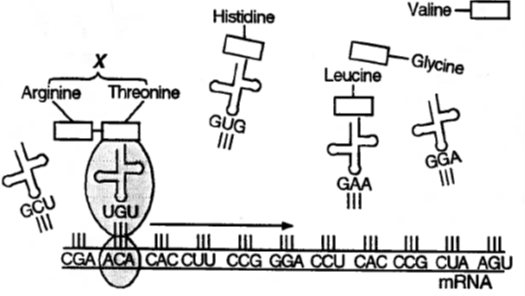
What letter correctly represents structure X in the diagram? 
a)
Spindle fibers
b)
Cleavage Furrow 
c)
Chromosomes
d)
Centrioles
8.
The following are the phases of the cell cycle
1. M Phase
2. S phase
3. G1 phase
4. G2 Phase
Where does the synthesis of DNA take place?
a)
I and III
b)
III and IV
c)
II only 
9.
Homologous chromosomes are very similar but not duplicates. Sister chromatids on the other hand are duplicate halves of a chromosome. What happens to homologous chromosomes and sister chromatids during Meiosis 1 and Meiosis 2? 
a)
Homologous chromosomes are divided in Meiosis 1 and sister chromatids are divided in Meiosis 2
b)
Homologous chromosomes are divided in Meiosis 2 and sister chromatids are divided in Meiosis 1
10.
Which of the following correctly identifies the order and phases of mitosis?
a)
C-prophase, D-metaphase, E-anaphase, B- telophase
b)
D-prophase, B-anaphase, E-telophase, C-metaphase
c)
C-anaphase, D-prophase,  E-metaphase, B-telophase
d)
E-prophase, D-metaphase, B-anaphase, C-telophase
11.
During which phase of mitosis does the nuclear envelope begin to disappear? 
a)
Metaphase
b)
Telophase
c)
Anaphase
d)
Prophase 
12.
A cell has gone through the process of meiosis and produced 4 daughter cells. Which statement correctly describes the daughter cells?
a)
They will not pass on any genetic information they received from the original cell
b)
They will pass on half of the genetic information they received from the original cell
c)
They will undergo the same mutations as the original cell after reproduction has occurred
d)
They will produce offspring that will have the same genetic information as the original cell. 
13.
What type of gene mutation results from the insertion or deletion of nucleotides and alters the entire amino acid sequence from that point forward?
a)
Frameshift
b)
Missense
c)
Nonsense
d)
Silent
14.
Replacing the amino acid serine with the amino acid glycine would be an example of which of the following mutations?
a)
Frameshift
b)
Missense
c)
Nonsense
d)
Silent
15.
Which of the following mutations results in a non-functional protein because a stop codon appeared too early in the mRNA sequence?
a)
Frameshift
b)
Missense
c)
Nonsense
d)
Silent
16.
Which of the following mutations results from one nucleotide being substituted for another?
a)
Deletion
b)
Frameshift
c)
Insertion
d)
Point
17.
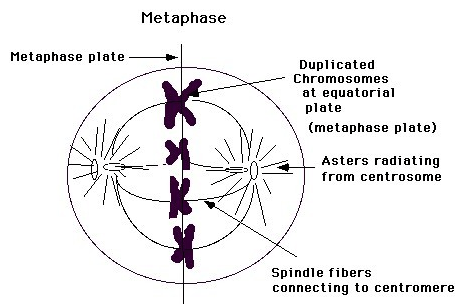
Which of the following phases of mitosis is represented by the diagram below?
a)
prophase
b)
metaphase
c)
anaphase
d)
telophase
18.
In meiosis, the haploid number of chromosomes in a human sex cell is:
a)
46
b)
92
c)
22
d)
23
19.
What is the diploid number of cells found in a human body cell?
a)
23
b)
46
c)
92
d)
47
20.
After meiosis is complete, the new cells:
a)
are all identical
b)
are all different
c)
are half identical and half different
d)
are all stretched out
21.
Why is sexual reproduction better than asexual reproduction?
a)
It gives an advantage to organisms to be different than the rest, if the environment changes.
b)
It is better for all organisms to be the same.
c)
It happens faster.
d)
It helps skin cells divide faster to heal wounds.
22.
The process on the left is:
The process on the right is:
a)
Left: meiosis
Right: meiosis
b)
Left: meiosis
Right: cloning
c)
Left: mitosis
Right: meiosis
d)
Left: mitosis
Right: mitosis
23.
Before a cell can divide, what must happen?
a)
Nothing, it is always ready to divide
b)
The number of chromosomes must be cut in half
c)
The number of chromosomes must double
d)
The number of chromosomes must triple.
24.
What phase of mitosis do the chromosomes line up in the middle of the cell?
a)
Prophase
b)
Metaphase
c)
Anaphase
d)
Telophase
25.
The phase in mitosis where chromosomes move away and are pulled apart by spindles to opposite sides of the cell.
a)
prophase
b)
anaphase
c)
metaphase
d)
telephase
26.
Another name for a sex cell is a:
a)
gamete
b)
embryo
c)
bone cell
d)
muscle cell
27.
Meiosis results in cells with
a)
half the number of chromosomes as the parent cell
b)
double the number of chromosomes as the parent cell
c)
identical number of chromosomes as the parent cell
d)
triple the number of chromosomes as the parent cell
28.
What is the result of meiosis?
a)
4 genetically different cells
b)
4 genetically identical cells
c)
2 genetically identical cells
d)
2 genetically different cells
29.
During which phase does DNA replicate?
a)
anaphase
b)
metaphase
c)
prophase
d)
interphase
30.
If an organism has a diploid (2n) number of 6, what is its haploid (n) number?
a)
2
b)
3
c)
6
d)
12
31.
If a cell has a haploid (n) number of 10, what is the diploid (2n) number?
a)
5
b)
10
c)
20
d)
25
32.
If a somatic cell in a butterfly contains 24 chromosomes, a butterfly egg would contain
a)
3
b)
6
c)
12
d)
24
33.
A male shark has 40 chromosomes in each of its sex cells. How many would be present in its body cells?
a)
20
b)
40
c)
80
d)
160
34.
Organisms with 18 chromosomes in the sex cells will have this many chromosomes in their body cells
a)
9
b)
18
c)
36
d)
64
35.
Organisms with 34 chromosomes in their body cells will have this many chromosomes in their sex cells
a)
34
b)
68
c)
124
d)
17
36.
What causes mutations?
a)
Mistakes in replication or environmental substances
b)
The amino acids
c)
Passed down by genetics
d)
It's how your born
37.
DNA molecule segment is : TTACGCAAG
The mutated DNA segment is TTCGCAAG. This is an example of ___ mutation.
a)
Substitution
b)
Deletion
c)
Addition
d)
Inversion
38.
If a mutation occurs in an expressed gene, it will most directly affect the structure of a cell's
a)
ATP
b)
proteins
c)
energy source
d)
membrane
39.
DNA molecule segment is : TTACGCAAG
The mutated DNA segment is TTACGCAAC. This is an example of ___ mutation.
a)
Substitution
b)
Insertion
c)
Inversion
d)
Translocation
40.

Crossing over" between maternal and paternal chromosomes takes place during

a)

meiosis I

b)

mitosis

c)

fertilization

d)

meiosis II

41.

Meiosis II takes place between fields

a)

B and C

b)

A and C

c)

A and B

d)

C and D

42.

A diploid cell in a buffalo has 60 chromosomes. A sperm or egg cell in a buffalo can be expected to have

a)

60 chromosomes

b)

120 chromosomes

c)

30 chromosomes

d)

15 chromosomes

43.

The process of meiosis

a)

begins with haploid cells and ends with haploid cells

b)

begins with diploid cells and ends with diploid cells

c)

begins with diploid cells and ends with haploid cells

d)

begins with haploid cells and ends with diploid cells

44.
The cells produced via meiosis are called:
a)
sex cells
b)
somatic cells
c)
body cells
d)
skin cells
45.
Unlike mitosis, meiosis in male mammals results in the formation of
a)
one haploid gamete
b)
three diploid gametes
c)
four diploid gametes
d)
four haploid gametes
46.
If the Diploid number of Carrots is 18, the haploid number is
a)
18
b)
9
c)
27
d)
36
47.
What process, and which type of resulting cells are represented?
a)
mitosis, gametes
b)
mitosis, body cells
c)
meiosis, gametes
d)
meiosis, body cells
48.

What is the main purpose of DNA (gene) mutations?

a)

mutations are bad. Mutations cause cancer.

b)

mutation is good, most of mutations help us the create genetic variations.

c)

mutations is the cause of disease or create new species.

d)

mutations are always passed onto the next generation.

49.

main purpose of meiosis is to

a)

create genetic variations

b)

create next generations

c)

cell division

d)

damage or repair

50.

Crossing over, the main event in Meiosis is to

a)

increase genetic variations

b)

reduce the probability of mutations.

c)

repair the DNA damage

d)

loose the DNA

51.
If a mutation occurs in a body cell, will the trait be passed onto the organism's offspring?
a)
No, the trait is in a somatic cell
b)
Yes, the trait is in a somatic cell
c)
No, the trait must be in a sex cell
d)
Yes, the trait is in a sex cell
52.
Are all mutations harmful?
a)
Yes, they are caused by toxic chemicals and radiation
b)
No, all mutations are beneficial
c)
Yes, mutations cause fatal diseases
d)
No, some can be useful in a changing environment
53.
Which genetic abnormality can be identified through karyotyping? 
a)
point mutation
b)
recessive allele
c)
extra chromosomes
d)
sex-linked allele
54.
Mutations within a DNA sequence are
a)
natural processes that produce genetic diversity
b)
natural processes that always affect the phenotype
c)
unnatural processes that are harmful to genetic diversity
d)
unnatural processes taht always affect the phenotype
55.
What is a possible result of a frameshift mutation with these base pairs TATTGGCTAGTACAT: 
a)
TATTTGGCTAGTACAT
b)
TATTCGCTAGTACAT
c)
TATTGGCTAGTACAG
d)
TATTGGGTAGTACAT
56.
What is the result of a substitution mutation with these base pairs?
a)
TATTCGCTAGTACAT
b)
TATTGCTAGTACAT
c)
TATTGGCTTAGTACAT
d)
None of the above
57.
AAA GCC CCC
Becomes:
AAA AGC CCC C
This is a kind of...
a)
... addition mutation
b)
... deletion mutation
c)
... substitution mutation
d)
... warp speed mutation
58.
Which of the following would be an example of a single substitution mutation of the codon "CCU"
a)
GGT
b)
CUU
c)
GGA
d)
GGG
59.
DNA: AAA CCC GGG
What is the transcribed mRNA?
a)
TTT GGG CCC
b)
UUU GGG CCC
c)
UUU CCC GGG
d)
TTT CCC GGG
60.
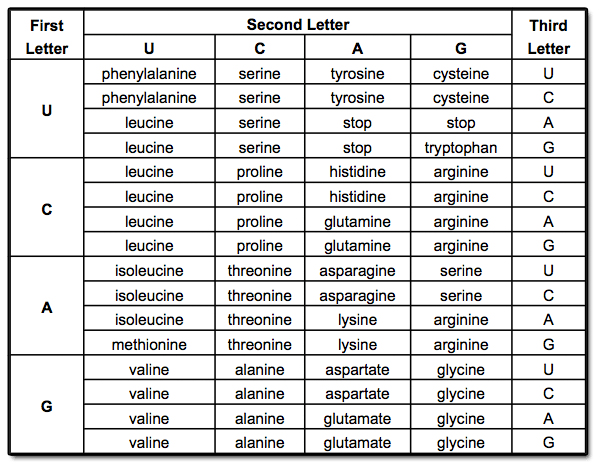
According to this corner of the codon chart, what amino acid does "CCG" code for?
a)
Pro (proline)
b)
Leu (leucine)
c)
Ser (serine)
d)
Phe (phenyline)
61.
CTA mutates to TTA. What changes?
a)
Leucine is made instead of proline.
b)
Serine is made instead of proline.
c)
It becomes unreadable.
d)
Nothing, it's still the same amino acid.
62.
"TCA"...
a)
... codes for serine (ser)
b)
... codes for proline (pro)
c)
... codes for phenyline (phe)
d)
... codes for leucine (leu)
63.
"When the reading frame is moved one or two bases off, causing all bases after the shift to be read wrong"
a)
Frameshift
b)
Exon
c)
Anticodon
d)
Cancer
64.
Mutants are always bad.
a)
Yes
b)
No
65.
Which of the following is not a type of RNA?
a)
mRNA
b)
tRNA
c)
yRNA
d)
rRNA
66.
Another name for protein is...
a)
Polysaccharide
b)
Carbohydrate
c)
Polypeptide
d)
Trans-fat
67.
How many nitrogenous bases would I need in order to code for 10 amino acids?
a)
10 bases
b)
20 bases
c)
30 bases
d)
5 bases
68.
If a "STOP" codon is accidentally created in the middle of an mRNA, what will happen?
a)
The ribosome will stop reading the mRNA at the STOP
b)
The ribosome knows to skip over the STOP and keep translating
c)
The ribosome never starts translating the mRNA to start with
d)
The ribosome explodes
69.
Which of the following is a base that is not found in RNA?
a)
Adenine
b)
Guanine
c)
Thymine
d)
Cytosine
70.
UUC GGA CAG
Becomes...
UUA GGA CAG
Is this a frameshift?
a)
Yes
b)
No
71.
In meiosis, the end product is...
a)
2 haploid cells
b)
2 diploid cells
c)
4 haploid cells
d)
4 diploid cells
72.
The cells produced in meiosis are...
a)
Identical
b)
Unique
73.
Sperm and Egg cells are produced using which process?
a)
Mitosis
b)
Meiosis
c)
Binary Fission
d)
None of these
74.
This phase of mitosis lines the chromosomes in the middle of the cell.
a)
Anaphase
b)
Prophase
c)
Metaphase
d)
Telophase
75.
What phase of mitosis is shown here?
a)
Cytokinesis
b)
Interphase
c)
Anaphase
d)
Metaphase
76.
In meiosis, the haploid number of chromosomes in a human sex cell (egg or sperm) is:
a)
46
b)
92
c)
30
d)
23
77.
What is the diploid number of cells found in a human body cell?
a)
23
b)
46
c)
92
d)
47
78.
What phase of mitosis is shown here?
a)
Anaphase
b)
Cytokinesis
c)
Telophase
d)
Metaphase
79.
Meiosis occurs in _____ cells.
a)
somatic
b)
sex
c)
body
80.
In which phase does the cell spend most of it's life?
a)
Interphase
b)
Nuclear Division
c)
Telophase
d)
Mitosis
81.
Why do we need meiosis?
a)
To double the number of chromosomes going into sex cells
b)
To halve the number of chromosomes going into sex cells
c)
To triple the number of chromosomes going into sex cells
d)
To not change the number of chromosomes going into sex cells
82.
The result of meiosis is:
a)
two diploid cells
b)
two haploid cells
c)
four diploid cells
d)
four haploid cells
83.
The chromosomes that pair up during meiosis, are called __________ chromosomes.  
a)
homozygous 
b)
asexual
c)
homologous
d)
genes
84.
A human zygote should have _____ chromosomes inside.
a)
46
b)
23
c)
92
d)
64
85.
During what stage does the G1, S and G2 phases happen?
a)
Interphase
b)
M phase
c)
Mitosis
d)
Cytokinesis
86.
During what phase of the cell cycle is DNA replicated?
a)
G1 phase
b)
S phase
c)
G2 phase
d)
M phase
87.
Why would it be important to replicate DNA before a cell divides in mitosis or meiosis?
a)
In order for genetic information to be transferred into daughter cells.
b)
In order for the cell to be able to increase in size.
c)
In order for the DNA to be contained in the nucleus.
d)
In order for the cell to re-order the DNA sequencing in the new cells.
88.

In the following structure, the circled item is a

a)

chromosome

b)

chromatid

c)

centromere

d)

chromatin

89.

specialized process during which the number of chromosomes is reduced by half, this is a type of cell division

a)

Mitosis

b)

Meiosis

c)

Pedigree

90.
Structure (b) is a ____.
a)
chromosome
b)
chromatid
c)
centromere
91.
What phase of mitosis is pictured?
a)
Metaphase
b)
Telophase
c)
Prophase
d)
Anaphase
92.
How many daughter cells are produced from meiosis ?
a)
10
b)
6
c)
4
d)
2
93.
Humans have how may chromosomes ?
a)
112
b)
46
c)
8
d)
67
94.
Are all mutations bad?
a)
Yes
b)
No
95.
Which of the following would result in a frameshift mutation?
a)
Insertions only
b)
Substitution only
c)
Deletion only
d)
Insertions and Deletions
96.

A mutation is any change in the _________ of a gene or chromosome.

a)

DNA

b)

mRNA

c)

rRNA

97.

What kind of mutation is caused by the addition of a new nucleotide?

a)

Substitution

b)

Insertion

c)

Deletion

d)

None of the above

98.

How many nucleotides make up one amino acid?

a)

3

b)

2

c)

4

d)

1

99.

What do you use when determining the amino acid in one codon?

a)

mRNA sequence

b)

DNA sequence

100.

Mutations can benefit humans because they can:

a)

Cause illness

b)

Make an organism more suited to live in its environment.

c)

Make organisms live shorter lives

d)

Cause organisms to grow extra limbs.

101.

When a beneficial mutation has occurred in an entire population of an organism, that species is said to have

a)

gone extict

b)

evolved

102.
ATTTGAGCC- Original
ATTGAGCC - Mutated
The example above is an example of a 
a)
Insertion- Frameshift
b)
Deletion- Substitution
c)
Deletion -Frameshift
d)
All of the above
103.
What mutation has occurred here? 
T-G-A-C-C-A
T-G-A-G-C-A
a)
Substitution
b)
Deletion
c)
Insertion
d)
Frameshift 
104.
Why are insertion and deletion (frameshift) mutations so harmful?
a)
They change all of the codons from the mutation on down the line, which changes the amino acid sequence
b)
They insert things that an organism doesn't need.
c)
They often delete things that organisms need.
d)
Insertion and deletions are not any more harmful than substitution mutations.
105.
Which change below would result in a different Amino Acid? 
3'-GCT-5'
a)
GTT
b)
TCT
c)
TCC
d)
GCA
106.
In a point mutation, this would have the worst effect on the function of the protein 
a)
an insertion or deletion near the end of a gene
b)
an insertion or deletion at the beginning of the gene
c)
an insertion at the middle of the gene
d)
a base substitution
107.
Which of the following would result in a frameshift mutation?
a)
Insertions only
b)
Substitution only
c)
Deletion only
d)
Insertions and Deletions
108.
Why is the order of amino acids so important?
a)
The order of amino acids dictates what shape the protein will fold into.
b)
It is not important. The protein folding chamber will force the protein to fold into the correct shape.
109.
Any change in the sequence of DNA is...
a)
transgenic shift
b)
Single Genotype
c)
Monohybrid Trait
d)
Mutation
110.
The process to go from mRNA to a protein is called ____
a)
transcription
b)
rRNA
c)
replication
d)
translation
111.
The main function of tRNA is to...
a)
carry a message that, when translated, forms proteins
b)
form a portion of ribosomes
c)
string together complementary RNA and DNA strands
d)
bring amino acids from the cytoplasm to the ribosomes
112.
What amino acid is represented by the codon UUA?
a)
Phenylalanine
b)
Tyrosine
c)
Leucine
d)
Stop codon
113.
What process is going on in this photo? 
a)
Transcription 
b)
Translation 
c)
Replication 
d)
All the above 
114.
What is the location in the cell for translation?
a)
nucleus
b)
mitochondria
c)
ribosome
d)
chloroplast
115.
What is the three base sequence of mRNA that codes for a single amino acid?
a)
Anticodon
b)
Codon
c)
Protein
116.
How many codons are needed to specify for five amino acids?
a)
3
b)
5
c)
15
d)
30
117.

What specifically holds the amino acids together to form a polypeptide chain?

a)

covalent bond

b)

ionic bond

c)

hydrogen bond

d)

peptide bond