
 Worksheets
Biology Fall Final Review
Total questions: 121
Worksheet time: 3hrs 12mins
Name
Class
Date
1.
Which type of data uses numbers?
a)
dependent
b)
independent
c)
quantitative
d)
qualitative
2.

What is the name of the structure shown in the diagram where cellular respiration takes place?
a)
Chloroplast
b)
Mitochondrion
c)
Nucleus
d)
Vacuole
3.
Which of the following is found in eukaryotic cells but NOT prokaryotic cells?
a)
Cell membrane
b)
Mitochondria
c)
Ribosomes
d)
DNA
4.

I am a protein packaging and shipping machine! Who am I?
a)
vacuole
b)
ribosome
c)
endoplasmic reticulum
d)
golgi apparatus
5.

I store water in both plant and animal cells. What am I?
a)
cytoplasm
b)
ribosomes
c)
vacuole
d)
lysosomes
6.
What makes the endoplasmic reticulum rough?
a)
Vessicles
b)
Vacuoles
c)
Ribosomes
d)
Chromosomes
7.
This organelle takes food and turns it into ENERGY for plant and animal cells.
a)
Chloroplast
b)
Mitochondria
c)
Lysosome
d)
Ribosome
8.
The site of photosynthesis
a)
ribosome
b)
mitochondria
c)
chloroplast
d)
nucleus
9.
Main producer of ATP in all eukaryotes
a)
chloroplast
b)
mitochondria
c)
lysosome
d)
smooth er
10.
The thick jelly like material inside of a cell that holds the organelles and gives it shape.
a)
nucleus
b)
cytoplasm
c)
mitochondria
d)
cell membrane
11.
What organelle is considered to be the “gatekeeper” for plant and animal cells?
a)
Cell Wall
b)
Cytoplasm
c)
Nucleous
d)
Cell Membrane
12.

This cell would be classified as a(n) ________________ cell.
a)
prokaryotic
b)
eukaryotic
c)
plant
d)
virus
13.

What is the name of the genetic material that is inside the nucleus?
a)
ER
b)
ATP
c)
YOLO
d)
DNA
14.

A rigid layer that lies outside the cell's membrane is...
a)
Cytoskeleton
b)
Cilia
c)
Cell Wall
d)
Flagella
15.

The tiny cell structures inside the cell are called
a)
Particles
b)
Organelles
16.

The image is an example of .....
a)
Animal Cell
b)
Plant Cell
17.

Name the organelle that makes food using energy from the sun.
a)
Chloroplast
b)
Mitochondria
18.
Controls what comes into and out of a nucleus; found in plant and animal cells
a)
Cell Membrane
b)
Golgi Bodies
c)
Cell Wall
d)
nuclear membrane
19.
Bacteria are ________________
a)
Eukaryotes
b)
Prokaryotes
20.
Animal cells are ________________
a)
Prokaryotic
b)
Eukaryotic
21.
What is one of the reactants of cellular respiration?
a)
energy
b)
glucose
c)
carbon dioxide
d)
water
22.
______________ produces the most ATP.
a)
photosnthesis
b)
aerobic respiration
c)
anaerobic respiration
d)
glycolysis
23.
What is one of the reactants of cellular respiration?
a)
energy
b)
oxygen
c)
carbon dioxide
d)
water
24.
What are the products of photosynthesis?
a)
sugar and glucose
b)
carbon dioxide
c)
sugar and Oxygen
d)
water and energy
25.
In photosynthesis ...
a)
chemical energy is changed to light energy
b)
light energy is changed to chemical energy
c)
sunlight is converted to ATP
d)
Glucose is used to make ATP
26.
What process is represented by the equation?
CO2+H2O => C6H12O6 + O2
CO2+H2O => C6H12O6 + O2
a)
photosynthesis
b)
cellular respiration
c)
Do not choose this answer.
d)
Do not choose this answer.
27.
What process is represented by the equation?
C6H12O6 O2 => CO2+H2O +ATP
C6H12O6 O2 => CO2+H2O +ATP
a)
photosynthesis
b)
cellular respiration
c)
Do not choose this option.
d)
Do not choose this option.
28.
The correct formula for sugar is:
a)
CH2O2
b)
C3PO
c)
C9H1O1
d)
C6H12O6
29.

What is the source of energy for photosynthesis?
a)
carbohydrates-chemical
b)
sunlight-radiant
c)
heat-thermal
d)
television-electrical
30.
Cellular Respiration's goal is to
a)
make water
b)
make ATP
c)
make glucose
d)
make oxygen
31.
Which group of organic compounds contains fatty acids?
a)
Carbohydrates
b)
Lipids
c)
Nucleic Acids
d)
Proteins
32.
Which of the following answers links a biomolecule with one of its proper functions?
a)
Lipids - Store genetic information
b)
Carbohydrates - short term energy storage
c)
Nucleic Acids - Catalyze reactions
d)
Proteins - long term energy storage
33.

This diagram shows the molecular structure of glucose.
Simple sugars like glucose can be used to make larger organic molecules. Identify a larger molecule made from simple sugars.
Simple sugars like glucose can be used to make larger organic molecules. Identify a larger molecule made from simple sugars.
a)
Carbohydrates
b)
Lipids
c)
Monosaccharides
d)
Amino Acids
34.

The molecule in the diagram plays what role in the body?
a)
Releasing Energy
b)
Carrying genetic information
c)
Storing Fat
d)
Controlling blood glucose levels
35.
The monomers used to synthesize proteins are called ____________.
a)
Nucleotides
b)
Fatty Acids
c)
Amino Acids
d)
Sugars
36.

What are the monomers for the molecules shown in the diagram?
a)
Amino Acids
b)
Fatty Acids
c)
Nucleotides
d)
Monosaccharides
37.

This molecule would best be described as a
a)
Polysaccharide
b)
Monosaccharide
c)
Trisaccharide
d)
Disaccharide
38.
All polymers are made of
a)
Monomers
b)
Nitrogen
c)
Lipids
d)
Simple sugars
39.
The amount of energy required to start a chemical reaction
a)
Activation Energy
b)
Energy in bonds
c)
Active site
d)
Amino Acids
40.

Identify the biomolecule
a)
monosaccharide
b)
disaccharide
c)
polysaccharide
d)
glycogen
41.
What is the functions of lipids?
a)
Quick source of energy
b)
Builds muscles, skin, enzymes
c)
Stores genetic information
d)
Stores energy, insulation, protection
42.
Which biomolecule is the key source of energy?
a)
Lipid
b)
Protein
c)
Carbohydrate
d)
Nucleic Acid
43.
Nucleotides are monomer for
a)
Nucleic Acids
b)
Proteins
c)
Carbohydrates
d)
Lipids
44.
Which biomolecule contains fats, oils, and waxes?
a)
Proteins
b)
Nucleic Acid
c)
Lipids
d)
Carbohydrate
45.
Which biomolecule contain your genetics?
a)
Carbohydrate
b)
Lipid
c)
Nucleic Acid
d)
Protein
46.
Which is true about active transport?
a)
It requires energy
b)
it does not require energy
c)
It moves substances down the concentration gradient
d)
it moves material from high to low concentration
47.
Osmosis is the movement of _____ across a membrane.
a)
food
b)
energy
c)
oxygen
d)
water
48.
What are two types of passive transport?
a)
endo and exocytosis
b)
cookies and milk
c)
active and passive
d)
Osmosis and diffusion
49.
What does it mean that a cell membrane is, "selectively or semi-permeable?"
a)
It allows all substances in
b)
It allows some substances in but not others
c)
It allows nothing in
50.
This cell organelle helps organisms maintain homeostasis by controlling what substances may enter or leave cells.
a)
vacuole
b)
nucleus
c)
cell membrane
d)
cell wall
51.

The cell below is in a _________ solution.
a)
Hypotonic
b)
Hypertonic
c)
Isotonic
52.
A cell in an isotonic solution will
a)
swell
b)
shrink
c)
stay the same size
d)
impossible to tell
53.
In passive transport, material moves from
a)
high to low concentration
b)
low to high concentration
c)
inside to outside of the cell
d)
outside to inside of the cell
54.
Cell membranes are made mostly from
a)
carbohydrate gates
b)
free moving proteins
c)
protein pumps
d)
phospholipids
55.

The picture shows
a)
Diffusion
b)
phagocytosis
c)
facilitated diffusion
d)
pinocytosis
56.

This image represents a/an
a)
nucleus
b)
phospholipid
c)
cell wall
d)
carbohydrate
57.
Are prokaryotes multicellular or unicellular?
a)
Multicellular
b)
Unicellular
58.

Which type of cell?
a)
Prokaryote
b)
Eukaryote
59.
What prokaryotic cell part helps them move?
a)
Cell Membrane
b)
Nucleiod
c)
Flagellum
d)
Capsule
60.
Prokaryotic does not have…….
a)
membrane bound organelles
b)
cell membrane
c)
DNA or RNA
d)
life
61.
Which type of cell have membrane bound organelles?
a)
prokaryotes
b)
eukaryotes
62.
The second part of Cell Theory states: "All living things are made up of cells."
a)
True
b)
False
63.
All cells are produced ____________.
a)
from nothing
b)
from other cells
64.
______________ are the basic unit of living things.
a)
Kittens
b)
Organisms
c)
Cells
d)
Organelles
65.
Enzymes are
a)
nucleic acids
b)
proteins
c)
lipids
d)
carbohydrates
66.
Which of the following binds to the active site of an enzyme?
a)
substrate
b)
product
c)
codon
d)
none of the above
67.
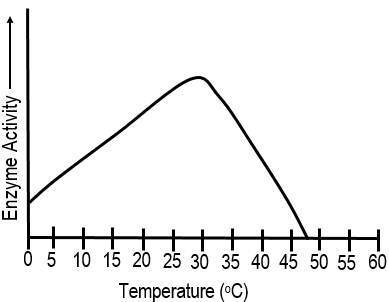
Based on the graph, what temperature does this enzyme work best?
a)
15 C
b)
40 C
c)
30 C
68.
What is the function of an enzyme?
a)
enzymes break themselves into small pieces
b)
they slow down chemical reactions
c)
they speed up chemical reactions
d)
enzymes combine products to form reactants
69.
What happens when enzymes are heated to a high temperature?
a)
The enzymes die.
b)
The shapes of the enzyme are altered or denatured
c)
The enzymes' amino acid sequence changes.
d)
The enzymes remain the same
70.
Which of these is NOT true?
a)
Enzymes can denature (change shape) when the temperature gets too high.
b)
Enzymes can only be used once in a chemical reaction.
c)
Extreme pH can denature enzymes.
d)
Enzymes speed up chemical reactions.
71.

Letter D...
a)
active site
b)
enzyme
c)
substrate
d)
products
72.

Letter E...
a)
active site
b)
enzyme
c)
substrate
d)
products
73.

Letter B...
a)
active site
b)
enzyme
c)
substrate
d)
products
74.

Letter C...
a)
active site
b)
enzymes
c)
substrate
d)
products
75.

Most enzymes have the ending:
a)
-ase
b)
-ose
c)
-ic acid
d)
-ate
76.
Which of these enzymes breaks down the sugar in milk?
a)
lactose
b)
lactase
c)
Fructose
d)
Amylase
77.

Which of the following conclusions can be drawn from this graph?
a)
The optimum pH of the enzyme is 6.6.
b)
The optimum pH of the enzyme is 5.8
c)
The enzyme’s activity increases as pH increases 5.0 to 9.0
d)
The enzyme’s activity is greater around pH of 8.0 .
78.
Enzymes are composed of which of the following monomers?
a)
amino acids
b)
carbohydrates
c)
nucleotides
d)
monosaccharides
79.
True or False: It is possible for a carnivore to be a producer.
a)
False
b)
True
80.
A graphic illustration that shows each trophic level and the amount of useable energy contained within.
a)
Food chain
b)
Food web
c)
Energy Pyramid
d)
All of these
81.
An organism at the second trophic level would be considered a...
a)
Top carnivore
b)
Producer
c)
Herbivore
d)
Carnivore
82.
The general name for organisms like animals and fungi that get their energy from eating other organisms.
a)
Producers
b)
Consumers
c)
Detritivores
d)
Carnivores
83.
Organisms that feed on both living producers and other consumers.
a)
Carnivores
b)
Omnivores
c)
Herbivores
d)
Detritivores
84.
Organisms that can capture energy from inorganic, nonliving sources.
a)
Producers
b)
Consumers
c)
Detritivores
d)
Carnivores
85.
Water temperature would be an example of ...
a)
A biotic factor
b)
An abiotic factor
86.
The living portions of the ecosystem.
a)
Biotic factors
b)
Abiotic factors
87.
An illustration that uses arrows to show the many possible directions in which matter and energy can pass through the organisms in an ecosystem.
a)
Food chain
b)
Food web
c)
Energy Pyramid
d)
Succession Map
88.
Which of the following would be the definition of a detritivore?
a)
Animals that eat insects.
b)
Organisms that feed on rocks, recycling the nutrients back into the ground.
c)
Organisms that eat only pants
d)
Things that feed on dead organisms, recycling the nutrients back into the ground.
89.
The amount of energy that usually transfers from one trophic level to the next...
a)
10%
b)
20%
c)
80%
d)
50%
90.

The image provided is an example of a(n):
a)
Carnivore
b)
Herbivore
c)
Producer
d)
Autotroph
91.

The image provided is an example of a(n):
a)
Producer
b)
Autotroph
c)
Consumer
d)
Insect
92.
What is the original source of almost all energy in most ecosystems?
a)
carbohydrates
b)
sunlight
c)
water
d)
carbon
93.

What does a food web represent?
a)
All connections of energy flow throughout all organisms in a habitat.
b)
The specific ways that mutualism is carried out.
c)
A single pathway or energy flow between organisms.
d)
How carnivores get their food.
94.

The non-living part of an ecosystem
a)
Ocean
b)
Lava Flow
c)
Birds
d)
Abiotic
95.
Two or more members of a particular species living and interacting in the same area
a)
Community
b)
Population
c)
Organisms
d)
Biosphere
96.

Different populations living and interacting with each other in the same area
a)
Biome
b)
Ecosystem
c)
Community
d)
Niche
97.
A _______________ cannot make its own energy and eats only plants for their energy.
a)
producer
b)
Primary consumer
c)
Secondary Consumer
d)
Tertiary Consumer
98.

symbiotic relationship in which both organisms benefit
a)
competition
b)
Mutualism
c)
nitrogen fixation
d)
energy pyramid
99.

A living relationship between two species in which one organism is harmed is called...
a)
mutualism
b)
commensalism
c)
parasitism
d)
niche
100.

which symbiosis is this
a)
parasitism
b)
mutualism
c)
commensalism
d)
nonalism
101.

What is the term for each step in the transfer of energy and matter within a biological community?
a)
energy path
b)
food web
c)
trophic level
d)
food pyramid
102.
If there is more food than usual in an ecosystem, then...
a)
Populations will stay the same
b)
Populations will decrease
c)
Populations will increase
103.

If a disease destroying barley plants in a field swept through an ecosystem, what would happen to the barley eating bird population in the the field ?
a)
The bird population would stay the same
b)
The bird population would infinitely increase
c)
The bird population would decrease
104.

Will competition increase/decrease the carrying capacity of an ecosystem for the animal in competition?
a)
Decrease
b)
Increase
105.

What point on the graph represents the carrying capacity?
a)
A
b)
B
c)
C
d)
D
106.

What type of growth is represented in this graph?
a)
exponential
b)
logistics
c)
a good kind
d)
representative
107.

What is the carrying capacity of the following graph?
a)
1000
b)
1200
c)
0
d)
15
108.

Based on the graph, what happened to species B?
a)
it decreased in population slightly
b)
it became carnivorous
c)
it became extinct
d)
it increased in population
109.
The major human causes of extinction today are
a)
hunting and destroying habitats.
b)
polluting and introducing non-native species.
c)
Both
d)
Neither
110.

What will happen to the population when the death rate is larger than the birth rate?
a)
grow
b)
shrink
c)
stay the same
d)
None of these
111.

What will happen to the population when the birth rate is larger than the death rate?
a)
grow
b)
shrink
c)
stay the same
d)
None of these
112.

What type of symbiotic relationship exists between this sea turtle and the barnacles attached to his shell? (the turtle doesn't care)
a)
competition
b)
commensalism
c)
parasitism
d)
mutualism
113.

When a jellyfish paralyzes a tiny fish with its poisonous tentacles, the jellyfish is the ___.
a)
predator
b)
prey
c)
host
d)
parasite
114.

Organisms that breaks down and absorbs nutrients from dead organisms
a)
consumer
b)
trophic level
c)
decomposer
d)
species
115.

What is happening at 1 of the carbon cycle pictured here?
a)
respiration: releasing CO2
b)
decomposing CO2 in the soil
c)
photosynthesis: absorbing CO2
d)
turning CO2 from the atmosphere into organic molecules
116.

Which organism would be at the top of the energy pyramid?
a)
shark
b)
algae
c)
fish
d)
shrimp
117.

Which organism would be at the bottom of the energy pyramid?
a)
bugs
b)
grass
c)
rabbit
d)
wolf
118.

When water leaves a plant through its leaves, like sweating
a)
Evaporation
b)
Transpiration
c)
Precipitation
119.
What is the role of decomposers in an Ecosystem?
a)
They recycle matter and nutrients to form fossil fuels
b)
They are burn and release as carbon dioxide
c)
Decomposers are responsible to turn oxygen into carbon dioxide
d)
They recycle energy back to the sun
120.
Photosynthesis
a)
absorbs CO2
b)
releases CO2
121.
Respiration
a)
absorbs CO2
b)
releases CO2
100 %

