wayground logo

Free Printable Worksheets

Font size

S
M
L
XL
Worksheets

Ag Chem Semester 1 Review

Total questions: 128

Worksheet time: 4hrs 15mins
Name
Class
Date
1.
A corn farmer wants to improve their crop yield. To find out the optimal amount of fertilizer, the farmer splits their field into three sections of the same size. In the first section, the farmer applies 40 pounds of fertilizer per acre. In the second section, the farmer applies 55 pounds of fertilizer per acre. In the third section the farmer applies 70 pounds of fertilizer per acre. The farmer notices that the third section of the field produces the largest yield. What is the independent variable?
a)
The three sections
b)
The amount of fertilizer
c)
The amount of corn produced
d)
The amount of water applied
2.
What piece of equipment is used to measure the MASS of a substance and what units are used?
a)
beaker, milliliters
b)
graduated cylinder, milliliters
c)
graduated cylinder, grams
d)
electronic scale, grams
e)
electronic scale, milliliters
3.
Which of the following is an INFERENCE (not an observation)?
a)
Susie must have had no sleep because she looks tired
b)
The calculator is the color pink
c)
The Starbucks coffee was steaming
d)
The rain poured down for 10 minutes
4.
What would be the next step: Arya is measuring out 0.7g of NaCl (salt). She starts out by reading the directions and turning on the scale. She should then:
a)
record her observation
b)
pour salt on the scale
c)
place a weigh boat on the scale
d)
zero out the scale
5.
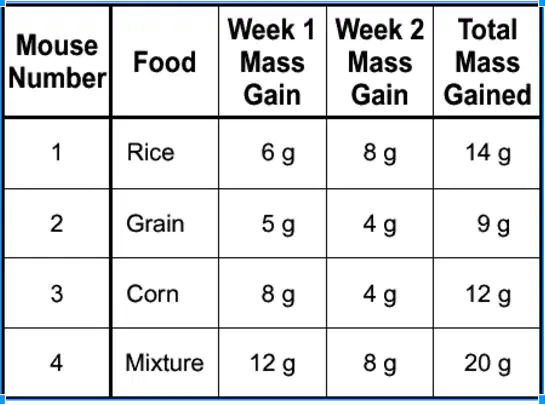
Which of the answers below is a valid claim based on the following table?
a)
the total mass gained is highest when the food eaten is corn only
b)
the total mass gained is lowest when the food eaten is rice only
c)
the total mass gained is highest when the food eaten is a mixture
d)
the total mass gained does not change based on different food types
6.
A scientist conducted an experiment to determine how the amount of salt affects the number of plants that can live in the water? What is the independent variable?
a)
water
b)
number of plants
c)
temperature of water
d)
salt amount in water
7.
Which piece of lab equipment would you use to measure volume of a liquid most accurately?
a)
test tube
b)
beaker
c)
hot plate
d)
graduated cylinder
8.
A scientist is testing the effects of chemicals on an apple field. One orchard gets the chemical, the second orchard does not. In the fall, the number of apples from each orchard is counted. What must be kept constant between the 2 orchards to make sure it is a good experiment?
a)
receive the same amount of sunlight
b)
receive the same amount of water
c)
have the same species of apple
d)
all of the above are needed
9.
The atomic number of an atom indicates:
a)
number of protons
b)
number of neutrons
c)
charge of the atom
d)
mass of the atom
10.
An electron....
a)
has more mass than a proton and has no charge
b)
has no charge and is found outside the nucleus
c)
is found in the nucleus and has negative charge
d)
has less mass than a proton and has negative charge
11.
Mrs. Bailey is working in the lab and has 5 unknown samples of elements. She has already concluded that each sample has a different mass and number of neutrons. QUESTION: Which unknown sample is the element Silver?
a)
Element 1
b)
Element 2
c)
Element 3
d)
Element 4
e)
Element 5
12.
How many protons, neutrons, and electrons are in the following:
a)
16 protons, 34 neutrons, 16 electrons
b)
16 protons, 16 neutrons, 34 electrons
c)
16 protons, 18 neutrons, 16 electrons
d)
16 protons, 16 neutrons, 18 electrons
13.
How many protons are in the following:
a)
63 protons
b)
29 protons
c)
34 protons
d)
92 protons
14.
The atomic MASS number of an element is calculated as:
a)
protons minus neutrons
b)
protons plus neutrons
c)
protons plus electons
d)
electrons minus neutrons
15.
An atom is electrically NEUTRAL because:
a)
neutrons balance the protons and electrons
b)
the number of electrons and neutrons are equal
c)
the number of protons and electrons are equal
d)
the number of protons and neutrons are equal
16.
How many neutrons are in bromine-80?
a)
35
b)
45
c)
70
d)
80
17.
Which of the following statements is NOT true?
a)
atoms of the same element can have different masses
b)
isotopes of an element have different numbers of protons
c)
the nucleus of an atom is positive because of protons
d)
protons and neutrons are located in the nucleus
18.
Isotopes of the same element have DIFFERENT ________?
a)
number of neutrons
b)
number of protons
c)
number of electrons
d)
atomic number
19.
Which of the following correctly identifies a group of the SAME ISOTOPE?
a)
boron-12, carbon-13, nitrogen-18
b)
boron-13, carbon-13, nitrogen-13
c)
carbon-12, carbon-13, carbon-14
d)
boron-11, carbon-12, nitrogen-13
20.
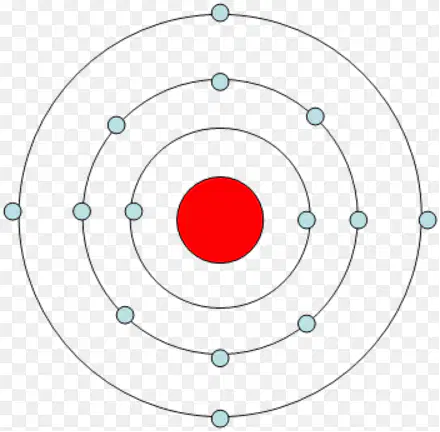
Use the picture to find the numbers of each subatomic particle.
a)
15 protons, 16 neutrons, 18 electrons
b)
15 protons, 31 neutrons, 18 electrons
c)
15 protons, 16 neutrons, 12 electrons
d)
15 protons, 31 neutrons, 12 electrons
21.
If an atom has 11 protons, 11 neutrons, and 10 electrons. What is the CHARGE?
a)
0
b)
+1
c)
-1
d)
22
22.
The periodic table shows that a NEUTRAL magnesium atom has 12 protons. This means that it has ______.
a)
more protons than electrons
b)
12 neutrons
c)
12 electrons
d)
an atomic mass that equals 12
23.
The elements in group 17/7A are called __________________.
a)
Halogens
b)
Alkali Metals
c)
Alkaline Earth Metals
d)
Transition metals
e)
Non-metals
24.
The elements in group 1 are called __________________.
a)
Alkali Metals
b)
Alkaline Earth Metals
c)
Transition metals
d)
Lanthanides
e)
Actinides
25.

BONUS: 1 + 1 =

a)

2

b)
True
c)
False
d)
2
e)
I can't math
26.
The elements in group 2 are called __________________.
a)
Alkaline Earth Metals
b)
Alkali Metals
c)
Transition metals
d)
Lanthanides
e)
Actinides
27.
The elements in group 18/8A are called __________________.
a)
Noble Gases
b)
Alkali Metals
c)
Alkaline Earth Metals
d)
Transition metals
e)
Non-metals
28.
The ____________________ separates the metals and the non-metals
a)
Metalloids
b)
Hallogens
c)
Lanthanides
d)
Metals
e)
Non-Metals
29.
This is the name for group 3-12 elements.
a)
Transition Metals
b)
Hallogens
c)
Lanthanides
d)
Metalloids
e)
Metals
30.
The present day Periodic Table is organized in order of increasing atomic mass.
a)
TRUE
b)
FALSE
31.
This effect blocks the force or pull of protons on the electrons in outer orbitals
a)
Blocking Effect
b)
Sheilding Effect
c)
Guarding Effect
d)
Covering Effect
32.
What is the common name for the group 8a/18 elements?
a)
Metals
b)
Noble Gases
c)
Halogens
d)
Metaloids
33.
What is true of the atom below?
a)
it has 14 valence electrons
b)
it is found in the 4th period
c)
it has 4 valence electrons
d)
it is found in the 1st period
34.
Which of the following elements has the highest number of valence or outer electrons?
a)
Li
b)
P
c)
Br
d)
Ne
35.
Which element would have the greatest atomic radius?
a)
F
b)
P
c)
Al
d)
N
36.
What is ionization energy?
a)
the ability of an atom to attract another atom's electrons
b)
the energy it takes to remove another atom's electrons
c)
the energy coming from the protons in the nucleus
d)
the ability to add electrons to an atom's outer shell
37.
What is electronegativity?
a)
the ability of an atom to attract another atom's electrons
b)
the energy it takes to remove another atom's electrons
c)
the energy coming from the protons in the nucleus
d)
the ability to add electrons to an atom's outer shell
38.
Which element has the greatest ELECTRONEGATIVITY?
a)
F
b)
O
c)
Si
d)
Cl
39.
Why does Cl have a higher IONIZATION energy than Na?
a)
Cl has to gain a higher level electron
b)
Cl has more protons, so it has greater attraction
c)
Na has a stronger pull to keep its outer electron
d)
Na's valence electrons are further away from the nucleus
40.
Where are the metals located on the periodic table?
a)
left side of the staircase
b)
right side of the staircase
c)
the staircase
d)
there are no metals
41.
Which element is found in group 4A, period 3?
a)
Germanium
b)
Titanium
c)
Silicon
d)
There is no element at that location
42.
Which has the greater EN: 
Cl or Al?
a)
Cl
b)
Al
43.
Which has the greater EN: 
N or C?
a)
C
b)
N
44.
Which has the greater EN: 
H or F?
a)
H
b)
F
45.
Which of the following will have a larger radius than Zinc?
a)
Gallium
b)
Aluminum
c)
Magnesium
d)
Strontium
46.
Which of the following will have a higher electronegativity than arsenic (As)?
a)
Carbon (C)
b)
Neon (Ne)
c)
Antimony (Sb)
d)
Germanium (Ge)
47.
Which of the following will have a lower ionization energy than Scandium (Sc)?
a)
Helium (He)
b)
Titanium (Ti)
c)
Calcium (Ca)
d)
Magnesium (Mg)
48.
As atoms of elements in group 16 are considered in order from top to bottom, the electronegativity of each successive element....
a)
decreases
b)
increases
c)
remains the same
d)
none of the above
49.
Which atom has the largest atomic radius?
a)
potassium
b)
rubidium 
c)
francium
d)
cesium
50.
As you move down the periodic table atoms get bigger.  This is because ____________.
a)
The atoms have more mass.
b)
The atoms have more protons.
c)
The atoms have more energy levels
d)
The atoms have more nuetrons
51.
As you move across the periodic table atoms tend to get smaller because, ______________.
a)
the atoms have more mass.
b)
the atoms have less mass
c)
the atoms have more protons.
d)
the atoms have less electrons.
52.
Atoms that have a high electronegativity, _______________.
a)
give up their electrons more easily.
b)
hold on to their electrons more tightly.
c)
have more electron shells.
53.
Electronegativity is...
a)
how good an atom is at attracting electrons
b)
the ability of an atom to lose electrons
c)
the energy required to remove an electron from a specific atom
d)
how easy it is to make friends. 
54.
Ionization energy is...
a)
the energy required to add an electron to a specific atom
b)
how much energy it takes to remove an electron from an atom
c)
the energy required to shield the outer electrons from the nucleus
d)
a measure of the ability of an atom to attract electrons
55.
The atom with the largest atomic radius in Group 18 is - 
a)
Ar
b)
He
c)
Kr
d)
Rn
56.
Which statement correctly and completely identifies a trend?
a)
Atomic radius decreases across a period and increases down a group.
b)
Electronegativity decreases across a period and decreases down a group.
c)
Ionization energy increases across a period and increases down a group.
d)
Ionic radius increases across a period and increases down a group.
57.
The element with the largest electronegativity in the halogens is - 
a)
At
b)
F
c)
Cl
d)
Br
58.

The element with the lowest electronegativity in Period 3 is -

a)

Na

b)

Cl

c)

Ar

d)

Mg

59.
Which periodic group has the smallest atomic radius?
a)
Alkali metals
b)
Halogens
c)
Noble Gases
d)
Transition metals
60.
Atomic radius generally increases as we move __________.  
a)
down a group and from right to left across a period 
b)
up a group and from left to right across a period 
c)
down a group and from left to right across a period 
d)
up a group and from right to left across a period 
61.
Electronegativity __________ from left to right within a period and __________ from top to bottom within a group.
a)
decreases, increases 
b)
increases, increases
c)
increases, decreases 
d)
stays the same, increases
62.

What are the FFA Colors?

a)

Blue and Yellow

b)

Red and Black

c)

National Blue and Corn Gold

d)

Green and Gold

63.

What year did the Future Farmers of America( FFA ) begin?

a)

1928

b)

1999

c)

1918

d)

1975

64.

What law created agricultural education in 1917?

a)

The Ag Education Act

b)

The Smith Hughes Act

c)

The Charlie Brown Act

d)

The Education for All Act

65.

What year was the New Farmers of America, or NFA, created?

a)

1928

b)

1998

c)

1935

d)

1977

66.

Who wrote the FFA creed in 1930?

a)

Leslie Applegate

b)

Ashley Dowdy

c)

E.M. Tiffany

d)

Jimmy Carter

67.

What was the name of the National FFA Organization before it was changed in 1988?

a)

Future Families of America

b)

Farming Fanatics of America

c)

Fully Functioning Athlete

d)

Future Farmers of America

68.

Which of the following is NOT one of the 3 circles of agricultural education?

a)

Classroom Instruction and Labs

b)

SAE (Supervised Agricultural Experience)

c)

FFA

d)

Sports

69.

What does SAE stand for?

a)

Supervised Agricultural Experience

b)

Sapp's Awesome Exposition

c)

Super Awesome Experience

d)

Simple Agriculture Experiment

70.

Which of the following is NOT an FFA degree?

a)

Bachelor's Degree

b)

American Degree

c)

Greenhand Degree

d)

Disocovery Degree

71.

What does the plow represent in the FFA Emblem?

a)

Hard Work

b)

Wisdom

c)

Progress

d)

Learning and Leadership

72.

What does the Owl represent in the FFA Emblem?

a)

Hard Work

b)

Wisdom

c)

Progress

d)

Learning and Leadership

73.

What does the Rising Sun represent in the FFA Emblem?

a)

Freedom

b)

Wisdom

c)

Progress

d)

Learning and Leadership

74.

What does the Eagle represent in the FFA Emblem?

a)

Freedom

b)

Wisdom

c)

Progress

d)

Hard Work

75.

What do the words "Agricultural Education" and "FFA" represent in the FFA Emblem?

a)

Freedom

b)

Learning and Leadership

c)

Progress

d)

Hard Work

76.

What does the Ear of Corn represent on the FFA Emblem?

a)

Freedom

b)

Unity

c)

Progress

d)

Hard Work

77.

What is the highest degree an FFA member can recieve, that only 1% of all FFA members actually get?

a)

Greenhand Degree

b)

Chapter Degree

c)

State Degree

d)

American Degree

78.

The Smith-Hughes Act is named after congressman from which state?

a)

Alabama

b)

Texas

c)

Georgia

d)

Kansas

79.

Doing to (a)  

80.

The president is stationed by the

a)

Ear of Corn

b)

Flag

c)

Rising Sun

d)

Emblem of Washington

81.

How many parts make up the FFA Emblem?

a)

5

b)

6

c)

8

d)

4

82.

(a)   to Live

83.

What is the first line of the FFA Motto?

(a)  

84.

The Cross Section of the Ear of Corn represents

a)

Unity

b)

Brotherhood

c)

Agriculture

d)

Crops

85.

What is the Highest Degree the Chapter can bestow upon its members?

a)

Greenhand

b)

Lonestar

c)

American

d)

Chapter

86.

The Advisor is stationed by the

a)

Plow

b)

Owl

c)

Flag

d)

Desk

87.

This image is known as the

a)

FFA Seal

b)

FFA image

c)

FFA emblem

d)

FFA symbol

88.

The (a)   degree is given to first year member in ag classes.

89.

"FFA makes a (a)   difference in the lives of students by...."

90.

FFA Mission Statement: FFA makes a positive difference in the lives of students by developing their potential for premier _____, personal _____, and _____ success through agricultural education.

a)

Leadership, Growth, Career

b)

LDE, CDE, SAE

c)

Career, Beginnings, Life

d)

Doing, Learning, Earnign

91.
What year was the Official FFA Jacket established as official dress? 
a)
1976
b)
1974
c)
1933
d)
1928
92.
National Blue and Corn Gold were adopted as the official FFA colors in what year? 
a)
1950
b)
1944
c)
1929
d)
1928
93.
The parts of the experiment that must be kept the same.
a)
Constants
b)

Independent variable

c)

Dependent variable

d)

Conclusion

94.

Maya designed an experiment to answer the following question: How does the amount of water given to a lima

bean seed affect how tall it grows?

In this experiment, what variable should Maya CHANGE?

a)

the amount of water

b)

the kind of plant

c)

the type of soil

d)

the amount of sunlight it gets

95.

Esther became interested in insulation while her parent’s new house was being built. She decided to determine which insulation transferred the least heat. She filled each of 5 jars half-full with water.

She sealed each jar with a plastic lid.Then she wrapped each jar with a different kind of insulation. She put the jars outside in the direct sunlight. Later, she measured the temperature of the water in each jar. What is the independent variable?

a)

The type of insulation

b)

The temperature of the water

c)

Number of houses

d)

The amount of sunlight

96.

Why is the placebo effect used?

a)

To compare results between the real medicine and placebo

b)

To make new medicine

c)

To train doctors

d)

To make food

97.
How many variables should you change in an experiment?
a)
none
b)

only 1

c)
2 or more
d)
depends on the type of experiment
98.

The type of variable that responds to the experiment and is what you measure or count to determine if your hypothesis is true.

a)
Independent
b)
Dependent
c)
Control
99.

Thomas tests different types of liquids to see which will grow his plants the most. He has water, soda, milk, and no liquid at all. What is the control group?

a)

the one with water

b)

the one with soda

c)

the one with milk

d)

the one with no liquid

100.
Three baseball players investigate to see who can throw a baseball the farthest. They mark off an area on the playground for their investigation. Which should they keep constant?
a)
height of the players
b)
color of the balls thrown
c)
order in which the players throw
d)
spot from which the players throw
101.
Dory set up an experiment to see how the mass of a ball affects the distance it rolls off a ramp. What is the dependent variable?
a)
distance traveled by the ball
b)
height of the ramp
c)
mass of the ball
d)
ball type
102.

Cindy wanted to find out how the amount of sunlight affects the growth of plants. She placed a tomato plant in 6 identical 10 inch pots with the same amount and type potting soil. She watered them ¼ cup each day. 3 plants were placed under a cardboard box and 3 plants were placed in the sunlight. She measured the growth of the plant each week for three weeks.

What is the dependent variable?

a)

Using the same type of plant

b)

Each plant was placed in a 10 inch pot

c)

The growth of the plant

d)

3 plants in the sunlight and 3 plants under a box

103.
An experiment is performed on plants to see how different liquids affect plant growth. Each plant in the experiment is given a different liquid; water, apple juice, or milk. Each plant has the same amount of soil, sunlight, and listens to the same music. In this investigation, the independent variable is ...
a)
The type of plant
b)
The amount of sunlight
c)
The type of music
d)
The type of liquid
104.
What is the factor that an experimenter changes on purpose?
a)
Dependent Variable
b)
Independent Variable
c)
Constant
d)
Control
105.

A scientist hypothesizes that the temperature at which an alligator's egg is incubated will determine whether the alligator will be male or female. The independent variable is

a)
the male alligators
b)
the incubator
c)
the gender of the alligator
d)
the temperature
106.

Erin is testing to see how different amounts of nitrogen infused in the soil will impact the height of her corn plants. She puts two corn plants into two pots. One is filled with nitrogen infused soil and the other is not. She puts the regular soil pot outside and the nitrogen infused plant in her bathroom. The corn in the regular soil grows to 7 feet tall and the corn in the nitrogen soil grows to 2 feet tall.

What is the dependent variable?

a)

The regular soil

b)

The nitrogen infused soil

c)

The height of the plants

d)

The plant in the bathroom

107.

Using the picture, identify the control group.

a)

Trial 1

b)

Trial 2

c)

Trial 3

108.

What makes a good scientific question?

a)

The question can be answered by yes or no.

b)

The question can be answered by doing an experiment.

c)

The question can be answered through extended thought.

109.

Cindy wanted to find out how the amount of sunlight affects the growth of plants. She placed a tomato plant in 6 identical 10 inch pots with the same amount and type potting soil. She watered them ¼ cup each day. 3 plants were placed under a cardboard box and 3 plants were placed in the sunlight. She measured the growth of the plant each week for three weeks.

What is the independent variable?

a)

Using the same type of plant

b)

Each plant was placed in a 10 inch pot

c)

The growth of the plant

d)

3 plants in the sunlight and 3 plants under a box

110.
What step does every scientific experiment begin with?
a)
hypothesis
b)
question/problem
c)

procedure or test

d)
conclusion
111.

If a laboratory fire erupts, immediately _________.

a)

Run for the fire extinguisher.

b)

Notify your instructor.

c)

Throw water on the fire.

d)

Open the windows.

112.

You are heating a substance in a test tube. Always point the open end of the test tube ________.

a)

Toward yourself.

b)

Toward your lab partner.

c)

Toward another classmate.

d)

Away from all people.

113.

Personal eyeglasses provide as much protection as ________.

a)

A face shield.

b)

Safety goggles/glasses.

c)

Splash proof chemical goggles.

d)

None of these.

114.

The following footwear is required in the lab ________.

a)

Sandals.

b)

Open-toe shoes.

c)

Closed-toe shoes.

d)

Shoes appropriate for the weather.

115.

True or False:

Return all unused chemicals to their original containers.

a)

True

b)

False

116.

True or False:

Chipped or cracked glassware is ok to use.

a)

True

b)

False

117.
When should accidents be reported to the teacher?
a)
if the injury is minor, it doesn't need to be reported
b)
immediately, no matter how small
c)
at the end of class 
118.
In what condition should the work areas should be kept? 
a)
As messy as you like - mess equals creativity.
b)
Clean and tidy at all times
c)
Clean and tidy if there is time, if not the next group will clean up.
d)
With all your books, laptops and art materials on them, in case they are needed.
119.

When smelling a chemical, you should hold it away from your face and ____ the air toward your nose!

a)

waft

b)

drink

c)

clean

d)

fire

120.

You should never ____ anything in the science lab without permission.

a)

drink

b)

equipment

c)

read

d)

fire

121.

When should you tie back long hair or baggy clothing?

a)

When working with chemicals

b)

When working with a Bunsen burner

c)

When doing dissections.

d)

Any time you are working in the lab.

122.
I must follow all instructions, written and verbal, about the laboratory procedures given by the teacher.
a)
True
b)
False
123.

I will perform only those activities that have been authorized by the instructor.

a)

True

b)

False

124.
You should never ______ chemicals in the lab. 
a)
taste
b)
touch
c)
smell
d)
all of the above
125.
If you are not sure what to do during a lab activity:
a)
guess
b)
change lab partners
c)
ask a teacher
d)
just sit quietly and do nothing
126.
Disrupting other students in the laboratory with horseplay in the lab is:
a)
helpful.
b)
allowed
c)
dangerous.
d)
the quickest way to do a job.
127.
What is the most important rule to follow in a science lab?
a)
tie hair back
b)
wear goggles
c)
follow directions
d)
get started right away
128.
When you walk into the science lab, you see the experiment set up at your table. You should:
a)
Start the experiment.
b)
Pick up each of the pieces of equipment.
c)
Wait for the teacher's directions.
d)
Walk around the lab to see other experiment set-ups.