
 Worksheets
Bracket II: Earth Science
Total questions: 122
Worksheet time: 2hrs 47mins
What happens to pieces of rock as they are transported by a river?
they get smaller and rounder
smaller and more jagged
much larger and rounder
gets larger and more jagged
Which is an example of oxidation?
Rust decomposes rocks completely with the passage of time.
Some of the minerals get dissolved in water.
The joints enlarge in size and lime is removed in the solution.
Due to the absorption of water by rocks, its volume increases.
In which of the following climates will chemical weathering be most rapid?
hot and dry
cold and dry
hot and humid
cold and humid
Which is not included in the group?
abrasion
acidification
carbonation
hydration
Weak organic acids are produced by the action of the growing root of lichens. These acids react with some minerals in rocks resulting in the decomposition of rocks. How will you classify this process?
Physical weathering
Chemical weathering
Biological weathering through physical means
Biological weathering through chemical compounds
Which type of rocks tends to weather more rapidly through the hydrolysis process?
Rocks that contain iron.
Rocks that contain feldspar.
Rocks that contain quartz.
Rocks that are impermeable.
What are the two things that affect the rate of weathering?
rain and ice
type of rock and climate
time and date
size of rock and time of the year

Both answers
Neither answer
Which of these MOST LIKELY causes small holes (or pits) that cover old concrete statues?
Water freezes in small cracks in the statue.
The concrete is broken down by acid rain.
Long exposure to sunlight.
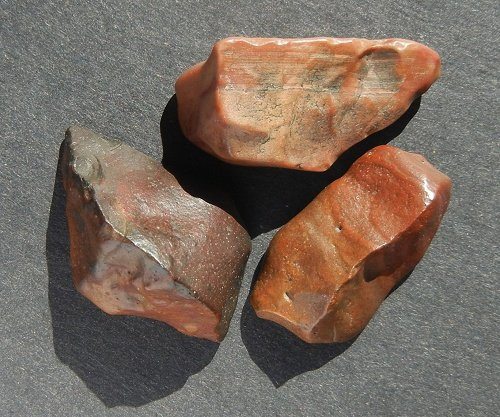

Exfoliation occurs when water continually seeps into cracks, freezes, and expands eventually breaking the rock apart.
Correct
Incorrect
Earthworms are physical weathering agents.
Correct
Incorrect
Is a form of physical (mechanical) weathering in which curved plates of rock are stripped from rock below.
(a)
(a) is the process that happens when the rock type in an area is limestone.
The main type of weathering in these areas is chemical,
Frost climate
Temperate climate
Desert
Humid Tropical climate
What is the organic material formed in soil from the decayed remains of plants and animals called?
bedrock
residual soil
humus
parent rock

What is the soil type: 20%-30%-50%?
Clay
Loam
Sandy clay loam
Clay loam
The layer of soil (Layer A) that is underneath the organic material horizon is called ________________.
topsoil
subsoil
bedrock
Weathered rock
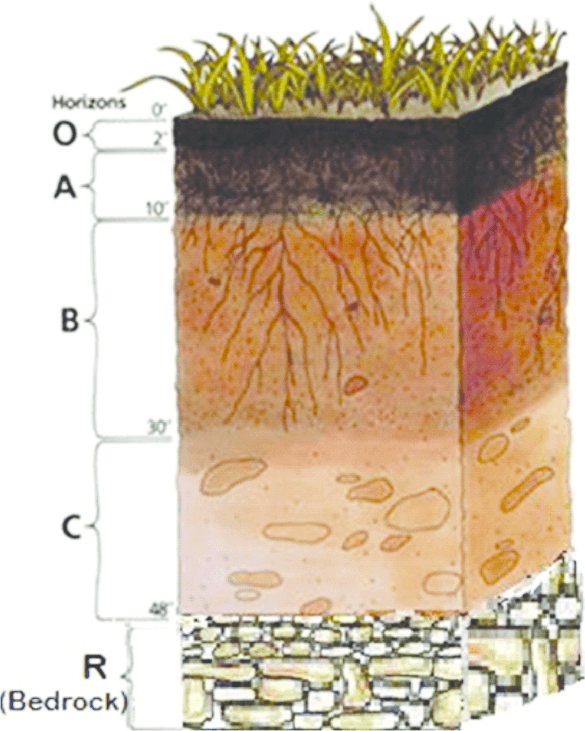
What are the five major factors that influence soil formation?
chronological factors (time), temperature, geology, topography, biological factors, and climate
chronological factors (time), precipitation, geology, temperature, climate
chronological factors (time), geology, topography, biological organisms, and climate
geology, topography, biological organisms, climate, and amount of earthworms
The layer of bedrock is found in which soil horizon?
R Horizon
B Horizon
C Horizon
O Horizon
The downward movement of water through soil and rock due to gravity is _________________________?
Infiltration
Drainage
Percolation
Runoff
When water enters the soil, it first goes through the process of _____________________.
Percolation
Draining
Infiltration
Runoff
One of the following mineral properties can be determined by observing, rather than doing something to a sample.
streak
fracture
luster
hardness
.Cleavage is caused by ____________.
weaknesses in the arrangement of the atoms
strength in the arrangement of the atoms
the hardness of the mineral
the arrangement of the atoms in a repeating pattern
Types of igneous rocks that erupt onto the surface, where they cool quickly to form small crystals.
Ultramafic
Pyroclastic
glassy
Intrusive
Limestone under so much heat and pressure can be transform into _________.
slate
marble
gneiss
granite
Metamorphic rocks that do not have a layered or banded appearance.
Foliated
Carbon based
Silica based
Non foliated
The Mohs scale classifies minerals by their ________.
color
luster
hardness
streak
______________refers to the color of the mineral in its powdered form which may or may not be similar to the color of the mineral.
COLOR
STREAK
HARDNESS
LUSTER
Chemical process where carbonic acid dissolves limestone, forming caves and sinkholes.
(a)
Clay-rich soil that expands when wet and shrinks when dry.
(a)
Dark, partially decayed organic matter that improves soil fertility.
(a)
Igneous rock texture showing large crystals embedded in a fine-grained matrix due to two-stage cooling.
(a)
The sequence describing how different minerals crystallize from cooling magma.
(a)
Boundary between the crust and the mantle, marked by a sudden increase in seismic velocity.
(a)
Rigid outer layer composed of crust and uppermost mantle.
(a)
Type of stress that pulls rocks apart at divergent plate boundaries.
(a)
Uplifted block of crust between two normal faults.
(a)
Lowest layer of the atmosphere where most weather occurs.
(a)
Electrically charged layer important for radio communication.
(a)
Fast, narrow current of air in the upper troposphere that influences storm tracks.
(a)
Boundary between two air masses of different temperature and humidity.
(a)
Prevailing wind during the wet season (May–October) in the Philippines.
(a)
Region of icy bodies beyond Neptune that includes Pluto.
(a)
Path followed by planets around the Sun.
(a)
Layer of the Sun visible during a total solar eclipse as a pearly glow.
(a)
Small body of rock or metal traveling through space, smaller than an asteroid.
(a)
Region between Mars and Jupiter containing numerous small rocky bodies.
(a)
Remnant core of a massive star composed almost entirely of neutrons.
(a)
Diagram that plots a star’s luminosity against its surface temperature.
(a)
Brightness of a star as seen from a standard distance of 10 parsecs.
(a)
Cloud of gas and dust where new stars form.
(a)
Principle stating that present geologic processes operated in the past.
(a)
Fossil used to establish the relative age of rock layers.
(a)
Difference in elevation between adjacent contour lines.
(a)
Deepest parts of the ocean, often at subduction zones.
(a)
Underwater mountain chain formed by seafloor spreading.
(a)
Isolated volcanic peak rising from the ocean floor but not reaching the surface.
(a)
Fertile area of the ocean where cold, nutrient-rich water rises to the surface.
(a)
Floating microscopic plants forming the base of the ocean food web.
(a)
Large, circular surface current in each major ocean basin.
(a)

