wayground logo

Free Printable Worksheets

Font size

S
M
L
XL
Worksheets

Unit 6 Test Review

Total questions: 119

Worksheet time: 2hrs 5mins

Name
Class
Date
1.
Where weather occurs.
a)
stratosphere
b)
thermosphere
c)
troposphere
d)
mesosphere
2.
Where we live.
a)
stratosphere
b)
thermosphere
c)
troposphere
d)
mesosphere
3.
The two most common gases in the atmosphere.
a)
Nitrogen and Oxygen
b)
Oxygen and trace gases
c)
Carbon Dioxide and Nitrogen
d)
Nitrogen and trace gases
4.
What is the function of the ozone layer?
a)
to allow UV rays to get to Earth
b)
to block UV rays from getting to Earth
c)
To keep oxygen in
d)
to allow meteors to get to Earth
5.
Which phenomenon can be seen only in the ionosphere?
a)
ozone layer
b)
Aurora Borealis
c)
Highlands
d)
water vapor
6.
The coldest layer.
a)
troposphere
b)
thermosphere
c)
exosphere
d)
mesosphere
7.
This gas makes up 21% of the atmosphere
a)
ozone
b)
oxygen
c)
nitrogen
d)
water vapor
8.
This gas makes up 78% of the atmosphere
a)
oxygen
b)
nitrogen
c)
ozone
d)
carbon dioxide
9.
What is O3?
a)
Oxygen
b)
Ozone
c)
Oranges
d)
Opposites
10.
What is H2O?
a)
Hydrogen
b)
Water
c)
Happy Oranges
d)
Nitrogen
11.
What is the first layer of the atmosphere?
a)
Mesosphere
b)
Troposphere
c)
Thermosphere
d)
Exosphere
12.
What is the 2nd layer of the atmosphere?
a)
Mesosphere
b)
Exosphere
c)
Troposphere
d)
Stratosphere
13.
What is the 3rd layer of the atmosphere?
a)
Stratosphere
b)

Troposphere

c)
Mesosphere
d)
Exosphere
14.
What is the 4th layer of the atmosphere?
a)

Exosphere

b)
Thermosphere
c)
Mesosphere
d)
Troposphere
15.
Meteors burn up here
a)
Thermosphere
b)
Mesosphere
c)
Exosphere
d)
Troposphere
16.
Space shuttle orbits here
a)
Mesosphere
b)
Stratosphere
c)
Thermosphere
d)
Troposphere
17.
The layers of the atmosphere are classified according to changes in _________.
a)
altitude
b)
density
c)
composition
d)
temperature
18.

What does the ozone layer do in our atmosphere?

a)

It protects the Earth from the sun's harmful ultraviolet radiation

b)

It keeps all of the gases in our atmosphere

c)

It cools down the Earth by reversing the greenhouse effect

d)

It breaks up space rocks and creates meteors

19.

The amount of water vapor in the air is known as ___.

a)

dew point

b)

humidty

c)

relative humidity

d)

rain

20.

When the air is full of water and has a relative humidity of 100% it is said to be ___.

a)

full

b)

humid

c)

saturated

d)

warm

21.

Which will hold more water, warm air or cold air?

a)

Warm Air

b)

Cold AIr

22.
Which weather instrument is useful in measuring relative humidity?
a)
barometer
b)
anemometer
c)
psychrometer
d)
wind vane
23.
The amount of water vapor in the atmosphere compared to how much it could hold.
a)
Saturation
b)
Vaporicity
c)
Absolute Humidity
d)
Relative Humidity
24.
If the air is "saturated", that means:
a)
the air is full of water
b)
the air is partially full of water
c)
it's amount of water vapor in the atmosphere right now
d)
how much liquid water it potentially can hold
25.
The sun heats up surface water, causing evaporation.  The water vapor then rises into the air creating....
a)
rain
b)
ice
c)
fog
d)
humidity
26.

Warm air tends to ______

a)

Rise

b)

Sink

27.

Chlorofluorocarbons is represented by the abbreviation _________________.

a)

CFC

b)

ChFC

c)

Chl

d)

hydrocarbons

28.
Harmful substances in air, water, or soil are called ________________.
a)
pollutants
b)
particles
29.

AQI

a)

Acid rain Quantity Index

b)

measures particulates and ground level ozone

c)

Air Quality Index

d)

measures sulfur dioxide and acid rain

30.

Smog

a)

mixture of smoke and rain

b)

mixture of fog and chemicals

c)

mixture of fog and rain

d)

mixture of smoke, fog, and chemicals

31.

Chlorofluorocarbons (CFCs) is a chemical that has been banned across the world because it destroys ozone. Why do you think it has been banned?

a)

It was reducing the amount of smog

b)

It was reducing the ability of our atmosphere to protect against solar radiation

c)

The world is trying to boycott the aerosol industry

d)

It was increasing the amount of smog

32.

You can find the AQI on your iPhones / androids weather app... What is AQI?

a)

Air Quality Index - determines the amount of pollutants in your immediate area to see if there are any health risks

b)

Average Quality Independent - determines the amount of pollutants in your immediate area to see if there are any health risks

c)

Air Quality Intervention - determines what color the sunset will be

33.

An AQI of 41 falls into the green category and means...

a)

Safe for all

b)

Unsafe for people in sensitive groups

c)

Unhealthy for all people to spend a lot of time outside

d)

Hazardous for anyone to be outside

34.

An AQI of 188 falls into the red category and means...

a)

safe for all people

b)

safe except for people in sensitive groups

c)

unhealthy for all people to spend a lot of time outside

d)

hazardous for anyone to be outside

35.

What is the major cause for noise & air pollution?

a)

deforestation

b)

oil spills

c)

transportation

d)

factories

36.
This type of cloud is thin, wispy, and made of ice crystals
a)
cumulus cloud
b)
stratus cloud
c)
cirrus cloud
d)
cumulonimbus cloud
37.
The temperature at which water vapor condenses is the 
a)
relative humidity
b)
humidity
c)
freezing point
d)
dew point
38.
This type of cloud is thick and puffy on top, and generally flat on the bottom. It has well-defined edges and can change shape rapidly.
a)
cumulus cloud
b)
stratus cloud
c)
cirrus cloud
d)
cloud 9
39.
Nimbostratus and cumulonimbus clouds can signal what type of upcoming weather?
a)
fair skies
b)
hot, sunny weather
c)
windy weather
d)
rainy weather
40.
Which of the following is an example of a cloud of vertical development?
a)
nimbostratus cloud
b)
cumulonimbus cloud
c)
cirrus cloud
d)
stratus cloud
41.
They are highest clouds in the sky. They look curly, white and feathery. Usually mean good weather.
a)
Cumulus
b)
Cumulonimbus
c)
Cirrus
d)
Stratus
42.
True or False: Cirrus clouds often produce rain or drizzle.
a)
True
b)
False
43.
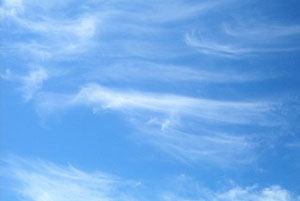
What type of cloud is this?
a)
Cumulonimbus
b)
Cirrus
c)
Nimbus
d)
Stratus
44.

What type of cloud is this? Made of ice crystals, signals snow; high puffy clouds

a)

Cirrocumulus

b)

Altocumulus

c)

Cirrostratus

d)

Altostratus

45.
What type of cloud is this? Middle altitude, flat layer
a)
Altostratus
b)
Cumulonimbus
c)
Altocumulus
d)
Stratocumulus
46.
Clouds are made up of tiny drops of ______ or ice. The moisture in the cloud affects the weather.
a)
dust
b)
water
c)
cloud particles
d)
precipitation
47.
These clouds are the closest to the ground. Their name means layer- or sheet like. They bring rain or snow and cover most of the sky. 
a)
Cirrus
b)
Stratus
c)
Cumulonimbus
d)
Cumulus
48.

Clouds that form very near the ground are called _______________.

a)

smog

b)

haze

c)

fog

d)

dust

49.

Clouds are formed by the process of ______________________.

a)

precipitation

b)

evaporation

c)

condensation

d)

collection

50.

Which word best describes cirrus clouds?

a)

Thick

b)

Grey

c)

Wispy

d)

Layered

51.
What happens to air pressure as you move upward into the atmosphere?
a)
increases
b)
decreases
c)
stays the same
52.
A device that is used to measure atmospheric pressure is a ___________.
a)
barometer
b)
thermometer
c)
kilometer
d)
micrometer
53.
what are isobars?
a)
lines connecting places of equal temperature
b)
lines drawn connecting places of equal pressure
c)
lines drawn to places of different temperatures
d)
lines drawn to places of different pressures
54.
What is altitude?
a)
how much something weighs
b)
the distance above sea level
c)
how big something is
d)
how far away something is
55.
In what direction(s) does air exert pressure?
a)
everywhere
b)
no where
c)
there is no pressure
d)
downward
56.

_____________ is air that flows from areas of high pressure to areas of low pressure.

a)

Convection Cells

b)

Wind

c)

Atmospheric Pressure

57.
_______ pressure systems are characterized by rising air.
a)
High
b)
Low
58.
_______ pressure systems are characterized by cloudy, rainy weather.
a)
High
b)
Low
59.
_______ pressure systems are characterized by fair weather.
a)
High
b)
Low
60.

What causes wind?

a)

differences in air pressure

b)

differences in gravity

c)

difference in oxygen

d)

differences in the thermosphere

61.

What causes differences in air pressure?

a)

even heating of the Earth

b)

Even cooling of the earth

c)

uneven heating of the earth

d)

global warming

62.
Which statement correctly defines wind?
a)
Wind is the movement of air from areas of low pressure to areas of high pressure
b)
Wind is the movement of air to a colder area in the atmosphere.
c)
Wind is the movement of air from areas of high pressure to areas of low pressure.
d)
Wind is the movement of air pushed around and bouncing off Earth's surface.
63.

Air is warmer and less dense at the equator because the equator receives more____________________.

a)

wind

b)

solar radiation

c)

air pressure

d)

condensation

64.

In the Northern Hemisphere, winds traveling north appear to curve east because of the:

a)

trade winds

b)

convection currents

c)

Coriolis effect

d)

polar easterlies

65.
The Coriolis effect is the curving of wind across Earth. What causes winds to curve?
a)
Earth's revolution
b)
Earth's magnetic field
c)
Earth's rotation
d)
Earth's gravitational pull
66.
In which direction do prevailing westerlies flow?
a)
from east to west
b)
from west to east
c)
from north to south
d)
from south to north
67.
This type of wind helped blow trader's ships from Europe to the Americas. It blows winds from EAST to WEST. 
a)
Polar Easterlies
b)
Trade Winds
c)
Prevailing Westerlies
d)
Horse Latitudes
68.

Air leaving the equator cools, becomes more dense, and sinks forming a pattern of smaller ____________________ cells.

a)

conduction

b)

convection

c)

radiation

69.

Zone of weak, variable winds, calm areas; located at 30° N and 30°S

a)

trade winds

b)

polar easterlies

c)

horse latitudes

70.
How do we name air masses?
a)
Water and temperature
b)
Air pressure
c)
Humidity and temperature
d)
Cold and warm
71.
Describe a continental air mass.
a)
Dry
b)
Wet
c)
Cold
d)
Warm
72.
Describe a maritime air mass.
a)
Dry
b)
Wet
c)
Cold
d)
Warm
73.
What types of air masses would be colder?
a)
Maritime
b)
Continental
c)
Polar
d)
Tropical
74.
What types of air masses would be warmer?
a)
Maritime
b)
Continental
c)
Polar
d)
Tropical
75.

Which type of air mass is COLD and DRY?

a)

Maritime Polar

b)

Maritime Tropical

c)

Continental Polar

d)

Continental Tropical

76.

Which type of air mass brings WARM and DRY weather?

a)

Maritime Polar (mP)

b)

Maritime Tropical (mT)

c)

Continental Polar (cP)

d)

Continental Tropical (cT)

77.

Which type of air mass brings WARM and WET weather?

a)

Maritime Polar (mP)

b)

Maritime Tropical (mT)

c)

Continental Polar (cP)

d)

Continental Tropical (cT)

78.

Which type of air mass bring COLD and WET weather?

a)

Maritime Polar (mP)

b)

Maritime Tropical (mT)

c)

Continental Polar (cP)

d)

Continental Tropical (cT)

79.

Which type of air mass bring COLD and DRY weather?

a)

Maritime Polar (mP)

b)

Maritime Tropical (mT)

c)

Continental Polar (cP)

d)

Continental Tropical (cT)

80.

Which air mass would be classified as Maritime Polar (mP)?

a)

purple

b)

green

c)

blue

d)

yellow

e)

red

81.

Which air mass would be classified as Maritime Tropical (mT)?

a)

purple

b)

green

c)

blue

d)

yellow

e)

red

82.

Which air mass would be classified as Continental Tropical (cT)?

a)

purple

b)

green

c)

blue

d)

yellow

e)

red

83.

Which air mass would bring warm and wet weather?

a)

purple

b)

green

c)

blue

d)

yellow

e)

red

84.

Which air mass is higher in humidity?

a)

purple

b)

blue

85.

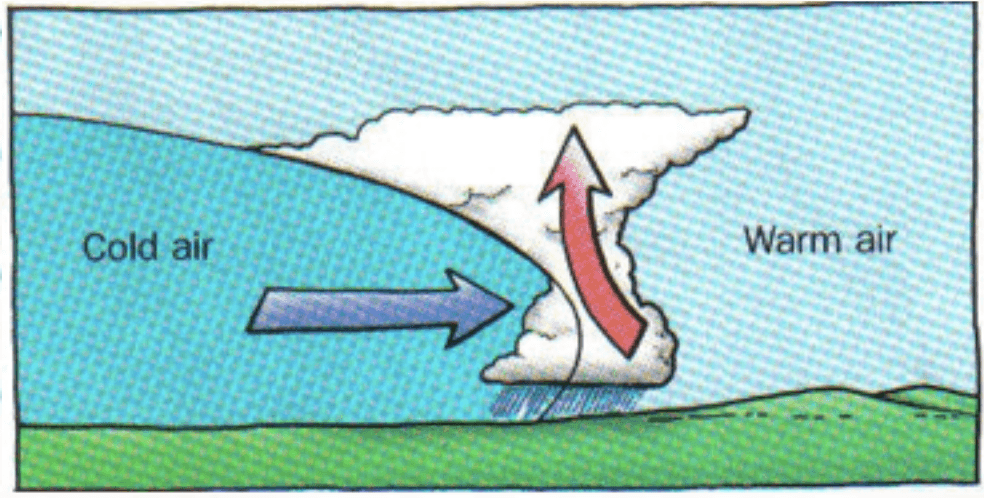
Name that front.

a)

Cold Front

b)

Warm Front

c)

Stationary Front

d)

Occluded Front

86.

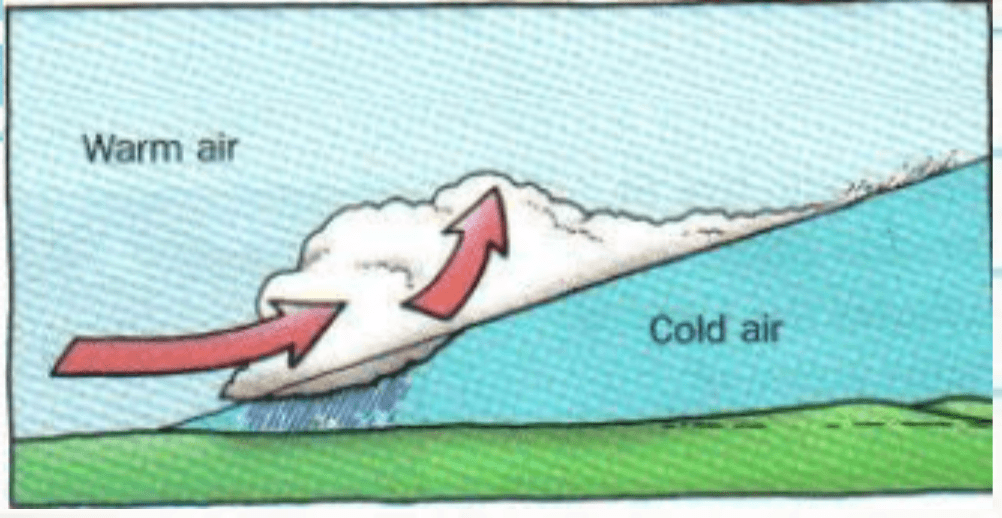
Name that front.

a)

Cold Front

b)

Warm Front

c)

Stationary Front

d)

Occluded Front

87.

Brings some clouds and gentle rains.

a)

Cold Front

b)

Warm Front

c)

Stationary Front

d)

Occluded Front

88.

Cold dense air slides underneath warm air. The warm air is forced up, cools, and condenses.

a)

Cold Front

b)

Warm Front

c)

Stationary Front

d)

Occluded Front

89.
This is the symbol for which type of front?
a)
cold front
b)
warm front
c)
stationary front
d)
occluded front
90.
This is the symbol for which type of front?
a)
cold front
b)
warm front
c)
occluded front
d)
stationary front
91.
This weather instrument is a...
a)
thermometer
b)
wind vane
c)
anemometer
d)
rain gauge
92.
What does this tool measure?
a)
Wind speed
b)
Wind direction
c)
Air pressure
d)
Temperature
93.
What is the name of this tool?
a)
Barometer
b)
Hygrometer
c)
Rain Gauge
d)
Thermometer
94.
This weather instrument is a...
a)
anemometer
b)
barometer
c)
wind vane
d)
thermometer
95.
This weather instrument is an...
a)
wind vane
b)
anemometer
c)
barometer
d)
thermometer
96.
Temperature is measured in...
a)
degrees
b)
inches
c)
centimeters
d)
feet
97.
Which tool measures air pressure?
a)
Thermometer
b)
Barometer
c)
Wind Vane
d)
Hygrometer
98.
Thunderstorm clouds are called - 
a)
Cirrus
b)
Stratus
c)
Cumulus
d)
Cumulonimbus
99.
What happens during the mature stage of a thunderstorm?
a)
The storm begins to break up
b)
The storm creates lightning thunder and heavy rain
c)
The cool air rises and stratus clouds build
d)
The warm air rises and cumulus clouds build
100.

Thunderstorms are the result of which type of pressure system?

a)

Low

b)

High

101.
A tornado is a violent rotating column of air extending from a thunderstorm 
a)
True
b)
False
102.
Collectively, the states of Texas, Oklahoma, Kansas and Nebraska, where tornadoes occur often, are all called
a)
Tornado towns
b)
Storm centers
c)
Tornado Alley
d)
Cyclone counties
103.
Where do tornadoes start?
a)
Over the ocean near the equator
b)
In the clouds that create blizzards
c)
In the clouds of severe thunderstorms
d)
Any time that it rains
104.

Thunder is the sound of what?

a)

Lightning hitting the ground

b)

water molecules colliding in clouds

c)

heated air expanding rapidly

d)

electricity travelling through the air

105.

__________________________ fuel a thundertorm with warm, moist air.

a)

Updrafts

b)

Winds

c)

Clouds

d)

Heat waves

106.

a rating scale developed in 1970 by the scientist T. Theodore Fujita to categorize tornadoes and their relative strength

a)

meteorologist

b)

Fujita Tornado Scale

c)

moisture

d)

Tornado Alley

107.

Which tornado is the most rare?

a)

F1

b)

F3

c)

F4

d)

F5

108.

Where are hurricanes formed?

a)

On cold water

b)

On Warm water

c)

Anywhere near the ocean

d)

In the clouds

109.

How many categories are there for hurricanes?

a)

2

b)

6

c)

4

d)

5

110.

At what speed does a tropical storm become a hurricane?

a)

129 mph

b)

74 mph

c)

156 mph

d)

130 mph

111.

The scale used to measure the size of hurricanes is called the __________.

a)

Saffir-Simpson Scale

b)

Cal-Ripkin Scale

c)

Richter Scale

d)

Bart-Simpson Scale

112.

Hurricanes usually occur between the months of __________.

a)

January and March

b)

April and June

c)

November and January

d)

June and November

113.

Each hurricane gets its own __________.

a)

song

b)

poem

c)

number identification code

d)

name

114.

In the northern hemisphere of the earth hurricanes circle __________.

a)

clockwise

b)

counter-clockwise

c)

up and down

d)

front to back

115.

In the southern hemisphere of the earth hurricanes circle __________.

a)

clockwise

b)

counter-clockwise

c)

up and down

d)

front to back

116.

Both El Nino and La Nina have this in common

a)

Influence birds that migrate over the ocean

b)

Influence rainy / dry weather world wide

c)

The weather at the polar regions

d)

The directions that ships travel in the oceans

117.

The image is of a(n):

a)

El Nino event

b)

La Nina event

c)

Non-El Nino (normal conditions)

118.

The picture below is of a(n) ____ event.

a)

Non-El Nino (Normal)

b)

El Nino

c)

La Nina

119.

The picture represents a(n) ___ event.

a)

El Nino

b)

La Nina

c)

Non-El Nino (normal conditions)