wayground logo

Free Printable Worksheets

Font size

S
M
L
XL
Worksheets

Electricity

Total questions: 123

Worksheet time: 3hrs 41mins

Name
Class
Date
1.
What causes lightning?
a)
A similarity in electrical charge.
b)
Electrons flowing through a conductor.
c)
A difference in electrical charge.
d)
Raindrops conducting electricity from the clouds to the ground. 
2.
A flow of electrons through a conductor is called:
a)
A river
b)
A spark
c)
An electron flow
d)
A current
3.
In most electrical circuits, the pathway is made of:
a)
Wood
b)
Plastic
c)
Metal
d)
Static
4.
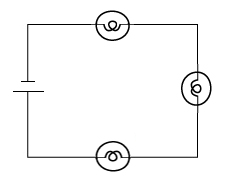
What kind of circuit is this?
a)
Series
b)
Consecutive
c)
Parallel
d)
Training
5.
What kind of circuit is this?
a)
Series
b)
Consecutive
c)
Parallel
d)
Training
6.
What kind of circuit is this?
a)
series
b)
parallel
7.
wood is a _____?
a)
conductor
b)
insulator
8.
A material in which electrons are able to move easily
a)
Circuit
b)
Insulator 
c)
Resistance 
d)
Conductor 
9.
A material in which electrons are not able to move easily 
a)
Circuit 
b)
Insulator 
c)
Resistance 
d)
Conductor
10.
Which statement is true?
a)
The light bulb will light up because the  circuit is complete.
b)
The light bulb will light up because the  circuit is broken.
c)
The light bulb will not light up because the  circuit is complete.
d)
The light bulb will not light up because the  circuit is broken.
11.
In a parallel circuit if one of the light bulbs burns out the rest _________.
a)
stop the flow of electricity
b)
 can still light up
c)
 will go out
d)
of the light bulbs burn out also
12.
Which best describes a parallel circuit?
a)
Electricity flows along one pathway.
b)
The flow of electricity comes from one source. 
c)
Electricity flows along more than one pathway. 
d)
The flow of electricity comes from more than one source. 
13.
Which best describes a series circuit? 
a)
It has two light bulbs. 
b)
The same current flows through both light bulbs. 
c)
It uses a single battery.
d)
The current is divided between the light bulbs. 
14.
____________ allows electricity to flow.
a)
A conductor
b)
An insulator
c)
A magnet
15.
____________ stops the flow of electricity.
a)
A conductor
b)
An insulator
c)
A magnet
16.
To complete a circuit the switch must be
a)
unattached
b)
open
c)
closed
17.
The plastic around the wire is
a)
conductor
b)
insulator
c)
decoration
18.
Two types of circuits are
a)
parallel and magnetic
b)
electromagnetic and series
c)
series and parallel
19.
Would would best complete this circuit?
a)
A wire
b)
A switch
c)
A battery
d)
A light bulb
20.
Metals such as copper, iron, gold, and silver are ...
a)
conductors
b)
brittle
c)
insulators
d)
resistors
21.
What types of charges attract?
a)
Positive and Positive
b)
Positive and Neutral
c)
Negative and Neutral
d)
Positive and Negative
22.
A ________________ circuit has more than one path for energy to follow.
a)
series
b)
parallel
23.
A ______________ circuit has only one path for electric energy to follow.
a)
parallel
b)
series
24.
What type of circuit is shown in the picture?
a)
Double circuit
b)
Series circuit
c)
Magnetic circuit
d)
Parallel circuit
25.
What type of circuit is shown in the picture?
a)
Series
b)
Parallel
c)
Double
d)
Switch
26.
The picture shows an electrical circuit. This circuit is a series circuit because: 
a)
It has 3 light bulbs.
b)
The same current flows through all three light bulbs.
c)
It uses a single battery.
d)
The electrical current is divided between the three light bulbs.
27.
A pathway for electricity to travel is called___________
a)
current
b)
static electrcity
c)
circuit
d)
circle
28.
What is a switch's function in a circuit?
a)
to make the current hotter or colder
b)
turn on and off the flow of current
c)
the pathway that current flows
d)
to add more power to the circuit
29.
In a parallel circuit if one light bulb goes OUT; then they ALL go out. TRUE OR FALSE?
a)
TRUE
b)
FALSE
30.
When there is only one path for electrons to move through it is called a _____. When one light goes out, they all go out. 
a)
closed circuit
b)
parallel circuit
c)
series circuit
d)
open circuit
31.
This is the symbol for a _____?
a)
switch
b)
light 
c)
battery
d)
wires
32.
Does this diagram represent a series or parallel circuit?
a)
series circuit
b)
parallel circuit
33.
A conductor is?
a)
material that current can pass through easily
b)
material that current cannot pass through easily
c)
magnet
d)
electric current
34.
What kind of circuit is this?
a)
Series
b)
Consecutive
c)
Parallel
d)
Training
35.
What kind of circuit is this?
a)
Series
b)
Consecutive
c)
Parallel
d)
Training
36.
Electricity is the flow of _________.
a)
Protons
b)
Neutrons
c)
Electrons
37.
What charge does an electron have?
a)
negative (-)
b)
positive (+)
c)
neutral or no charge (0)
38.
What charge does a proton have?
a)
negative (-)
b)
positive (+)
c)
neutral or no charge (0)
39.
A continuous flow of electricity is called_____________
a)
series
b)
circuit
c)
static
d)
current
40.
Which of these materials is a good insulator?
a)
Plastic and metal
b)
Metal and rubber
c)
Plastic and rubber
41.
What is a material that resists, or does NOT allow, energy to flow through?
a)
circuit
b)
insulator
c)
series
d)
conductor
42.
A form of energy produced when electrons move from one place to another.
a)
Gravity
b)
Electricity
c)
Heat
d)
Solar
43.
A material that limits the flow of electrical current but does not stop it completely.
a)
Battery
b)
Conductor
c)
Insulator
d)
Resistor
44.
What type of circuit will allow one light bulb to stay on while a second light bulb is turned off?
a)
Open
b)
Parallel
c)
Series
d)
Closed
45.
Electricity is the flow of ______.
a)
electrons
b)
protons
c)
neutrons
d)
atoms
46.
What is static electricity?
a)
the flow of electric charges
b)
the build-up of an electrical charge on a surface.
c)
the opposition of current flow. 
47.
A material in which electrons are able to move easily
a)
Circuit
b)
Insulator 
c)
Resistance 
d)
Conductor 
48.
A material in which electrons are not able to move easily 
a)
Circuit 
b)
Insulator 
c)
Resistance 
d)
Conductor
49.
A closed path that electric current follows 
a)
Voltage
b)
Current
c)
Resistance 
d)
Circuit
50.
Which best describes a parallel circuit?
a)
Electricity flows along one pathway.
b)
The flow of electricity comes from one source. 
c)
Electricity flows along more than one pathway. 
d)
The flow of electricity comes from more than one source. 
51.
How many different types of circuits are there? 
a)
1
b)
3
c)
2
d)
4
52.
The charge that stays on an object that can either repel or attract objects is
a)
static electricity
b)
conductor
c)
insulator
d)
force
53.
Electricity is the flow of _________.
a)
Protons
b)
Neutrons
c)
Electrons
54.
a build up of charged particals
a)
electricity
b)
electric current
c)
static electricity
d)
circuit
55.
What does a resistor do? 
a)
Reduces the flow of electrons
b)
Reduce the flow of the current
c)
Increase flow of electrons
d)
Decreases the flow of electrons 
56.
What types of charges attract?
a)
Positive and Positive
b)
Positive and Neutral
c)
Negative and Neutral
d)
Positive and Negative
57.
The accumulation of excess electric charge on an object is called
a)
Static electricity 
b)
Electric discharge
c)
Resistance
d)
Circuit 
58.
Electric charges that are alike _______ each other.
a)
Attract
b)
Repel
59.
Electric charges that are different _______ each other.
a)
Attract
b)
Repel
60.
What charge does a proton have?
a)
negative (-)
b)
positive (+)
c)
neutral or no charge (0)
61.
What charge does an electron have?
a)
negative (-)
b)
positive (+)
c)
neutral or no charge (0)
62.
If a substance has a higher number of electrons than protons on its surface, what type of charge does it have?
a)
A positive charge.
b)
A negative charge.
c)
A neutral charge
d)
No charge at all
63.
How do electrons differ from protons?
a)
They are the same thing
b)
Electrons hold a negative charge and protons hold a positive charge.
c)
Electrons are positively charged and protons are negatively charged.
d)
Protons are neutral 
64.
Which of the following is caused by static electricity?
a)
a stove getting hot when it is turned on
b)
a magnet being attracted to a refrigerator
c)
a lightning strike during a storm
d)
a light bulb coming on when a switch is turned on
65.
True or False, Lighting is a form of static electricity.
a)
True
b)
False
66.
What is the continuous movement of electrons called? 
a)
static electricity
b)
current electricity
c)
friction
d)
power
67.
Electrical charge built up on the surface of an object is called _________________.
a)
static electricity
b)
current electricity
c)
lightning
d)
electrons
68.
What are the charged parts of an atom?
a)
proton and neutron
b)
proton and electron
c)
neutron and electron
d)
proton, neutron, and electron
69.
An object that is neutral contains the same number of electrons and protons.
a)
True
b)
False
70.
What would have to happen for an atom to become negatively charged?
a)
Gain protons
b)
Gain electrons
c)
Lose protons
d)
Lose electrons
71.
What would have to happen for an atom to become positively charged?
a)
Gain protons
b)
Gain electrons
c)
Lose protons
d)
Lose electrons
72.
two objects with the same charge will move away from each other
a)
attraction
b)
repel (repulsion)
c)
conduct
d)
insulate
73.
two objects with opposite charges will move towards each other
a)
attract
b)
repel (repulsion)
c)
conduct
d)
insulate
74.
a flow of electric charge
a)
static electricity
b)
electrical field
c)
electric current
d)
electrical charge
75.
the charging of an object through rubbing.
a)
friction
b)
induction
c)
conduction
d)
neutralization
76.
the negatively charged particle in an atom. Moves freely. Can be released, shared, or “stolen” from an atom.
a)
proton
b)
neutron
c)
electron
77.
the neutral particle in an atom. Stays in the nucleus.
a)
proton
b)
neutron
c)
electron
78.
An electric circuit is a closed loop or pathway that allows electric charges to flow.
a)
True
b)
False
79.
A ______ opens and closes a circuit. 
a)
power source
b)
conductor
c)
switch
d)
output device
80.
Electricity is the flow of _________.
a)
Protons
b)
Neutrons
c)
Electrons
81.
This is the symbol for a ...
a)
Wire
b)
Battery
c)
Buzzer
d)
Fuse
82.
This is the circuit symbol for ...
a)
an AC current source
b)
a DC current source
c)
a battery
d)
a single cell
83.
This is the circuit symbol for ...
a)
an AC current source
b)
a DC current source
c)
an ammeter
d)
a voltmeter
84.
This is the circuit symbol for ...
a)
an AC current source
b)
a DC current source
c)
an ammeter
d)
a voltmeter
85.
Electric current is the flow of:
a)
electrons
b)
protons
c)
neutrons
d)
none of these
86.
Choose the corrrect sentence.
a)
This circuit will work because it is an open circuit
b)
This circuit will work because it is a closed circuit.
c)
This circuit will NOT work because it is an open circuit.
d)
This circuit will NOT work because it is a closed circuit.
87.
This is the symbol for a ...
a)
Bulb
b)
Battery
c)
Horn
d)
Fuse
88.
Electrical lights will not come on unless their electrical circuit is a --
a)
parallel circuit
b)
series circuit
c)
closed circuit
d)
short circuit
89.
Will the light bulb in this circuit light and why/why not?
a)
yes, because it has two batteries
b)
no, because the switch is open
c)
yes, because it is in a circuit
d)
no, because the bulb is burned out
90.

What is the following symbol represent?

a)

Wire

b)

Resistor

c)

Battery

d)

Switch

91.
a)
Motor
b)
Mouse
c)
Ground
d)
Fuse
92.
What is the energy source for a circuit?
a)
Light bulb
b)
Battery
c)
Wire
d)
Switch
93.
What is it called when a circuit is complete?
a)
Closed circuit
b)
Light bulb circuit
c)
Open circuit
d)
Series circuit
94.
a)
Wire
b)
Light
c)
Battery
d)
Switch
95.

This is needed in a circuit to start the electrons moving.

a)

light

b)

power source

c)

switch

d)

wire

96.

Identify the component

a)

Bell

b)

Ammeter

c)

Power Supply

d)

Globe

97.

Identify the component

a)

Closed Switch

b)

Open Switch

c)

Globe

d)

Wire

98.
In a Series circuit the more lightbulbs you add the brighter they get 
a)
False 
b)
True 
99.
Bits of paper are attracted to the surface of this balloon.  What attracts the paper pieces to the balloon?
a)
Friction
b)
Static Electricity
c)
Magnetism
d)
Potential Energy
100.
How many Volts would it take to push 1 Amp through a resistance of 1 Ohm
a)
10 volts
b)
1 volt
c)
48 volts
d)
5 volts
101.
What size resistor would produce a 3 Amp current flow with a 12 Volt battery
a)
1 Ohm
b)
3 Ohms
c)
4 Ohms
d)
12 Ohms
102.
How many Volts would we need to produce a current flow of 8 Amps through a 6 Ohm resistor
a)
12 volts
b)
24 volts
c)
1.3333
d)
48 volts
103.
What is current measured in?
a)
Ω (Ohms)
b)
V (Volts)
c)
A (Amps)
d)
W (Watts)
104.
What is resistance measured in?
a)
Ω (Ohms)
b)
V (Volts)
c)
A (Amps)
d)
W (Watts)
105.
What is Resistance?
a)
The flow of electrons
b)
Electric potential difference
c)
A battery
d)
The ability to reduce the flow of electrons
106.
What is the Voltage of a circuit that has a resistance of 5 Ω and a current of 2 A?
a)
25 V
b)
10 V
c)
2.5 V
d)
0.4 V
107.
The mathematical relationship among Voltage, Current, and Resistance
a)
Faraday's Law
b)
Tesla's Law
c)
Edison's Law
d)
Ohm's Law
108.
Current times Resistance equals
 (I X R)
a)
Power
b)
Voltage
c)
Amperage
d)
Ohm
109.

Voltage divided by Resistance

(V / R)

a)

Current

b)

Power

c)

Ohms

d)

Watts

110.

Voltage divided by Current

(V / I)

a)

Current

b)

Power

c)

Resistance

d)

Watts

111.
How many Volts would we need to produce a current flow of 8 Amps through a 6 Ohm resistor
a)
12 volts
b)
24 volts
c)
1.3333
d)
48 volts
112.

What is the name for the pressure that forces electrons to flow through a circuit?

a)

Voltage

b)

Capacitance

c)

Resistance

d)

Current

113.
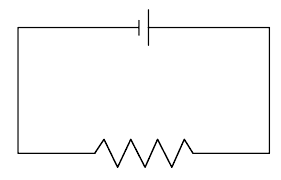
This circuit has a 24 volt battery and the resistor is 8 ohms. How many amps are running through the circuit?
a)
3 Amps
b)
192 Amps
c)
2 Amps
d)
4 Amps
114.
What word means how hard it is for electrons to flow through.
a)
Current
b)
Voltage
c)
Resistance
d)
Power
115.
What word means how fast the electrons flow.
a)
Current
b)
Voltage
c)
Resistance
d)
Power
116.
What would the circuit resistance be if a 7.5 Amp draw was present with the engine running and the charging system producing 15 Volts
a)
15 Ohms
b)
4 Ohms
c)
0.3333 Ohms
d)
2 Ohms
117.
What letter represents Current?
a)
A
b)
I
c)
R
d)
E
118.
How do you calculate current
a)
Resistance X Voltage
b)
Voltage X Resistance
c)
Resistance ÷ Voltage
d)
Voltage ÷ Resistance
119.
What voltage is needed to cause a 2A current flow through a 10Ω resistor?
a)
5V
b)
0.2V
c)
20V
d)
200V
120.
What resistance is needed to cause a 20A current flow because of a 100V battery?
a)
0.2Ώ
b)
2000Ώ
c)
120Ώ
d)
121.
What resistance is needed to cause a 50A current flow because of a 500V battery?
a)
10Ώ
b)
c)
2500Ώ
d)
550Ώ
122.

Which best describes a parallel circuit?

a)

Electricity flows along one pathway.

b)

The flow of electricity comes from one source.

c)

Electricity flows along more than one pathway.

d)

The flow of electricity comes from more than one source.

123.

A series circuit has ____ path(s) that the electric current can take.

a)

One

b)

Two

c)

Three

d)

Four