
 Worksheets
Earth Space and Scientific Inquiry
Total questions: 123
Worksheet time: 2hrs 20mins
Name
Class
Date
1.
A possible explanation for a set of observations or answer to a scientific question.
Must be something that can be tested.
Typically worded as an if...... then........ statement.
Must be something that can be tested.
Typically worded as an if...... then........ statement.
a)
hypothesis
b)
scientific inquiry
c)
data
d)
controlled experiment
2.
Any factor that can change in an experiment.
a)
responding variable
b)
manipulated variable
c)
controlled experiement
d)
variable
3.
The ongoing process of discovery in science; the diverse ways in which scientists study the natural world and propose explanations based on evidence they gather.
a)
experiment
b)
hypthesis
c)
scientific inquiry
d)
communicating
4.
The observations and measurements you make in an experiment.
a)
data
b)
operational definition
c)
hypothesis
d)
scientific inquiry
5.
An experiment in which all factors except one are kept constant.
a)
responding variable
b)
controlled experiment
c)
manipulated variable
d)
hypothesis
6.
The factor that changes as a result of the manipulated variable. What you measure or observe to obtain you results.
a)
responding variable
b)
operational definition
c)
data
d)
manipulated variable
7.
The factor in an experiment that you change.
a)
variable
b)
manipulated variable
c)
responding variable
d)
controlled experiment
8.
Studies the solid portions of the earth, including volcanoes, earthquakes, and fossils.
a)
Geology
b)
Geography
c)
Cartography
d)
Oceanography
9.
Weather, climate, and the atmosphere are studied in this branch of Earth Science.
a)
Astronomy
b)
Meteorology
c)
Cartography
d)
Geology
10.
The study of the physical and biological parts of Earth's oceans.
a)
Geology
b)
Geography
c)
Cartography
d)
Oceanography
11.
The study of the stars and other celestial bodies.
a)
Meteorology
b)
Astronomy
c)
Oceanography
d)
Astrology
12.
Which is NOT a step in the scientific method?
a)
Make observation
b)
Form a theory
c)
Collect data
d)
Form a hypothesis
13.
Should experiments be repeated over and over to see if the results are the same each time?
a)
yes
b)
no
14.
There are two types of data. Which type of data involves numbers that are obtained by counting or measuring?
a)
quantitative
b)
qualitative
15.
There are two types of data. Which type of data involves descriptions that cannot be counted or measured?
a)
qualitative
b)
quantitative
16.
Many breeds of dogs are used for work. In many cultures dogs are used to herd sheep. The dogs keep the flock from being attacked by animals such as wolves. They also keep sheep from wandering off. Sheepdogs are known for their loyalty and gentleness. Based on your reading of the text, you can INFER that:
a)
Sheepdogs are not very smart dogs.
b)
Sheepdogs are gentle and loyal.
c)
There are many breeds of dogs.
d)
Wolves are afraid of sheepdogs.
17.
Is this a good hypothesis?
If I raise the temperature of a cup of water, then the amount of sugar that can be dissolved in it will be increased.
If I raise the temperature of a cup of water, then the amount of sugar that can be dissolved in it will be increased.
a)
Yes
b)
No
18.

This volcano is an example of something you would find in the:
a)
Atmosphere
b)
Biosphere
c)
Hydrosphere
d)
Geosphere
19.

This picture shows
a)
Atmosphere
b)
Biosphere
c)
Hydrosphere
d)
Geosphere
20.

A farmer plowing a field to plant crops:
a)
Biosphere-Atmosphere
b)
Biosphere-Geosphere
c)
Biosphere-Hydrosphere
d)
Geosphere-Hydrosphere
21.

Caves are formed:
a)
Biosphere-Atmosphere
b)
Geosphere-Hydrosphere
c)
Hydrosphere-Atmosphere
d)
Biosphere-Hydrosphere
22.
What are other NAMES for dependent variable?
a)
responding variable and outcome
b)
outcome and change
c)
manipulated variable and test
d)
manipulated variable and responding variable
23.
This person's hypothesis is: "If I add salt to the plant, then it will grow taller."
When planning their experiment, what should be 2 constants (controlled variables)?
When planning their experiment, what should be 2 constants (controlled variables)?
a)
type of plant and amount of light
b)
type of plant and amount of salt
c)
amount of growth and amount of water
d)
amount of growth and amount of salt
24.
If an object has a density of 3.6 g/mL and you put it into water, will it sink or float?
a)
sink
b)
float
25.

What is the volume of the fish?
a)
18.0 cm3
b)
6.0 cm3
c)
38.0 cm3
26.
______ is the ability of an object to float in a liquid.
a)
Density
b)
Buoyancy
c)
Archimedes' Principle
d)
Volume
27.
Why does ice float?
a)
Liquid water is less dense than solid water.
b)
Solid water is less dense than liquid water.
c)
Gaseous water is less dense than solid water.
d)
Liquid water is less dense than gaseous water.
28.
Which lab tool might you use to measure the volume of a liquid?
a)
electric scale
b)
bunsen burner
c)
test tube
d)
graduated cylinder
29.

What is the volume of Object X?
a)
10.0 cm3
b)
15.0 cm3
c)
20.0 cm3
d)
25.0 cm3
30.

I have two objects with the same volume but different masses. Which object will be more dense?
a)
The object with less weight.
b)
The object with more weight.
c)
The object with more mass.
d)
The object with less mass.
31.
Frank has a paper clip. It has a mass of 9g and a volume of 3cm3. What is its density?
a)
3 g/cm3
b)
1/3 g/cm3
c)
27 g/cm3
d)
39 g/cm3
32.
The tool used to measure the mass of a substance or object is a ______________.
a)
balance
b)
graduated cylinder
c)
ruler
d)
thermometer
33.
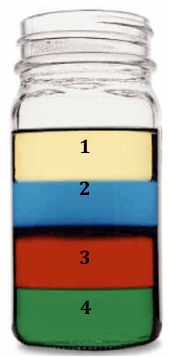
Put the liquids in order from most dense to least dense?
a)
4, 3, 2, 1
b)
1, 2, 3, 4
c)
3, 4, 2, 1,
d)
4, 3, 1, 2
34.

Which box has a higher density?
a)
Box A
b)
Box B
c)
cannot be determined
d)
they are the same
35.
What is the formula for density?
a)
density = mass x volume
b)
density = mass / volume
c)
density = mass + volume
d)
density = mass - volume
36.
Frank has an eraser. It has a mass of 4g, and a volume of 2cm3. What is its density?
a)
8 g/cm3
b)
2 g/cm3
c)
1/2 g/cm3
d)
24 g/cm3
37.

Complete the hypothesis:
If I eat too much....
If I eat too much....
a)
then I will get an upset stomach
b)
I will get an upset stomach
c)
it's bad for me
d)
nothing will happen
38.
Any information that is collected with tools or any of the senses.
a)
Observation
b)
Model
c)
Control
d)
Peer Review
39.
The initial stage of an experiment that involves finding background information, developing a hypothesis, and devising an experimental method for testing the hypothesis.
a)
Data
b)
Opinion
c)
Control
d)
Research plan
40.
The group in an experiment in which everything-except the variable to be tested is identical: the standard of comparison in an experiment.
a)
Conclusion
b)
Peer Review
c)
Evidence
d)
Control
41.
The decision made about the outcome of an experiment; usually based on how well the actual result matches the predicted result.
a)
Conclusion
b)
Bias
c)
Data
d)
Assumption
42.
A representation used to explain or demonstrate a process or structure; also used to predict what may occur in a new situation
a)
Conclusion
b)
Hypothesis
c)
Model
d)
Experiment
43.
A series of trials or tests that are done to support or refute hypothesis.
a)
Data
b)
Control
c)
Experiment
d)
Model
44.
The results of specific trials or tests completed during experiments.
a)
Data
b)
Control
c)
Research
d)
Model
45.
Support for the idea that something is true.
a)
Evidence
b)
Model
c)
Conclusion
d)
Observation
46.
The process by which scientists carefully examine the work of other scientist to look for possible flaws in their experimental design or their interpretation of results.
a)
Opinion
b)
Inference
c)
Control
d)
Peer Review
47.
which is an example of a quantitative observation?
a)
the ant is 3 centimeters long
b)
the clouds are big and white
c)
the classroom feels cold
48.

Which of the following is an observation about this picture?
a)
The player is wearing a red jersey
b)
the red team is going to score a touch down
c)
the quarterback is getting the ball
49.

Which of the following is an inference about this picture?
a)
The player is wearing a red jersey
b)
the red team is going to score a touch down
c)
the quarterback is getting the ball
50.

The things that may change or vary in an experiment are also known as what?
a)
hypothesis
b)
variables
c)
investigation
d)
conclusion
51.
Variables that are kept the same or not changed in an experiment.
a)
independent variable
b)
controlled variable
c)
dependent variable
52.
A student hypothesized that robins prefer large birdhouses to small ones. He build four birdhouses of different sizes to test his hypothesis. What was the independent variable in the students study?
a)
The size of the birdhouse
b)
The number of birds in the house
c)
The location of the birdhouse
d)
The season of the year
53.
Studies the solid portions of the earth, including volcanoes, earthquakes, and fossils.
a)
Geology
b)
Geography
c)
Cartography
d)
Oceanography
54.
Which of the following is a condition that will preserved remains?
a)
amber
b)
frozen in permafrost
c)
tar
d)
all of these are correct
55.
What is hardened tree sap called?
a)
coprolites
b)
index fossils
c)
gastroliths
d)
amber
56.
Which of the following is an example of a trace fossil?
a)
petrified wood
b)
index fossils
c)
gastroliths
d)
amber
57.
The hollowed out impression in a rock that is the same shape as a shell.
a)
cast
b)
mold
c)
trace fossil
d)
index fossil
58.
A fossil is...
a)
a radioactive element used to determine the age of a rock layer
b)
the remains or evidence of a once-living organism
c)
only the hard parts of a organism
d)
only found in ice
59.
How do fossils form?
a)
Living things die and their remains are covered by sediment
b)
insects are covered in tree sap
c)
all of these are correct
d)
Freezing preserves the remains of an organism
60.
Why don't all living things become fossils?
a)
because some living things are too small
b)
because some living things are too big
c)
because some are subject to catastrophism and others are not
d)
because environmental conditions have to be just right to prevent decay
61.
Why is a fossil dinosaur bone much heavier than the original bone it was made from?
a)
it has absorbed water
b)
it is much older
c)
much of it has dissolved
d)
it is now made of minerals
62.
Fossils that haven't changed over time, all tissues are still intact.
a)
index fossils
b)
trace fossils
c)
petrified fossils
d)
preserved remains
63.
Fossils of fish are found under land where cows now live. What does this tell you?
a)
the fish were dropped their by flying birds
b)
this land was once under the ocean
c)
farmers fed the fish to the cows
d)
fish used to live on land
64.
Why don't all living things become fossils?
a)
because some living things are too small
b)
because some living things are too big
c)
because some are subject to catastrophism and others are not
d)
because environmental conditions have to be just right to prevent decay
65.

Which of the following is NOT an example of a fossil?
a)
a petrified dinosaur bone
b)
a footprint captured in mud
c)
a seashell found on the beach
66.

a scientist who studies fossils
a)
geologist
b)
biologist
c)
paleontologist
d)
chemist
67.
gone forever. all one kind of a plant or animal dies
a)
trace fossil
b)
extinct
c)
preserved
d)
paleontologist
68.
How are fossils formed?
a)
Insects are caught in tree sap that turns into amber
b)
Hard parts of animals are trapped in sedimentary rock
c)
Both a and b
d)
None of the above
69.
Which of these animals are extinct?
a)
elephants
b)
mammoths
c)
caterpillars
d)
sea animals
70.
Most fossils are found in metamorphic rocks
a)
true
b)
false
71.
What type of fossil is a mold?
a)
a cavity made by a shell (cake pan)
b)
a type of fossil that forms when sediments fill in the cavity left behind by a shell
72.
What type of fossil is a cast fossil?
a)
a cavity made by a shell (jello mold)
b)
a type of fossil that forms when sediments fill in the cavity (jello)
73.
What is relative dating?
a)
determining whether an event or object is older or younger than other events or objects
b)
the principle that states that younger rocks lie above older rocks
c)
an arrangement of rock layers in which the oldest rocks are at the bottom
d)
an intrusion
74.
Fossils are most often preserved in?
a)
ice
b)
amber
c)
tar pits
d)
rock
75.

What is an example of an index fossil?
a)
t-rex fossils
b)
insect in amber
c)
trilobites or ammonites
d)
woolly mammoth fossils
76.

Is this cake pan the mold or cast?
a)
mold
b)
cast
77.

What is a way an organism can become a fossil?
a)
amber
b)
strata
c)
geologic column
d)
superposition
78.
Fossils usually provide paleontologists with information about each of the following except:
a)
An organism's structure
b)
An organism's DNA
c)
An organism's size
d)
Where the organism came from
79.
Most fossils are found in:
a)
Murky water
b)
Sedimentary rock
c)
Volcanic rock
d)
Ice
80.
After Precambrian Time, the basic divisions of the geologic time scale, from largest to smallest, are:
a)
Periods, Eras, Eons
b)
Eons, Periods, Eras
c)
Eras, Eons, Periods
d)
Eons, Eras, Periods
81.
To compare the relative ages of rocks, scientists sometimes use an easily recognized and widespread fossil type called:
a)
Radioactive decay
b)
An inventory fossil
c)
An index fossil
d)
A radioactive fossil
82.
Fossilized evidence of Earth's first forms of life would most likely consist of:
a)
Mammals from Precambrian
b)
Invertebrates from Precambrian
c)
Eukaryotes from Precambrian
d)
Prokaryotes from Precambrian
83.
An event during which many types of living things suddenly die out is called a(n):
a)
Tsunami
b)
Spontaneous Event
c)
Extinction
d)
War
84.
What are fossil fuels made of?
a)
Products made in refineries
b)
Remains of marine plant and animal life
c)
Renewable plant and animal matter
d)
Living bacteria byproducts
85.
Which of the following theories explains why the edges of Africa and South America fit together like a puzzle?
a)
Continental Drift
b)
Plate Tectonics
c)
Big Bang
d)
Meteor
86.
Length of time for half of the radioactive atoms in a sample to decay
a)
Radioactive decay
b)
Half-life
c)
Relative dating
d)
Index fossil
87.
What does carbon-14 decay into?
a)
Nitrogen
b)
Lead
c)
Uranium
d)
Cobalt
88.
Where are older rock layers found?
a)
on top of younger rock layers
b)
under younger rock layers
c)
near igneous intrusions
d)
near faults
89.
Which of the following is an index fossil?
a)
brachiopods
b)
tyrannosaurus rex
c)
coprolites
d)
trilobites
90.
___________ is the idea that the earth changes very rapidly over short periods of time.
a)
uniformitarianism
b)
catrastorphism
c)
superposition
d)
disconformities
91.
Most fossils are found in __________ rock layers
a)
metamorphic
b)
sedimentary
c)
igneous
92.
What is the half life of carbon-14?
a)
10,000 years
b)
5,730 years
c)
2,135 years
d)
1,025 years
93.
A fault is always _________ than the layers of sedimentary rock it cuts through.
a)
older than
b)
younger than
c)
the same age as
94.
I found a layer of sandstone with a 400 million year old trilobite in it. Laying below is a layer of metamorphic rock. Which of the following must be true?
a)
the metamorphic rock must be younger than 400 million years old.
b)
The sandstone is greater than 800 million years old.
c)
The metamorphic rock must be at least 400 million years old.
d)
The metamorphic rock was deposited after the trilobite was alive.
95.

Morphology is the study of
a)
Fossils
b)
Evolution
c)
Physical characteristics
d)
Genetic characteristics
96.

How can you determine the age of a fossil?
a)
Examining the rings found inside
b)
Radiometric dating
c)
You can't determine fossil age
d)
Traveling back in time to when the organism existed
97.

What is the process of biological change in organisms over time?
a)
Fossils
b)
Evolution
c)
Adaptation
d)
Species
98.

What geologic theory describes natural disasters that may cause extinctions and changes to landforms?
a)
Gradualism
b)
Uniformitarianism
c)
Catastrophism
d)
Evolution
99.

According to the law of superposition, the oldest fossils are found
a)
At the top of the rock layers
b)
Near the bottom of the rock layers
c)
In the middle of the rock layers
d)
Somewhat near the surface
100.
a rock that formed from layers of sediments
a)
metamorphic
b)
igneous
c)
sedimentary
d)
magma
101.

Which best describes a fossil that helps determine the relative age of a rock layer?
a)
trace fossil
b)
index fossil
c)
radioactive fossil
d)
unconformity fossil
102.

Which layer formed first?
a)
Rock Layer W
b)
Rock Layer X
c)
Rock Layer Y
d)
Rock Layer Z
103.
Where can the oldest layer be found?
a)
The top layer
b)
The middle layer
c)
They are all the same age
d)
The bottom layer
104.
In what kind of rock can fossils be found?
a)
Sedimentary Rocks
b)
Igneous Rocks
c)
Metamorphic Rocks
d)
Granite
105.
What are the 3 main fossil fuels?
a)
Coal, Oil, and Gasoline
b)
Coal, Oil, and Natural Gas
c)
Electricity, Gasoline, Petroleum
d)
Coal, Oil, Non-renewable Resources
106.

Which type of rock is made from magma cooling inside Earth?
a)
cool rock
b)
igneous
c)
metamorphic
d)
sedimentary
107.
Which type of rock is heated and pressurised but does NOT melt?
a)
igneous
b)
hard rock
c)
metamorphic
d)
sedimentary
108.
Metamorphic rocks go through __________________________ to become igneous rock.
a)
heat and pressure
b)
weathering and erosion
c)
compacting and cementing
d)
melting and cooling
109.
Tiny bits of weathered rock or once living plants or animals is called
a)
Sediment
b)
basalt
c)
mineral
d)
coal
110.
What geologic process can change granite (igneous rock) into gneiss (metamorphic rock)?
a)
Compacting and cementing
b)
Cooling
c)
Heat and pressure
d)
Melting
111.
What type of rock is formed from slow cooling magma under the earth's surface?
a)
Extrusive Igneous
b)
Intrusive Igneous
c)
Metamorphic
d)
Sediment
112.
What type of rock is sandstone and limestone?
a)
Igneous
b)
Metamorphic
c)
Sedimentary
d)
None of the above
113.
Which of the following is NOT one of the major 3 types of rocks?
a)
Igneous
b)
Metamorphic
c)
Oceanic
d)
Sedimentary
114.

Rock layers can be most closely correlated if they both contain the same...
a)
Shapes
b)
Elements
c)
Fossils
d)
Types of Rocks
115.

Index fossils CAN tell us the age of a rock layer.
a)
True
b)
False
116.

This rock diagram has a line running through with arrows pointing in the direction of rock movement. What does the line represent?
a)
A fold
b)
A fault line
c)
A tilt
d)
An intrusion
117.

Which rock layer is the youngest?
a)
Permian
b)
Cabroniferous
c)
Silurian
d)
Cambrian
118.

Which rock layer was formed most recently?
a)
Permian
b)
Carboniferous
c)
Silurian
d)
Cambrian
119.

Which rock layer was formed first?
a)
Permian
b)
Carboniferous
c)
Silurian
d)
Cambrian
120.

Which layer is the oldest?
a)
Permian
b)
Carboniferous
c)
Silurian
d)
Cambrian
121.

Which Rock layer or intrusion is the youngest?
a)
A
b)
B
c)
C
d)
D
122.

The diagram shows a cross section of rocks beside a highway. Which rock type is the oldest?
a)
1
b)
2
c)
3
d)
4
123.
This rock diagram has a line running through with arrows pointing in the direction of rock movement. What does the line represent?
a)
A fold
b)
A fault line
c)
A tilt
d)
An intrusion
100 %

