wayground logo

Free Printable Worksheets

Font size

S
M
L
XL
Worksheets

Fall Benchmark Review

Total questions: 120

Worksheet time: 4hrs 0mins
Name
Class
Date
1.
Which of the following is the correct equation for PHOTOSYNTHESIS?
a)
CO+ light + H2O --> O+ Sugar
b)
CO+ sugar + H2O --> O+ light
c)
O2 + light + H2O --> CO+ Sugar
d)
CO+ O2 + H2O --> Light+ Sugar
2.
What is the ultimate ORIGINAL source of energy for living things
a)
Sugar
b)
Sun
c)
Moon
d)
Carbon Dioxide
3.
Which organisms perform Photosynthesis?
a)
Only Autotrophs
b)
Only Heterotrophs
c)
Autotrophs and Heterotrophs
4.

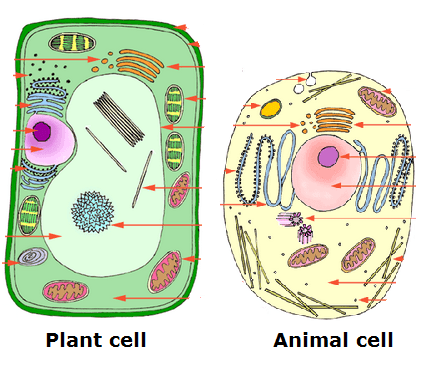
What distinguishes a plant cell from an animal cell? (How do you tell them apart) Hint: There's 3 ways (Check all 3)

a)

Central Vacuole

b)

Mitochondria

c)

Cell Wall

d)

Ribosomes

e)

Chloroplasts

5.

Cellular Respiration occurs within me and I am in BOTH plant and animal cells. I am a....

a)

Nucleus

b)

Golgi Body

c)

Cytoskeleton

d)

Mitochondria

6.
Robert Hooke, Anton van Leeuwenhoek, Theodor Schwann, Rudolf Virchow, and Matthias Schliden were all responsible for what theory?
a)
The Theory of Gravity
b)
The Theory of Relativity
c)
The Cell Theory
d)
The Theory of Continental Drift
7.
All cells are produced ____________.
a)
From pre-existing and deceased cells
b)
from other pre-existing cells
c)
Cells can come from anywhere, as long as there is the sun.
8.
Which of the following statements is not part of the cell theory?
a)
Cells are the basic unit of structure and function in all living things.
b)
All cells are produced from other cells.
c)
Only animal cells are composed of cells.
d)
All living things are composed of cells.
9.
Why are microscopes important when studying most cells?
a)
Most cells are very large.
b)
Most cells are very small.  
c)
Most cells move very quickly.
d)
Most cells are dead.  
10.
What do vacuoles do? 
a)
They actually do not have an important role
b)
They protect the cell
c)
They are the brain of the cell
d)
storage area for cells; water storage in plants 
11.

What are the two types of cells?

a)

Prokaryotic & Eukaryotic

b)

Bacteria & Eukaryotic

c)

Eukaryotic

d)

Animal & Plant

12.

What is a unique characteristic of the plasma (cell) membrane?

a)

Semipermeable

b)

Rigid

c)

Jelly-like

d)

Orange

13.

Which organelle is responsible for the removal of waste and foreign particles?

a)

Plasma Membrane

b)

Lysosomes

c)

Peroxisomes

d)

Mitochondrion

14.

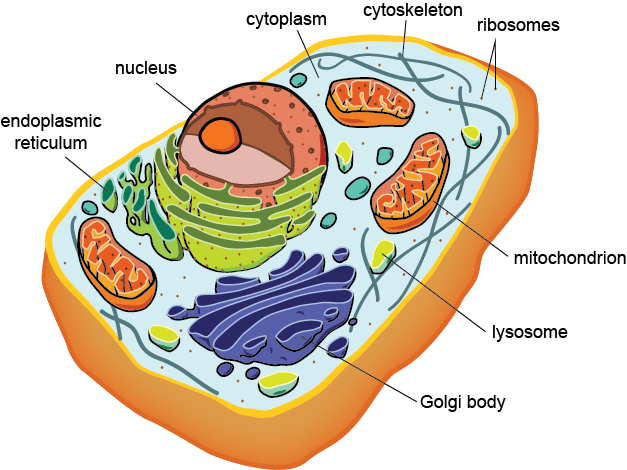
What is the name of this organelle?

a)

Mentos

b)

Mitochondrion

c)

Chlorophyll

d)

Chloroplast

15.
Has membrane bound organelles
a)
Prokaryote
b)
Eukaryote
c)
both
16.
Both prokaryotes and eukaryotes have a nucleus.
a)
True
b)
False
17.

This part of a cell is where energy is produced:

a)

nucelus

b)

mitochondria

c)

cell membrane

d)

cell wall

18.

Animal and plant cells both have (check all that apply):

a)

cell wall

b)

cell membrane

c)

nucleus

d)

mitochondria

e)

vacuole

19.

The smallest unit of matter that has the chemical properties of a particular element...

a)

ion

b)

compound

c)

cell

d)

atom

20.

DNA is an example of a(n)...

a)

atom

b)

element

c)

molecule

d)

ion

21.
A phospholipid has 2 parts. What are they called? 
a)
Hydrophilic Head, Hydrophobic Tail 
b)
Hydrophobic Head, Hydrophilic Tail 
22.
Describes the arrangement of the cell membrane as bendable and made of many parts. 
a)
The Fluid Mosaic Model 
b)
The Major Mobility Model 
c)
The Crazy Cell Model
d)
The Maze Model
23.
During osmosis
a)
water moves from high to low concentration
b)
large or oddly shaped molecules move across a cell membrane
c)
water moves when energy is used
d)
proteins are built
24.

The diffusion of WATER through a semi-permeable membrane is called?

a)

Osmosis

b)

Cell wall

c)

Diffusion

d)

Respiration

25.
Which diagram best shows the end result of diffusion?
a)
F
b)
G
c)
H
d)
J
26.
Molecules will move from an area of high concentration to an area of low concentration until they reach
a)
osmosis
b)
equilibrium
c)
selective permeability
d)
diffusion
27.
In diffusion, particles move down a _______ ________
a)
Concentrate gradient
b)
Conceited gradient
c)
Concentration gradient 
d)
Concentrated orange juice
28.

Passive Transport uses ____ energy

a)

no

b)

a lot of

c)

a little bit of

d)

some

29.
In which solution will water move into a cell?
a)
Hypertonic
b)
Hypotonic
c)
Isotonic
d)
Equilibrium
30.
What type of transport is this?
a)
Diffusion
b)
Osmosis
c)
Facilitated Diffusion
d)
Active Transport
31.
What type of transport is this?
a)
Endocytosis
b)
Facilitated Diffusion
c)
Active Transport Pump
d)
Osmosis
32.
What type of transport is this?
a)
Endocytosis
b)
Diffusion
c)
Exocytosis
d)
Osmosis
33.
Which biomolecule is made of amino acids?
a)
Nucleic Acid
b)
Carbohydrate
c)
Protein
d)
Lipid
34.
Which biomolecule is your main source of quick energy?
a)
Nucleic Acid
b)
Protein
c)
Lipid
d)
Carbohydrate
35.
Once an enzyme does it's work, the enzyme is ___________.
a)
destroyed
b)
unchanged
c)
duplicated
d)
changed
36.
What are the products of photosynthesis?
a)
water and carbon dioxide
b)
oxygen and glucose
c)
oxygen and carbon dioxide
d)
oxygen and water
37.
Which gas is removed from the atmosphere during photosynthesis?
a)
hydrogen
b)
oxygen
c)
nitrogen
d)
carbon dioxide
38.
Plants need ________ for photosynthesis
a)
oxygen
b)
soil
c)
carbon dioxide
d)
sugar
39.
Which organelle from the plant cell is primarily responsible for converting sunlight to energy?
a)
Mitochonria
b)
Nucleus
c)
Vacuole
d)
Chloroplast
40.
Cellular respiration is a process that converts __________ into __________.
a)
Sunlight, Glucose
b)
ATP, Glucose
c)
Glucose, Sunlight
d)
Glucose, ATP
41.
Fermentation is the process by which 
a)
cells break down food without using oxygen
b)
plant cells create glucose
c)
cells use oxygen to produce energy 
d)
cells grow and reproduce
42.
Which process produces the most ATP per molecule of glucose?
a)
lactic acid fermentation
b)
aerobic respiration
c)
alcoholic fermentation
d)
all are about the same
43.
When a phosphate group is removed from an ATP molecule, 
a)
a substantial amount of energy is released
b)
an enzyme is formed
c)
energy is stored
d)
activation energy is increased
44.
Please select who performs cellular respiration: 
a)
Animals 
b)
Both animals and plants 
c)
plants 
45.
Glucose is a ...
a)
sugar
b)
carbohydrate
c)
source of quick energy
d)
all are correct
46.
The formula for glucose is...
a)
C12 H22 O11
b)
NaCl
c)
NaOH
d)
C6 H12 O6
47.
Which major macromolecule is being represented in this image? 
a)
carbohydrate
b)
lipid
c)
protein
d)
nucleic acid
48.
What are the single sugars that are the building blocks of carbohydrates?
a)
monosaccharides
b)
disaccharides
c)
polysaccharides
d)
amino acid
49.
A possible explanation to a problem that has not yet been tested. 
a)
data
b)
theory
c)
hypothesis
d)
fact
50.
This variable in an experiment is the one being deliberately changed by the scientist. 
a)
dependent variable
b)
independent variable
c)
data
d)
control group
51.
What step does every scientific experiment begin with?
a)
hypothesis
b)
question/problem
c)
procedures
d)
conclusion
52.
An experiment is performed on plants to see how different liquids affect plant growth. Each plant in the experiment is given a different liquid; water, apple juice, or milk. Each plant has the same amount of soil, sunlight, and listens to the same music. In this investigation, the independent variable is ...
a)
The type of plant
b)
The amount of sunlight
c)
The type of music
d)
The type of liquid
53.
The summary at the end of an experiment that explains the results. 
a)
conclusion
b)
procedures
c)
materials
d)
responding variable
54.
A student wants to test the effects of type of exercise on heart rate.  What is the dependent variable?
a)
heart rate
b)
type of exercise
c)
amount of exercise
d)
time of day exercise occurs
55.
Observations made during an experiment are called:
a)
data
b)
problems
c)
conclusions
d)
questions
56.
On what axis should the independent variable always be?
a)
X
b)
Y
57.
Approved eye protection devices (such as goggles) are worn in the laboratory
a)
to improve vision
b)
only if you don't wear glasses
c)
anytime heat, chemicals, or glassware are used
d)
to avoid eye strain
58.
If a laboratory fire erupts, immediately
a)
notify your teacher
b)
run for the fire extinguisher
c)
throw water on the fire
d)
open a window
59.
After completing an experiment, all chemical wastes should be
a)
dumped down sink
b)
taken home
c)
thrown in trash
d)
disposed of according to teacher's directions
60.
You are heating a substance in a test tube. Always point the open end of the tube
a)
towards your body
b)
toward your lab partner
c)
towards another classmate
d)
away from all people
61.
The proper technique for smelling chemicals is ______________
a)
keeping your nose close to the glassware
b)
wafting
c)
to sniff only a small amount
d)
Trick question; you never are allowed to smell chemicals in class
62.
The name given to the internal balance that a cell maintains with its external environment.
a)
velocity
b)
membrane
c)
homeostasis
d)
circulation
63.

All of the chemical reactions that occur in living things.

a)

metabolism

b)

genetics

c)

homeostasis

d)

evolution

64.
This is an organism made of one cell.
a)
multicellular
b)
unicellular
c)
colonial
d)
plant kingdom
65.

An organism made of many cells that work together.

a)

unicellular

b)

colonial

c)

multicellular

d)

bacteria

66.
All living things are composed of cells. 
a)
True
b)
False
67.

What is a variation of a trait that allows for an organism to survive in its environment?

a)

response

b)

stimulus

c)

metabolism

d)

adaptation

68.

This is when cells divide so an organism gets bigger.

a)

development

b)

reproduction

c)

growth

d)

evolution

69.
During which phase of the cell cycle does the cell spend the most time?
a)
Mitosis
b)
Cytokinesis
c)
Interphase
70.
During which part of the cell cycle is DNA copied?
a)
Mitosis
b)
Cytokinesis
c)
S phase
71.
Which phase of mitosis is shown in the picture?
a)
Interphase
b)
Metaphase
c)
Telophase
72.
Which phase of mitosis is shown in the picture?
a)
Prophase
b)
Metaphase
c)
Anaphase
73.
Which phase of mitosis is shown in the picture?
a)
Prophase
b)
Anaphase
c)
Telophase
74.
Which phase of mitosis is shown in the picture?
a)
Prophase
b)
Telophase
c)
Metaphase
75.
What is the purpose of the cell cycle?
a)
To create new daughter cells
b)
To prevent cancer from developing
c)
To help the body fight viruses and bacteria
76.

Uncontrolled cell division which usually leads to tumors and disease is called:

a)

Metaphase

b)

Cytokinesis

c)

Cancer

d)

Diabetes

77.
Mitosis results in the formation of...
a)
Two identical cells with all of the original chromosomes
b)
Two different cells with half of the original chromosomes
c)
Four identical cells with all of the original chromosomes
d)
Four different cells with half of the original chromosomes
78.
What is the correct order of the phases of mitosis?
a)
Prophase
 Anaphase
Metaphase
Telophase
b)
Prophase
Metphase
Anaphase
Telophase
c)
Interphase
Cytokinesis
Metaphase
Prophase
d)
Interphase
Prophase
Metphase
Telophase
79.
If a parent cell going through mitosis starts with 22 chromosomes, how many chromosomes will be in the daughter cells?
a)
22
b)
11
c)
44
d)
15
80.
Which statement best describes the importance of sexual reproduction?
a)
sexual reproduction produces variation in offspring
b)
sexual reprosuction provides regeneration of body parts
c)
sexual reproduction occurs between individuals of the same species
d)
sexual reproduction produces offspring that are identical
81.
Which of the following cell types is formed by meiosis?
a)
skin cells
b)
sperm cells
c)
blood cells
d)
muscle cells
82.
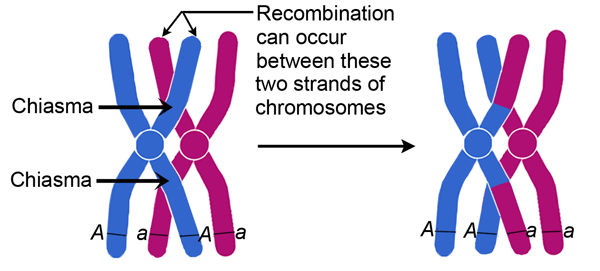
This image shows chromosomes during Prophase 1. Which of the following correctly describes the process shown?
a)
segregation of sister chromatids
b)
condensation and segregation of alleles
c)
mutationin which the DNA content of the gene is altered
d)
crossing - over in which alleles are exchanged
83.
Which of the following statements correctly describes meiosis?
a)
Meiosis does not occur in reproductive cells.
b)
The cells produced at the end are identical 
c)
the cells produced at the end contain half the # of chromosomes
d)
cells divide only once during meiosis
84.
What is one advantage of sexual reproduction?
a)
The offspring are identical to the parents
b)
the offspring are resistant to viruses
c)
the offspring are born live, instead of from eggs
d)
The offspring inherit a wider variety of genetic information
85.
Meiosis is the key process in the production of_________.
a)
body cells
b)
RNA
c)
white blood cells
d)
gametes
86.
Controls the passage of materials inside and outside of the cell. 
a)
Cell Membrane
b)
Lipid Cleric Layer
c)
Membrane Gate
d)
Protein Receptors 
87.

Which of the following is represented in the image?

a)

Nucleotide

b)

Carbohydrate

c)

Lipid

d)

Protein

88.
A dog has 78 chromosomes in its body cells.  What is the diploid number?
a)
78
b)
39
c)
1
d)
100
89.

All human have _________ chromosomes

a)

23

b)

46

c)

Diploid

d)

Haploid

90.

Where does TRANSCRIPTION occur?

a)

Nucleus

b)

Ribosome

c)

Cytoplasm

d)

Mitochondria

91.

Why must transcription occur where DNA can be found?

a)

because DNA can't leave

b)

because ribosomes are in the nucleus

c)

because DNA polymerase is found there

d)

because helicase unzips the DNA

92.

How many codons equals 1 amino acid?

a)

1

b)

2

c)

3

d)

4

93.

How many nucleotides equal 1 amino acid?

a)

1

b)

2

c)

3

d)

4

94.

Which of the following is a codon?

a)
b)

ATG

c)

AUG

d)

AUT

95.

On which molecule can an anticodon be found?

a)

mRNA

b)

DNA

c)

tRNA

d)

rRNA

96.

A polypeptide is a sequence of ____________________ held together by a ______________ bond.

a)

amino acids; peptide

b)

fatty acids; ionic

c)

proteins; hydrogen

d)

fatty acids; covalent

97.
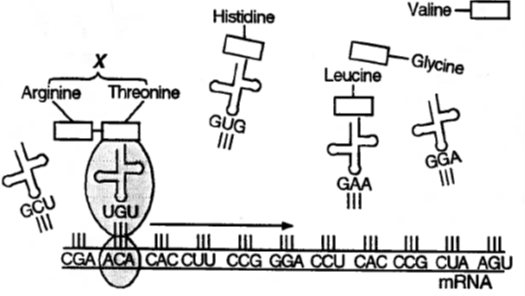
What process is going on in this photo? 
a)
Transcription 
b)
Translation 
c)
Replication 
d)
All the above 
98.

TRANSCRIBE this DNA sequence: TACGTTACT

a)

AUGCAAUGA

b)

ATGCAATGA

c)

AUGGATUGA

d)

TACGTTACT

99.

A DNA nucleotide may be made up of a phosphate group, along with

a)

deoxyribose sugar and uracil

b)

ribose sugar and cytosine

c)

deoxyribose sugar and thymine

d)

ribose sugar and adenine

100.

Which of the following units are repeatedly joined together to form a strand of DNA? (This is the MONOMER of DNA.)

a)

amino acids

b)

nucleotides

c)

fatty acids

d)

polysaccharides

101.
One human disease is caused by a change in one codon in a gene from GAA to GUA. The disease is a result of 
a)
a mutation
b)
crossing-over
c)
a meiosis error
d)
polyploidy
102.
Who is considered the "father" of modern genetics?
a)
Einstein
b)
Mendel
c)
Disney
d)
Trump
103.
TT,tt,PP,pp,SS,ss are examples of alleles that are?
a)
homozygous
b)
heterozygous
c)
different
d)
homologous 
104.
The exact genetic makeup of an organism, such as RR, Tt, PP is its?
a)
phenotype
b)
dominance
c)
genotype
d)
trait
105.
Y for yellow body is dominant over y for blue body.  What alleles would produce yellow bodies?
a)
YY,yy
b)
Yy,yy
c)
YY only
d)
YY,Yy
106.
A physical characteristic that can be passed from parent to offspring.
a)
behavior
b)
trait
c)
strong muscles
d)
ability to fly a plane.
107.

Which part of DNA structure is responsible for the variation we see within and among organisms?

a)

the arrangement of the sugar molecules

b)

the arrangement of the nitrogen bases

c)

the arrangement of the phosphate molecules

d)

the arrangement of the deoxyribose molecules

108.

Who discovered the structure of DNA?

a)

Holmes & Watson

b)

Watson & Crick

c)

Einstein

d)

Moriarty & Crick

109.

For snakes, L represents the gene for long offspring and l represents the gene for short offspring. If long (L) is dominant over short (l), which of the following can be said about genotype Ll?

a)

It produces a long snake

b)

It produces a short snake

c)

It produces a medium snake

d)

It produces a snake with bunny ears

110.
Two heterozygous (Tt) tall pea plants are crossed. Which describes their offspring?
a)
50% tall and 50% short
b)
75%tall and 25% short
c)
100%short
111.

We use an uppercase (capital) letter to indicate this

a)

recessive allele

b)

dominant allele

c)

gene

d)

phenotype

112.

We use a lowercase letter to determine this.

a)

dominant allele

b)

recessive allele

c)

outcome

d)

Gregor Mendel

113.
Alternative forms of a gene are called
a)
Alleles
b)
Homozygous
c)
DNA
d)
Genetics
114.
What is a genetic test cross?
a)
Testing a suspected homozygote by crossing it with a known heterozygote
b)
Testing a suspected heterozygote by crossing it with a known heterozygote
c)
Testing a suspected homozygote by crossing it with a known homozygous dominant
d)
Testing a suspected heterozygote by crossing it with a known homozygous recessive
115.
What gamete possibilities could come from this parent's genotype?
a)
AB, AB, aB, aB
b)
Ab, AB, Ab, ab
c)
Ab, Ab, Ab, Ab
d)
AB, aB, ab, aB
116.

What goes in box 3

a)

Aabb

b)

AABB

c)

AAbb

d)

aaBb

117.
Based off this punnett square, what fraction of the offspring will have wrinkled, yellow seeds?
a)
9/16
b)
3/16
c)
1/16
d)
16/16
118.
B = brown eyes
b = blue eyes
What is true about these two brothers that have brown eyes?
One has genotype BB the other Bb.

a)
they have same phenotype and genotype
b)
they have different genotypes and phenotypes
c)
they have same phenotype but different genotypes
d)
they have same genotype but different phenotypes
119.
How many offspring will you have in a dihybrid cross? 
a)
4
b)
8
c)
16
d)
5
120.
T4 - Black fur in mice (B) is dominant to brown fur (b). Short tails (T) are dominant to long tails (t). What percentage of the offspring of the cross BbTt x BBtt will have black fur and long tails?
a)
0%
b)
25%
c)
50%
d)
100%