
 Worksheets
Plasma Membranes and Cellular Transport (AP 2.4-2.9)
Total questions: 121
Worksheet time: 2hrs 10mins
According to the fluid mosaic model of cell membranes, phospholipids___________________.
can shift laterally along the plane of the membranee
frequently flip-flop from one side of the membrane to the other
occur in an uninterrupted bilayer, with membrane proteins restricted to the surface of the membrane
have hydrophilic tails in the interior of the membrane
Which of the following types of molecules are hydrophilic and therefore excluded from the hydrophobic portion of the phospholipid bilayer?
transmembrane proteins
integral membrane proteins
peripheral proteins
cholesterol
In what way do the membranes of a eukaryotic cell vary?
Phospholipids are found only in certain membranes
Certain proteins are unique to each membrane
Only certain membranes of the cell are selectively permeable
Some membranes have hydrophobic surfaces exposed to the cytoplasm while others have hydrophilic surfaces facing the cytoplasm.
Which of the following statements describes a characteristic feature of a carrier protein in a plasma membrane?
It exhibits specificity for a particular type of molecule
It requires the expenditure of cellular energy to function.
It works against diffusion.
It has not hydrophobic regions.
Which of the following would likely diffuse through the lipid bilayer of a plasma membrane most rapidly?
sucrose.
an amino acid.
O2.
Na+.
Which of the following statements about diffusion is true?
It is very rapid of long distances.
It requires an expenditure of energy by the cell.
It is an active process in which molecules move from a region of lower concentration to a region of higher concentration.
It is a passive process in which molecules move from a region of higher concentration to a region of lower concentration.
Which of the following processes is an "umbrella" term for the others?
Osmosis.
Facilitated diffusion.
Passive transport.
Transport of an ion down its electrochemical gradient.

Which cell is in a hypertonic environment?
A
B
C
None of them are hypertonic


Assuming that the purple molecules are too large to pass through the membrane, what would happen to the water level as a result of osmosis?
The water level would rise on the A side
The water level would rise on the B side
The water level would remain constant
The water level would drop on the A side.
White blood cells engulf bacteria using _______________.
phagocytosis
pinocytosis
osmosis
receptor-mediated exocytosis
Which of the following factors would tend to increase membrane fluidity?
a greater proportion of unsaturated phospholipids
a greater proportion of saturated phospholipids
a lower temperature
a relatively high protein content in the membrane
Which of the following membrane activities requires energy from ATP?
Facilitated diffusion of chloride ions through a chloride channel.
Movement of Na+ ions from lower concentration in a mammalian cell to a higher concentration in the extracellular fluid.
Movement of glucose molecules into a bacteria cell from a medium containing a higher concentration of glucose than inside the cell.
Movement of carbon dioxide out of a paramecium.
An animal cell lacking in carbohydrates on the external surface of its plasma membrane would likely be impaired in which function?
transporting ions against an electrochemical gradient
cell-cell recognition
attaching the plasma membrane to the cytoskeleton
establishing a diffusion barrier to charged molecules

Which of the following correctly describes hydrophobic and hydrophilic regions of the cellular membrane?
The hydrophobic region is made of phosphates, and the hydrophilic region is made of lipids.
The hydrophobic region is 'water-loving', and the hydrophilic region is 'water-fearing'.
The hydrophobic region is polar, and the hydrophilic region is non-polar.
The hydrophobic region faces inward in the interior of the membrane, the hydrophilic region faces outwards towards the aqueous environment.
Which of the following is the correct name of the model that describes the structure of the cell membrane?
The Fluid Molecular Model
The Free Molecular Model
The Fluid Mosaic Model
The Free Mosaic Model
Which of the following would need assistance moving through the plasma membrane?
Nitrogen gas (N2)
Oxygen gas (O2)
Carbon Dioxide gas (CO2)
Water
Which of the following is a difference between passive and active transport?
Passive transport moves molecules against their gradient, while active transport moves molecules with their gradient.
Passive transport moves molecules with a direct input of energy, while active transport moves molecules without a direct input of energy.
Passive transport moves molecules non-spontaneously, while active transport moves molecules spontaneously.
Passive transport moves molecules without a direct input of energy, while active transport moves molecules with a direct input of energy.
What is the primary role of aquaporins?
To transport water across the membrane.
To change the state of water from gas to liquid.
To pump water into the mitochondria for cellular respiration.
To use water for hydrolytic purposes.
Which of the following describes a solution that has a higher concentration than the internal environment of the cell?
Hypotonic
Isotonic
Hypertonic
Transtonic
If a cell is placed in a hypotonic solution, what is likely to happen to it over time?
The cell will swell, as water flows into the cell.
The cell will not change, as it will be at dynamic equilibrium.
The cell will lyse, as water bursts the cell.
The cell will shrink, as water flows out of the cell.

Identify cholesterol molecule
structure a
structure b
structure h
structure i

Identify a peripheral protein
structure a
strucure b
structure g
structure h
Plasma membranes are selectively permeable. This means
anything can pass in and out
the membrane regulates the passage of the material in and out of the cell
glucose cannot enter the cell
cholesterol cannot enter
Which is NOT a function of the membrane?
it forms a selective barrier
it has receptors for chemical messages
it is the control center of the cell
it is involved in self recognition
Small, nonpolar, hydrophobic molecules such as fatty acids
easily pass through the membrane's bilayer
very slowly diffuse through the bilayer
require transport proteins
enter through endocytosis
Membrane phospholipids
have hydrophobic heads that face the center of the membrane and are shielded from water
have hydrophilic tails that face outward
remain fluid because they are tightly packed
none of these
Which of the following substances would have the most trouble crossing the membrane by diffusing through the bilayer?
water
oxygen
carbon dioxide
a sodium ion
A major function of glycoproteins and glycolipids in the membane is to
glue cells together to form tissues
allow cells to identify each other
attach membrane to cytoskeleton
help retain shape
When doctors perform organ transplants, they choose a donor tissue match. Which component is being matched?
membrane phospholipids
cytoskeleton
cell surface carbohydrates
cholesterol
The fluid mosaic model describes a membrane consisting of
a phospholipid bilayer with embedded proteins
2 layers of phospholipids with proteins in between
individual proteins and phospholipids that can drift
both a and c
What kinds of molecules pass through a cell membrane most easily?
ionic
small and hydrophobic
large polar
large and hydrophobic
Which of the following allows water to move faster across cell membranes?
aquaporins
ATP
peripheral proteins
the sodium-potassium pump

Which structure is the hydrophilic polar head of the phospholipid molecule?
F
D
C
A1

Which structure is the hydrophobic tail of the phospholipid molecule?
E
B
G
A2

The majority of the plasma membrane is composed of ______.
phospholipids
proteins
carbohydrates
cholesterol

What property does the phospholipid bilayer give to a plasma membrane?
provides the barrier between the inside and outside of the cell
communicates between cells
conducts electrical impulses in nerve cells
allows cells to bind to each other
Which type of biological macromolecule is the main component of the plasma membrane?
carbohydrate
lipid
protein
nucleic acid

This image is an example of a phospholipid. Which part of a phospholipid is HYDROPHOBIC?
the phosphate "head"
the lipid "tails"

Where can carbohydrates be found when part of a plasma membrane?
On the outside of the membrane
On the inside of the membrane
Embedded part of the way into the membrane
Embedded the whole way through the membrane
All of the above
Where can PROTEINS be found when part of a plasma membrane?
On the outside of the membrane
On the inside of the membrane
Embedded part of the way into the membrane
Embedded the whole way through the membrane
All of the above
What is the function of cholesterol in a plasma membrane?
To make the membrane flexible
To control the effect of temperature changes
To attract water molecules
To allow nutrients and other essential molecules into the cell

identify a glycolipid
structure a
structure d
structure e
structure g
What is the outer boundary called on ALL cells that controls what goes in and out of that cell?
Cell Wall
Nucleus
Cell Membrane
What happens when we mix oil and water? (Watch the video if you are unsure)
They mix together
They stay separate
It explodes
The cell membrane is described as a (a) mosaic model.

How many layers does the phospholipid bilayer have?
Two
One
Three
The polar head of the phospholipid (a) water. (loves or hates?)

Phosphate head
E
F
G
I
Cholesterol
E
F
G
I
Lipid tails
E
F
G
I
Carbohydrate Chains
E
F
G
I
Phospholipid Bilayer
A
B
C
D
Membrane Protein
A
B
C
D
Carrier Protein
A
B
C
D
Channel Protein
A
B
C
D
Active transport
A
B
F
G
Detects other cells and chemicals
A
B
E
F
Transport gas
A
B
E
F
Hydrophobic
A
B
E
F
Hydrophobic
G
I
E
F
Hydrophilic
G
I
E
F
Maintain shape and prevent tail from sticking
G
I
E
F

Define plasma membrane
lipid that helps minimize effects of temperature
only on the outer surface of the plasma membrane and are attached to proteins or lipids; form distinctive cellular markers
flexible boundary of a cell that separates a cell from its surroundings
may extend partway into the plasma membrane, cross the membrane entirely, or be loosely attached to its inside or outside face
Which type of biological macromolecule is the main component of the plasma membrane?
carbohydrate
lipid
protein
nucleic acid
What is the "big idea" of the fluid mosaic model of plasma membranes?
the plasma membrane creates a specialized FLUID that looks like a MOSAIC.
the plasma membrane is a MOSAIC.
the fluid mosaic model is NOT related to the plasma membrane.
a plasma membrane is a MOSAIC of components that move FREELY and FLUIDLY.
What does "hydrophobic" mean?
water loving, associates with water
water fearing, does not associate with water
a world war II submarine
an example would be solutes like sugar or salt
What does "hydrophilic" mean?
water loving, associates with water
water fearing, does not associate with water
a world war II submarine
an example would be solutes like oil or fat
Which are example is hydrophobic in nature.
Oil
Sugar
Salt
Water
Plasma membrane .....
is selectively permeable
consist of triglyceride and cholesterol
separate cytoplasm and extracellular fluid
have proteins embedded the phospholipid bilayer

Name structure P
(a)

Choose correct statement(s) about structure R
makes membrane less fluid by restrain phospholipid movement
lower the temperature required for mombrane to solidify
is a type of lipid
can be found higher in plant compared to animals

Figure shows three different plant cells immersed in solution with different concentration. Choose a normal healthy plant cell in the figure.
Cell A
Cell B
Cell C

Identify suitable stimulus to open ion gated channel in the figure.
Voltage
Mechanical
Chemical
Enzyme

How molecule in the figure can be transported across plasma membrane? (can be more than one answer)
Down concentration gradient
Using channel protein
Using carrier protein
Diffuse through phospholipid bilayer
How sucrose is transported into a plant cell?
Uses H+ gradient generated by proton ATP-powered proton pump.
Down its concentration gradient into the cell.
In the company of H+ that travels against its electrochemical gradient.
Uses sucrose transporter channel protein.
Statements below are true about receptor medited endocytosis EXCEPT .
It is a specialized type of pinocytosis.
It is a type of passive transport
Substance can be acquired even in low quantities in extracellular fluid
It enables cells to acquire bulk quantities of specific substance.

Which statements are true about active transport?
molecules move from low concentration to high concentration.
molecules move from high concentration to low concentration.
ATP is required
Uses channel proteins
Small polar molecules like O2 and CO2enter a cell through
simple diffusion
osmosis
facilitated diffusion
phagocytosis
Some celery sticks were placed in distilled water. What type of solution are they in? What will happen to the celery sticks?
hypotonic, the celery sticks increase in size
hypertonic, the celery sticks reduce in size
isotonic, the celery sticks remains in size

The animal cell on the left is in a(n) __________________ environment
Hypertonic
Hypotonic
Isotonic
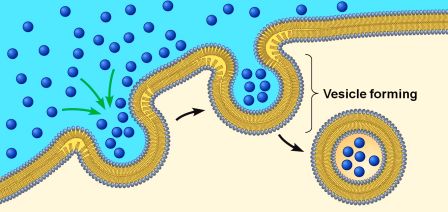
Which form of active transport is being shown?
Facilitated Diffusion
Exocytosis
Endocytosis
Proton pump
sodium-potassium pump transport
only potassium ions and sugar molecules
3 potassium ions out of the cell
3 sodium ions into the cell
2 potassium ions into the cell
white blood cells engulfing invading bacteria is an example of
Phagocytosis
Exocytosis
Pinocytosis
Facilitated Diffusion
Name small compartment enclosed by a membrane formed to transport of material during bulk transport.
vesicles
large vacuole
mitochondria
lysosome
Plasma Membrane Is Also Known As
Plasma Cell
Cell Membrane
Plasma Apparatus
Golgi Membrane
Which Molecules Makes Up The Plasma Membrane
Proteins
Calcium
Sulphur
Lipids
Amoeba Acquires Its Food Through Which Process
Exocytosis
Hypocytosis
Hypercytosis
Endocytosis
Choose The Perfect Definition For Osmosis
Osmosis is the passage of water from a region of high water concentration through a selectively permeable membrane to a region of low water concentration till equilibrium is reached.
Osmosis is the passage of water from a region of high water concentration to a region of low water concentration till equilibrium is reached.
Osmosis is the passage of gases from a region of high water concentration through a selectively permeable membrane to a region of low water concentration till equilibrium is reached.
Osmosis is the passage of water from a region of low water concentration through a selectively permeable membrane to a region of high water concentration till equilibrium is reached.
What is The Effect On The Cell When Dropped In A Hypertonic Solution.
(I) The cell will swell
(II) The cell will shrink
(III) The cell will stay neutral
Only (III)
Only (II)
Both (I) and (II)
Only (I)
In Which Solution Will There Be More Solvent Than Solute In Its External Environment
Isotonic
Hypertonic
Osmotic
Hypotonic
Plasma Membrane Is Flexible
True
False
Which Gas Accumulates In High Concentration Inside The Cell
Hydrogen
Helium
Carbon Dioxide
Nitrogen
Which Gas Accumulates In Low Concentration Inside The Cell
Oxygen
Argon
Nitrogen
Helium
Choose The correct Statement
The movement of water across the plasma membrane is also affected by the amount of substance dissolved in water
The movement of Oxygen across the plasma membrane is also affected by the amount of substance dissolved in Water
The movement of Carbon Dioxide across the plasma membrane is also affected by the amount of substance dissolved in Water
The movement of Argon across the plasma membrane is also affected by the amount of substance dissolved in Water
The Plasma Membrane Is The outermost layer In Plants
False
True
The Plasma Membrane Is The Outermost Layer In Animal Cell
False
True
Define plasma membrane
lipid that helps minimize effects of temperature
only on the outer surface of the plasma membrane and are attached to proteins or lipids; form distinctive cellular markers
flexible boundary of a cell that separates a cell from its surroundings
may extend partway into the plasma membrane, cross the membrane entirely, or be loosely attached to its inside or outside face
The cell membrane is _______________ permeable.
selectively
somewhat
physically
ionically

